
🎧Beyond the Pass — Operator Podcast (1:48)
Why your kitchen drains pub profits?
0:00
-1:36
Prefer reading? The full breakdown is below.
Why adding food to a drinks business is far harder than adding drinks to a food business, and the volume threshold that decides whether a kitchen earns its place.
Two venues, both convinced they needed to broaden their offer. Both made a move. One of them made money. The other quietly lost it for two years.
The first was a wet-led pub in Shropshire doing about £11,000 a week behind the bar. Good trade, loyal locals, no kitchen to speak of. The owner did what every consultant and brewery rep had been telling him to do for years: he put in a kitchen and added food.
The second was a food-led bistro doing around £14,000 a week in food with a thin, unloved drinks offer. House wine nobody chose deliberately, no cocktails, a bar that existed mainly to pour tap water. The owner decided to take drinks seriously.
Same instinct in both cases: broaden the offer, capture more spend per customer, build a second engine. But one of these moves is structurally much harder than the other, and almost nobody prices that in before they commit.
Here is the thing that makes wet-versus-food decisions so easy to get wrong: food and drink have completely different cost structures, and that difference runs entirely in one direction.
A drinks business is almost purely variable. To sell more drinks you need stock and a bit of training. The staff are already there, the space is already there, the glassware is already there. Sell fewer drinks and your costs fall with them, more or less in step. There is no meaningful floor.
A food business is loaded with fixed cost. You need a chef whether you sell twenty covers or eighty. You need the equipment, the gas, the extraction, the cleaning, the storage, the compliance, the prep hours, whether the room is full or empty. Those costs do not scale down when trade is quiet. They sit there every single week regardless.
That asymmetry has one enormous consequence. Drinks scale down gracefully. Food does not. Which means adding food to a drinks business introduces a high fixed cost that has to be cleared before the food contributes anything at all, while adding drinks to a food business introduces almost no fixed cost and starts contributing on the first sale.
Most operators treat “add food” and “improve drinks” as two versions of the same growth move. They aren’t. One carries a threshold. The other doesn’t.
If food carries a fixed cost, then there is a volume of food sales below which the kitchen cannot pay for itself. There are actually two lines worth knowing, and confusing them is where a lot of operators go wrong.
The first line is the kitchen’s own break-even. Take the direct weekly cost of running the kitchen at all: chef and KP wages including on-costs, plus equipment depreciation, kitchen utilities, cleaning and compliance. In a modest pub kitchen with two chefs and a KP, that lands somewhere around £1,850 a week before you have bought a single ingredient.
Now take your food gross margin after food cost, call it 69% on a 31% food cost. Divide the fixed cost by that margin:
£1,850 ÷ 0.69 = roughly £2,700 a week in food sales
That is the point where the kitchen covers its own existence. Nothing more. It contributes nothing toward the rest of the business.
The second line is where food starts contributing. The kitchen consumes more than its own direct costs. It occupies space that carries rent and rates. Food service requires additional front-of-house labour that a wet-only operation would not need. It draws on general overheads, insurance, admin, waste collection, and it ties up capital that could be working elsewhere.
For a modest pub operation those attributable costs might add roughly £1,200 a week. So the real total the food side needs to cover is closer to £3,050, which means:
£3,050 ÷ 0.69 = roughly £4,400 a week in food sales
Below £2,700, food is losing money outright. Between £2,700 and £4,400, food is paying for itself but contributing nothing to the site. Above £4,400, food is genuinely earning its place.
The Shropshire pub was doing £2,400.
At £2,400 of food sales, the kitchen produced £1,656 of gross profit against £1,850 of direct fixed cost. A loss of £194 a week, every week, absorbed by the bar without anyone naming it. Over two years that is around £20,000 of wet profit poured into a kitchen that was never given the volume to work.
The owner described it as “building nicely.” Covers were growing slowly, the food was well reviewed, the kitchen team were proud of what they sent out. Every qualitative signal said it was working. The number said it had never once cleared its own floor.
There is a limitation in everything above, and it is worth being honest about it, because a reader raised it after this piece first went out and the point is sharper than my original framing.
The threshold test asks whether the kitchen covers its own costs. But a kitchen does not exist in isolation. If it brings in groups who would otherwise go elsewhere, keeps them in the building longer, or turns a two-drink visit into a four-drink one, then some of the bar’s profit exists precisely because the kitchen exists. A kitchen losing £194 a week on its own line while pulling in trade that drinks £800 a week is obviously worth keeping.
So the sharper test is a counterfactual: what share of the total bill would disappear if the kitchen disappeared?
That is harder to measure cleanly, but two proxies get you close. Compare average drinks spend on covers that ordered food against those that didn’t. And look at what your wet trade actually does on days the kitchen is closed. Between them you get a rough read on how much of the bar’s takings the kitchen is genuinely responsible for.
Run both tests. The threshold tells you whether the kitchen pays for itself. The counterfactual tells you whether it earns its place in the wider business. A kitchen can fail the first and pass the second, and that combination is worth keeping. A kitchen that fails both is the expensive one.
None of this means wet-led pubs shouldn’t do food. Plenty do it brilliantly and make excellent money. The point is narrower and more useful than that.
Food is not a gentle, incremental addition you can dip into. It is a step change with a floor underneath it. You either commit hard enough to clear the threshold, with the menu, the marketing, the opening hours and the reputation to actually drive the volume, or you do something much smaller that carries no fixed cost at all.
The failure mode is the middle. A half-committed kitchen, doing half the volume it needs, staffed properly because you can’t run a kitchen unstaffed, is the single most expensive configuration in the trade. It has all the fixed cost of a food business and none of the volume, and unless it is pulling in serious wet trade alongside it, the bar pays the difference every week without anyone noticing.
If you cannot realistically get to the threshold and the kitchen isn’t visibly driving drinks trade, the honest answer is usually a much lighter offer: a short, low-labour menu built on bought-in or minimal-prep items with no dedicated kitchen brigade, or nothing at all. That’s not a failure of ambition. It’s recognising that the fixed cost is the whole game.
Now the other direction, which is where the asymmetry pays.
The bistro doing £14,000 a week in food had drinks running at about 18% of total revenue, which is low for a site with that kind of trade. At £14,000 of food representing 82% of takings, total revenue was around £17,100, with drinks at roughly £3,100 a week. Every customer was already there, already seated, already spending, and simply not being sold a drink worth having.
The owner made modest changes. A proper by-the-glass wine offer with two premium options on preservation. Three simple, fully batched cocktails, thirty seconds to build, so they never slowed service. Staff trained to actually offer a drink rather than wait to be asked.
Drinks went from 18% to 27% of total revenue over about four months. With food steady at £14,000, that puts total revenue near £19,200 and drinks at roughly £5,200 a week: an increase of about £2,100 a week.
Here is why that number matters more than it looks. It required no new fixed cost. No extra staff, no new equipment beyond a preservation unit, no additional space. Which means the incremental contribution rate on that £2,100 is far higher than the bar’s average, because the labour and overhead were already being paid for. Most of it drops through to the bottom line.
Same business. Same customers. Same building. Considerably more profit, from the side of the operation the owner had been ignoring because he thought of himself as a food person.
This is the asymmetry working in your favour rather than against you. Adding drinks to a food business has no threshold to clear. It contributes from the first sale.
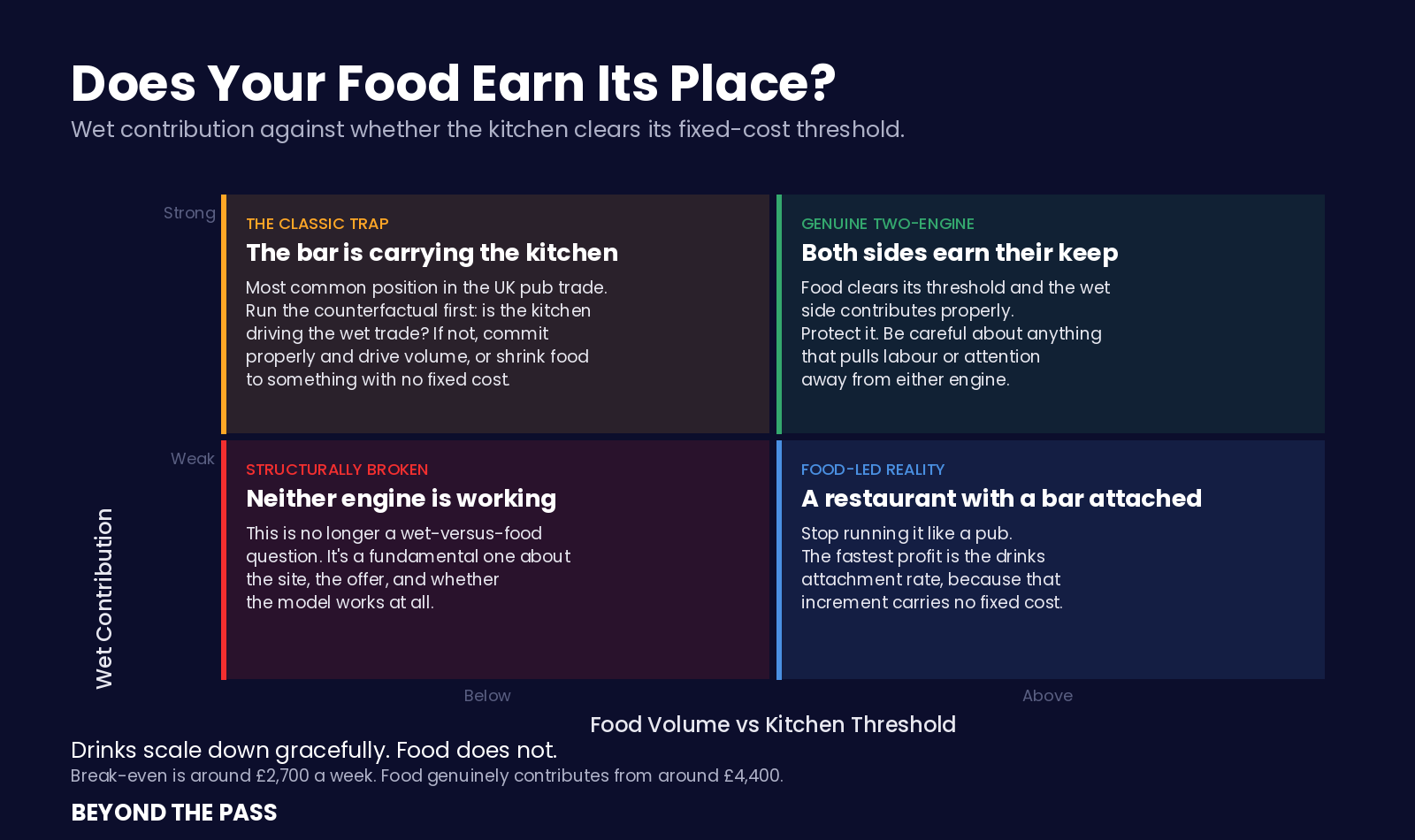
Put the two variables together, your wet contribution and whether your food clears its threshold, and every venue sits in one of four places.
Strong wet, food above threshold. A genuine two-engine business. Both sides earn their keep and each supports the other. Protect it, and be careful about anything that pulls labour or attention from either engine.
Strong wet, food below threshold. The classic trap, and the most common position in the UK pub trade. Run the counterfactual before you act: if the kitchen is genuinely driving the wet trade, it may be earning its place despite the numbers on its own line. If it isn’t, you have two honest options: commit properly and drive the volume, or shrink the food offer to something with no fixed cost. Continuing exactly as you are is the one thing that never works.
Weak wet, food above threshold. You are a restaurant that happens to have a bar. Stop running it like a pub. The opportunity is almost always the drinks attachment rate, exactly what the bistro did, because that increment carries no fixed cost.
Weak wet, food below threshold. Neither engine is working. This is not a wet-versus-food question any more, it is a fundamental question about the site, the offer, and whether the model works at all.
Three calculations, about forty minutes.
Step 1. Find your kitchen’s break-even. Add up the direct weekly fixed cost of having a kitchen: chef and KP wages including on-costs, equipment depreciation, kitchen utilities, cleaning, compliance. Divide by your food gross margin as a decimal. That is the food sales needed for the kitchen to cover itself.
Step 2. Find your contribution threshold. Add the attributable costs the kitchen consumes beyond its own direct ones: its share of rent and rates, the additional front-of-house labour food service requires, its share of general overhead. Add those to your fixed cost, divide by the same margin. That is where food starts genuinely contributing.
Step 3. Run the counterfactual. Compare average drinks spend on covers that ordered food against those that didn’t, and look at what wet trade does on days the kitchen is shut. That tells you how much of the bar’s takings the kitchen is actually responsible for.
Then place yourself on the four positions above, and the decision that felt impossible usually becomes obvious.
This is the question that scales all the way up. Every hospitality business with more than one revenue stream faces some version of it: does this part of the operation genuinely earn its place, or is it being quietly subsidised by the part that does?
A pub asks it about its kitchen. A restaurant asks it about its bar. And a hotel asks it about the whole of its food and beverage operation, which is where this gets genuinely expensive, because hotel F&B carries the heaviest fixed cost in the industry and is very often subsidised by the rooms without anyone naming it out loud. The counterfactual question matters even more there, because a hotel restaurant that loses money on its own line while filling rooms is doing a different job than its P&L suggests.
The maths does not change as the building gets bigger. Only the size of the number does.
Next in the bar series, the finale: The beverage diagnostic. The three numbers that tell you whether your wet side is genuinely carrying the business or just looks like it, and what to fix first.
Free 15-minute diagnostic that surfaces these numbers for your own operation here.
Thanks for reading Beyond the Pass! This post is public so feel free to share it.
No posts
Comments
Nothing yet. Say the first thing.
Sign in to join the conversation.