
I have been quiet here for a couple of weeks because life has been very full. High school graduation for two. Elementary school farewell for one. End-of-school everything. May absolutely May’ed.
But I am coming up for air, and I wanted to share something I recently came across that I think can really help families who are earlier in the college process, especially rising freshmen, sophomores, and juniors.
This would have saved me SO MUCH manual research over the years.
A few weeks ago I met a dad of a graduating senior who built a tool called CreditMap after going through admissions with his own daughter and realizing how confusing AP and dual enrollment credit policies really are.
It is, in fact, confusing. And most families do not find that out until it is too late to do anything about it.
Here is the thing most people do not realize: AP credit does not work the same way everywhere.
A student can earn a 4 or 5 on an AP exam and receive substantial credit at one university and almost nothing at another. Dual enrollment policies vary just as wildly. Some schools accept certain classes. Some do not. Some majors leave very little room for outside credits to actually count toward anything useful.
What CreditMap does is let families plug in a student’s AP and dual enrollment classes alongside the colleges they are considering and compare how those credits would likely transfer across schools.
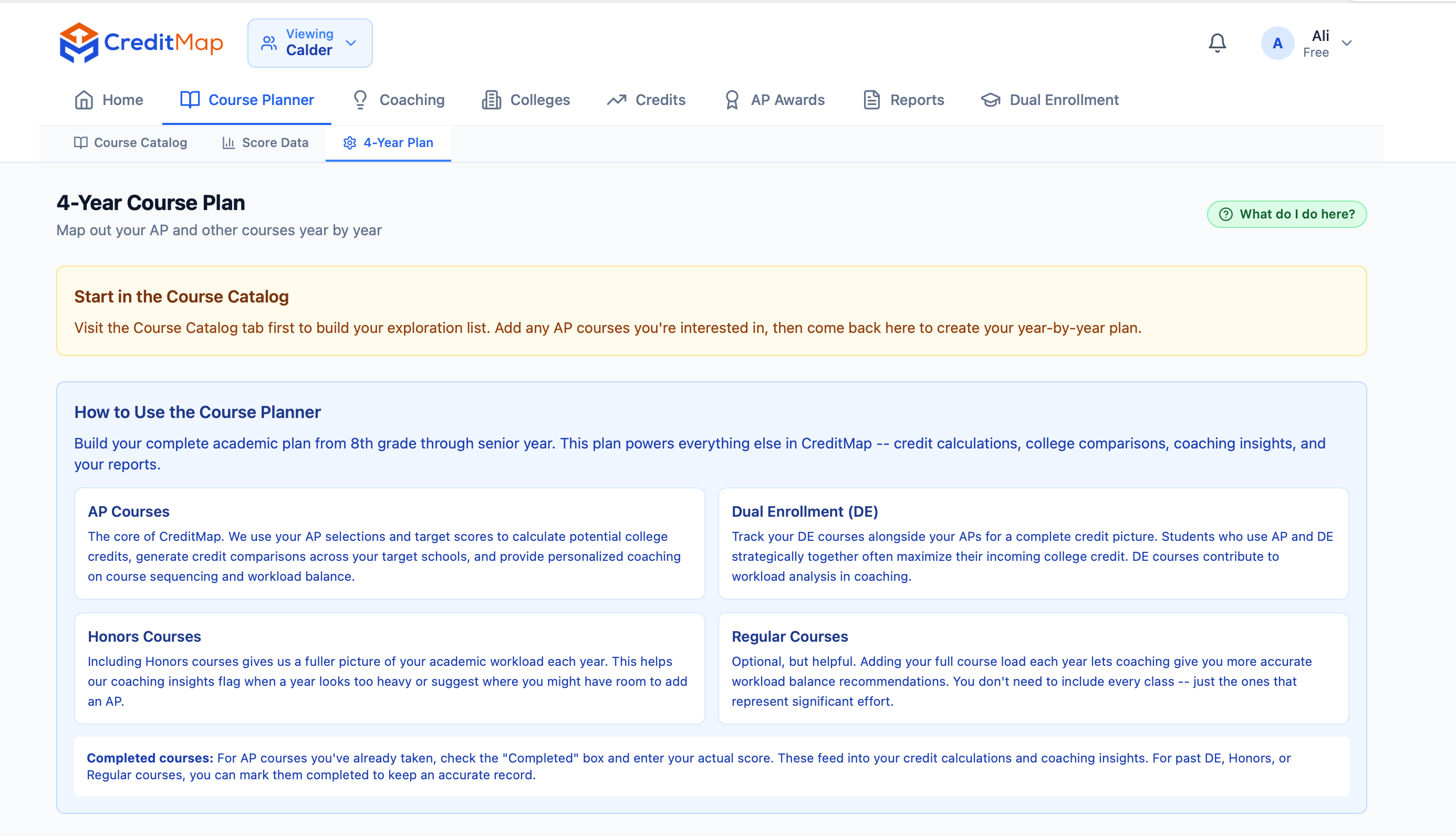
Instead of digging through dozens of university websites trying to decode policy charts, or filling out counselor-created spreadsheets by hand, families can see the differences side by side.
And sometimes the differences are pretty shocking.
A student could walk into one school with close to a semester or even a full year of credit and walk into another with almost nothing, despite taking the exact same classes in high school.
This matters academically, logistically, and financially. Credits can affect course flexibility, double majors, study abroad opportunities, lighter semesters, and whether all the stress of loading up on AP classes is actually likely to pay off at the schools on your student’s list.
While this is especially valuable for families with younger students who are still building their high school plans, it is not too late for anyone. Even families with rising seniors may find it incredibly useful as college lists become more concrete and AP scores are released this summer.
Which brings up the timing: AP scores come out in July, and a lot of families are about to start asking what those scores actually mean. Sometimes the answer is “a lot.” Sometimes it is less than you would think. But it is always better to know sooner.
I especially thought about families who do not have access to a well staffed college counseling office. So many parents are piecing this together late at night from scattered university websites and conflicting information online. This tool is trying to make that process clearer and earlier for everyone.
CreditMap has a free version you can try without a credit card at creditmap.app. You can also use my referral code 0808C208 in the field that requests it when you sign up.
One thing I have learned over and over through this process is that there are already enough surprises in college admissions. Families deserve clearer information earlier so they can make decisions without feeling like there was a hidden rulebook everyone else had access to.
Give it a try, share the love, and let me know if you know anyone, any school, or any system that would like connection to the founder.
Comments
Nothing yet. Say the first thing.
Sign in to join the conversation.