
CORRUPTION RUN RAMPANT! HERE, THERE, EVERYWHERE!
Corruption is a word we’ve probably all been reading a lot about recently, and statistically speaking, if you read national newspapers, odds are strong you’ve been reading about it in the New York Times.
Start, of course, with the reality TV star, would-be American Caesar in the White House, who has 1) weaponized government agencies, most flagrantly the Justice Department and the Directorship of National Intelligence, the former of which recently attempted to award him a 1.776 billion dollar slush fund after he sued the government that he himself heads up while expelling, with the aid of a complicit Supreme Court, independent agency watchdogs; 2) reaped windfalls to the tune of billions for himself and his adult children via assorted crypto scams, which double as bribe-taking mechanisms from foreign governments that make the so-called Hunter Biden “Burisma” scandal look like a game of three-card monte; 3) accepted not even disguised bribes, like the Qatari luxury jet that he means to add to the Air Force One fleet; 4) dished out ambassadorships, pardons, and full-on cabinet positions to big dollar donors and January 6th Capitol rioters; 5) moved Jeffrey Epstein-accomplice Ghislaine Maxwell to a cushy, lower-security penitentiary in exchange, quite obviously, for her silence concerning the president’s implication in Epstein’s circle; 6) used the FCC to threaten and bully network broadcasters like ABC and CBS, the latter of which appears to have ended The Late Show with Stephen Colbert to make nice with federal power; 7) compelled former FOX news weekend host Pete Hegseth to winnow out any non-MAGA diehard officers from our nation’s military, with an eye perhaps to a coup in the event of a Republican election wipeout and 8) bestowed regulatory relief on corporations who have donated to superPACs aligned with his name—which may seem like the least of it, but, really, is the most, since it epitomizes the underlying rot from which our political system has suffered for decades, with Donald J. Trump less the cause than possibly a terminal symptom.
That’s only a partial list, concerning the president himself. Of course, his personal corruption has spawned imitators within his own orbit (the Examples We Set Might Really Matter?), including by the since-deposed Secretary of the Department of Homeland Security Kristi Noem, who—as ICE and Border Patrol officers were murdering Renée Good and Alex Pretti in the streets—directed hundreds of millions of taxpayer dollars toward no-bid advertising and deportation contracts as a prize for cronies; Elon Musk’s dismantling, while at DOGE, of the Federal Aviation Administration (which was levying fines on Musk’s company SpaceX) to so drastic a degree that a handful of likely preventable airplane disasters ensued; in Texas, philandering Ken Paxton’s adjudicated bribery scandals and securities fraud and his attempted impeachment as attorney general by members of his own party, which is not even to mention the sweetheart plea-deal he doled out for an accused child molester; in New York City, faux-centrist, tech billionaire ring-kisser Bari Weiss’s gutting of ratings champion 60 Minutes, a TV program whose brand has been ‘journalistic integrity’ for more than half a century.
That, too, is necessarily a partial list, for your sake and for mine. I didn’t even get to Robert Kennedy Jr., who seems to have corrupted his own family’s political ideals to the extent that he now operates as a sort of measles-spreading Frankenstein’s monster, reanimated from a political grave of his own making, and trotted out by the administration every once in a while to stand in the background as the president fumes about those who have done him wrong. The thought presents itself that maybe at some point in his time as a passionate environmentalist, Bobby Jr. so despaired of the possibility of a sustainable future that he decided, darkly, on striving to deplete the human species via mass illness as the most viable path to conserving the wetlands. (Then again, it might just be the worm that ate a portion of his brain is what has him taking his family out to bathe in a shit creek—or was it the absence of his father as a guide during his troubled teenage years?)
And guess what, there’s even more! With the sudden ubiquity of betting markets everywhere, permeating every major sport, we have seen someone from the president’s orbit with inside knowledge make over $400k by wagering on Venezuelan President Nicolás Maduro’s compulsory field trip to New York City; others who bet via Polymarket that the United States would bomb Iran shortly before it happened, thereby racking up a cool $1.2 million; the president’s son, Donald Jr., invest himself in both Kalshi and Polymarket, and get bullish on Vulcan Elements, a rare-earth magnet startup, shortly before his pal Peter Navarro arranged for a $620 million loan from the Pentagon that sent Vulcan’s value up, up, up; the transformation of the Commodity Futures Trading Commission, which would have been the agency to investigate these and other instances of insider trading, into an ally providing safe spaces for such bold, ethics-free endeavors.
Not everybody is getting away with it, though: a talented and well-paid relief pitcher for the Cleveland Guardians may have thrown his career juuuust a bit outside by rigging specific pitches over the course of 40+ MLB games, while coordinating with bettors from the dugout via cellphone; Miami Heat guard Terry Rozier and assistant coach Damon Jones are accused of leaking non-public injury information for the sake of prop bets; former Republican Congressman George Santos is under investigation (again) for making a bet on whether or not he himself would appear at this year’s State of the Union address (he declared on social media that he would, then—ha, rug pull!—did not). It is too bad that none of these folks work in the current White House where presumably they would be protected from prosecution and maybe even encouraged to get more creative in their schemes.
FOX pundits like Sean Hannity have for years, across both Trump administrations, coordinated programming with the Oval Office’s priorities, an interesting usage for a “news” channel whose parent company owns another (Fox Broadcasting) that depends on access to public airwaves. From the era of the Fairness Doctrine, which was struck down in the ’80s by the Reagan administration, we’ve reached peak “news” programming that is all but indistinguishable in tenor from the state propaganda arms of Putin’s Russia.
Then, too, there’s the corruption of our very attention spans by algorithms primed to keep us scrolling; the possibility of the Death of Print Media looming on the not-so-distant horizon, where text is fixed and accountable to history’s judgment, now replaced by the tabula rasa, never-ending feed in which no word is final and everything kind of depends, you know? Social media does its level best to make hustlers of us all; suppose we all might feel a little complicit in the grift, somehow, some way? Talk to an indie book publisher in Los Angeles and he’ll tell you, confidently: “Nobody reads books anymore.” Presumably, under the belief that people are just buying them as ornaments? The brains we used to rely on for focus have been shot through with widespread silliness, discrete, constantly updating information packets—Excuse me, I’m getting bored writing this, going to check for status updates, one minute, right back…
And don’t forget about the so-called rise of AI Influencers on platforms like Instagram, which is to say accounts that tech ownership, or interested parties, may use for messaging, or simply to take clicks away from human influencers, much in the way that Spotify, as reported by author Liz Pelly, is said to have generated “ghost artists” whose existence allows Spotify itself to compete with the artists attempting to make a living on Spotify, much in the way (again) that Amazon has used its marketplace to push its own cheap competitors to products that their company metrics have flagged as on the rise within Amazon’s marketplace (Get it? They’re seeing what sells in the marketplace they own, then creating cheap imitations to sell against the original products that their numbers show people want). Look, as well, at PostPulse.social, which “trains on your posts to capture your voice, then creates content based on formats from high-engaging posts in your niche” in concert with, say, an engine like Anthropic’s Claude; rather than harmless travesty, it would seem AI accounts are poised to play a more and more prominent role in political outcomes by sheer force of number (see “Dead Internet Theory”): Who is really going to go through a viral post, with ten of thousands of likes, and parse how many of those likes are real and how many from fake accounts?
All this—or most of this?—you can read about in mainly fine reporting and arts coverage by the New York Times. It is no small thing that over the last several decades as newspaper after newspaper has closed shop all across the country, there is one that became essentially an emporium, the paper of all American papers. At the same time, that paper has pulled up stakes from some of the local coverage through which it first made its name. The “New York” is right there across the top, after all, even if, at this point, the World Times, or Times of the Western Hemisphere from New York City, might be more accurate. Yes, too long, though, and why dilute the brand of the thing that everybody knows?
In counterpoint to the gatekeeping “elites” of the New York Times, there’s the rapidly disseminating ethos of, let’s call it, the Social Media Mentality, whereby any individual has the capacity to go around gatekeepers, direct truth to power (or the performance of same), and try garnering clicks for What The Mainstream Is Not Telling You. This dynamic, of course, if not the exact delivery mechanism, has existed at least since the early 20th century and the dawn of the Media Age. In more recent eras, New York City enjoyed bona fide, and justly celebrated, indie papers and gossip-inclined rags like the Village Voice, New York Press, and the New York Observer whose missions, among much else, were to keep the Times honest, or at least to report on subcultures and stories the Times missed, or instances of the Times going flagrantly astray.
Without the existence of shame, could there be such a thing as honor? Who gets heard on social media has a lot to do with whose voice gets boosted; in a sea of big accounts and tiny upstarts, down to the myriad so-called burners expressly set up to troll, how stand out? Among the most impactful of “Big Accounts” and anointer of Those Worth Paying Attention To are old guard institutions like the New York Times, which, perhaps for the same reason, finds itself the target of endless campaigns intent on corroding the credibility of its brand, seemingly in favor of a world where there are no old guard institutions left, and all news is atomized opinion in a popularity contest whose outcomes can be goosed with, say, AI accounts or algorithmic control. In the absence of smaller scale gatekeepers (like those of the aforementioned Village Voice or New York Press, etc.), everything becomes a game of “doing numbers” to signal importance, and gaming that perception is more and more the order of the day.
The New York Times’ online antagonists include the Free Gaza hive, a present-day alliance between the morally outraged, the genuinely aggrieved, and yes, most definitely, some old school anti-Semites who stand in opposition to what looks a lot like a genocide committed at the direction of Benjamin Netanyahu’s government—as well as the rabid rightwing social media sphere atop which sits our very own necrotic and corrupt, social media savant president. (Give him credit for something!)
Consider all this a long windup to say that I am an avid reader of the Times, through every era of its existence coinciding with my adult life in New York City, and when I raise my voice in criticism of the paper I mean to do so judiciously, and with respect for the institution. Newspapers writ large are bulwarks against fascism; an informed populace is a necessary precondition for participatory democracy, and it is newspapers, above all, that do that vital work when they are enabled to do so. Their disappearance and/or billionaire-abetted crippling over the past couple of decades all across the United States, or cooptation and hollowing out by bad faith propagandists, is part and parcel of how we ended up with this crisis of rampant corruption in the first place.
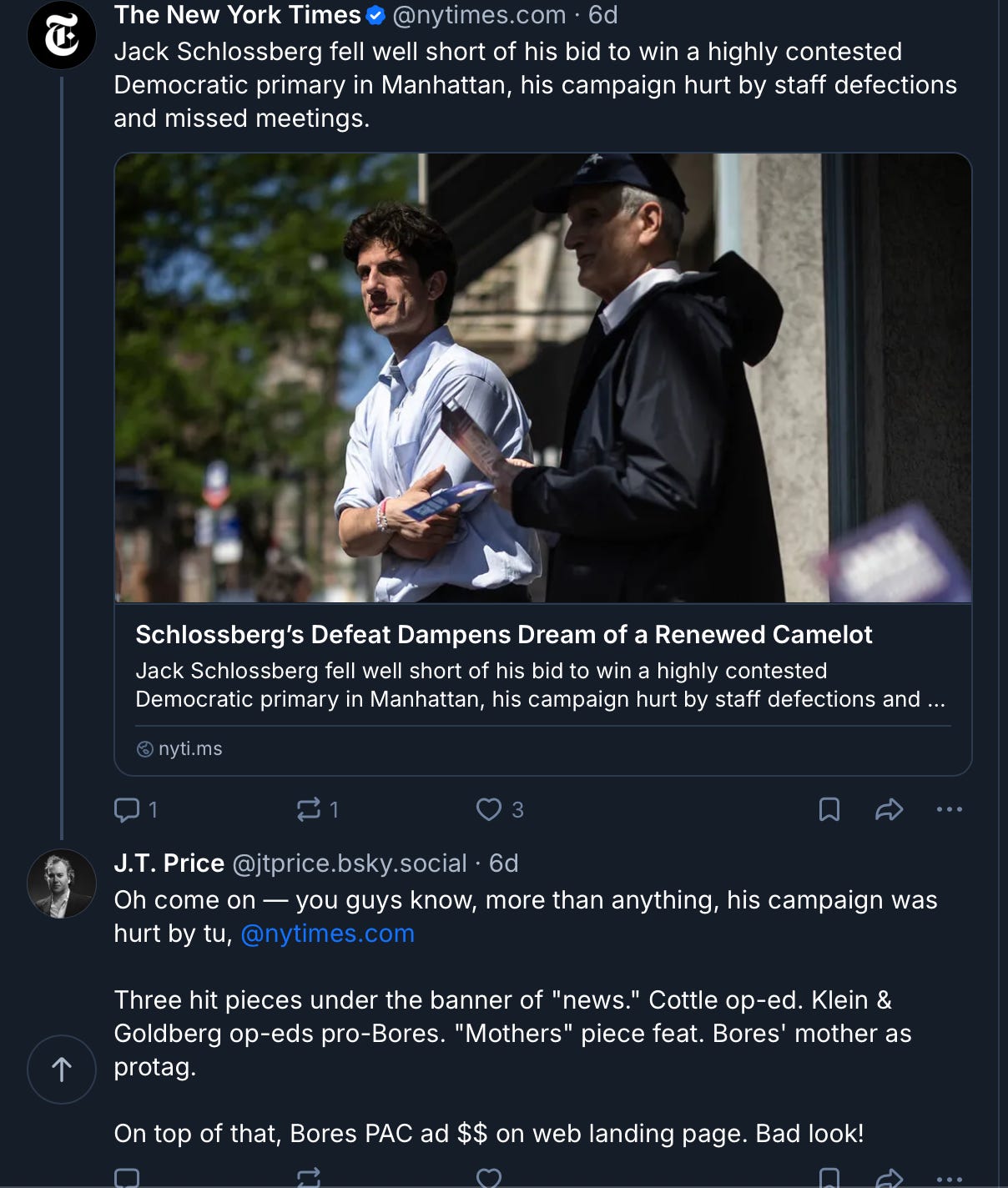
THE TIMES WENT REALLY, REALLY, REALLY, REALLY HARD ANTI-SCHLOSSBERG… WTF!?
Even though, a few years ago now, the paper adopted the somewhat shocking stance of no longer making official endorsements in local races, the New York Times really, really, really, really did not want Jack Schlossberg to win in NY-12, at the same time as piece after piece after piece after piece plumped for his opponent State Assemblyman Alex Bores. Perhaps alarmed by how ineffectual their posturing against Mayor Zohran Mamdani’s ascendancy proved to be, the Times, with great intentionality, worked to put down Schlossberg’s first campaign for the House of Representatives.
Did that have anything to do with the Times being the instigator of a lawsuit against OpenAI, one of the companies behind the anti-Bores PAC? And was that lawsuit sufficient reason—a perceived existential threat—to champion a favorite in the NY-12 race, across the purportedly separate news and Op-Ed divisions within the paper, while electing not to report on widespread astroturfing by those aligned with that same candidate, as well as a viral encounter between Schlossberg and a provocateur that may, in all likelihood, have been a paid set-up followed by the viciously cynical A.I.-boosting of social media heat around Israel/Gaza?
New York Times: I put the question to you! People want to know.
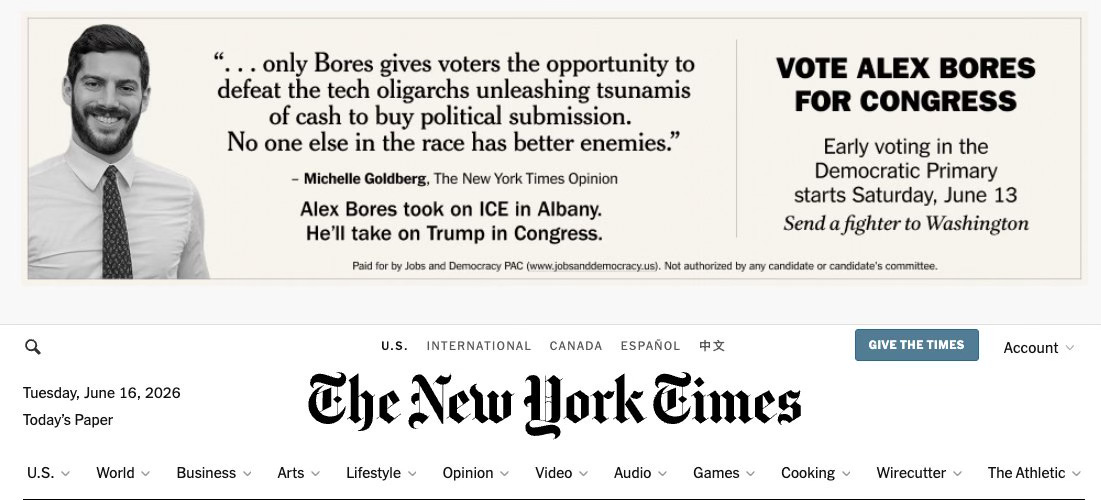
Anyway, if all that weren’t enough of a dereliction of duty, here’s the ‘corruption’ kicker: the Times was unabashedly hoovering up ad dollars by pro-Bores super PACs and displaying the candidate’s advertisements across the top of their website every day during the lead-up to the election.
Could it be said that in addition to astroturfing accounts far and wide across social media, and appearing to drive the numbers of pro-Bores or anti-Schlossberg viral posts with A.I. pile-ons, Bores people actually reached a big, A.I.-empowered hand into the Paper of Record and made its mouth flap like a puppet?
Because… holy shit!
And because… If this is the new normal, how long do we believe the New York Times’ constantly beset reputation for integrity will hold? There’s astroturfing, and then there’s Astroturfing. And this really appears to have been Astroturfing, with the Paper of Record as a vessel. But at least they got paid well! (Congrats, guys 👍)

I should state, off the bat, that my positionality in “reporting” this story is, at best, muddled; it would not meet the Times’ purported ethical standards (although, given the occasion for this piece, it isn’t so clear that the Times itself is able to meet those ethical standards at the moment, either). I was a small dollar donor to the Schlossberg campaign (under $100 across, I think, five donations), and volunteered as a canvasser which I have done previously on several other campaigns, including for a hospitality union on behalf of Harris/Walz in the run-up to the ’24 presidential, and with the Working Families Party on behalf of their slate of preferred candidates in the most recent NYC Democratic Mayoral Primary, which included our present-day mayor. Even though I live in what is poised to become Brad Lander’s district, I decided early that he had that race cinched up, and so chose to throw in my efforts toward a closer race. Over the course of two months I struck up a friendly rapport with a few of Schlossberg’s campaign staffers and, during the final ten days of the race, interviewed the candidate himself.
Normally, then, I would respect it is best to defer to a real political journalist to cover a story like this. Yet, when nobody else is, and I saw what I saw with my own eyes and heard what I heard with my own ears, then, hey, it’s time to put on the old fedora and get out the figurative notepad and pen, ring up My Girl Friday, and start shouting questions toward the spotlight. Say, whaddya think yer doin’ there, fellas? Why wait for institutional backing when the news environment will never not be full steam ahead?
My own view of the race, and what led me to align with Schlossberg’s candidacy?
Micah Lasher, the establishment pick favored by Michael Bloomberg (who poured over 10 million into a pro-Lasher PAC), Governor Kathy Hochul, and retiring NY-12 rep Jerry Nadler, appears by every indication of that oh-so-important “experience” the Times and others liked to cite to have his fingerprints on some pretty, pretty unsavory policies, including Bloomberg’s proto-fascistic “stop-and-frisk” and the NYPD’s “Gang Database,” which Bertha Lewis, a founder of the Working Families Party, cited in what ought to have been a devastating op-ed, as a “racially biased” tool used by ICE “to target immigrants.” Lewis further brought back to light Lasher’s singular responsibility for a racist caricature of candidate Fernando Ferrer distributed across wealthy white neighborhoods in the 2001 Democratic Mayoral primary. Lasher was also involved in the Bloomberg administration’s implementation of statewide pension reforms that thinned out workers’ retirement benefits. Then, this April, during remarks on the occasion of his receiving a Stonewall endorsement, Lasher is alleged to have made a young trans activist cry when he got his hackles up, reprimanding his questioner, “I’ve been fighting for trans right since before you were born.”
The portrait that takes shape is of a bright, pragmatic, and kind of snakey, kind of arrogant guy—of the type that NYC political veterans will say you have to be to survive here—whose outward appearance is as of someone attempting to present as Jerry Nadler’s younger clone, in that old school hierarchal practice whereby an aspirant to power mirrors the look and mannerisms of an anointed elder in a never-ending quest for approval. A sort of nouveau The Man in the Gray Flannel Suit. In short, someone who, although charisma-free, seems serviceable and perhaps of a piece with the extremely wealthy, pronouncedly pro-Israel, ravenously pro-business district he is running to represent, but who, at the outset of the race, I felt I’d rather not see win. Lasher was also most definitely, if there’s any question as certain retrospective narrativizing has sought to cast the NY-12 race as one that Jack Schlossberg let slip through his hands, the odds-on favorite to win the seat from the beginning.
Then, Alex Bores. When I decided to throw in with the Schlossberg campaign, my view was that the goal ought to be stopping Lasher, which meant, if in the closing days of the race it appeared Schlossberg stood no chance of winning, I would have rather he had thrown in with Bores to get a more progressive candidate in the seat. By the end of the race, though, my outlook had changed, and I was only too glad to see Alex Bores lose, given the means that his campaign, or associated PACs, had used to try and drive Schlossberg’s numbers down, which included astroturfing and quite possibly the hiring of a professional troll to create a viral moment around Israel/Gaza.
The overriding label I would assign to how Alex Bores presented over the course of the race: Disingenuous. You might recognize that label from such notable (and decidedly far, far worse) embodiments as our current vice-president, J.D. Vance. Bores seemed to have trouble, at times, maintaining control over his facial expressions, in the manner of an actor who tires of his role—what you believe about him, but what he knows is not entirely true of himself—such that the mask starts to slip. The rigors of campaign season, sure, I get that, but the manner in which Bores would say, in essence, Well, but this has already been reported on!, seemingly with the intention of directing viewers back to his viral interview with Ezra Klein, rather than answering challenging questions at the NY-12 debates, or those put to him on the final day of the race by CNN’s Erin Burnett, and allowing an almost frighteningly blank, disassociated expression to overcome him, perhaps ought to have given folks a second thought or two about the authenticity of his self-presentation as the “real progressive.” By then, it was far too late, though, as the narrative had been set in stone, first and foremost by the New York Times.
It’s part and parcel of Ezra Klein’s cream-on-the-coffee interviewing tone that rarely does anyone who is given the privilege of sitting in the chair opposite him receive any sort of concerted pushback from the host unless that pushback is implicit to the framing of the interview. In the case of Bores, Klein provided very limited probing. Rather, he allowed Bores to present his candidacy as a hero’s story: One man versus the titans of A.I. Ezra Klein did broach the news story reported by Bloomberg that Bores departed Palantir not because of his ethical concerns about the work he was doing—which, curiously, even by his own account, took until Trump’s first term was nearly over to seize hold of him in his capacity as a liaison to the administration—but following an accusation of inappropriate workplace conduct brought by a female coworker. Bores claimed that the accusations were false and one more facet of OpenAI/Palantir’s efforts at smearing him and trying to end his career.
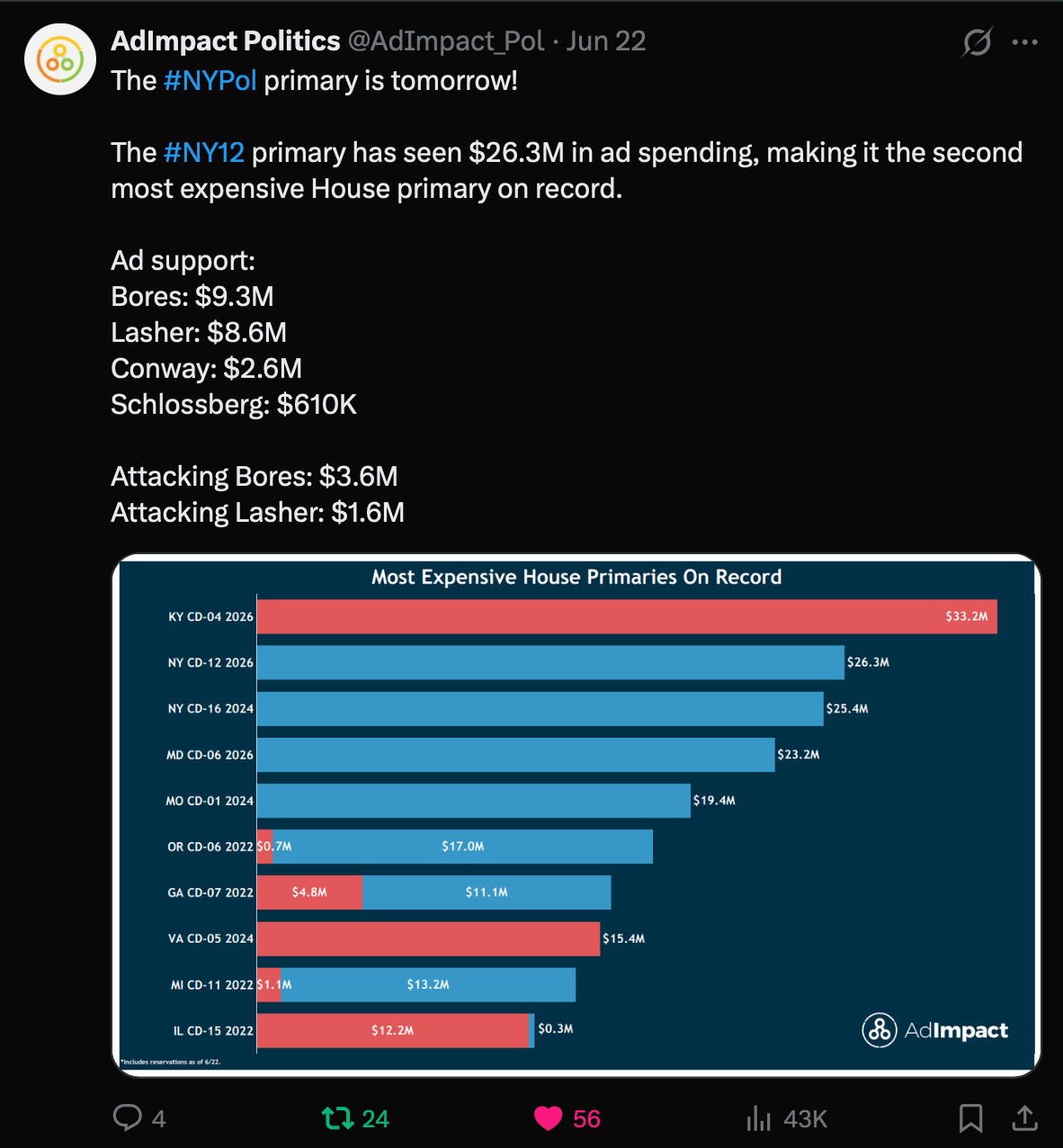
Then, too, there was the core premise of his campaign: Alex Bores pitched himself as NY-12’s one shot at A.I. regulation; Klein correctly noted that Anthropic had been spending a ton to power a pro-Bores superPAC, but never seemed to raise an eyebrow at the notion that a candidate whose resume included a long stint at Palantir might stand to benefit, in a Democratic primary, from having as a professional wrestling style antagonist a big bad A.I. firm playing the heel. Even as a competing firm geysered money into propping his candidacy up—and indeed, well before the race ended, the Bores antagonist PAC drew down its spending (total ~$3.6 mil), while the pro-Bores PAC poured more and more into the race (at least $7.9 mil), which goes a long way towards accounting for how the 2026 NY-12 race ended up being the second-most expensive ever primary for the U.S. House of Representatives.
On top of everything else, Bores’ core argument was, at root, ridiculous: he seemed to argue that only he, as someone who knows A.I. companies, would be capable of writing the legislation to regulate A.I.
I would ask anybody who bought into that argument to dig into American history and figure out how many of the elected representatives who voted to pass industry regulations into law were originally beneficiaries of that industry, i.e. We did not elect factory overseers to government to regulate factories, or Wall Street titans to regulate Wall Street, or Ma Bell employees to break up Ma Bell. Rather, disinterested elected officials are meant to have the stature and wherewithal to seek out expert opinion (like, perhaps, Alex Bores’?) on the pressing issues of the day. When industry beneficiaries get involved with federal government it is almost invariably with the goal of loosening regulations or of choosing winners. The reductio ad absurdum of Bores’ campaign argument, given that he would have been only one congressman, is voters having to elect an entire slate of formerly A.I.-aligned legislators to regulate A.I. — or else… who would ever know how to do it?
The race for NY-12 then was one between the establishment pick and a progressive challenger; the difficulty, for the residents of NY-12, was deciding who the true progressive in the race might be. The conventional storyline, the next morning, was how, even if Mayor Mamdani’s endorsed slate of socialist candidates had won their primaries, the establishment had prevailed in NY-12.
But that isn’t quite true, either. Add up the share of the progressive vote in NY-12 (Bores’ 34%, Schlossberg’s 11%, and Schwalbe’s 7%) and you will see that Lasher, even with all of George Conway’s 6% added to his total, would have lost by a decent margin. More voters in the district wanted what they believed to be a progressive in office than a centrist.
Just as easily as the New York Times decided to make the race a referendum on professional careers (even while brushing under the rug anything from the careers in question that might raise eyebrows), they could have dogged Lasher over his fingerprints on racist policies and tactics, or Bores with respect to the parts of his story that didn’t quite add up. That could have been the premise of every news article about them, and the basis from which each Op-Ed piggy-backed. They could have accepted, in other words, Jack Schlossberg’s proffered frame for the race as one featuring a PAC-free, small dollar candidate against leading contenders who appeared, embarrassingly, bought and paid for. Instead, the New York Times sought to pin that embarrassment elsewhere, and not in a subtle way; further, in their respective profiles of Bores and of Lasher, they allowed the candidates to push back on any misgivings raised within what they reported. In contrast, they ran no counterpoint to their anti-Schlossberg Op-Ed. They gave him no chance to rebut their reporting (despite his direct appeals to do so on social media), but instead retroactively placed into their story, out of context, words he said to MSNow’s Jen Psaki on the day the first Times article published. (This particular statement of Schlossberg’s wasn’t his best; the first-time candidate took a few days, and a few more media hits, to find the correct tone in response.) The Times also blocked comments in their articles, whether news or Op-Ed, that included links to news articles that were negative about Bores, or in defense of Schlossberg, but permitted commenters who linked to anti-Schlossberg articles (from the same publication, Politico, as the one negative about Bores).
Oddly, Times reporters Jesse McKinley and Tim Balk ended their election night, sum-it-up news piece on Jack Schlossberg’s first Congressional campaign with a partial quotation from the candidate regarding the word of the hour: “If we win tonight, or if we don’t, we’re still in the midst of a corruption crisis.” Corruption: a strange note for the Times to wrap on, abridging as they did, Schlossberg’s habitually repeated citation of a three-part crisis (cost crisis, corruption crisis, and constitutional crisis), and landing on that one element, almost as if the reporters were looking in a mirror rather than at the candidate himself and naming what they saw looking back at them.
That closing article marked the fourth instance of negative news coverage of Schlossberg’s campaign, to go with the aforementioned Ezra Klein pro-Bores piece, as well as another pro-Bores column by Michelle Goldberg (which to a greater degree even than Klein swallowed the candidate’s framing, hook, line, and sinker), plus Michelle Cottle’s utterly fatuous anti-Schlossberg column (“He’s Entitled and Nepotistic. This Is Not What the Democrats Need.”) that piggybacked off Nicholas Fandos’ initial reporting. That reporting mainly boiled down to a portrait of a candidate who could be, at times, hard to pin down while he dealt with the grief of recently losing his sister. That crucial article also hinged on a young organizer for the campaign who repeatedly flouted instructions and, on being granted second chance after second chance, threatened the team that he would go to the media in tandem with a consultant whose services had, likewise, been cut free. At least, that’s what I heard from campaign staff, as well as the contention that they had given this information to the Times, who refused to print it amid their takedown.
The Fandos article’s thesis is here: “Behind the scenes, a group of fellow Democrats, family friends, union leaders and others with direct knowledge of the campaign described an operation so erratic and plagued by turnover that it raises questions about how he might handle himself as a member of Congress.”
It is the characterization—chaotic—that Fandos returns to again and again in the piece, even when his transitions to that thruline are strained. Quotations from those who spoke up, on the record, in support of Schlossberg saw their statements buried, the first of which, attributed to former State Department employee Sally Yozell a little more than halfway thru the article, directly contradicts the notion that Schlossberg is spoiled or entitled: “You can imagine I was like, ‘oh boy, what is this going to be like?’” she says of having Schlossberg as a junior employee at State. “And it was fantastic. He was very humble and worked really well with everybody,” which Fandos, for some reason, uses as a transition to discuss the candidate’s trust fund.
A subsequent quotation toward the end of the piece by former Biden White House Chief-of-Staff Ron Klain (“Of all the congressional candidates I’ve ever worked with, Jack is one of the ones who has been most serious about policy”) leads to Fandos recounting a trivial instance of Schlossberg borrowing the substance of a Dem House member’s Instagram reel for his own reel on the same subject before publicly acknowledging that debt when pressed to do so by the House member (military vet Seth Moulton).
Dare I say it? That isn’t newsworthy! It’s a petty point of contention when the subject at hand is really about signal-boosting condemnation for the Trump administration’s corrupt overreach, but nevertheless functions, by Fandos and his editors’ choice to include it, as rain upon Klain’s praise.
As if hellbent on reenacting over and over again the tale of the farmer and the viper, the Times kept sending different news reporters, in subsequent weeks, to the Schlossberg campaign staff who (so I heard) would treat them nicely before looking to what eventually made the printed page and find bad faith attack after bad faith attack. This class of reporters who I won’t bother to name—look them up if you want—had essentially started to deploy the nostalgia-soaked term “Camelot” like a schoolyard taunt against Schlossberg by the time voters were going to the polls, at the same time as Schlossberg never once invoked it over the course of his campaign except to put distance between himself and that association. It isn’t like the Kennedy name hasn’t been in the news for other reasons, and under concerted attack now for some time by the current denizen of the White House in the manner of a parasitic wasp seeking to perpetuate his own legacy by invading that of someone greater. I would contend, too, that, for a Democratic Party trying to find, or reclaim, some lost identity, looking at what their chief antagonist is obsessed with wrenching from them, and claiming as his own, might be worthwhile?
Sidebar, but sorry, can’t resist: the problem with Cottle’s op-ed, which is distinguished from the stylings of a crank in the void (😀) by virtue of being published via a dynastic institution, is that the attack she employed against Schlossberg’s candidacy is pure ad hominem, completely divorced from the substance of the NY-12 race, which she addressed in her column not at all. By her logic, a critic could rule her point of view entitled and myopic because of past Times scandals involving Judith Miller, or Jayson Blair, or the incessant reporting on Hillary’s emails that helped throw the 2016 presidential election, or some of the more ghastly language contortions around Israel’s massacres of Palestinians, and hey why not, let’s go true vintage, the Times having played the part of apologist and civilized veneer for Mr. The Power Broker himself, Robert Moses. These instances all obviously mark low-points in the history of the Times, but are not sufficient reason to throw out the vital role the institution serves with the bath-water, any more than extended Kennedy family misbehavior, or moments of notoriety, were sufficient reason to rule Schlossberg’s campaign as unworthy of the district, out-of-hand. Contra Cottle’s contention that Schlossberg is entitled, there’s her own cultural entitlement which took in the average $40 donation from all 50 states sent to his campaign, regarded that reservoir of political strength and collective expectation, then looked down her nose at it. Real “smart” stuff. How did the Democratic Party get so out of touch with their own voters again?
All I know is that if the great, tragic Minnesota Senator Paul Wellstone, whose hand I shook while volunteering, full-time, in January of 2000 for the Bill Bradley campaign in New Hampshire (my first, which Bradley lost, narrowly, to Al Gore, and we know the rest…), were deciding who the “true progressive” in the 2026 NY-12 race was, I’d have to think he would have started by identifying those who practiced what they preached and showed the courage to refuse the dark money which has done so much to lead our collective politics astray. Wellstone, famously, won his seat in the Senate via a spirited, and truly grassroots, somewhat goofy, big money-free campaign—and in that sense, prefigured Bernie Sanders as an icon of progressive politics. Not such a bad model, either, for fathoming what Schlossberg was pursuing.
CYNICAL MEANS = CYNICAL ENDS, WHEN LOOKING AHEAD TO THE 2028 PRESIDENTIAL
So, yes, as previously said, by the end of the race, I’d undergone a change of heart. At race’s end, I was keen on seeing Alex Bores lose.
Why? What turned me?
I’ll get to that, but I do want to point to the moment in one of the final debates when Schlossberg put the question to Bores directly: Why wouldn’t he renounce his superPACs and run the remainder of the race without dark money, as Schlossberg had all along the way?
Now, OK, I’m mostly just a fiction writer and lit mag editor, but I’d hazard that if Alex Bores had taken Schlossberg up on that exhortation, said, right there and then, “OK, I will, I’ll do it”: What a moment that would have been.
A profile in courage, or definitely approaching one?
And you know what? Maybe at that point—it’s conceivable, because imagine again how dramatic—Schlossberg does drop out at the end of the race and endorse Bores.
Then Bores, who lost by only 4 points, wins? Do we think that the superPAC deluge for Bores and yucky appearance of collusion with the Times, and even more egregiously the Daily News, was driving his numbers up in the final weeks of the race, or do we think that his percentage of the vote had already peaked, and was starting to fall back? Given how he was out there on the final day along with, comically, cardboard cutouts of himself that an obviously tech-brained person had seen fit to position on NYC corners near polling places, as the candidate in the flesh signaled to Erin Burnett that his campaign really was about so much more than A.I., it seems like maybe someone on his staff had gotten him the message that he’d reached saturation with his hero’s story, and had better suggest to people that he was good for more than doing the thing that no industry insider has ever previously been elected to Congress to do.
Schlossberg is a smart guy, though, and probably accurately assessed that Bores would not renounce dark money, would not even dream of doing so—because Bores’ campaign persona, certain accomplishments and intentions notwithstanding, was fake. He was not the true progressive in the race.
The means to victory do matter when the country is undergoing a five-alarm fire caused, at root, by the bad means poisoning our national system. (I’d have thought that Zohran Mamdani’s victory as mayor, and first six months in office, would have done much to show us that.)
Get the Money Out. And if you’re going to do it, start by showing you can do it yourself: Walk the walk you talk.
(The Times, I forget which reporters, in one of their final news articles about Schlossberg’s campaign, tried pinning on him what they deemed the hypocrisy of his spending one million of his own in the final week of the campaign to prevent being completely drowned out by his primary opponents’ much, much heftier dark money-abetted advertising. I did not ask Schlossberg about that, but of course, it would have been the decision of someone who had decided to stay in the race through to the end, and to honor the efforts of his own staffers and volunteers by offering up a significant slice of his own wealth toward the political ideals on which his campaign made an actually pretty heroic stand.)
What got to me about the Bores campaign, though, was indeed the utter nastiness of the astroturfing, the slipperiness in pinning down what was happening, and the understanding that had he prevailed—and even though he did not—we are probably looking at the same means anti-progressive forces will deploy in the upcoming ’28 Democratic presidential primary as well as the marquee event itself that November.
I want readers to stop and think for a moment about the degree of cynicism that would lead a Bores-aligned political actor to hire an ostensibly pro-Palestine provocateur to ambush a competing candidate on a parade route, while Alex Bores, who benefitted from that confrontation with Schlossberg (at least somewhat in the style of other confrontations cropping up in other races around the country, including against CA State senator Scott Weiner), is for uninterrupted support to Israel’s military, and marched on Israel Day in New York City with genocidal Netanyahu-government official Bezalel Smotrich. Alex Bores did that, and yet, people aligned with him appear to have deployed a “pro-Palestine” provocateur to damage his competitor’s standing with young people.
Am I able to prove this, you ask? I do not have the resources, or the ability to apply public pressure, of an institution like the New York Times. But we do have the Anthropic’s Chris Larsen-funded, pro-Bores superPAC fessing up to astroturfing social media posts; we do have Instagrammer kaitlyndoespolitics who did the basic groundwork of contacting CrackheadBarney and inquiring whether their services would be available to go after an unnamed candidate to which CrackheadBarney responded that, yes, for $10k each for a three-video segment they would do that; we do have the seeming news organizational work that Schlossberg’s own campaign put out in the aftermath of the Bores astroturfing to try and educate voters about the phenomenon; and we have a series of ignorantly backwards, or possibly paid (#BoresBucks), viral posts that disparaged Schlossberg as an Israel supporter while vouching support, by name, for Alex Bores.
That’s a lot of smoke!
Yet the New York Times, despite the CrackheadBarney encounter having transpired merely blocks from their headquarters, elected not to touch the story with a 10-foot pole, or that of astroturfing writ large in the NY-12 primary either.
If Rep. Seth Moulton’s feelings being hurt that Schlossberg chose to boost an anti-Trump message while borrowing some of Moulton’s language constituted news, then I have to think the voters of NY-12 might have wanted to hear, too, about astroturfing for a race in their district, especially considering that the same tactics will surely figure prominently in 2028. Start heightening people’s awareness now.
Against the establishment favorite Lasher, the real race in NY-12 was to dominate, and clear out, the progressive lane; the Times played a big part in that competition within the competition, got paid (well, I imagine!) by the campaign they championed, and imho, chose poorly.
Once more, was it the lawsuit against OpenAI?
Was it Israel/Gaza?
Was it a sense that, with Lasher’s victory appearing inevitable, they could milk the Bores people for all they were worth in the interest of boosting NYTimes’ institutional coffers?
Whatever it might have been, the Times risks a lot by refusing to deliver its readers the facts while dedicating its local politics resources to trying to choose a winner.
We have seen how obeisance to this president of the United States has ruined the reputation for integrity of public figures who previously at least retained some shred of the same.
Probably better not to lose yourself becoming what you hate?
But then again, what the hell do I know? Look at my resume. I’m not even a real political reporter.
If you read & dug this, by sharing the link / sending to readers who you think will also dig, you’re stepping into the traditional gatekeeper role in a way that I must applaud.
Comments
Nothing yet. Say the first thing.
Sign in to join the conversation.