
Greetings, lovely humans!
Instead of plugging all the books that I usually do (good little Indie Author that I am), I’m just gonna plug one that’s now available for pre-sale! (But please read all the way to the end… there’s a story installment and a new Ask Adeena bit. Have your own question that you’d like me to answer? Fill out this form.
Back to pre-sales and pre-orders…
T is for Time Travel is now available for pre-order! It’ll be available March 31st 2026.
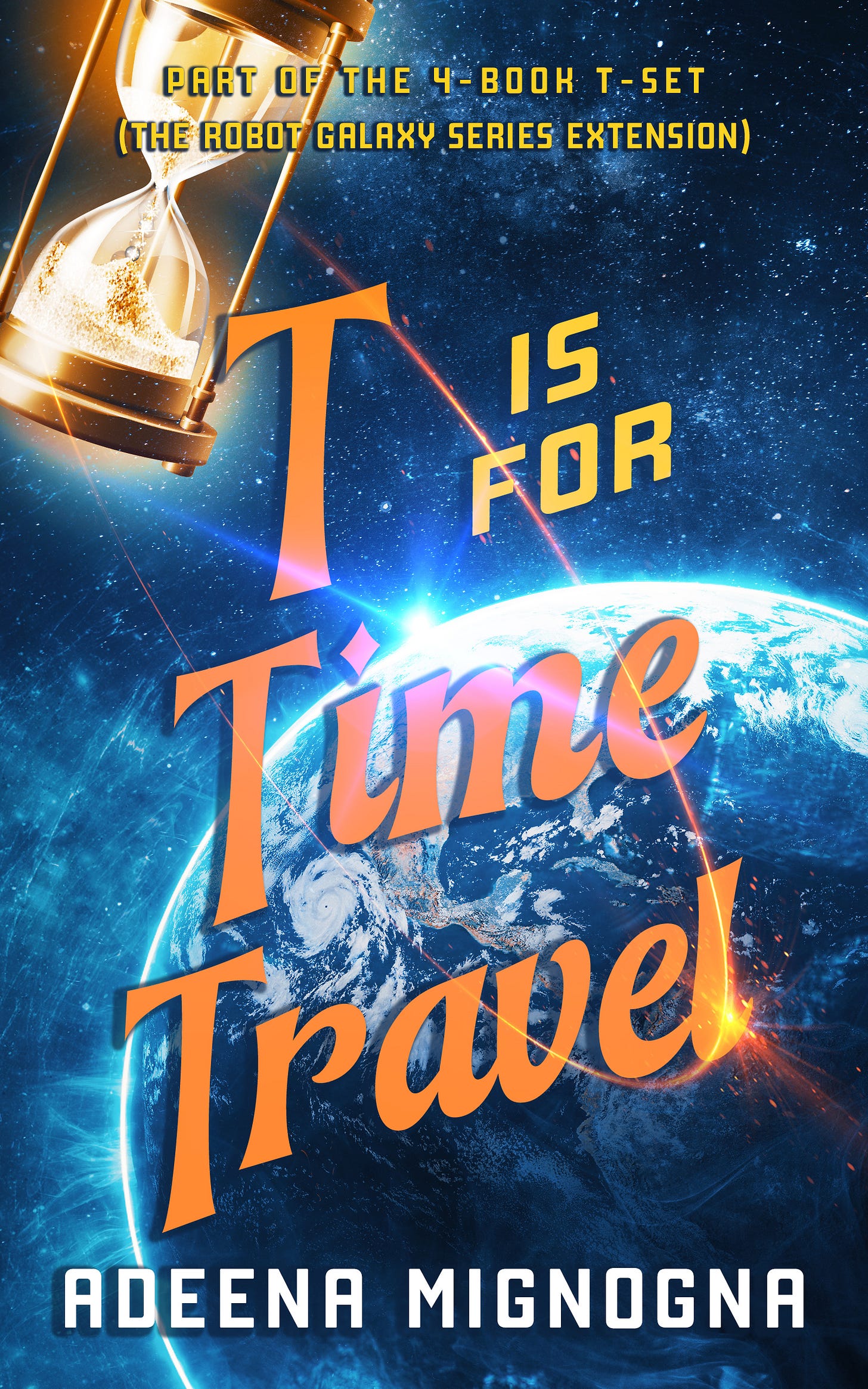
You’d think robots would know better than to mess with time.
You’d be wrong.
Tee hee! I can’t wait for you to read this!
And if you can’t wait either… consider becoming an ARC (Advance Review Copy) reader. If you don’t know, an ARC reader is someone who receives an Advance Review Copy of a book before it’s officially released. In exchange, ARC readers provide honest reviews (on one or more platforms like Goodreads or Bookbub) to generate interest and visibility for the book.
The deets:
ARC delivery date: March 9, 2026 (or as early as March 3rd)
Posting of review: BEFORE MARCH 31, 2026
SIGN UP HERE: https://forms.gle/Zg7WibcUHUquKCN87
I hope you’ll sign up to be an ARC reader, pre-order the book, or both!
Today’s story is part 2 of 3. As I mentioned last time, this was a complete story before I started dropping it here.
If you need to catch up on part 1 first, read this:
…and then continue on here!
Refraction (part 2 of 3)
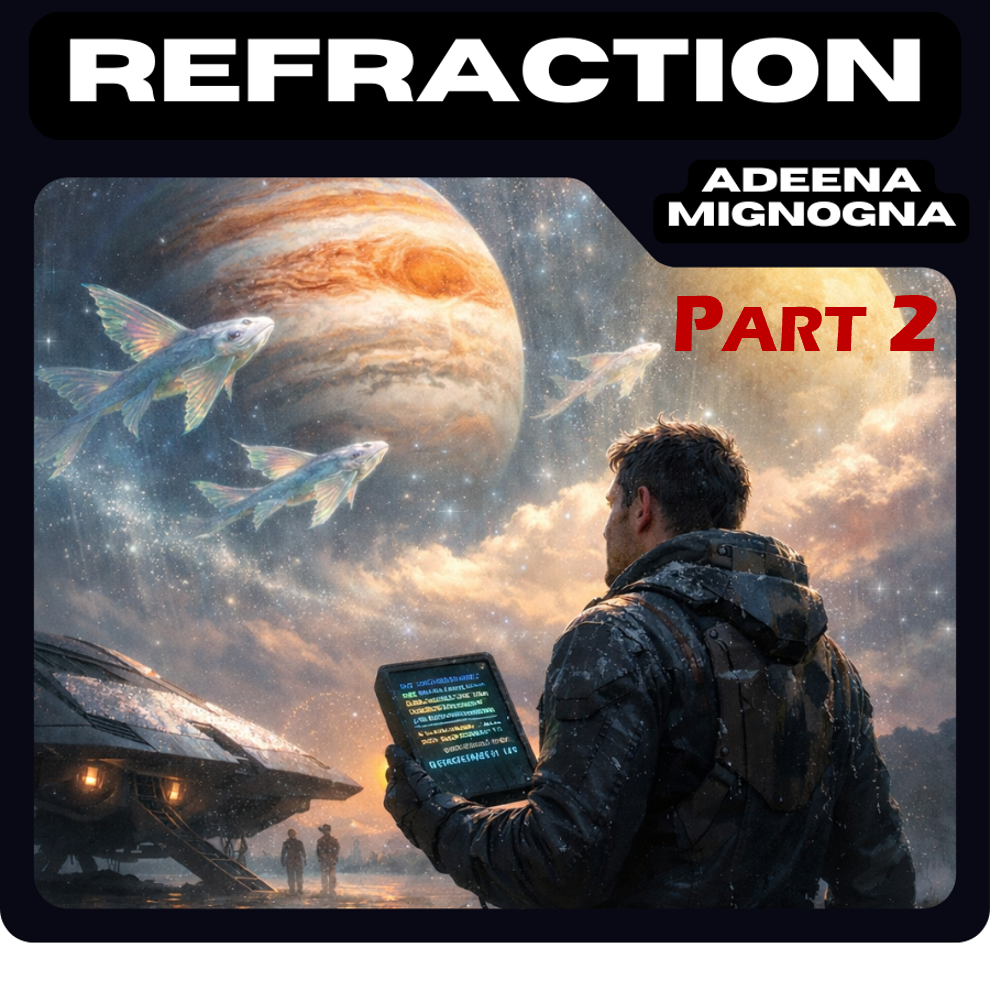
Jema sat down next to Dor.
Dor had been at the diagnostics for more than an hour. Jema noticed he hadn’t touched his meal pack that sat on a crate next to him.
“You know what the worst thing is?” Jema said.
Dor grunted in response, engrossed in the diagnostics.
“A cool meal pack. They never reheat well the second time.”
Dor leaned back, blinked, and rubbed his fingers over his eyebrows and forehead.
“I don’t get it,” he said.
Jema raised her eyebrows.
“There’s nothing wrong with the handhelds,” he said.
“They can’t be picking up a biosignature?” Jema responded. “Can they?”
Dor moved his head back and forth. “They shouldn’t be. There is nothing to pick up. Except…”
Dor stood up and started pacing.
“This is impossible right?”
“You’re talking about your dream?” Jema asked. “The one you were telling me about before?”
Dor nodded.
“Look,” Jema started. “There are probably only so many combinations of… stuff… out here… in our galaxy. In the universe even. It doesn’t strike me as terribly strange that you happened to imagine something that really exists.”
“But you don’t understand… it feels like I’ve been here before.”
Jema hesitated, watching him. “You’ve been running diagnostics for hours. Maybe you’re just overtired.”
“And what’s this biosignature all about?” Dor asked, a little too loudly. He glanced toward the other crewmates, lowering his voice. The last thing he needed was anyone overhearing.
“I don’t know,” Jema said. “But I do know it’s late and we should get some sleep. After being cooped up in that ship the last few weeks, I don’t know about you, but I’m sleeping in the open air. Maybe you should do that, too. It’ll do you good.”
Dor nodded. He pushed a button on the screen of the machine he was using for diagnostics, pushed another button on the handheld, and both pieces of equipment turned inert. Without the light emanating from the equipment, when Dor looked up, he could see not only Fomulhaut d and e, which were both still visible, since they were reflecting light off of Fomulhaut, the star. He could also see other stars shimmering in other parts of the sky, the water layer working to distort any light in its path.
As they made their way over to the cots that had already been laid out outside of the tents, which was Jema’s doing, Dor said:
“So in my dream, the planets would appear slowly and disappear slowly. I think the moon was pulling on the water… I guess I’ll call it a lens… as it orbited.”
“That seems to be what’s going on here,” Jema said. “We took a lot of readings as we orbited the planet before passing through the water layer. There was definitely a distortion in it that corresponded to the current location of the moon. Remember that’s why we chose this landing site.”
Dor nodded. “But there’s more, and now I can’t get it out of my head.”
“Tell me,” Jema said.
“The water layer…. It had an ecosystem.”
“An ecosystem?”
“Yes. There were giant flying fish. They lived half in the water and half outside and would pass through an air and water barrier. I remember seeing them swim in massive shimmering schools…”
Jema heard him, but didn’t know what to say.
The two of them climbed under the blankets of their respective cots and stared up at the magnified planets.
After several minutes, Jema said, “You’re not falling asleep, are you?”
“No,” came Dor’s instantaneous reply.
“Let me guess… you’re thinking about that biosignature.”
Dor propped himself up to face Jema. “Yes. If the scanners aren’t malfunctioning…”
Jema picked up where Dor was going with this. “...there’s something up there.”
The glow from Fomalhaut d and e provided enough light that Dor and Jema could lock eyes.
“Your fish,” she said.
“We need to go check it out.”
“QED wasn’t built for flying around in an atmosphere. She’s a spaceship. With the ability to let us glide to land and take off. I’m not sure how we could do much of anything else.”
Dor didn’t answer. The biosignature blip still pulsed on the darkened screen, steady as a heartbeat.
#
The sky shimmered in liquid pastels. The layer of suspended water caught the light of Fomalhaut like a living mirror, and for a moment Dor could almost convince himself it was moving—breathing.
Jema was already awake, her focus on setting up more of the scanning equipment they brought along.
Dor sat up, yawned, and briefly contemplated whether he should get up. Looking back at the other cots, he saw they were empty.
As if guessing his question, Jema said, “Venn and Arin decided to stay on the ship. I boiled some water. There’s coffee packets.”
She said all of this without taking her eyes off her task at hand.
“What are you doing?” Dor asked, pulling a mug from his kit and dumping in instant coffee, followed by the lukewarm water.
“Seeing if we can use this to amplify your biosignature detection. The handheld wasn’t really meant to pick up signals in any medium other than air, and if that’s water up there…”
Dor nodded and sat down next to her.
“...and this computer is being a little bitch,” she added.
Dor half-chuckled. “I’m awake for less than five minutes and you’re already frustrated at a computer. Sounds like a normal day.”
Jema gave him a look that said ‘not now’ but Dor kept the smirk on his face.
Dor drank while Jema worked. She’d ask for help if she needed it. She muttered at the computer the whole time, and just as he finished his coffee, she announced:
“There!”
She moved over and let Dor look at the computer screen.
“You’ve found the biosignature,” he said. “It’s not a fluke.”
“Nope. And look,” she pointed to an orange blob that was moving across the screen.
“It’s drifting,” Dor said.
“Moving,” Jema corrected. The pulse on the screen had a rhythm that made Dor’s chest tighten. Not random. Mechanical.
“What kind of movement? Drift? Powered?” Dor asked.
“We don’t have enough information. But look again…”
This time, Jema pointed to the side of the screen that showed an axis and was labeled ‘altitude’.
Dor squinted and compared the orange blob to the tick marks that marked off altitude in tens of kilometers.
“That’s… close to the top of the water layer,” Dor said. “No, wait… that’s above the water later. No…”
“Yeah, weird, right? It’s moving in between.”
“So if we’re going to head up there, we want to get on top of the water layer.”
Jema shook her head. “Dor, nothing has changed since last night. QED wasn’t meant for this.”
“What about the drones?” Dor asked.
“Oh c’mon. You know those are only good for about two kilometers up. Then we lose their signal.”
Dor rose to refill his coffee—more for something to do than for the caffeine. Sitting back down, he said, “We could program the drones for autonomous sensor gathering? We don’t need to stay in contact with them the whole time. Let them fly up, take their data, and come back.”
Jema shook her head at the suggestion. “The atmosphere thins out too much right before that water layer begins. The drones can’t fly there.”
More silence as the two of them contemplated options.
“I don’t see any way around it,” Dor said. “We need to take QED up there.”
Jema enthusiastically shook her head. “No, Dor. I think we have no choice but to wait until we leave in a few days. We’ll pass through it then, and we’ll be prepared to take a deeper look. For now, we have to get on with work.”
Dor heard her, but didn’t like it.
[TO BE CONTINUED…]
What do you think…?
You can also:
And of course, subscribe so you get notified when I post new stories/newsletters!
And here are a couple of group promotions with other Indie Authors. This is one of the ways we help each other get the word our about our books. There are several this month, including one that’s all about audiobooks!

Over at The BIG Sci-Fi podcast, we’ve begun Season 10! Our interview with sci-fi author Hugh Howey—the mind behind Silo!
Are you on Facebook? Come join our private FB group where we discuss episodes, host weekly polls, and other fun! Just make sure to agree to the group rules when you send in the join request!
Ask Adeena!
I mentioned how much I love answering questions on lots of topics! I’m thrilled with the response I’ve received to this concept (and yes, this is likely going to spawn it’s own newsletter in the not-too-distant future). But for now, I’m going to keep answering them here.
What kind of questions can you ask? Questions about writing. Indie publishing. Engineering work and related careers. School. Technology. Book recommendations (scifi and non-fiction). Even fandom questions. A whole bunch of things. Submit your question using this form: https://forms.gle/yWzLbKjYAhJpuvQGA
Today’s question (came from another and is paraphrased because I’ve received a version of this question from several folks):
Adeena,
I’ve written a book.
Now what?
-M (and others)
Dear M (and the others who’ve asked),
First, pat yourself on the back and congratulate yourself! Because no matter what comes next, you did something that a lot of people talk about doing, but you actually did.
I understand that implied in that “what’s next” question, you want to know how to publish the book and are wondering if you should consider Indie publishing or find an agent.
To this I say: hold your horses!
You probably need to let some folks read it first. You probably need some feedback. Especially if this is the first time you’ve written a novel. You want to know how it’s going to be received if you publish it.
A lot of first-time authors—and even no-so-first-authors—have plenty of room to grow. That growth can span everything from technical craft (are you accidentally mixing tenses or head-hopping between POVs?) to storytelling fundamentals (are your characters engaging? did you front-load the first chapter with an info dump?), and beyond.
If you skip all this and send it to an agent… it’s possible they’ll see the bones of a good book, but more likely they’ll reject it for another book that doesn’t have the same problems… and even worse, you likely will never know why they rejected it.
Of course, this invites several more questions like who should you give your manuscript to read? The standard advice is to NOT give it to your spouse or bestie—unless they’re authors/writers, or readers of your genre who have some critiquing skills already. I agree with that advice.
Best thing is to get involved in a writers group somewhere. There are online groups (like critters.org for sci-fi, fantasy, and horror and Critique Circle—note that I was part of the former 25 years ago, and have not tried the latter), but you might be able to find a local group (I’ve been a part of the Frederick (Maryland) Writers’ Salon for more than a decade). There are a lot of ways and places to connect with feedback and critique partners.
Of course you can start gathering info on what to do re: agents or publishing it yourself, but don’t rush to get your baby out into the world without immunizing it first. The world can be pretty cruel to a book that hasn’t revised, critiqued, and strengthened by honest feedback. Let it survive some tough questions. Polish it until you’re uber-confident it can stand on it’s own.
Good luck! (But again… don’t forget that congrats!)
-Adeena
What’s next?
You saw the beta read request (for T is for Tangent). Above is the ARC request (for T is for Time Travel). That’s a lot. While I’m anxious to get back to the other two books in the T-Set, before I know it I’ll have the beta feedback I need on T is for Tangent, so I’ll still be living there for a while. Maybe while I’m waiting for the feedback I’ll start drafting answers to more Ask Adeena question. Have one? Fill out this form: https://forms.gle/yWzLbKjYAhJpuvQGA
My bonus picture today:
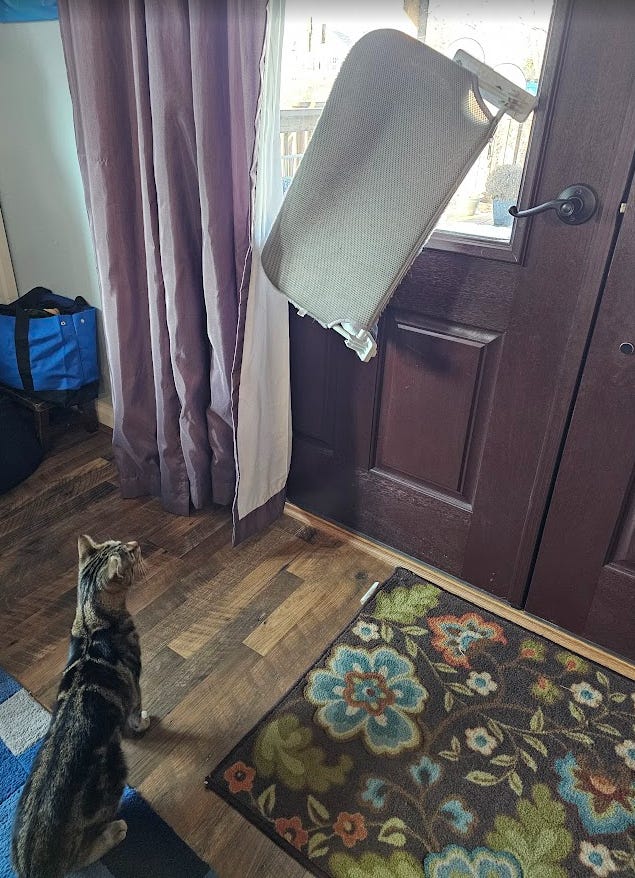
We had a little problem. After four years, the window seat that are one of Ruby and Pearl’s favorite places to curl up (and watch squirrels and birds), detached itself from the window. And we haven’t been able to successfully get it to stick for more than a few hours at a time since!
That’s Pearl looking up and evaluating the situation, by the way.
Stay tuned for Part 3 of Refraction in two weeks!
Until then… be kind, be well!
-Adeena
Comments
Nothing yet. Say the first thing.
Sign in to join the conversation.