
Greetings, you amazing humans! (and the odd robot)
I’ve been busy. In more ways than one. Today I have the start of a new story and a brand new Ask Adeena section that might spawn into a new and separate newsletter! As always, make sure you get to the end ‘cause near the bonus picture are a few details about my next upcoming beta read!
First, I need to do my usual plug for all the books and stories I have out there, with their links:
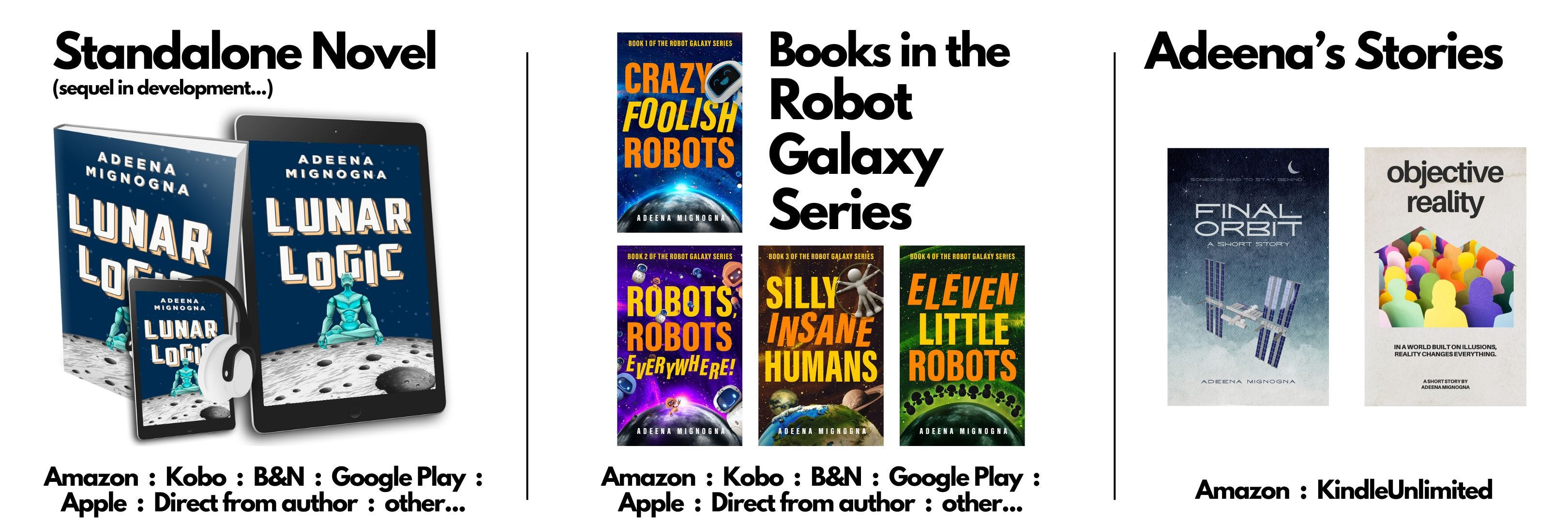
Links: Lunar Logic | Robot Galaxy Series | Final Orbit | Objective Reality
Today’s story is a part 1 of 3. Unlike other times where I started stories and continued them in this newsletter, this story is truly complete so I know I will be delivering it in exactly 3 parts! (And I’m going to do it every other week so you don’t have to wait 3 months to read the whole story.)
I have to credit a colleague for spawning the initial idea. He told me about a dream he had when he was a kid that always stuck with him. I asked if I could turn it into a story and he said sure!
I wrote this in the fall… and while I’m mostly an Indie/self-published author, I do submit stories to magazines like Clarkesworld and others. I would love to be published in them one day!
Well, after several rejections—and most times when a story is rejected you get little to no feedback—I’ve been wondering what to do with it next.
My options: 1) Continue to submit to other markets 2) Publish it myself like I did with Final Orbit* and Objective Reality* or 3) post it here.
Given I hit all the primary markets I care about, I’m not interested in option 1. Especially not knowing why the story might be rejected. And while I love reading magazines like Clarkesworld, Asimov’s and others… they get hundreds, sometimes thousands, of submissions… per issue and can only take a few. My story might be perfectly fine, and people might love it… but in order to know, people need to read it!
So I’m left with option 2 or 3. And the difference between those two… do I get paid or not for my creative work? I believe artists should get paid, including myself. But obviously, if you’ve been on this newsletter for any amount of time, you know that I do “give away” my stuff for free a lot of the time, too.
Obviously, I chose option 3 for this story. The ultimate reason is that I think this is a good story and I want people to read it. Plus, I feel guilty for the times I started something in this newsletter and didn’t finish and I like going into this knowing it’s truly a complete story!
I’m doing several new things… like include a “did you like it?” poll at the end!
(* If you’ve read Final Orbit and/or Objective Reality, please consider leaving a review over on Amazon!)
Refraction (part 1 of 3)
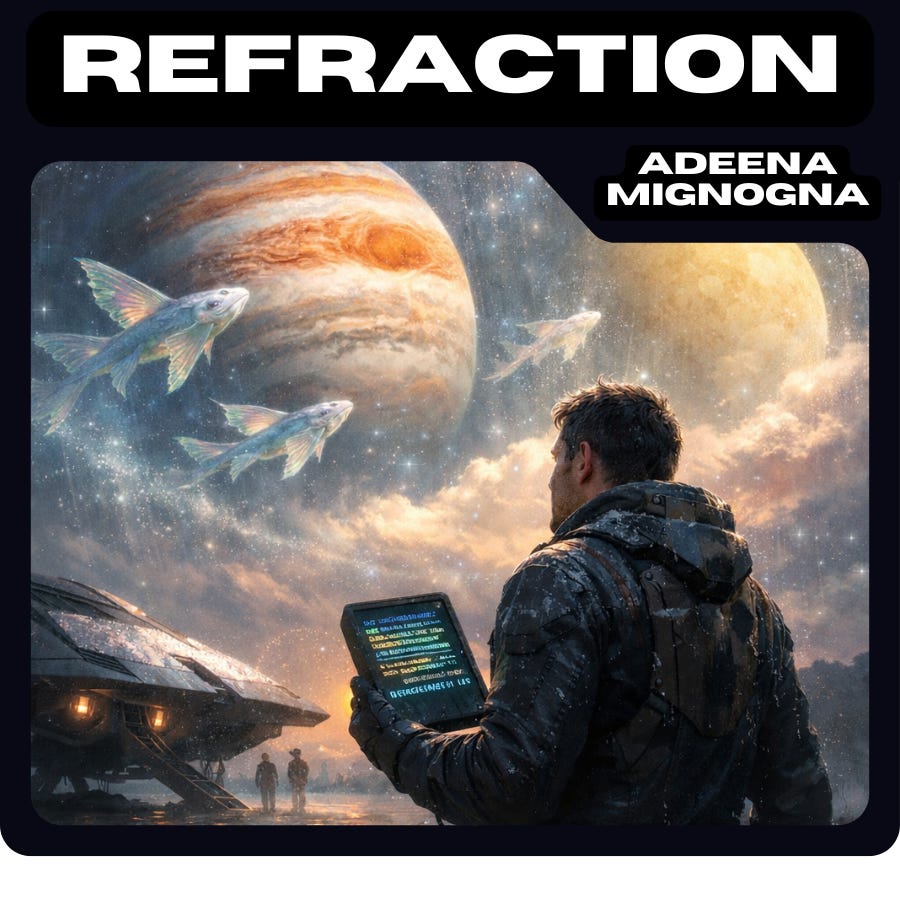
The QED shimmied as it cut into an unexpected layer of vapor dense enough to send every sensor into confusion. Too dense. Too wet. Too bright. Silver streaks rolled across the hull. Inside the cockpit, Jema’s hands tightened on the controls.
“We’re passing through a layer of water,” she said, voice steady but taut. Her training told her to put all the ‘should and should nots’ that were popping into her brain aside and focus on the task at hand. Water vapor shouldn’t exist at this altitude. The pre-mission data should have included this. The task at hand was to make sure the ship survived—otherwise there would be no mission.
“Water?” Dor leaned forward, watching the external feeds dissolve into streaks of silver. Droplets slid across the hull like liquid glass, jarring something half-remembered in Dor’s mind. “As in liquid?”
“Not fully? Maybe? Maybe a supercooled vapor layer? My sensors are freaking out a little. The ship wasn’t expecting this kind of density. The skin’s adjusting.”
Outside, the QED’s adaptive plating rippled, scales of dark alloy flexing to shed the moisture. The sound was unlike anything they’d heard in space–a soft, constant hiss, as if the ship were slicing through a living ocean suspended in the sky.
Dor glanced at the readouts. Temperature gradients spiked, then steadied. Pressure, normalizing. For a moment the viewports were blind with refracted light, then the murk broke apart into brilliance.
“We’re through,” Jema said, exhaling.
Dor pressed a button, and the viewscreen displayed the visual from the cameras aimed at the planet’s surface. The surface glimmered through the last wisps of mist. A mosaic of color and shadow that almost looked wet itself.
Fifteen minutes later, the QED settled onto firm ground. Sensors fanned out across every spectrum, evaluating both air and soil, confirming what they thought they knew about this planet: breathable atmosphere, stable chemistry, and no sign of native hazard.
The four-person survey team had a simple assignment. At least, it was simple in scope but high in risk: conduct environmental sampling and atmospheric modeling for potential colonization candidates within the Fomalhaut system. This planet–Fomalhaut c–was the first to show stable conditions.
#
Dor had ventured only four steps from the QED when he stopped and stared at the sky.
Dor was the mission’s system specialist, officially second-in-command beneath Jema, the pilot and expedition lead. They’d served together on two prior Coalition surveys, which gave their exchanges an easy rhythm–half professionalism, half shorthand built from months in close quarters.
“What’s wrong?” Jema asked, hoisting a crate onto the hovering dolly.
“Nothing. It’s just…”
Jema followed Dor’s gaze upward, and she, too, froze. Two enormous planets hung in the sky, so large and near that for an instant her mind refused to accept what she saw.
“They’re the fourth and fifth planets,” Dor said quietly.
Jema nodded. They stood on the third. Yet those other worlds were supposed to be billions of miles away. The thick layer of water in the atmosphere must have bent the light enough to make them appear close–so close it looked as if they shared the same orbit as the planet’s moon.
Neither world had yet been given a proper name, only the standard, sterile designators automatically assigned to new celestial objects.
They were staring at Fomalhaut d and e. Although neither knew which was which. But they both presented differently in the sky. One was multi-colored, with swirls of what could only have been large atmospheric storms. The other presented as a muted shade of pale yellow, belying a possible atmosphere. Each subtended at least thirty degrees in the sky.
“It’s just a refraction effect,” she said. “You know that. Pretty impressive though.”
Dor didn’t answer right away. When he did speak, it was as though he was speaking through hypnosis and not of his own accord.
“I know but…” Dor trailed off once more.
“What?”
“I had this dream. When I was a kid. Maybe I was 5? 6?” Dor said. “My mom said I used to wake up crying.”
When Dor didn’t continue, Jema asked, “What was the dream?”
“Huh? Oh. This. This,” he said, his voice rising and with more emphasis. “This was the dream. I dreamed this. But I had fallen from the sky, or I was falling, and someone, something, caught me.”
Jema furrowed her brow and then said tentatively, “...and by this you mean…?”
“This! This place! This planet!” Dor finally tore his gaze from the sky and gestured wildly around them, then upward again. “I dreamed them!”
Before Dor could elaborate, the rest of the crew emerged from the ship.
Venn guided another dolly down the ramp that extended from the rear of the ship, Arin following behind with his eyes glued to a handheld scanner.
“I think this one is malfunctioning too,” Arin said.
“What’s going on?” Jema asked.
Venn parked the dolly next to the one Jema had been loading. “Arin says two of the handhelds are acting up now.”
Jema gave Dor a look that was half concern, half get back to work.
Dor rubbed his forehead, then held out his hand. Arin passed him the scanner. Dor poked at it then announced, “Once we’re set up, I can use the core diagnostic array to run a full check. What’s wrong with it?”
“It says it’s picking up a biosignature,” Arin replied. “Which can’t be right.”
“Huh,” Dor turned the unit over, frowning. The display shimmered into a vertical graph labeled by altitude, colored bands indicating atmospheric composition. An orange streak appeared at roughly a hundred kilometers, right where the water later began.
“I’m sure the diagnostic will sort it out,” Dor said, though his brow stayed furrowed long after the conversation ended.
[TO BE CONTINUED…]
What do you think…?
You can also:
And of course, subscribe so you get notified when I post new stories/newsletters!
Indie authors love helping out other indie authors. Which means we cross-promote in each other’s newsletters in the hope that we’ll find readers for each other!
“Beware who you trust!” At least, when you read Perfidy, The Debacle Series by Ardith A. Price!
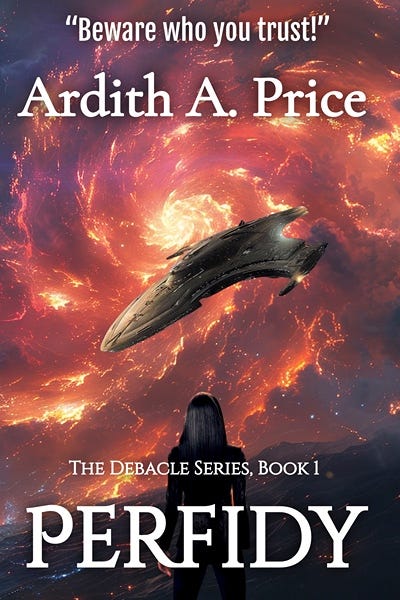
And here are a couple of group promotions with other Indie Authors. This is one of the ways we help each other get the word our about our books. There are several this month, including one that’s all about audiobooks!
Over at The BIG Sci-Fi podcast, we’ve begun Season 10! We kicked it off by “watching” Outland, a 1981 sci-fi thriller staring Sean Connery. Listen and you’ll understand why I put “watching” in quotes! lol

Are you on Facebook? Come join our private FB group where we discuss episodes, host weekly polls, and other fun! Just make sure to agree to the group rules when you send in the join request!
Ask Adeena!
Often, people email me with questions. Questions about writing. Indie publishing. Engineering work and related careers. School. Technology. Book recommendations (scifi and non-fiction). Even fandom questions. A whole bunch of things.
I love responding because I love the thought that I’m helping someone. If something I’ve said means that the other person has a good day, gets unstuck, moves forward, gets even a little bit past a problem… well, that’s my dopamine hit.
I’ve been thinking about this for a while, and I decided no time like the present to start!
So I’m going to begin answering these questions here, in this newsletter. I might eventually spin this off into a separate newsletter, but before I do that, I’d love your reaction. If you’re willing, react in one of three ways:
reply and tell me what you think,
comment on this newsletter here on Substack,
or submit your own question using this form: https://forms.gle/yWzLbKjYAhJpuvQGA
(If I suddenly I get a bunch of questions, that will tell me that a standalone Ask Adeena newsletter should DEFINITELY happen!)
Today’s question (came from a friend/colleague):
Adeena,
You talk about your one-hour in the morning writing habit. I can usually carve out about an hour a day to write. I open the document and then just… stare at it.
What should I be doing in that hour if my real goal is to finish a book?
-N.R.
Dear N.,
The dirty little secret is that it’s slightly more than an hour.
That hour is truly writing time. But what I do before is prep… so when I get to my hour, I already have a plan and know what I’m doing.
Prep doesn’t have to be extensive. If I’m in the middle of a particular book or story, before I got to bed I open up my document and navigate to exactly where I need to start. I also open the file where I keep my outline and any notes I need. That way, when I get up, all I need to do is grab my coffee, get my butt in the chair, and start.
But if you’ve prepped and know what you’re supposed to be writing and the words still aren’t coming, I posit what you’re dealing with is fear.
Often it’s the fear that the idea in our head is perfect, and will be less so once it’s on the page. Honestly? There’s a good chance it will be kind of crap at first. That’s what editing is for.
So here’s the workaround.
If fear is what’s holding you back (not prep), then your task for the next writing session is simply this: write one sentence. Just one. One imperfect sentence.
If you accomplish this and still have time left, congratulations—you now have a new task: write one sentence! Repeat until you run out of time.
Maybe this gets you 50 sentences. Maybe it gets you one. But one is more than you had when you sat down, so congratulate yourself on a successful writing session and go do whatever it is you do until your next writing session.
If you are so stuck that you can’t even get that one sentence down, then type this exact sentence into your manuscript:
“What are you supposed to be writing?” Adeena asked.
Your next sentence is you—or maybe one of your characters—answering that question in dialogue.
Yeah, it’s a little meta. Yes, it might be a little silly. But it gets your fingers moving, and sometimes just a teeny bit of momentum is all we need. You can always come back and delete this part later.
(Or if you make me a character in your story, let me know!)
-Adeena
What’s next?
There is a beta read coming REALLY soon. As in, look for an ad-hoc email about it within the next week. This will be for T is for Tangent, the 2nd book in the T-Set. I know… T is for Time Travel isn’t even available yet. But, a 2nd T-Set book was part of my Kickstarter and needs to be in the hands of backers by June! So… gotta get this one done!
And my bonus picture comes from Farpoint this past weekend:
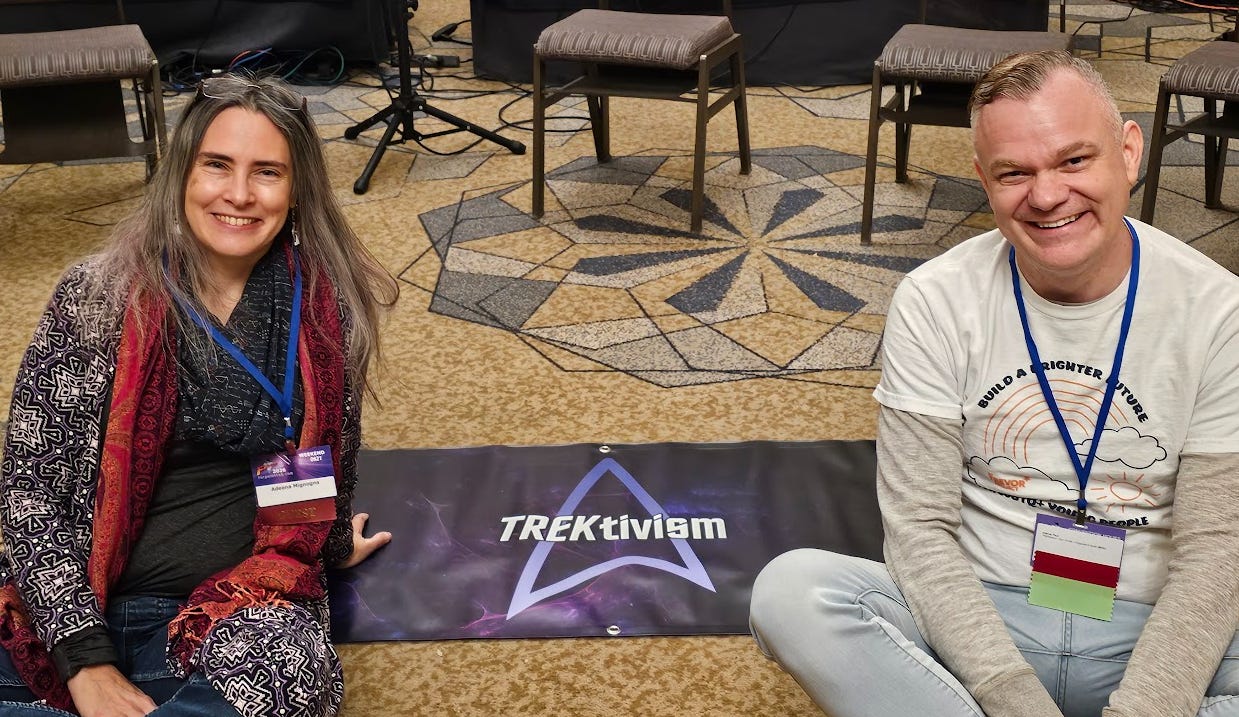
My friend Paul and I led a panel on TREKtivism. It’s about Star Trek-inspired activism and we’ll be doing this at other conventions this year like the upcoming Awesomecon in DC in March!
All always, thanks for being here and reading all of stuff. Remember you can reply anytime with questions/comments/feedback! And don’t forget to ask me your questions for Ask Adeena with this form: https://forms.gle/yWzLbKjYAhJpuvQGA
Until next time… be kind, be well!
-Adeena
Comments
Nothing yet. Say the first thing.
Sign in to join the conversation.