

With equities back at close to all-time highs, powered by the strongest two-month move in the S&P 500 since April 2009, the bulls are back in control.
The concerns that have weighed on stocks this year (the disruptive impact of AI and the stagflationary impact from the conflict in Iran) have both been pushed aside by the ebullience around AI.
It’s business as usual for the equity bull market that has been ongoing for seventeen years now.
Yet, from a macro perspective much has changed. As economist, Mark Blyth told me earlier this year, the hardware of global capitalism still runs, but the software is broken. It’s a topic I will pick up with him at our upcoming event.
So far, both bond markets and commodity markets have taken note of that change in software but equities have embraced the opportunities while largely overlooking the risks. Can that continue?

The Old Operating System
For decades, the global economy was shaped by the dominant ideology of neoliberalism, free markets and globalisation. The embrace of those principles emanated from the disappointment of the 1970s when stagflation was seen as a product of a more unionised, managed and closed system.
The big bang deregulation of the 1980s, the embrace of free market principles by Thatcher and Reagan, China’s accession to the WTO, and the acceptance of the need for independent central banks were all landmarks on the road to a globalised, free trading world. It became known as the Washington Consensus.
The result was a low inflation economy where cheaper manufactured goods from the east kept inflation in check in the west. At the same time surpluses were recycled into developed market bonds, keeping yields subdued and supporting financial assets. The Great Moderation of solid growth, low inflation and low macro volatility of the early 2000s was the high point of the era.
But each macro regime sows the seeds of its own destruction, and the old regime was no different. The excess of free markets became apparent in the Global Financial Crisis, which left a housing bust and bankrupt banking system in its wake. The bill for the bailout came to the taxpayer.
The monetary response was large scale asset purchases (QE) and austerity in many cases. That backdrop was a boon for financial assets (and their holders) but produced a sluggish low-growth real economy fuelling a disquiet with neoliberalism. Occupy Wall Street, Brexit, Trump 1.0 and the rise of the far right were all emblematic of changed mood.

The New Macro Era
The disillusionment with neoliberalism has precipitated a shift in policy. An unfettered belief in free markets has been replaced by activist industrial policy. Free trade has been replaced by tariffs, fiscal conservatism by large deficits and free movement of labour by immigration restrictions. The need for independent central banks is being increasingly questioned given the more imminent need to keep government borrowing costs down.
That shift in ideology has come when the global economy faces a long list of structural challenges.
COVID exposed the limitations of just in time manufacturing and has placed a premium on supply chain resilience over efficiency. The result is a bias towards home near-shoring rather than outsourcing. The conflicts in Ukraine and Iran have exposed Europe’s energy and defence dependence. The need to shift from fossil fuels to alternative energy remains a priority for many economies
The net effect is a supply constrained economic system, more prone to inflation where the default policy response is higher spending.

What It Means For Markets
The profound shift in the macro and policy back drop is most obviously seen in global bond markets. In the 2010s weak growth combined with widespread asset purchases from central banks pushed government bond yields down relentlessly: trillions of dollars of government debt offered negative yields.
Cheap financing was a boon for private equity and public equities benefited from the valuation effect of lower discount rates, stock buybacks and liquidity flows from asset purchases. US equities annualised at 13.6% in the decade while bonds delivered solid, albeit unspectacular returns of 4% given the low starting yields. Gold produced modest returns and broader commodity indices were negative.
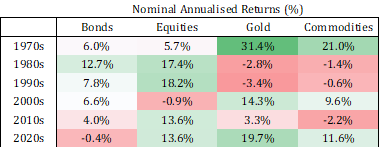
But COVID was the turning point. US 10-year yields touched 0.5% and bounced. US yields are now about 4.5%. In Japan yields went from 0% to 2.5% and in Germany from -0.5% to 3.0%.
Industrial commodities also reflect the new macro reality. Oil prices briefly traded below zero during COVID but over the 2010s WTI averaged about $60 a barrel. It is now around $100. Copper averaged about $7,000 a tonne in the 2010s, it’s now double that level.
Despite the higher yields and the higher input costs, equities have been resilient. The S&P 500 TR Index is up 220% since April 2020. Higher bond yields might have meant lower equity valuations, but it hasn’t been the case.
In theory, the new software of the global economy is less efficient, more inflationary and less market friendly than the old model. But equity returns in the decade to date are on a par with the low inflation secular stagnation of the 2010s, despite the adjustment on bond yields.
The Risks In The Capex Boom
Of course, the missing piece is AI.
Concerns about macro stability matter little in a world where AI capex spending is the dominant driver of markets, exerting a huge influence on earnings, growth and the longer-term outlook.
It’s not just the direct boost to earnings from the AI buildout, it’s a virtuous cycle where the second and third order impacts are as significant.
Rising spending on data centres and AI infrastructure is a support for economic growth and boosts equity earnings. The capex directly boosts investment spending in the GDP figures and boosts earnings of chip makers and hyperscalers.
Strong earnings growth pushes up equity prices. The US stock market capitalisation is now 250% of GDP meaning the wealth effect from rising equity prices is more significant than probably at any time in history. For context, in 2000 the stock market cap as a % of GDP peaked at about 150%.
The wealth effect encourages greater consumer spending, keeping the economy moving forward when the lower part of the “K shaped economy” is struggling with higher gas prices and rising debt delinquency.
Rising stock valuations encourage new issuance such as the coming SpaceX, Anthropic and OpenAI IPOs. They facilitate exits for insiders but also attract capital to be deployed in further capital spending.
It’s a classic Soros reflexive process that keeps going as long as the AI infrastructure build out continues.
But there are side effects to the process. Whereas buy backs were a feature and important support for equities in the 2010s, free cash flow is now directed towards capital spending.
Debt financed capex now competes with government borrowing requirements as a force pushing up global bond yields.
Back to Blyth
But the key question is what happens if the cycle turns down? Could the virtuous cycle go into reverse?
Once the data centre build out has run its course, capex will slow, directly reducing economic growth and employment. If the wealth effect then went into reverse the impact on growth via consumption could be even more profound.
Meanwhile, that could be the point at which the technology becomes more widely adopted, as companies seek to eke out efficiency gains amid weaker top-line growth. In that scenario already weakening demand and rising aggregate supply could be a serious headwind for the labour market, potentially compounding any downturn.
The old software of neoliberalism ran on fiscal restraint and asset purchases. But that playbook has now been thrown out.
Yes, government deficits are already stretched and at levels associated with a recession in the US, but as Blyth said to me, “if you focus too much on debt and deficits in the next downturn people will want to burn your house down, and rightly so.”
That may sound sensationalist, but it contains a kernel of truth. There is no appetite for fiscal restraint in a system where many already feel left behind. An economic downturn naturally pushed up deficits but in the current zeitgeist the clamour will be for even more fiscal supports. It may well be the point of fiscal dominance.
It’s both fascinating but also hugely worrisome. A sharp economic downturn and greater AI adoption could be hugely deflationary, but the policy response could be hugely inflationary. It’s the ultimate conundrum for investors.
Markets may be right. AI may ultimately deliver the productivity gains needed to offset the inflationary pressures of the new regime. But investors should recognise that the software governing the global economy is being rewritten in real time.
Bond and commodity markets have already adjusted. Equities have so far been rescued by the AI boom. The question is whether that boom ultimately proves durable enough to offset the inflationary and fiscal pressures of the new regime.
Are you in Dublin on June 17th?
For anybody in Dublin, I will pick up on the conversation with Mark Blyth on June 17 at a special in-person event to mark the launch of our new fund.
Register here: Link
Comments
Nothing yet. Say the first thing.
Sign in to join the conversation.