

Just weeks ago, markets were fixated on a coordinated effort to weaken the U.S. dollar—the so-called "Mar-a-Lago accord." Echoing the 1985 Plaza Accord and drawing on ideas from Steve Miran, the aim was to engineer a weaker dollar to boost trade and rebalance global flows.
The recent movements of the dollar highlights how in FX markets it’s a case of “careful what you wish for.” In openly considering discouraging capital inflows into the U.S., the U.S. may have contributed to capital flight.
Emerging market literature often warns of “sudden stops” in capital flows that lead to currency and bond crises. That thinking is now being applied to the U.S.
In the immediate aftermath of Liberation Day, U.S. equities, bonds, and the dollar all sold off, sparking fears of a structural shift in capital away from the U.S. Equities have since rebounded, but the dollar’s recovery has lagged. Sentiment remains fragile.
It seems that as soon as the dollar begins to fall—particularly when it does so abruptly—concerns emerge that a structural change is underway that could erode the dollar’s reserve status. While important, even for long-term allocators, it misses the central issue.
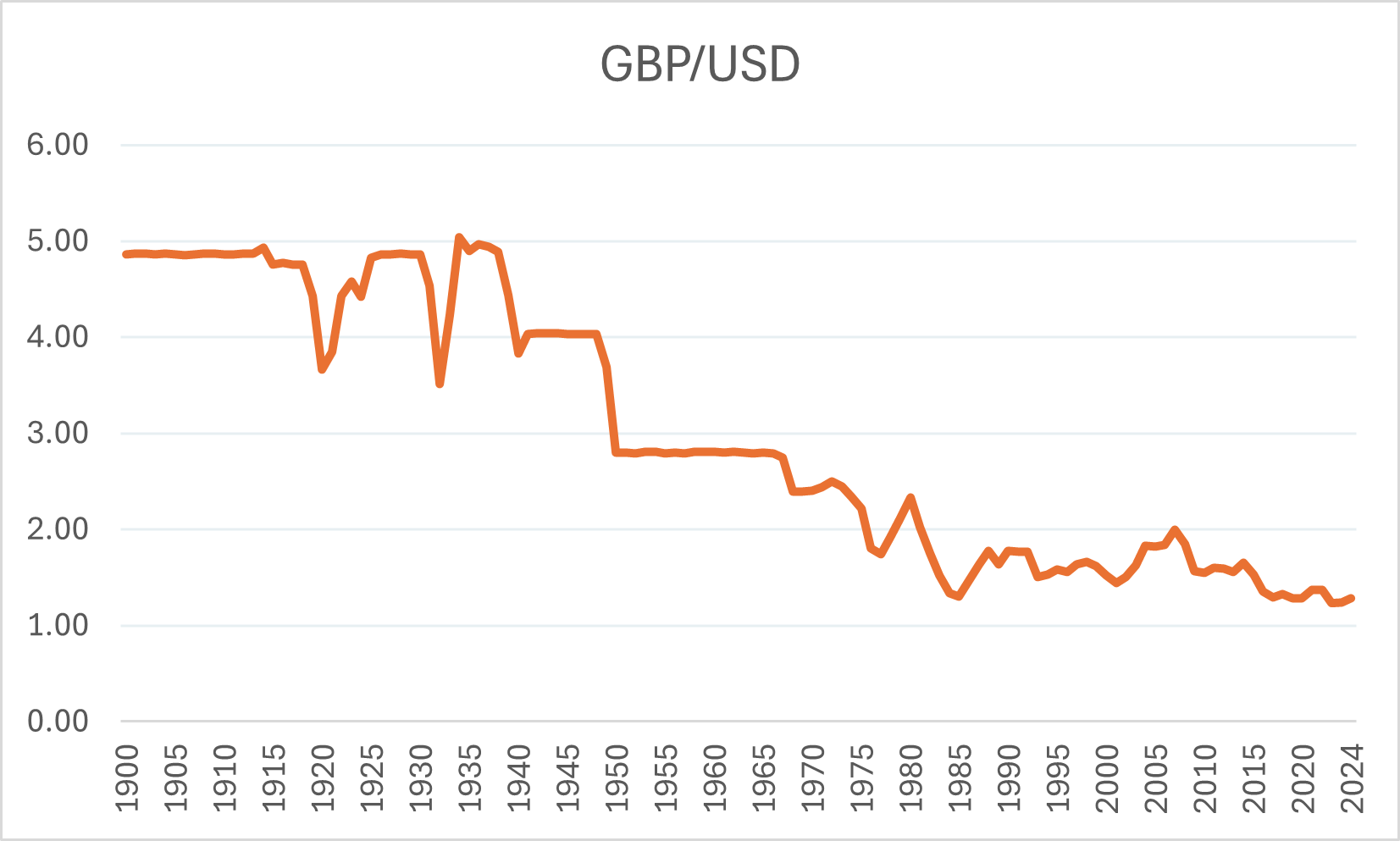
Source: Measuring Worth
If you look at the experience of sterling, it began to lose its reserve currency status in the 1920s but GBP/USD remained quite stable until World War II, and its long-term decline accelerated in the post-war era.
In the case of the U.S. dollar, it has already experienced structural bull and bear markets (including major declines) whilst maintaining its reserve currency status.
The relevant question is whether the demand for U.S. assets will diminish—and is the dollar on the verge of a structural bear market?

The Bearish Case for the Dollar
On that question, the odds of a structural bear market have certainly increased.
First, there’s growing suspicion that U.S. policymakers—either implicitly or explicitly—prefer a weaker dollar to support domestic manufacturing and reduce external imbalances.
Second, there is the question of policy credibility, which appears increasingly strained—whether due to unanchored fiscal trajectories, erratic tariff announcements, or threats to undermine Fed independence.
Third, the narrative of U.S. exceptionalism, which underpinned the prior cycle of dollar strength, appears to be weakening.
And history tells us that prior periods of sustained dollar appreciation were accompanied by high-quality, credible policy responses—from Volcker’s aggressive hikes in the early 1980s, to Clinton-era fiscal consolidation in the 1990s, to the Fed’s crisis stewardship under Bernanke and Powell. That credibility now looks more fragile.
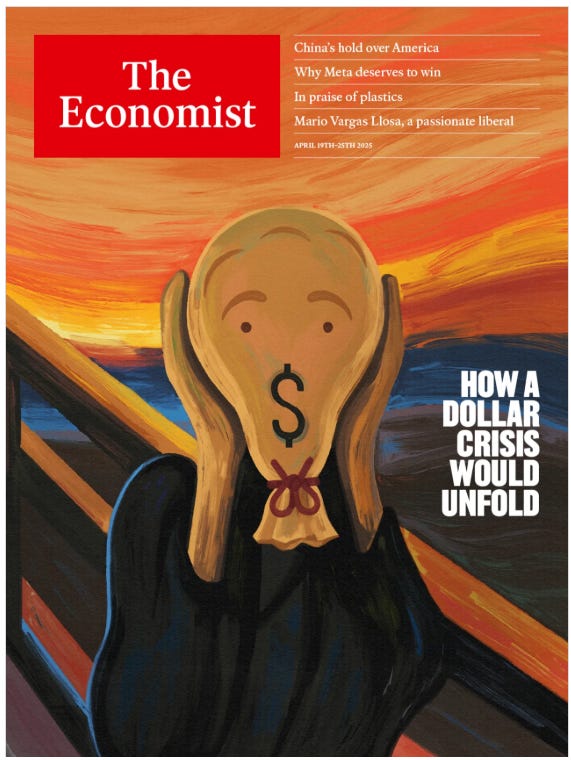
Against that, in the short term, sentiment may have gone a bit extreme. The Economist magazine has run front-page stories warning of a structural decline in the dollar. Their front pages have a history of being contrary indicators.
Also, as Alan Greenspan once remarked, “I’ve never been able to forecast the dollar. I can’t do it and nobody else can either.” That humility is worth remembering. FX markets are driven as much by narrative and perception as by fundamentals. And narratives can shift with little warning.
Is there a case that this is just a cyclical correction in the dollar bull market?
It looks unlikely right now, but investors must remain open-minded. Themes in FX markets change quickly. If sentiment shifts again—for instance, if U.S. growth proves more resilient or institutional credibility is restored—short positioning could reverse just as abruptly as it built up.
One possibility is that the Fed proves more resistant to easing policy and stays on hold, disappointing market expectations of rate cuts. While in theory that should support the dollar in the current environment, such a move may antagonize the already fraught relations between the Fed and the White House.
So while we have to remain open-minded about this being just a cyclical decline, the negatives are accumulating for the dollar.

The Dollar Trilemma
At the heart of U.S. dollar policy lies a trilemma. The U.S. faces three conflicting goals:
A desire for a weaker, more competitive dollar to support manufacturing.
Maintaining the dollar's reserve currency status.
Attracting sustained capital inflows to fund large fiscal deficits.
The U.S. has long enjoyed the "exorbitant privilege" of borrowing in its own currency. But the flip side of persistent trade deficits is a growing foreign ownership of U.S. assets. Each year, the current account deficit is matched by a capital account surplus.
This dynamic—known as the Triffin dilemma—remained academic in normal times. But when confidence in U.S. policy weakens, the risks become more tangible. That’s especially concerning when the U.S. is running fiscal deficits of 6–7% of GDP. Just weeks ago, proposals were floated to tax holders of Treasuries. But now it’s the expression “relying on the kindness of strangers” that comes to mind.
The current pessimism is even more remarkable when considering that, only a few years ago during COVID, the U.S. dollar surged. At that time, investors were preoccupied with the idea that the world is structurally short dollars.
Making Sense of the Great Dollar Mismatch
How can the world be overweight U.S. assets but structurally short U.S. dollars?
The answer lies in two different sides of the global balance sheet. Long-term investors such as pension funds, sovereign wealth funds, and family offices are fully funded and have surplus capital to invest. Over time, increasing flows from these investors have gone into U.S. assets, leaving the world structurally long dollars on the asset side.
At the same time, global banks and shadow banks, both inside and outside the U.S., have issued massive volumes of dollar-denominated liabilities. In times of funding stress, liquidity becomes scarce, and these issuers scramble to source dollar funding. That’s why the dollar surged during the Global Financial Crisis and during COVID, and why the Fed activated swap lines with other central banks to meet global dollar demand.
From Strength to Stress
It’s the asset side of the equation where the risks to the dollar are now mounting.
With over $60 trillion in U.S. assets held by foreign investors—more than $20 trillion of it in liquid instruments—even modest selling could trigger persistent pressure. U.S. investors may also diversify overseas if confidence erodes or valuations shift, raising the risk of structural outflows even without outright panic.
Cyclical variations in the dollar are often driven by relative interest rate movements and relative economic growth. The strength of the U.S. dollar since the Financial Crisis owes much to stronger economic growth and higher interest rates. Notwithstanding the large trade and fiscal deficits, the dollar has been the “cleanest dirty shirt.”
But even those factors are either eroding or not providing support. U.S. 10-year yields have been rising relative to foreign yields, and the ECB has been cutting rates while the Fed has been on hold. Both should have supported the dollar, yet the dollar has fallen—suggesting something more structural may be at work.
FX markets are also highly thematic and sentiment-driven. Over the past year, the dominant narrative was one of U.S. exceptionalism, reinforcing dollar strength. But that has quickly shifted. Investors are now focused on institutional fragilities, fiscal excesses, and foreign policy uncertainty—each undermining the credibility of U.S. stewardship of the global monetary system.
Importantly, the dollar now appears sensitive not just to macroeconomic variables like growth and interest rates, but to structural supports such as the credibility of the Fed, the stability of governance, and geopolitical trust.
The freezing of Russian reserves post-Ukraine, rising gold purchases by central banks, and an increase in non-dollar trade settlements all hint at subtle shifts underway. The strong and persistent rally in gold, seemingly driven at least in part by central bank reserve buyers, points to a slow-moving structural transition.
Barry Eichengreen has pointed out how individuals as much as institutions influence when currencies rise and fall. Although Scott Bessent has reiterated that the U.S. has a strong dollar policy, in the aftermath of Steve Miran’s “Mar-a-Lago paper” and Trump’s previous comments, there is a suspicion that the U.S. is happy to see the dollar slide.

Implications for Long-Term Allocators
With all the negativity around the dollar and debates over its reserve status, a few truths are worth keeping in mind:
If the U.S. dollar is to lose its reserve status, it won’t happen overnight. In fact, a steady decline in dollar holdings has already been under way even through the Dollar rally of the last decade.
Global Reserve Manager Currency Holdings
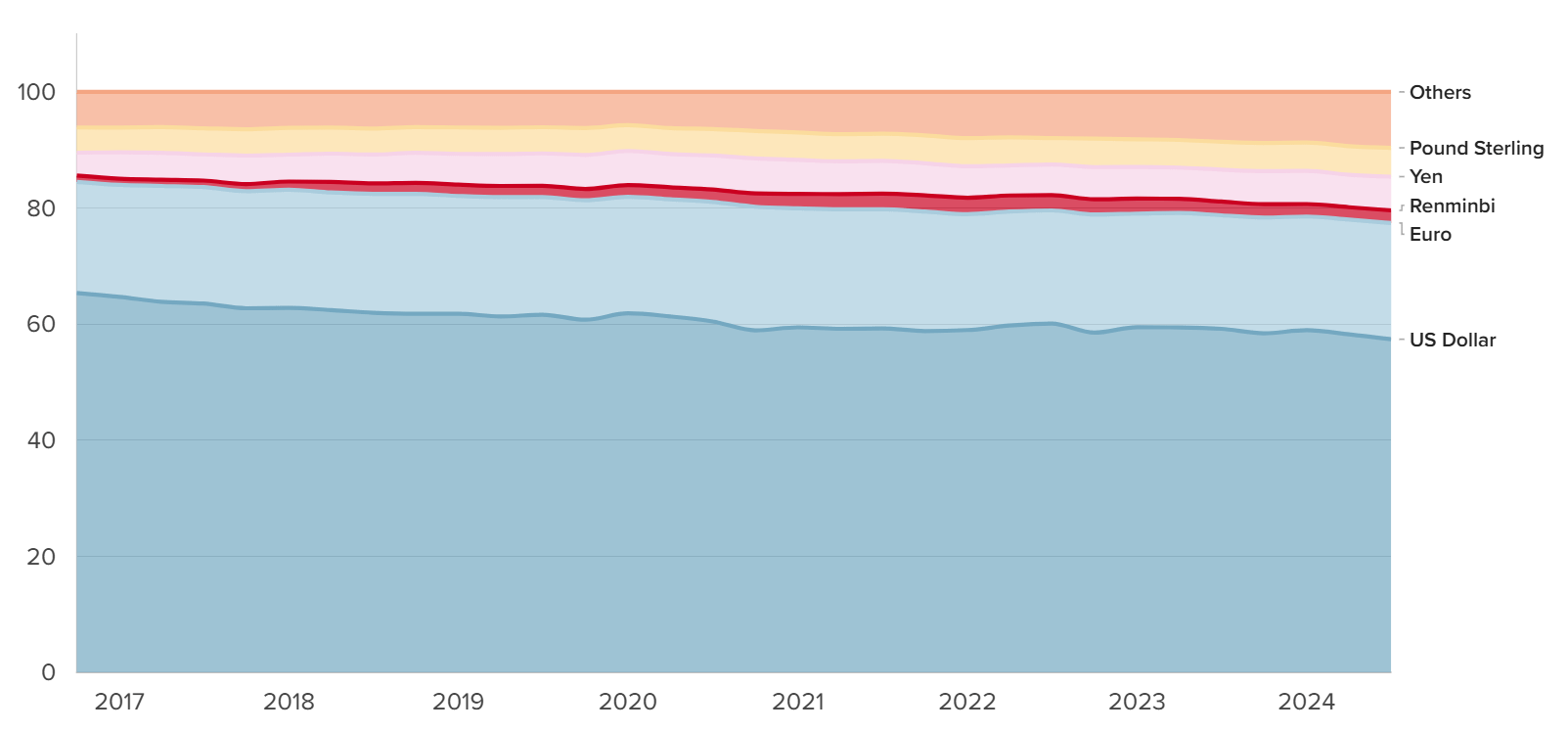
Some commentators point out that the dollar’s importance in the global system has increased as the Fed has agreed swap lines with even more foreign central banks. But even if the dollar remains structurally important, that doesn’t preclude a significant decline in value—we’ve seen 30–40% drawdowns multiple times since the breakdown of Bretton Woods.
Although many asset holders are long dollars, international borrowers remain structurally short dollars. This means the dollar can still experience sharp rallies during episodes of funding stress.
A weaker dollar typically supports global liquidity and growth, but a disorderly collapse in the dollar is in nobody’s interest—as captured by former Treasury Secretary John Connally’s famous line: “Our dollar, your problem.”
Conclusion: Demand, Not Dominance
The dollar’s role as a reserve currency is not binary—it can persist while the dollar weakens, and it can be challenged even while the dollar rallies. Today, the debate is less about global “de-dollarization” and more about whether foreign and domestic investors still want to hold U.S. assets at scale. On that score, the risks to the dollar now appear structurally tilted to the downside.
Comments
Nothing yet. Say the first thing.
Sign in to join the conversation.