


Scott Bessent wants a stronger yen and a weaker US dollar, without having to sell US dollars or US Treasuries.
His carefully choreographed recent foray into the JPY again highlights the dilemma the US faces: it seeks a weaker USD to support manufacturing, but a stable dollar to attract investors into the US Treasury market and keep yields stable.
But, as a former FX trader he will know that, when it comes to FX intervention, it’s a case of careful what you wish for. In 1998 US intervention to support the JPY ultimately saw a USD/JPY collapse from 136 to 111 in four days, amid a huge carry unwind. A repeat of that episode would not be helpful.
Threading the needle will be difficult and may ultimately rest on the actions of Kevin Warsh and the FOMC, rather than the BoJ and Treasury.

A historic intervention
The JPY weakened over the last two weeks as investors continued to digest the historic Fed/BoJ coordinated intervention in late July. The intervention was a success in terms of the magnitude of the initial move, but we’ve already seen a giveback of gains.
Although the US intervened to buy Argentine pesos in recent months, forays into FX markets are rare. It’s not an overstatement to label the joint BoJ/Fed intervention of late July as historic. In fact, you have to go back to 1998 to find the last time the Fed and BoJ jointly intervened to buy JPY.
But even at that, this was no ordinary intervention. Curiously, the Fed sold EUR to buy JPY (rather than selling USD/JPY), and the BoJ and Bessent agreed that the BoJ would tap the FIMA (Foreign and International Monetary Authorities) facility at the Fed for future interventions
Why sell euro/jpy?
The decision to sell euros rather than dollars was curious.
It was framed as a portfolio management decision for the Exchange Stabilisation Fund – the vehicle the US Treasury can tap into for FX trades. The US had bought euros in a previous joint intervention with the ECB in 2000, and EUR/JPY is about 80% higher than those levels now. The US can plausibly argue they were just taking profits and buying some cheap JPY.
However, it was notable that the US defied normal currency market and international monetary convention by not informing the ECB of the move beforehand. The fact that the US administration didn’t obey normal conventions in this matter is hardly a shock, but it is another reminder that relations between the US and Europe remain cool.
Some, like Barry Eichengreen, have argued that the decision to sell EUR not USD reflected a desire not to upset the Treasury market. That’s possible but in reality the US could have raised USD from any number of sources.
Of more significance is that the US still, officially, has a strong dollar policy. Intervening to sell dollars might have been seen as flying in the face of that policy, even if the market already suspects the US has a desire for a weaker USD.

Tapping FIMA
But where the sensitivity around the US Treasury market really was apparent was in the announcement that the Bank of Japan would tap the Fed’s FIMA repo facility for any future interventions.
The announcement was startling for (1) effectively acknowledging that more BoJ intervention is likely and (2) highlighting the current sensitivity the US has towards any large holder of Treasuries liquidating their holdings.
The FIMA facility was originally designed as a facility to access USD liquidity, particularly for foreign central banks that didn’t have US dollar swap arrangements with the Fed.
Some have suggested that this amounts to QE in disguise – it’s not. It’s much more akin to standard open market operations. But the move does highlight Bessent’s pragmatic approach and greater coordination between the Fed and Treasury.

What’s the end game?
As I wrote previously, the US faces a currency trilemma. Bessent is trying to balance Trump’s desire for a weaker USD, maintain the US dollar’s reserve currency status and keep the dollar stable enough to attract inflows into the US Treasury market to fund ever-rising US issuance.
The current episode puts that trilemma in sharper focus.
Trump has previously been very vocal in his belief that the USD/JPY rate is misaligned. In 2024, prior to re-election, he gave an interview with Bloomberg Businessweek stating that “ we have a big currency problem because the depth of the currency now in terms of strong dollar/weak yen, weak yuan, is massive“.
That was in June 2024 when USD/JPY was in the high 150s, just before the USD weakened following a mini-unwind of the carry trade driven by an expectation of lower US interest rates.
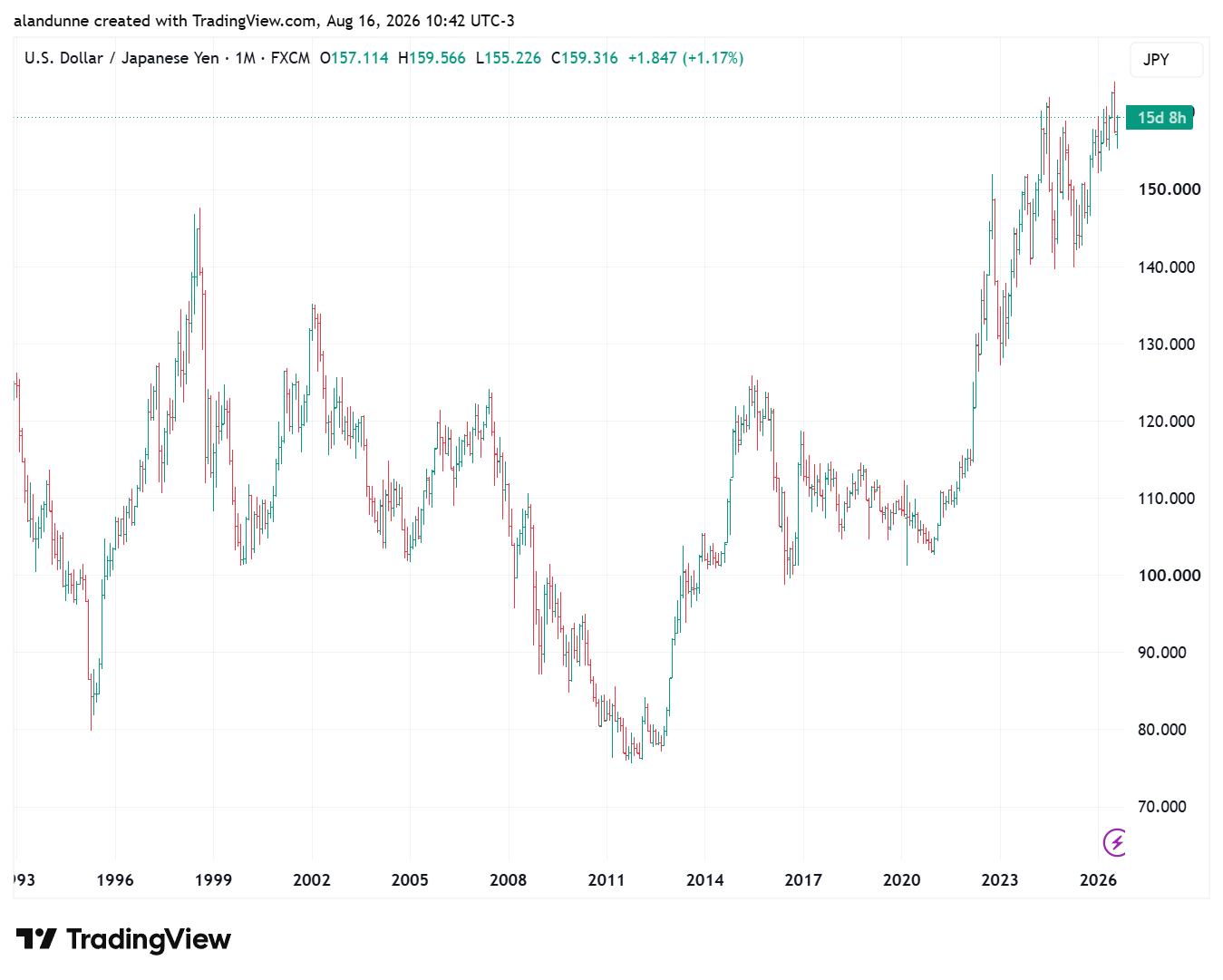
From that perspective, it appears 160 may be a line in the sand in USD/JPY. Although the JPY has been on a weak trend since 2021, it has been in a 140-160 range since 2024. Just recently it had appeared to have broken out above 160. Bessent would have known that momentum can build quickly in FX markets – after 160, markets will look for 180 and 200.
The US-Japan rate differential
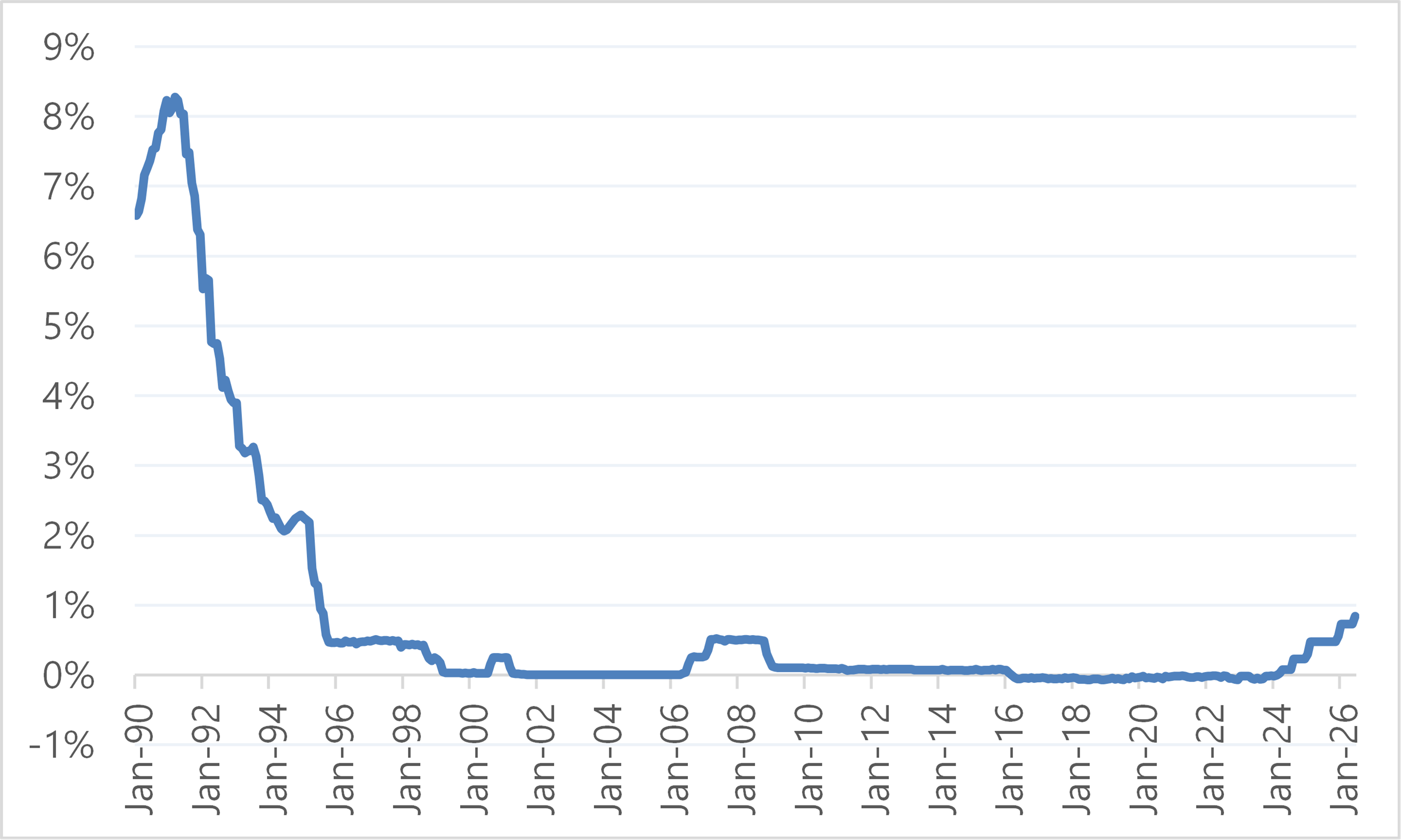
Key to the fundamentals is the US-Japan rate differential. The obvious cure for a weak yen is higher Japanese rates. If the BoJ were to more aggressively tighten policy that would likely be a more significant support for the yen than any BoJ or Fed FX intervention.
Japan Call Money/Interbank Rate
Source: FRED
Although the BoJ has raised rates from below zero, it has done so in a more gradual manner than other central banks, resulting in a positive rate differential that drives not just the carry trade amongst speculators but also capital flows from Japan.
Of course, JGB yields now offer a reasonable alternative at 2.8%. But yields continue to trend higher, suggesting demand is still lukewarm. Higher JGB yields may also be a thorn for the US, to the extent that they push up US yields at the margin.
Also, although Japan has emerged from deflation, the scars of decades of deflation still remain. The suspicion in markets is that Japan (and particularly new PM Takaichi) is comfortable with a mix of loose fiscal policy and accommodative monetary policy to try and supercharge the economy.
From the US perspective that’s not all bad. A strong Japanese economy is also beneficial to the US, increasing demand for US goods. But it’s a delicate balancing act to try and engineer a strong economy, stable yields and a stable currency.
Careful What You Wish For
As Treasury Secretary, Bessent will know, engineering a stable currency is not as easy as it sounds. Back in 1998, the last time the Fed intervened in the JPY alongside the BoJ, the move initially did produce stability and the JPY rose.
But then the Asian crisis escalated and led to the Russian debt default and the demise of LTCM. The Fed reacted and cut rates 75bp. A gentle downtrend in USD/JPY turned into a stampede, and USD/JPY fell from 136 to 111 in four frenetic days of trading.
It’s a warning sign of what could happen if there were a more widespread unwind of the carry trade.
What that episode also highlights is the importance of the FOMC. What happens from here is not just about Bessent or the BoJ, it’s about the Fed and Kevin Warsh.
If the US hikes in the next few months, the pressure for a stronger USD will likely resume. At the same time, if at some point the US economy turns down and the rate cycle turns, that would be a significant signal for a weaker USD (as we also saw in 2024).
Threading the Needle
For now, with the rate differential largely unchanged, the impulse for the market is likely to test the topside again and feel out the authorities’ resolve. After intervention in June 1998, the USD rebounded and tested the top of the range but couldn’t make new highs.
But in the bigger picture, what we can say is Bessent’s experience in FX can help him be pragmatic and tactical. We have already seen this in Treasury issuance.
But there is a limit. Market forces inevitably prevail. For USD/JPY, Warsh may ultimately prove to be the bigger player than Bessent or the BoJ.
Thanks for reading Beyond The Cycle! Subscribe for free to receive new posts and support my work. If you’ve found this interesting please share.
Comments
Nothing yet. Say the first thing.
Sign in to join the conversation.