
Intellectual giftedness, one of many forms of giftedness, is often formally identified through cognitive testing with a psychologist. Though my graduate training is in education, during my decade of working in neuroscience research, I administered thousands of hours of cognitive, creativity, and aptitude tests under the supervision of licensed psychologists, giving me important insight into the strengths and limitations of these tests.
Yet I recognize that if you haven’t had this type of direct experience or aren’t a trained psychologist, these tests can feel opaque, confusing, and daunting to take—especially when the results can mean acceptance or denial into specific programs or organizations.
That’s why I asked my colleague, experienced clinical psychologist, and licensed evaluator, Dr. Stephanie M. Fox, to write today’s article about the do’s, don’ts, and need-to-knows of intelligence testing, focusing specifically on one of the most widely used batteries of cognitive tests: the Wechsler Scales.
If you are looking for a great testing provider, please consider contacting Dr. Fox directly or finding one near you through The Gifted Provider Directory.

Intelligence Testing: Four Things to Know
Before I turn it over to Dr. Fox, I want to share a few important pieces of information to help contextualize many of the most common questions and concerns about IQ testing I receive from clients and families I work with.
Giftedness is far broader than IQ alone. Gifted people, broadly defined, are those who demonstrate one or more of the following: high intellectual ability, specific talents or aptitudes, or high creativity; they also share common socio-emotional needs and lived experiences related to their neurobiology and abilities.
Intelligence is one of the best-researched phenomena in all of psychology. Intelligence is highly heritable, with a correlation of around 80% by the time children reach adulthood.1 If your child is intellectually gifted, it is very likely that one or more parents are as well. Cognitive testing is a reliable marker for assessing intellectual giftedness when evaluators are well-trained and aware of the nuances of test interpretation across different cases.
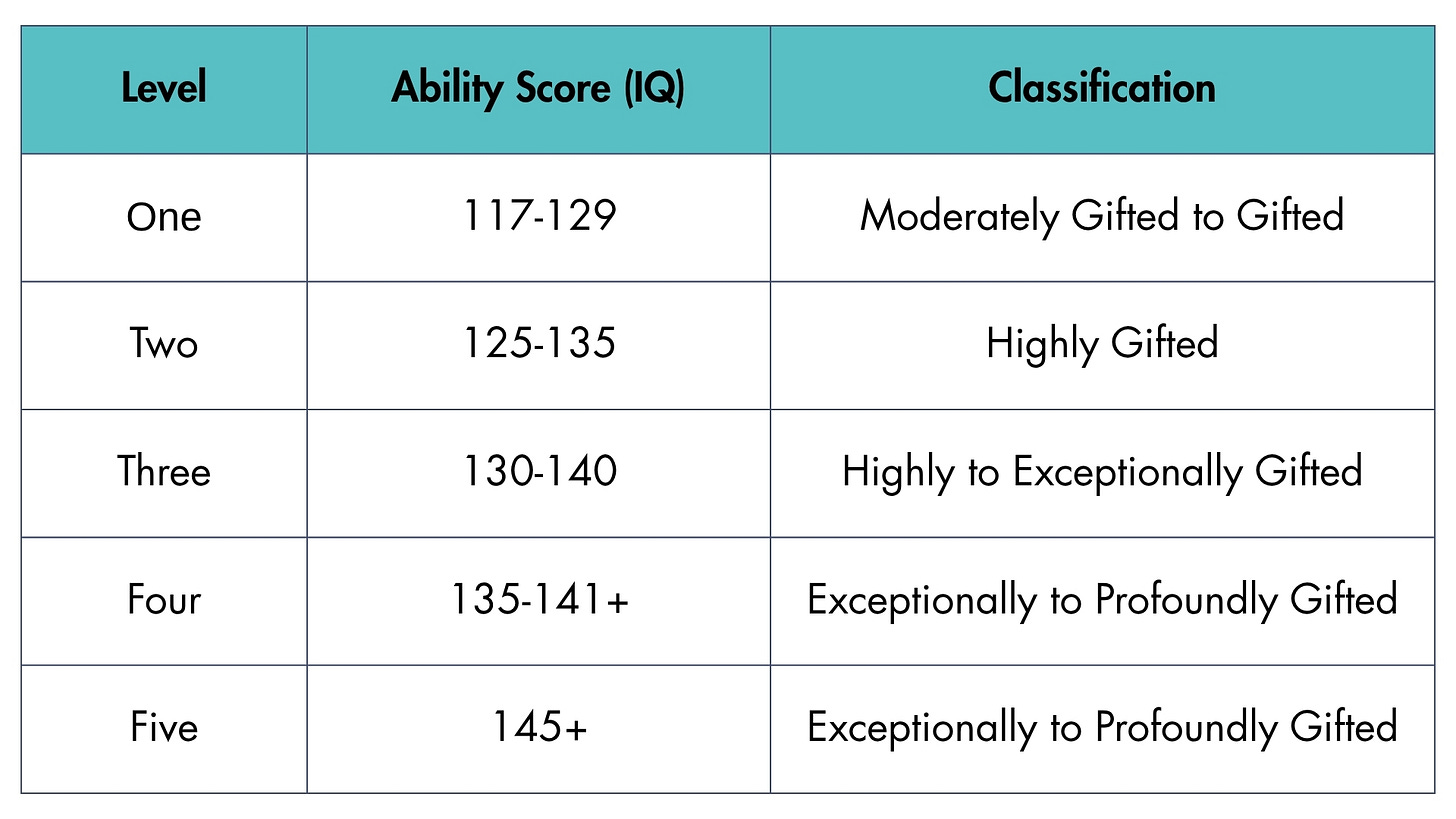
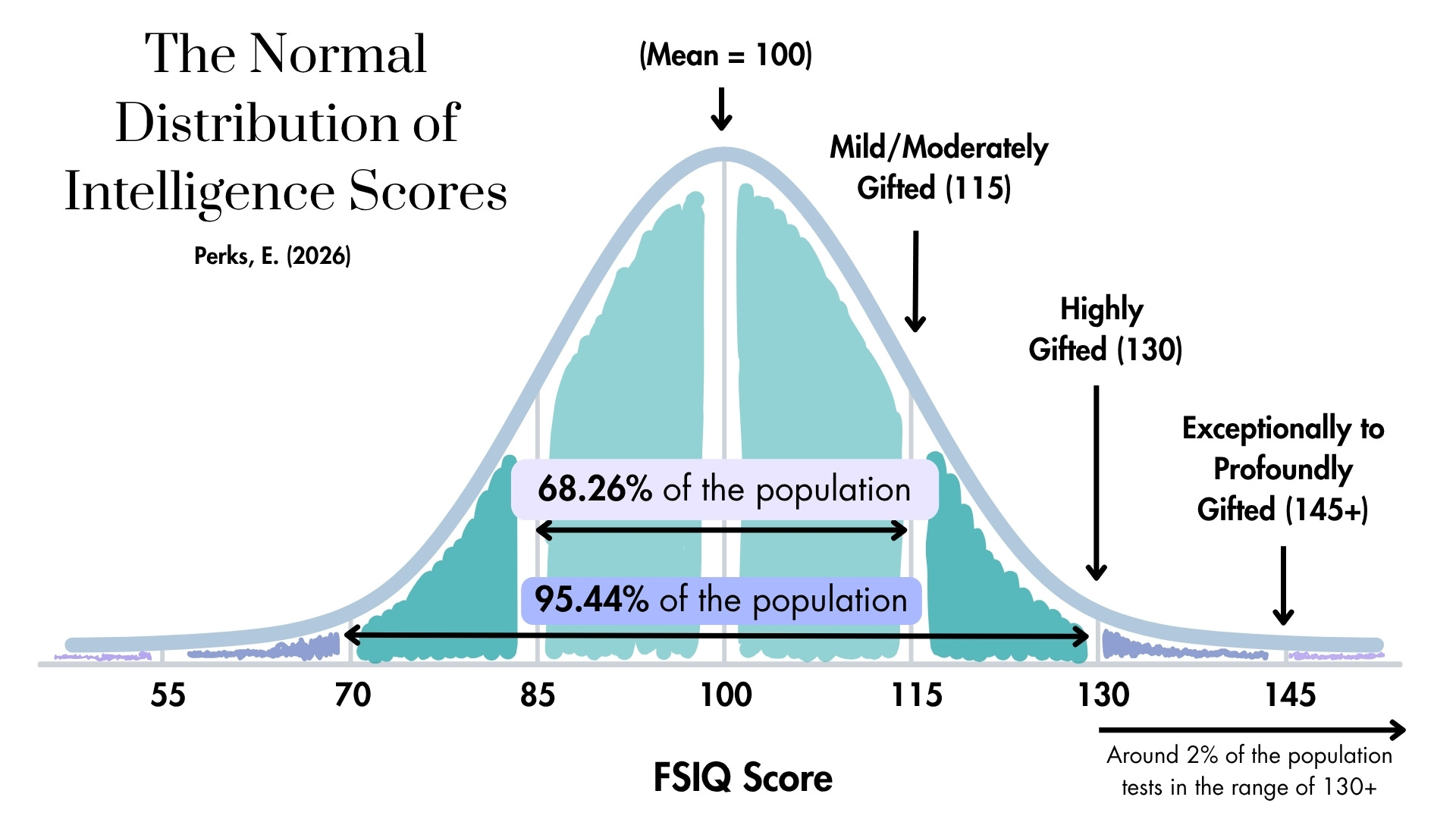
In Deborah Ruf’s book, Five Levels of Gifted, she outlines the results of her original research with gifted children and maps giftedness by level, focusing on the qualitative attributes of each level rather than on discrete IQ categories alone. The table above is adapted from her work. Human intelligence is a continuous variable. This means it occurs on a continuous scale, rather than as a yes/no binary. On normed IQ tests, about 2% of the population will demonstrate a Full-Scale IQ (FSIQ) of 130 or higher, which is two standard deviations above the mean of 100. An FSIQ of 130, or a similar score on other cognitive tests, is often used as the primary eligibility cut-off for many gifted programs. There is nothing magical about the number 130 compared with, say, 125; it simply reflects statistical rarity: 98% of the population will score below 130. Gifted programs and organizations set these eligibility requirements to ensure the intended students or members are served, but the best programs take into account the whole child’s profile alongside their cognitive scores.
There are many reasons intellectually gifted people may not test at a level that reflects their true abilities. This can include having a concurrent learning disability, severe test anxiety, or poor testing conditions.
Less than 3% of subscribers help keep Beyond Gifted going by becoming paid. Please consider upgrading to a paid plan today to access the entire library of evidence-based articles like this one.
The Wechsler Scales
Now, without further ado, here is Dr. Fox to speak to the nuances of cognitive testing:
The Wechsler Intelligence Scale for Children, currently in its 5th edition (WISC-V), is a standardized cognitive assessment designed to measure the intellectual abilities of children and adolescents ages 6 to 16. There are related measures for younger children (WPPSI-V) and older adolescents and adults (WAIS-5).
Administered by a trained clinical or school psychologist, the WISC-V evaluates several areas of cognitive functioning, including:
Verbal comprehension
Visual-spatial reasoning
Fluid reasoning
Working memory
Processing speed
Each of these areas is designated by an index score, which is comprised of two subtests. Index scores have a Mean of 100, with an Average range of 85-115. Each subtest performance is converted to a scaled score, with a Mean of 10 and an Average range of 8-12. Some organizations, schools, or formal guidelines will require specific scores or percentiles to qualify as “gifted” or meet admissions standards.
Beyond the routine scores noted above, the WISC-V also has numerous other domains and scores that can be calculated. Typically, the five domains on the WISC-V will be sufficiently uniform to allow calculation of the FSIQ. The FSIQ is one measure of global intellectual abilities, or potential giftedness.
Special Considerations
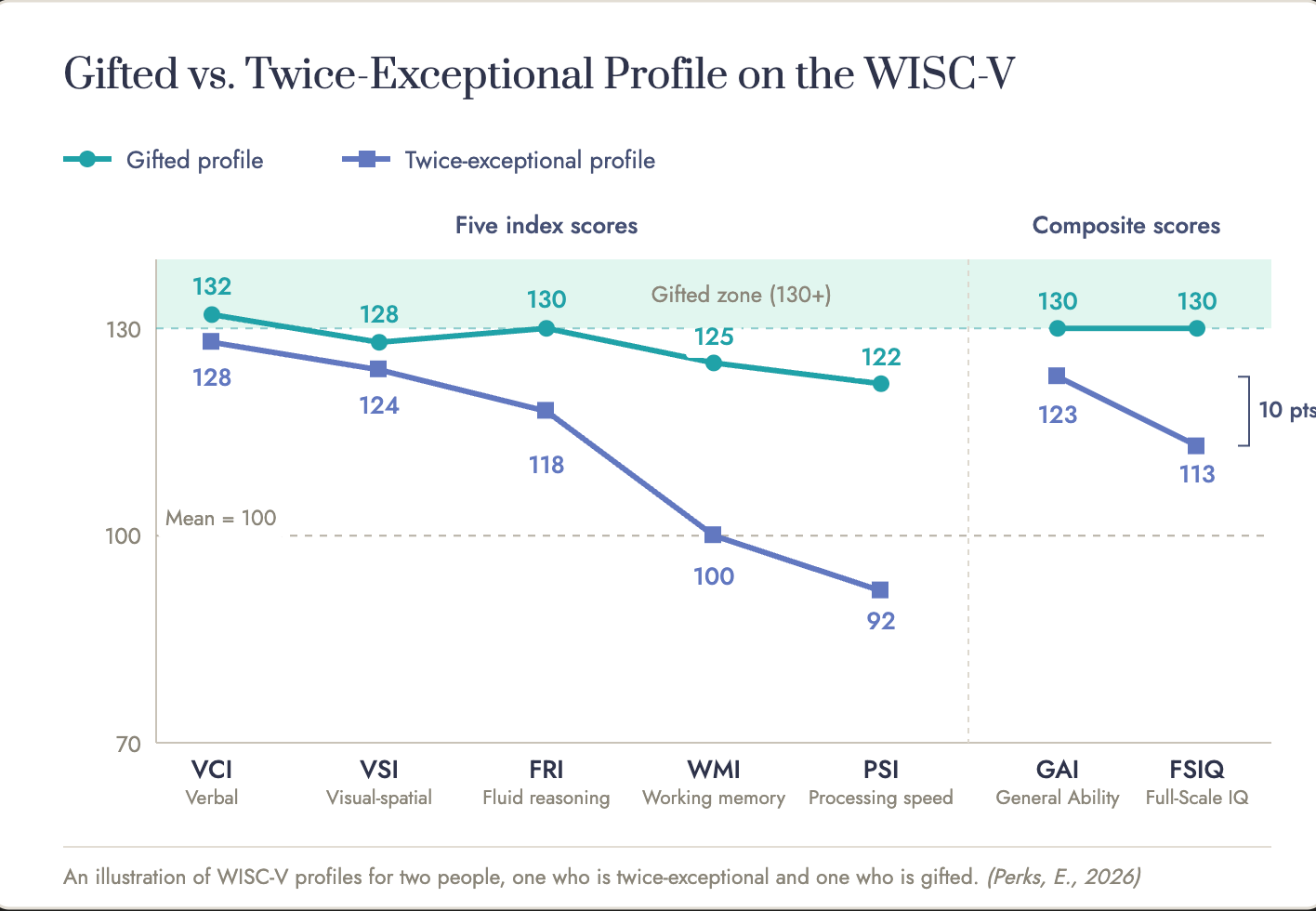
Often, however, children have imbalances in their abilities, such as a single very significant area of strength, a mix of Superior and Average scores, or one or two areas of weakness. This is especially common for neurodivergent children, either based on their giftedness, twice-exceptionalism, or a learning disability.
When this occurs, which again is quite common, relying on only one score is not the best reflection of the child, especially the FSIQ.
Instead, another global measure, the General Ability Index (GAI), is based on the more “stable” markers of intelligence and is comprised of verbal and nonverbal abilities without the impact of outlying working memory or processing speed scores.
Emmaly says: I frequently review test results in my educational consulting practice to help families develop IEPs and apply for gifted programming. It is very, very common for twice-exceptional children (gifted children who have one or more disabilities) to demonstrate a wide discrepancy of 20 points or more between sub-tests.
For example, gifted children with ADHD will often have a verbal comprehension score of 125 or above (in the high average to superior range), while their processing speed and working memory scores are closer to 90 or 100 (in the average range). As a result, the GAI is a much better indicator of these children’s abilities compared to FSIQ.
A couple of other noteworthy WISC-V scores that may be requested in relation to giftedness are:
The VECI (Verbal Expanded Crystallized Index) comprises more measures of verbal ability, general knowledge, comprehension, and experience-based learning.
Conversely, the QRI (Quantitative Reasoning Index) is more oriented toward mathematical reasoning, concept knowledge, and skills application. Certain schools or camps with math-based programming may like to see a student’s abilities in these areas.
Finally, the NVI (Nonverbal Index) comprises subtests that assess skills without a verbal component, which helps to minimize the impact of language difficulties or bilingualism.
Five Tips for Parents and Test Takers
When taking the WISC-V, there are several tips psychologists like to consider. While these tips are written for parents, they are equally applicable to adults considering cognitive testing.
ONE: DO NOT have your child practice for the WISC-V
There are several negative outcomes that are being risked if a child practices:
First, if your evaluator learns that your child has practiced or been exposed to similar material on the test, the administration will not be considered valid and likely will be discontinued.
Second, if your child is overly familiar with the practice materials, they may become confused on the actual test or simply replicate what they practiced, rather than focusing on what is being asked of them in the moment. Consequently, they may unintentionally underperform.
Third, if your child earns a test score much higher than their true abilities because of the practice effect, they may not be well-suited to the environment the test is being used to assess the child for, and are at risk of unnecessary academic challenges and stress because they cannot be accurately fitted to the preferred school. While it may feel frustrating for your child to be more capable than their current academic environment, it is also detrimental if they are mistakenly identified as having skills they are unable to demonstrate later.
Relatedly, the WISC-V should not be administered within 1 year of a prior WISC-V administration. If you are dissatisfied with your child’s WISC-V score, it is not permissible to pursue a different evaluator to re-administer the test, as these scores will also be invalid and unreliable due to practice effects.
Alternative measures, such as the Stanford-Binet Intelligence Scale (SB5), Differential Ability Scales (DAS-II), or Woodcock-Johnson Cognitive Battery (WJ V Cog), can be used in place of the WISC.
TWO: DO make sure your child has the best conditions for test-taking
Similar to how you might approach a test at school, try to have a good night’s sleep and breakfast (or a meal/snack) before testing.
Be sure your child has their glasses, hearing devices, medication, or other typical aids during a school day (including ADHD medication). When these factors are addressed, the evaluator can feel more confident that they did not negatively impact the results.
Consider the time of day when scheduling a WISC-V administration. Most evaluators agree that the morning is an optimal time to capture a child’s full potential and alertness, while coming at the end of a school day or rushing in at lunchtime may not be a peak cognitive opportunity. If your child tends to be groggy in the morning and takes until mid-day to be fully alert, then an 8:00 AM appointment may not be ideal.
THREE: DO ask your evaluator about their process
Many parents pay significant sums for testing, but don’t fully understand the process or what will be assessed. It is important to communicate openly with the evaluator about which tests will be performed and what additional information-gathering will be done.
Test results should not be interpreted in isolation, so it is important that your evaluator wants to have some background information and relevant history going into the evaluation. For example, as an evaluator, I would like to know if a student tends to be very anxious, distracted, perfectionistic, or restless so that I can anticipate the student’s needs and adjust accordingly.
FOUR: DO mindfully explain the test to your child
Many parents ask how to explain the test or the reason for the appointment to their child. When children hear “test,” they expect something like what they are given in school, or worry if they are going to get a “good grade.”
Explain that the test (WISC-V) is not like the tests s/he takes at school; it’s not about what they know or how good a test-taker they are. The evaluator wants to see how their brain works—how they solve problems and how they think about things. It’s not about what they know, but what their brain looks like in action.
Refrain from saying, “There’s no right or wrong answer,” as this is not true for the WISC-V. Most children (particularly gifted children) realize this quickly and can feel misled.
Five: DO NOT Panic
Additionally, while a parent may feel anxious about how the child will score and if this will lead to the desired outcome, it is best to keep these feelings from the child to prevent unnecessary pressure. Certainly, express concerns and ask questions to the psychologist, but these exchanges should occur without the child present.
As psychologists, we strive to advocate and support our clients where we can, but ultimately, outcomes and acceptances are outside of our control. The factors we can control, such as a child’s and parents’ comfort, preparation for the test, and the quality of the process, should be of utmost importance. In what can be a confusing and overwhelming process, having a knowledgeable and patient evaluator is an asset!
The Takeaway
Cognitive testing doesn’t have to be a stressful, overwhelming process. Cognitive scores are but one measure of your or your child’s abilities at a single moment in time. Finding a provider who truly understands gifted and twice-exceptional profiles can make all the difference in having a positive evaluation experience.
Editor’s Note: This article was amended On July 16th, 2026 to clarify cut-offs on the diagram showing the Normal Distribution of Intelligence Scores.
Stephanie M. Fox, PsyD, is a licensed psychologist and founder of Four Corners Psychological Services, an educational testing practice offering assessment for children, teens, and adults. Dr. Fox conducts evaluations for giftedness, ADHD, autism, learning disabilities, and psychological concerns. More information can be found at www.fourcorners-ps.com or by emailing Dr. Fox at drfox@fourcorners-ps.com.
Looking for Gifted Support?
Emmaly Perks, M.Ed., is a gifted education and career consultant specializing in supporting bright, intense, and creative minds from childhood through adulthood. Whether seeking school placement for a gifted child, navigating career choices as an adult, or exploring your gifted identity, she offers personalized, compassionate support grounded in gifted-specific training, education, and 15+ years in the field.
Want to join the CURIOUS Career Cohort™ starting Sept. 2nd? 👉🏻 Register
Interested in joining a gifted community group? 👉🏻 Register
To get my book, The CURIOUS Career Workbook™ 👉🏻 Click here
Find a gifted or 2e-specific therapist or provider 👉🏻 View The Gifted Directory
In Case You Missed It:
Keywords: intellectual giftedness, IQ testing for children, cognitive testing, WISC-V, Wechsler Intelligence Scale for Children, gifted IQ score, Full-Scale IQ, FSIQ, General Ability Index, GAI, gifted and twice-exceptional, 2e children, twice-exceptional testing, how to prepare for IQ test, IQ test for kids, gifted program eligibility
Plomin, R., Deary, I. Genetics and intelligence differences: five special findings. Mol Psychiatry 20, 98–108 (2015). https://doi.org/10.1038/mp.2014.105
Comments
Nothing yet. Say the first thing.
Sign in to join the conversation.