
✨ I have some exciting news that I want to share with you, gifted readers. Starting September 2nd, 2026, my colleague Erin Krellwitz and I are launching a brand-new CURIOUS Career Coaching Cohort (C³) that includes an online career support community.
This is an opportunity for gifted and neurodivergent folks to get intensive career support built around the framework from my book, The CURIOUS Career Workbook™: Re-defining Work for Gifted, Creative, and Multi-Talented Minds.
You can find all the details here, and if you register by July 15th, you’ll save $600 (payment plans available)!✨
Note: This is an updated version of an article I first ran in November of 2025. I’m sharing it again because of the recent influx of readers to Beyond Gifted, many of whom are asking about this subject. I hope you find this helpful! - Emmaly
A fair number of people first learn about the concept of giftedness while searching for information about ADHD, autism, or other cognitive differences.
Many of my clients only learn they are gifted because they suspect they have a learning disability and, after completing testing, discover they are actually twice or multi-exceptional (i.e., gifted and have one or more disabilities).
Three common questions I’m often asked include:
How can you know whether you are gifted, have a disability, or something else?
Do you always need to undergo formal testing, even as an adult?
How can you tell which behaviors are related to giftedness and which are part of another difference?
Today’s deep dive addresses these questions. For paid subscribers, I’ve also included five pages of original, evidence-based charts comparing research on the markers of giftedness, autism, ADHD, and their combinations.
I break down:
Why the overlap is so confusing
When to get tested and when you can skip it
Common behaviors and traits of giftedness, autism, ADHD, AuDHD, and multiply-exceptional profiles
How to find a therapist, testing, or other support with the Gifted Provider Directory
Let’s dive in!
Part of the confusion around giftedness versus other differences arises from the fact that we speak very little about what adult giftedness looks like. Many people, including clinicians, are simply unaware that adult giftedness even exists, and they are more likely to have had training in autism or ADHD.
Compounding the confusion, the behaviors and traits of gifted people can resemble those of people with other cognitive differences, such as hyper-focus, having specific interests, or intense emotional reactions. You can also be gifted and have a learning difference(s) or disability, so teasing out individual behaviors can be tough.
Unfortunately, what this means is that giftedness is often overlooked or pathologized. One study found that when therapists were presented with a gifted client profile, they were less likely to diagnose ADHD, but when giftedness was not considered, the same client behaviors were more likely to be interpreted as ADHD.1
If trained clinicians find the nuances difficult to discern, you can imagine how difficult it is for the rest of us.
One way to illustrate the overlap of autism, ADHD, and giftedness is this chart created and popularized by marriage and family therapist Katy Higgins Lee:
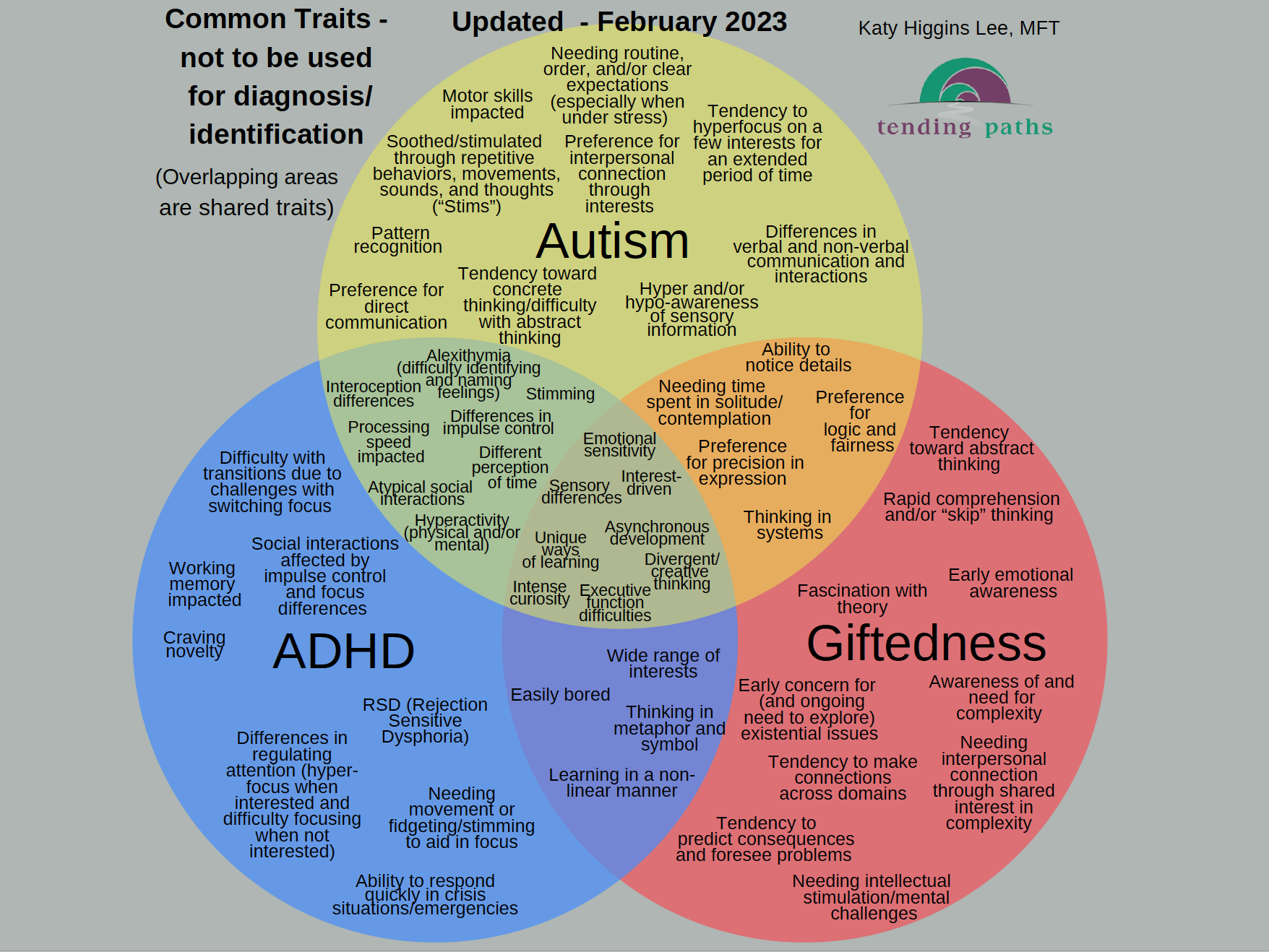
The placement of individual traits on the diagram is up for debate, but as you can see, this chart reflects what many of us sense intuitively: there is not a sharp line between giftedness and other neurotypes, or unique ways of processing and being in the world.
So, how do we make sense of so many conflicting labels, traits, and behaviors?
The fields of psychiatry and psychology have long tried—with mixed results—to apply the medical model of disease to human psychological suffering. This approach entails diagnosis of discrete psychiatric issues and attempts to alleviate the conditions through medication, therapy, or other interventions. Unfortunately, while well-intentioned, this approach has issues.
First, unlike with medical conditions, we have a dearth of discrete biological markers for most psychiatric diagnoses. Among diagnoses, many factors overlap, such as irritability, sleep disturbances, and mood changes, which may correspond to a number of underlying conditions.
Second, diagnoses are not free from provider and patient bias. Disabilities may manifest differently in certain contexts, giftedness can mask how disabled someone appears on standardized assessments, and many people who are gifted may not “appear” gifted to untrained providers.
✨ Looking for a therapist, coach, or testing provider who actually understands giftedness or twice-exceptionality? Check out The Gifted Provider Directory 🧠
We also erroneously treat diagnostic labels as if they were irrefutable facts about a person's essence, when in reality they are shorthand for clusters of symptoms, traits, and behaviors that often co-occur. Our diagnostic labels evolve over time as our understanding of cognitive differences changes, so even if a person’s symptoms or traits remain unchanged throughout their lifetime, the diagnosis may change.
This doesn’t mean it is useless to pursue a diagnosis—in fact, receiving a diagnosis can be life-changing, supportive, and helpful in cultivating a sense of identity and constructing a more congruent worldview. Research suggests that the way we come to identify with these differences and diagnostic labels, whether positively or negatively, is more important than the labels themselves.2
Some clients I’ve worked with say they were “diagnosed” with giftedness—despite the fact that giftedness is not a disorder or disability. Yet the notion of receiving a gifted “diagnosis” makes sense when you consider that for many, it can be just as paradigm-shifting to learn that you are gifted as it is to learn you have a disability, particularly when not all aspects of being gifted are so positive. If you’ve spent a lifetime feeling different from peers, but don’t meet diagnostic criteria for mental illness, a gifted “diagnosis” can finally make everything make sense.
Many people with traits or behaviors of autism, ADHD, or other differences won’t meet formal DSM criteria but describe themselves as having “subclinical” presentations. It’s not that they don’t differ in important ways from the general population, but their behaviors either a) don’t significantly impact their lives, or b) aren’t problematic because their environment is sufficiently supportive of their neurobiology.
Because of the challenges with traditional diagnostic models, the field of psychology is increasingly moving towards a focus on identifying and treating transdiagnostic factors, which are the underlying psychological factors that can lead to a variety of mental health problems, regardless of whether or not a person meets specific diagnostic criteria.3 These can include factors like internalizing versus externalizing behaviors, threat inhibition, sleep, substance use, or avoidance behaviors.4
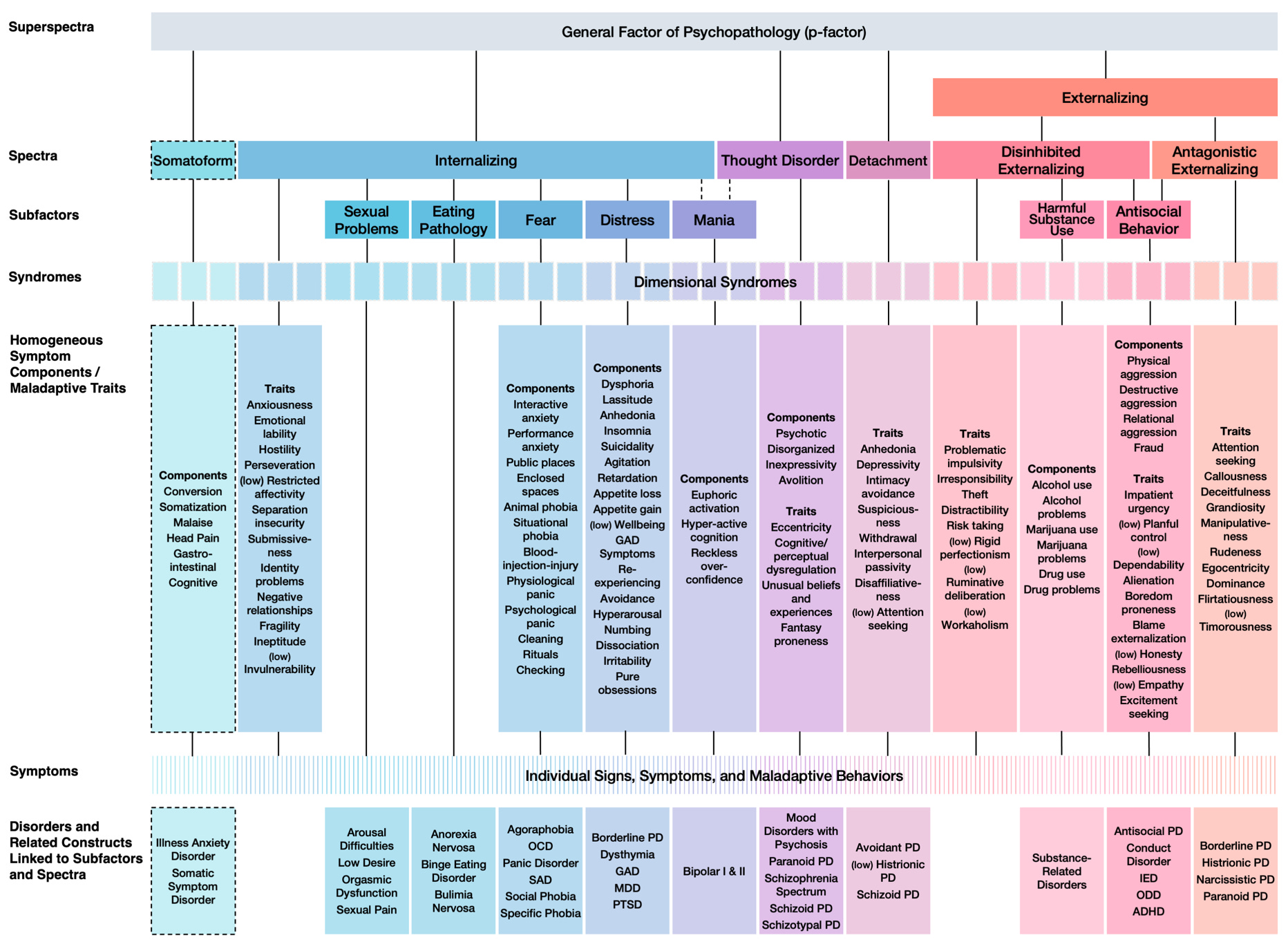
Still others reject the concept of diagnosis and the medical model of mental illness altogether. Many people don’t see their differences as inherently pathological—it’s that traditional environments weren’t built for their needs—so it’s of little utility to talk about a diagnosis at all.
For more on this, see here for a nice overview of the various approaches to the neurodiversity paradigm, including the medical and social models of disability.5
Regardless of how you conceptualize these differences—diagnoses, neurotypes, neurodivergence, or a mix of these—it can be helpful to have more information on the behaviors, traits, and presentations of each.
Here are five pages of charts outlining the various similarities, differences, and markers of autism, ADHD, and giftedness. Read on to decide whether and when it’s worth pursuing a formal diagnosis or gifted evaluation for yourself or your child.
Comments
Nothing yet. Say the first thing.
Sign in to join the conversation.