
Anyone who works with children knows that it is critical to first support the adults who care for those children. Children simply don’t have the same level of access, agency, or control that grown-ups do, nor the same level of responsibility.
Babies can’t reliably feed, bathe, or clothe themselves. Children can’t drive themselves to the doctor, navigate school and sports registrations, or ensure they get to bed at a reasonable time. Even teens still need parental support, particularly with high-stakes decisions such as choosing a dating partner or applying to college.
All of these tasks are terribly ordinary, yet they add up to an enormous responsibility for parents. If it turns out your child is also gifted, twice-exceptional (2e), or otherwise differently wired, you most certainly have an even more complex path to navigate.
This is why many of the strategies I work on with parent clients include first building supports for caregivers: the systems, behaviors, routines, community, and activities that help parents stay regulated.
✨ Are you a caregiver of a gifted or 2e child? Looking for support, answers, community, and evidence-based resources? 👉🏻 Click here to join our next 6-week, virtual Gifted & 2e Caregiver Group, starting April 14th! This is your last chance to join a group until fall 2026!! ✨
Yet after helping parents gain the skills to care for themselves, one of the most common concerns we often tackle is this: How do I help my bright child make friends?
Making friends requires considerable social acumen, mutual affection, shared interests, and a certain level of cognitive development. It’s part of why we usually see toddlers playing side by side in the sandbox, but not really together (called parallel play); their brains simply haven’t developed enough yet to meaningfully incorporate other children into their play.
But when your child is old enough to form friendships—yet they’re having a rough go of it—how can you know what the barriers are? And what can caregivers do to support this process?
Of course, we can’t do the crucial task of making friends for our children, but there are a variety of ways parents can facilitate these interactions to maximize the chances of success.
Today’s article outlines four highly successful, tried-and-true strategies you can try right away to help your child find supportive, kind friends who really “get” them—even when your child is an outlier among outliers.
I’ll cover:
The toughest ages for gifted kids to make friends, and what we know about the brain development behind this issue
The places, spaces, and communities to help gifted and 2E children look for friends and find true peers
The specific skills many children are missing, but which are essential to making positive friends and keeping them
Let’s hop in!

For the gifted, friendship can be the central challenge of an entire childhood—or even an entire lifetime. It’s often an issue of structural mismatch more than anything else: gifted individuals are biologically wired for connection like everyone else, but they’re often looking for intellectual peers—something that can be harder to find when you’re a statistical outlier.
Gifted children often experience precocious, asynchronous development. This means that their cognitive and social skills may outpace those of their peers, and different developmental domains may be at different stages within the same child (e.g., cognitive skills may be at the level of a 12-year-old, while social skills are closer to those of a 7-year-old).
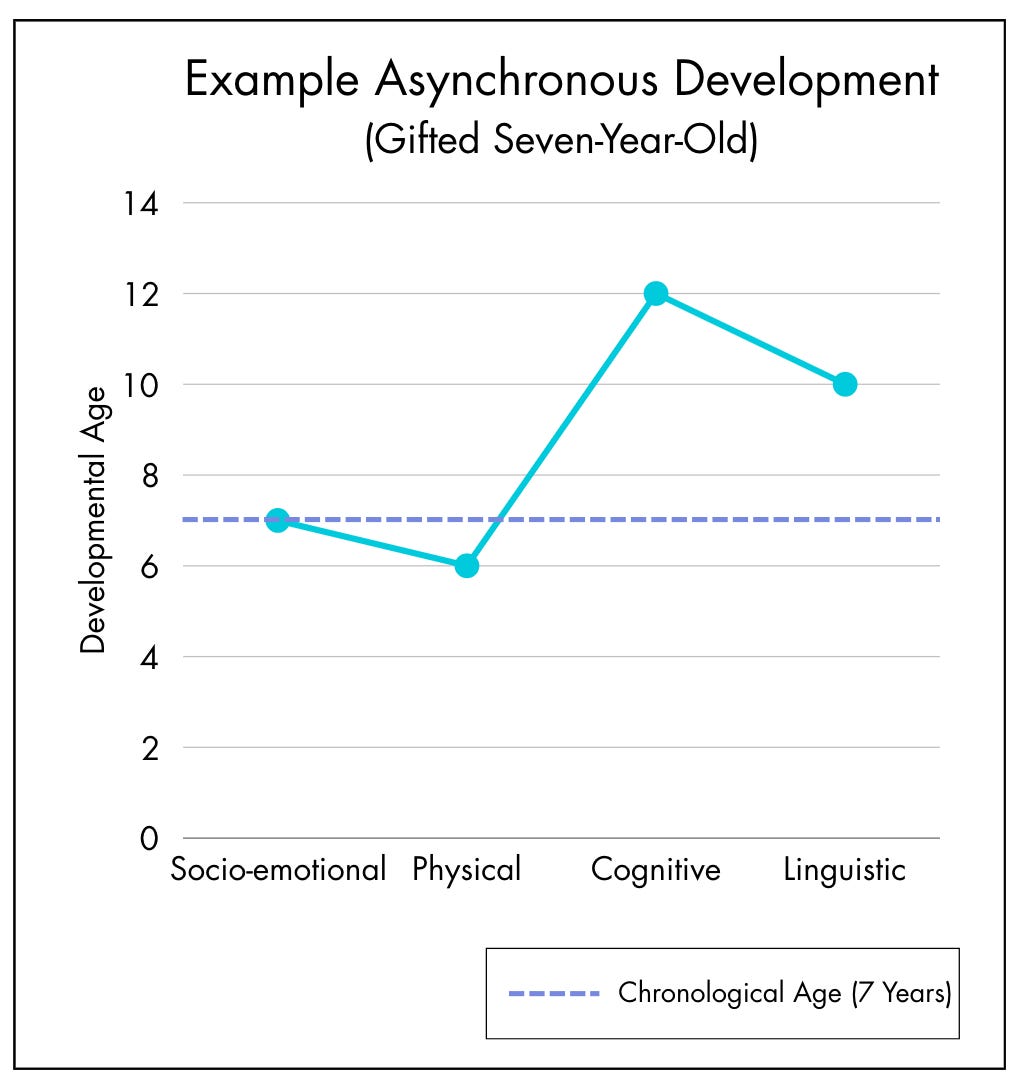
Miraca Gross’s landmark longitudinal research with over 700 gifted children found that they choose friends based on mental age rather than chronological age.1 A gifted seven-year-old, who experiences precocious development, may already be seeking the kind of deep, trusting friendship—what Gross calls “the sure shelter”—that most of their classmates won’t be developmentally ready for until they’re eleven or twelve.
The most challenging period for gifted kids to make friends is often between the ages of four and nine.2 This is likely because the differences between gifted children and typically developing age peers are greatest early in their development. As children age, developmental differences tend to “even out” somewhat between groups, though gifted people remain so throughout their lives.
Typically developing children also reach a critical neurodevelopmental period around age nine, allowing them to focus more deeply on others’ needs.3 By age 12, children are usually capable of developing mutually beneficial friendships, more akin to the “sure shelter” that gifted children often seek at much earlier ages.
This is why it’s essential to understand the distinction between agemates and intellectual peers. An agemate is someone who shares your child’s chronological age. An intellectual peer is someone who shares a similar level of intellectual development, marked by similar curiosity, complex thinking, verbal ability, reasoning, and so on. For most children, agemates are their intellectual peers. For gifted children, agemates frequently are not.4
How you can help:
Comments
Nothing yet. Say the first thing.
Sign in to join the conversation.