
Have you ever used a pen name or thought about using one?
Pen names have been used by writers as long as there have been writers. I’ve used a couple of pseudonyms myself, and that prompted me to explore why others do it.
Sometimes authors seek anonymity when they have published something controversial. The political journalist Joe Klein wrote the 1996 novel Primary Colors under the name “Anonymous” at least in part because of a potential conflict of interest. As a journalist he had covered the Bill Clinton presidential campaign, so to expose the secrets he gained in a work of fiction might have cost him access to future political efforts. Using the pseudonym “Anonymous,” however, was also a marketing ploy. That he didn’t use another human-sounding name was a clue that the author had to have a connection to insider politics. It probably helped make the book a bestseller.
Then there are authors writing in different genres than usual, like Stephen King (as Richard Bachman), JK Rowling (Robert Galbraith), and Agatha Christie (Mary Westmacott). Usually it’s because they don’t want to affect sales of their better known work. Readers expect certain styles and content and don’t want to feel they’ve been misled, or that the writing is a diluted version of the author’s work. Sometimes, though, it’s just to give the author creative freedom to write something different.
Authors may change their names to make them sound more palatable to the public. Who would read Heart of Darkness if it were written by Józef Teodor Konrad Korzeniowski? Would The Fountainhead be as popular if it were written by Alisa Zinovyevna Rosenbaum?
Perhaps the most common reason authors use pen names in the current literary landscape is because they believe it will give them greater opportunity for publication. Social media occasionally explodes with revelations of white men pretending to be women or traditionally marginalized writers because they believe the publishing industry is prejudiced against them. But it wasn’t too long ago that the situation was reversed, and women sometimes wrote under male pen names. That practice went on for much longer in what was for centuries a male-dominated industry. For example, Mary Ann Evans wrote under the name George Eliot during a time when women were not considered serious enough to author good fiction.
Related to that are writers who use pen names to bypass submission volume restrictions. A literary journal will only allow you two submissions a year? Just use a pen name and a new email address, and you can surpass that limit.
My favorite purveyor of pen names is the Portuguese writer Fernando Pessoa. He used more than 70 of them for his work. He wrote in many styles and about a variety of subjects and apparently believed that for each to have credibility, it should be written by someone with a background that fit the work and style. A massive biography of Pessoa by Richard Zenith also hints that he was an unconventional person, living in an existence often born of his fantasies.
Pessoa didn’t call his pen names pseudonyms. Instead he called them heteronyms, and invented personalities and biographies to go along with each name, so they would seem apropos to the writing they authored. His three most common heteronyms:
Alberto Caeiro: Caeiro was an uneducated, rural man who lived in the countryside and wrote simple free-verse poetry focused on nature.
Álvaro de Campos: A bisexual naval engineer who had studied in Scotland. His style was modern, chaotic, and influenced by the Futurism of the time.
Ricardo Reis: A medical doctor and classical scholar. He was a royalist during a time of political upheaval in Portugal, who chose exile in Brazil rather than accept a socialist government. He wrote traditional neoclassical odes inspired by the Roman poet Horace. This is my favorite of his heteronyms, in no small part because José Saramago made Reis the main character of his classic novel, The Year of the Death of Ricardo Reis.
Pessoa’s abundance of names intrigues me, since I write in a variety of styles and genres as well. I’ve done satire, historical fiction, speculative, high literary, family saga, and more. Plus, Ponepinto has always been difficult for some people to pronounce or place. So many times when I was younger people asked about its cultural origin. (People seem to be much more accepting of origins these days.) Guesses ranged from Spanish, to Greek, to Native American, even to Polynesian Islander. It’s Sicilian. According to Ellis Island records, that’s the name assigned to my grandfather when he came over, but he was only four years old at the time so who knows? Might have been what the customs official wrote down incorrectly. I’ve never encountered the name while traveling in Italy, although I’ve heard of it here in the states — distant cousins, perhaps. My grandfather shortened it to Pinto when he was in vaudeville, probably to make it easier for the people of his time.
Those difficulties with the name have stayed with me, so I have occasionally searched for something that is easier to pronounce and remember. The kind of a name an author ought to have. I’ve played around with using my mother’s maiden name, Tori, which is from Tuscany. But Joe Torre was a Hall of Fame baseball player and manager, so Joe Tori would sound the same. Maybe Giuseppe Tori. Then I would have to create a bio to go along with it. Born in the Tuscan hills, Giuseppe Tori grew up tending to the pigs on his family’s farm. But he had an unexpected opportunity to attend university, and when he started writing creatively his talent became immediately evident to readers and publishers in Italy. He was invited to teach in the United States and decided to stay and continue to write. That’s the kind of bio literary journal editors drool over. But I’ve never used that heteronym. I’ve created a few other Italian sounding names, but never used any.
I’ve also toyed with using Gray Davenport as a nom de plume. When I got kicked off Facebook a decade ago1, I had to create a new account to get back on, so I used the name of the main character from my recently published book, Mr. Neutron. Gray Davenport, as his name implies, is a blandly upholstered sofa of a man, something to be sat upon by asses of all weights and configurations… That worked for Facebook (although I rarely log on), but I couldn’t see using it for any of my writing. Authors are supposed to be forceful and confident.
A name that I have used is Tomlin Martinson. Tomlin is a creation based on Tomlinson Avenue in the Bronx, where I first lived. I was going to go with Martin Tomlinson because I have a great-uncle whom I admired named Martin, but I felt at the time that a more androgynous name might get better consideration at very liberal literary journals, and so I switched it around. Tomlin has had several stories published under that name, but I’ve always made sure the editors knew that it was a pen name.
It’s intriguing to give yourself another name. You feel like you’re getting away with something — hiding in plain sight. Like Pessoa, you can adopt a completely other history and personality. Why not? This is creative writing, after all. Why not be creative with ourselves?
Let’s see… For my speculative writing, how about Joseph T. Quark? For historical fiction, J. Edward Percival. Not that I’m a romance writer, but if I ever did, maybe Josephina Ardor…
Get the idea?
Back to my original question. Have you ever used or thought about using a pen name? And if so, why?
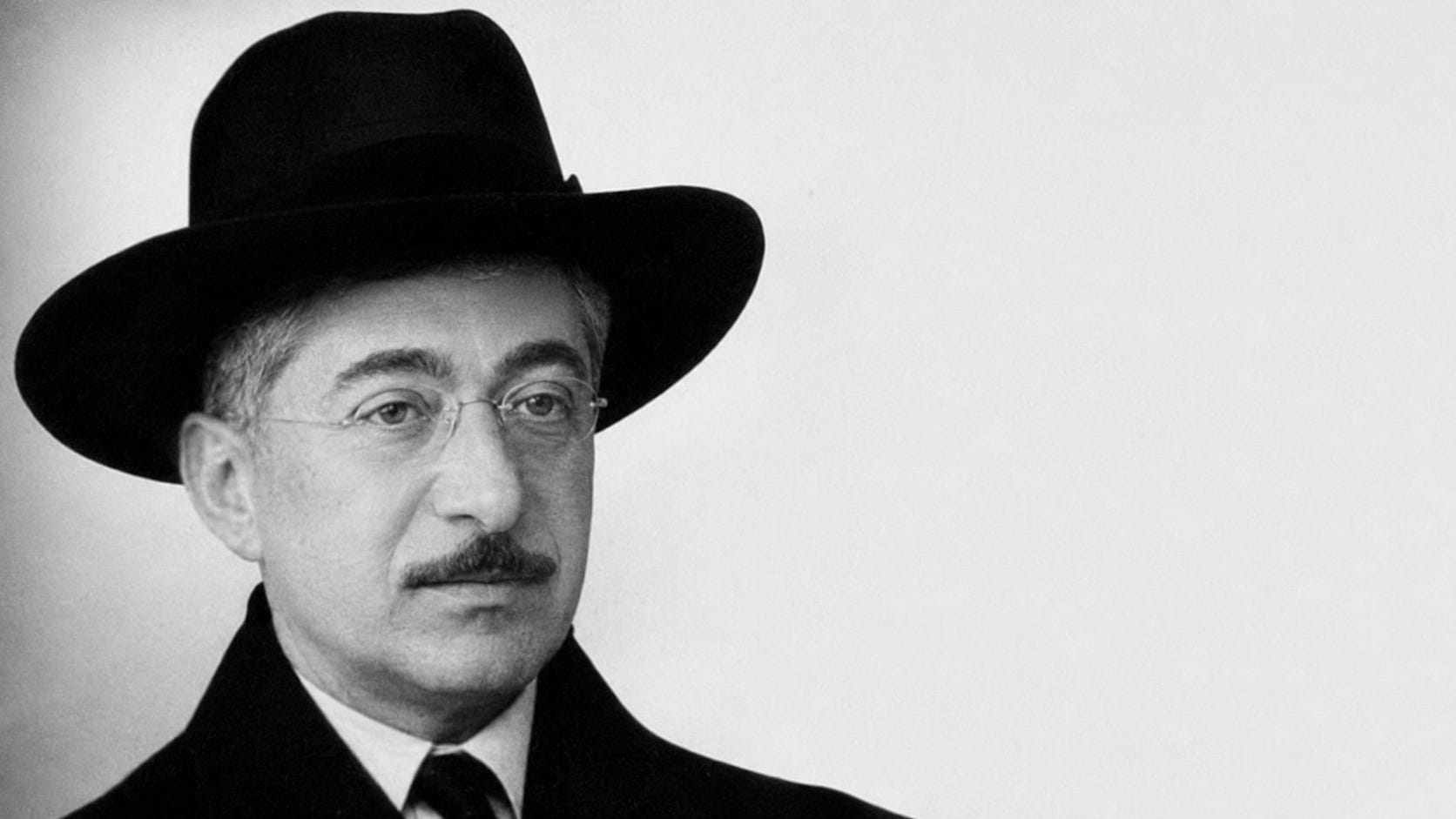
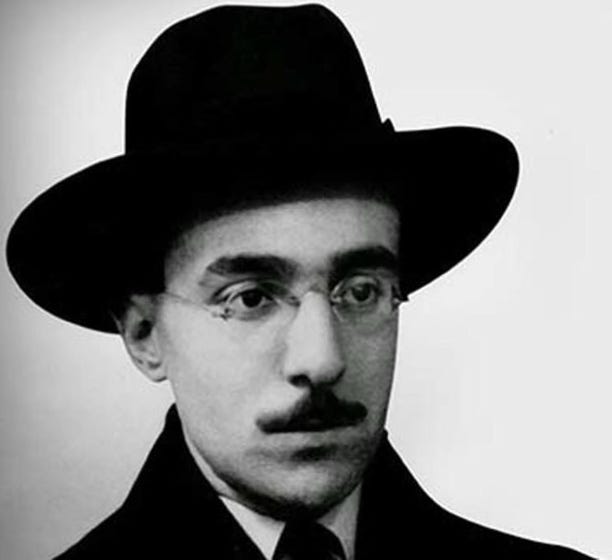
About this week’s image: I used AI to substitute my face for Fernando Pessoa’s (see below), although apparently I already look a lot like him. It did a great job adapting my face to the original photo style. Maybe AI can’t write that well, but it’s quite good at this stuff.
A hacker tried to get into my account, prompting an automatic email asking me to verify it, and in my morning stupor I messed it up. As you may know, you cannot actually speak to a human being at Facebook, but must deal with their algorithms, which are completely unforgiving, so I was never able to reclaim my account. Apparently there are thousands of other people who have had the same problem. I haven’t missed it.
Comments
Nothing yet. Say the first thing.
Sign in to join the conversation.