
In 2024, the German Constitution celebrated its 75th anniversary. The occasion was marked by grand celebrations, speeches, and fanfare.
Yet not everyone joined in the festivities. The constitution, ratified in Bonn on 8 May 1949, was originally conceived as a temporary measure—an interim solution until the German people could eventually reunite as a single state.
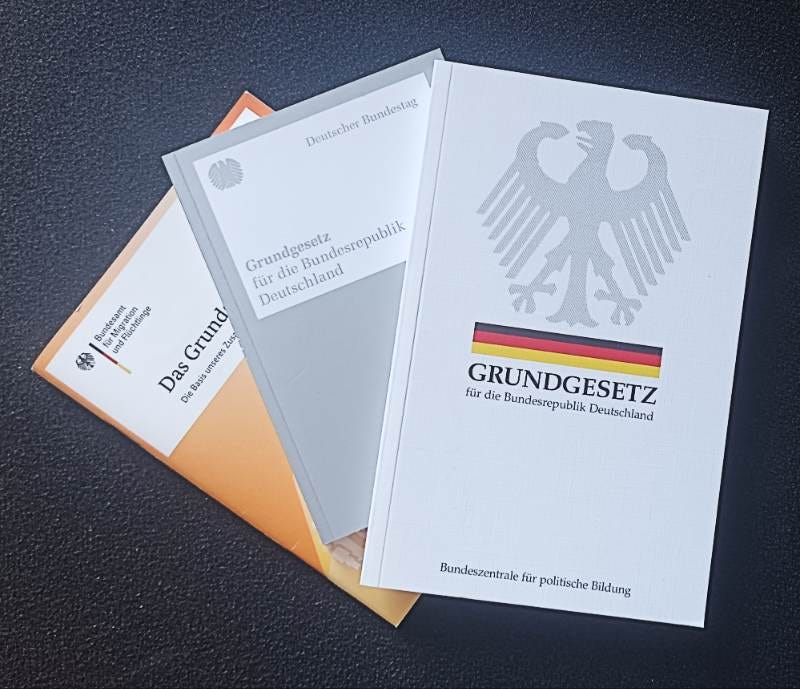
Article 146 of the Grundgesetz, which remains in effect today, states: "This Basic Law, which applies to the entire German people following the achievement of German unity and freedom, shall cease to be valid on the day a constitution freely adopted by the German people comes into force."1
However, a new constitution never materialised.
In 1989–90, events outpaced politics. Free elections in the GDR favoured parties supporting immediate accession to West Germany. This accession became possible through Article 23 of the Western Constitution, which permitted new Länder to join—as had occurred with Saarland in 1957 when it chose Germany over France—thereby adopting the existing Basic Law.
This approach offered a quick solution to seize the historical moment, particularly since many nations—including Italy—were wary of a reunified Germany. On 23 August 1990, the first and only freely elected parliament of the GDR voted for accession under Article 23. Rather than a true Wiedervereinigung (reunification between equals), it resembled an Übernahme—a takeover. Some would characterise it as nearly an annexation.
Many still consider it the original sin: a provisional constitution, written in the West and then imposed on the East, later transformed into a definitive one.
From that point onward, the East German population felt excluded from political parties, businesses, universities, and the distribution of wealth. This exclusion became the foundation of a divide that still marks the country today.2
This division extends far beyond election polls or headlines about the AfD's rising popularity. It cannot be simplified to a graph. The divide runs deeper: unprocessed traumas, broken promises, and emerging fears. According to historian Ilko-Sascha Kowalczuk3, freedom itself was a shock for many East Germans. Additionally, different cultural imprints remain influential: in the East, socialist education and ties with Soviet Russia have left lasting marks, while in the West, the cultural compass has remained Atlantic and American. This fundamental difference helps explain why, even today, attitudes toward Russia and Ukraine divide Germans more profoundly than outside observers might realize.
In less than a month, on 3 October, Germany will celebrate the 35th anniversary of reunification.
It might seem like a distant event, ready to fade into history amidst official speeches and ceremonial wreaths. But quite the opposite is true. Spirits are high, discussions heated, and symbols that should unite the nation are resurfacing—often only to reveal lingering divisions.
Since the 2006 World Cup, the German flag has become normalised in public life. Today, it's even wielded in an anti-AfD context as a symbol of 'clean' patriotism, distinguishing mainstream Germans from far-right supporters. Meanwhile in the East, you can still spot the old GDR flag with its hammer and sickle, compass and wheat ears—though it now represents folklore more than political conviction.
The anthem, however, tells a completely different story.
It's a thorny issue. On closer inspection, Germany has at least five anthems: the original from 1841 with three verses; the Nazi version reduced to a single verse and used as an ideological weapon; the "cleaned up" version adopted by the Federal Republic in the 1950s, consisting of just the least controversial verse; the GDR anthem, celebrating peace and friendship between peoples (provided they were socialist); and finally, the ghost that has haunted Germany since reunification—the anthem many would have preferred: a poem by Bertolt Brecht with simple words suitable for children yet perfect for adults.
The debate on the national anthem has resurfaced in Germany this past week. As usual, it emerges in the lead-up to every German anniversary.
Bodo Ramelow said it in 2019 and has repeated it today. Until the end of 2024, he served as the beloved Minister-President of Thuringia and is now Vice-President of the Bundestag. A West German who chose to move to the East, with an Italian wife, Ramelow remains one of the most popular figures in Die Linke, Germany's left-wing party.
According to him, 'many East Germans, for various reasons, do not sing the national anthem'. He believes that an old proposal from East Berlin's civic movements is now more relevant than ever – to give reunified Germany a new anthem by reviving the Kinderhymne, or 'Children's Hymn', a poem set to music by Bertolt Brecht.

Just as six years ago, Ramelow has brought upon himself what in contemporary German parlance is called a "shitstorm." Critics have held nothing back: accusing him of overstepping his role as vice-president of the Bundestag, stirring up emotions, and applying the standard label of modern public discourse—'populist.' (And in Germany, as elsewhere, we now brand anyone we disagree with as a populist.)
But is his proposal truly so absurd?
Most national anthems emerged in the mid-19th century during the era of liberal revolutions, anti-imperial movements, and the so-called 'Spring of Nations'.
While often portrayed as a period of progress, this was in fact an ambiguous time. Every nation-building process contains the seeds of nationalism, and each nationalist movement harbours the potential for minority oppression. This fertile ground is where fascism eventually took root.
Nations are born in opposition to tyranny and imperial control. Yet they frequently transform into the very empires and tyrannies they once opposed. Their anthems travel with them, shifting in meaning as times change.
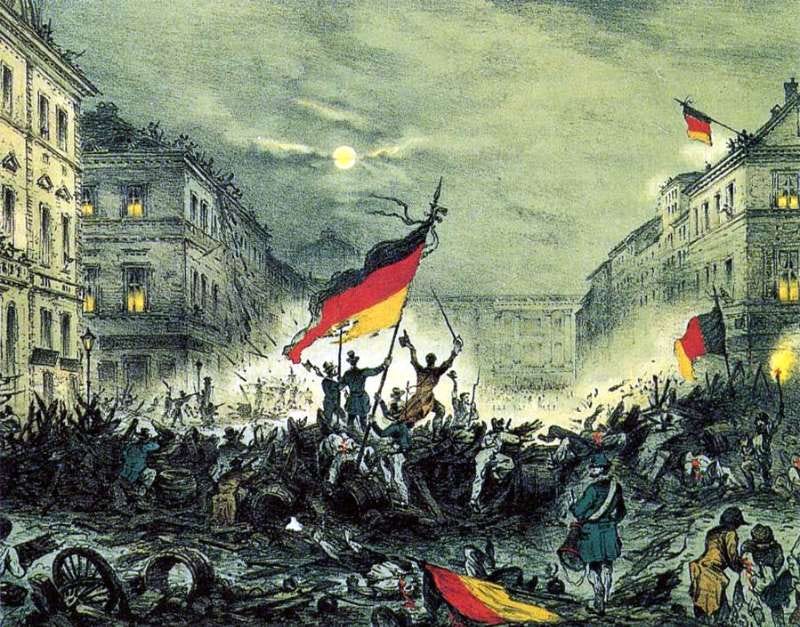
In 1841, on Helgoland, an island in the North Sea, August Heinrich Hoffmann von Fallersleben penned what would become the German national anthem. A young liberal and romantic poet in exile, he opposed the feudal-minded German princes and dreamed of a free, united, democratic Germany.
Perched on a cliff, he composed "Das Lied der Deutschen" (The Song of the Germans). Though a poet and not a musician, he paired his lyrics with his favorite melody—the one Joseph Haydn had composed for Austrian Emperor Francis II.
This created a fascinating paradox: a German national hymn set to the music of an imperial, supranational anthem. Yet history is full of such contradictions, and Haydn's composition is undeniably beautiful.
The combination of lyrics and melody quickly gained popularity, partly because the poem was intended to be sung in taverns frequented by students and intellectuals. It celebrated not only Germany, but also life itself—and women.
First part
Deutschland, Deutschland über alles…
“Germany, Germany above all: above all in the world, when for protection and defence it remains united in brotherhood, from the Meuse to the Memel, from the Etsch to the Belt – Germany, Germany above all, above all in the world!”4
Questa è la parte che è rimasta nella memoria collettiva europea. Per pessimi motivi.
Second part
Deutsche Frauen, deutsche Treue, deutscher Wein und deutscher Sang…
“German women, German loyalty, German wine and German song may retain their ancient beauty throughout the world, inspiring us to noble deeds throughout our lives - German women, German loyalty, German wine and German song!”5
A hymn to the “Made-in-Germany”, more joyful than nationalistic: women, wine, music. Different from Johann Strauss II's waltz Wein, Weib und Gesang ('Wine, Women and Song'). But that was Austrian. A different lifestyle. (And, let's face it, better wine too).
Third part
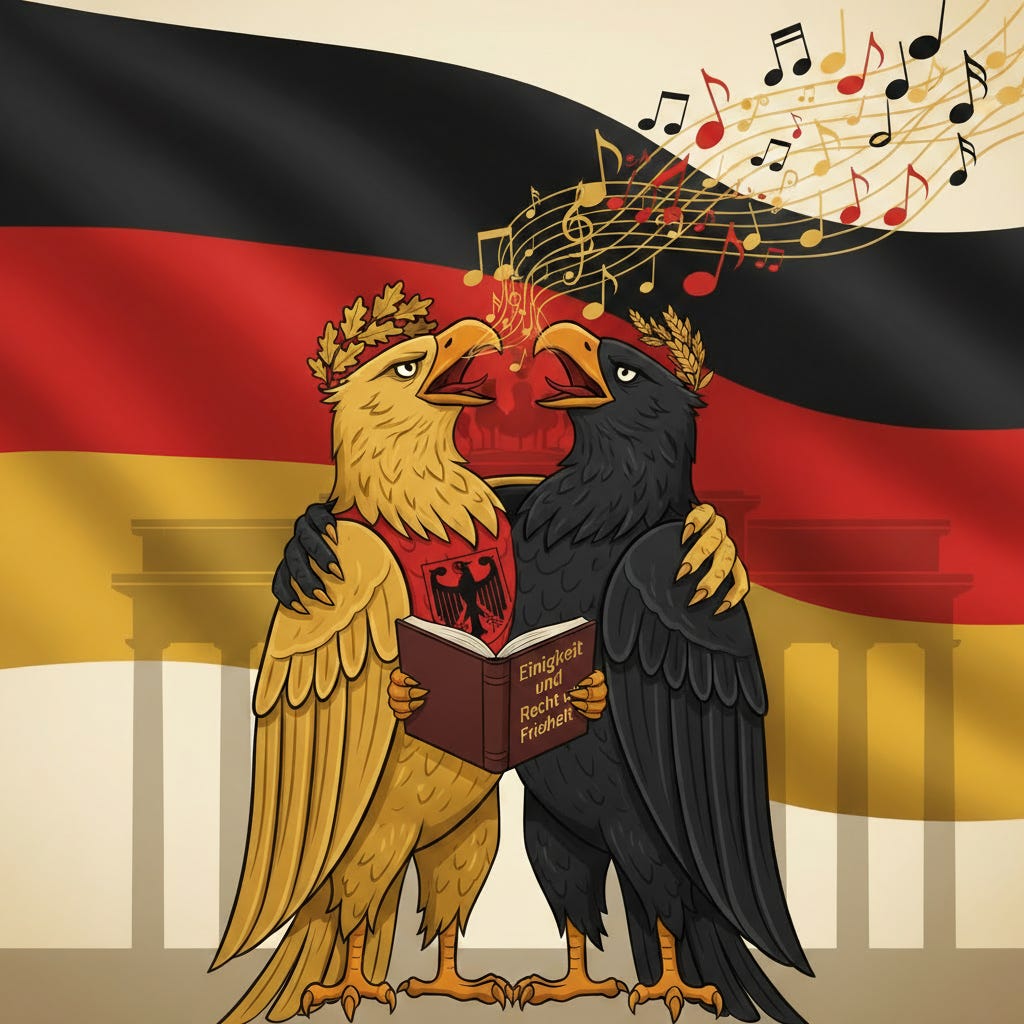
Einigkeit und Recht und Freiheit…
“Unity, justice and freedom for the German fatherland! To this we must all aspire, fraternally with heart and hand! Unity, justice and freedom are the pledge of happiness - flourish in the splendour of this happiness, flourish, German fatherland!”6
Unity, justice and freedom—the pledge of happiness. A song that could have suited not just Germany, but also Italy, Poland and Greece. It captured the spirit of the times.
In 1922, the fragile yet luminous Weimar Republic adopted this song as its official anthem, including all three verses.
It embodied proud nationalism and the joy of living that people sought to reclaim after the Great War. Unity was essential in a Europe newly redesigned by the victors.
Weimar was both tragic and beautiful, remarkable for its art, creativity and social progress. Yet it ended disastrously. Even today, the word 'Weimar' evokes fear—an echo of collapse and a warning of history that might repeat itself.
The Nazis, who emerged from Munich's beer halls, truncated the song.
They removed references to women and wine, keeping only the first stanza: 'Deutschland über alles.' They transformed its meaning from 'Germany above all in our hearts' to 'Germany above all others'—a declaration of supremacy.
Haydn's melody, originally composed for an Austrian emperor, became the chilling soundtrack for SS parades. Repugnant. Consequently, that first verse has become toxic in German society—not officially prohibited, but entirely taboo.
When the Federal Republic was founded in 1949, the national symbols debate resurfaced.
The flag issue was resolved, but the anthem remained problematic. Attempts to create a new anthem failed. Konrad Adenauer, the post-war Chancellor, proposed a pragmatic solution: permanently remove the toxic first verse, discard the frivolous second verse about women, wine, and singing (inappropriate for the serious post-war climate), and retain only the third verse: 'Unity, justice and freedom'. This choice was perfect—democratic, non-threatening, and western in its values. It became the official anthem in 1950.
The GDR seized this opportunity. While the West maintained what they considered an 'intoxicated' anthem—portraying them as continuing fascists—the East positioned itself as the only true anti-fascist state. Thus "Auferstanden aus Ruinen" (Risen from the Ruins) was born: three verses celebrating peace, reconstruction and youth.
First verses
Auferstanden aus Ruinen / und der Zukunft zugewandt…
"Risen from the ruins and facing the future, let us serve you for the good, Germany, united homeland. The old sufferings must be overcome, and we will overcome them together, because we must succeed in making the sun shine on Germany more brightly than ever before."7
"Risen from the ruins and facing the future..." This powerful and poetic rhetoric creates an admirable opening. It evokes the image of a Germany rising from the rubble and looking hopefully towards a united future.
Second verses
Alle Welt sehnt sich nach Frieden, reicht den Völkern eure Hand…"May fortune and peace be granted to Germany, our homeland. The whole world longs for peace, reach out your hand to the peoples. When we unite in brotherhood, we defeat the enemy of the people. Let the light of peace shine, so that never again will a mother weep for her child."8
The GDR portrayed itself to the world as a 'state of peace'. The dove of peace was ubiquitous and remains visible today on many buildings in East Berlin. Behind this façade, however, lay the propaganda machinery of the Soviet bloc and, later, the GDR's role as an arms supplier to various regions of what we now call the 'Global South'. What kind of pacifism was this really?
Third verses
Laßt uns pflügen, laßt uns bauen, lernt und schafft wie nie zuvor…
“Plough, build, learn and create as never before, and trusting in your own strength, a free generation will arise. German youth, the best aspiration of our people united in you, you will become the new life of Germany. And the sun will shine on Germany more beautifully than ever before.”9
"Arbeiter, Bauern, und Intelligenz": workers, farmers, doctors, engineers... This was the fundamental concept of the GDR, where everyone would contribute with equal dignity to the reconstruction of the country. Young people would play a key role in this process—it was their task to make the sun shine on socialist Germany.
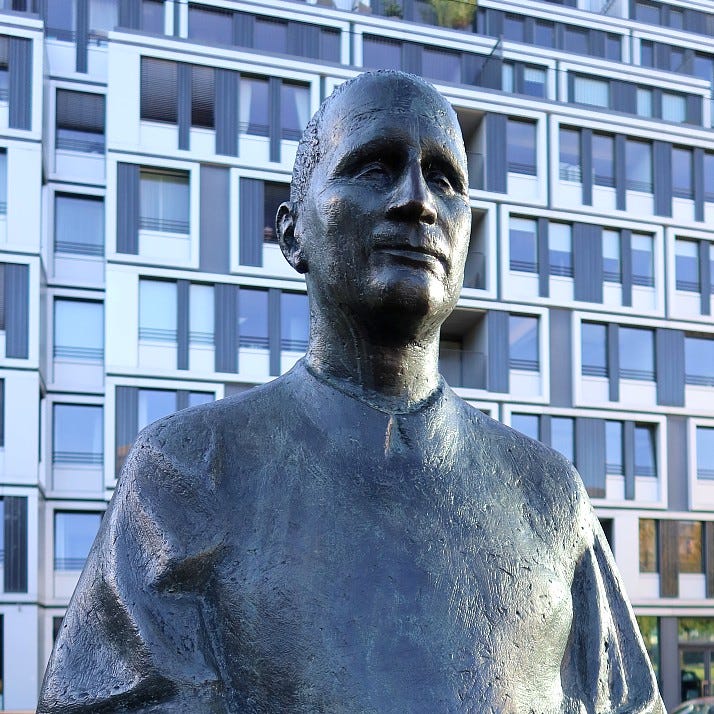
Poet, playwright, free spirit. Brecht lives in the East out of conviction, not blind adherence. For him, neither the Western nor Eastern hymns work—too much toxicity in one, excessive rhetoric in the other.
So he creates an alternative: the Kinderhymne, the Children's Anthem.
Simple words crafted for children—because if children understand you, everyone does. The brilliance: it can be sung to Haydn's original melody. It begins like this:
Anmut sparet nicht noch Mühe / Leidenschaft nicht noch Verstand / Daß ein gutes Deutschland blühe / Wie ein andres gutes Land
"Spar neither grace nor effort, neither passion nor intellect, so that a good Germany may flourish, like any other good country."
"Grace"? In the first version of the text, Brecht wrote "Arbeit" (work). But he reconsidered: the effort of rebuilding a country—a good country—needed to be accompanied by grace. (Re)building a nation shouldn't be merely hard work and effort, but requires lightness of heart. With this lightness, beauty and goodness can flourish. And above all else, the new Germany must be good.
Daß die Völker nicht erbleichen / Wie vor einer Räuberin / Sondern ihre Hände reichen / Uns wie andern Völkern hin.
"May the peoples not turn pale as before a robber, but reach out their hands to us as they do to other peoples."
In Brecht's vision of Germany, other nations need no longer live in fear: this Germany is not an abstract concept but a people—us, 'uns', 'wir'—the Germany we collectively create. To this reimagined Germany, other nations, no longer intimidated, will extend their hands in friendship.
Und nicht über und nicht unter / Andern Völkern wolln wir sein / Von der See bis zu den Alpen / Von der Oder bis zum Rhein.
"And we want to be neither above nor below other peoples, from the sea to the Alps, from the Oder to the Rhine."
Brecht rejects "Deutschland über alles" in favor of a more equal vision: neither above nor below other nations, but alongside them. He calls for a united Germany within boundaries that would only be officially recognized in 1990—from the Rhine to the Oder, from the sea to the Alps.
Und weil wir dies Land verbessern / Lieben und beschirmen wir's / Und das liebste mag's uns scheinen / So wie andern Völkern ihrs.
"And because we improve this country, we love and protect it. It may seem dearest to us, just as other peoples' countries seem dearest to them."
Democratic patriotism distilled into four lines and twenty words: we—who are Germany—improve this country. It may never be perfect, but it can be improved. Because we make it better, we can love it—and we must protect it. Just as one loves and protects what one cherishes, as other peoples have both the right and duty to do with their own countries.
Brecht's Germans: a people among peoples who love, defend and, above all, improve their country. When JFK urged, "Ask yourself what you can do for your country," he embodied American democratic patriotism—an America worthy of love. Similarly, Brecht's vision presents a Germany that can be loved. It portrays a people who, through effort and grace, help their country flourish, as any good nation should.
How could anyone say no to such an anthem? Yet things turned out differently. In 1991, the third verse of West Germany's anthem became the anthem of reunified Germany. Once again, the East had to adapt.
Today, the AfD often sings the first verse at its rallies—the one that goes "..über alles." They can do this legally. It's toxic, but not prohibited.
But why not counter this with the Kinderhymne? Why not consider a second anthem alongside the first—complementary, bringing together the two Germanys in their best versions?
Why not have two anthems, similar to the national football team's shirts—one for home games, one for away games when a different colour is needed? Why choose exclusion when inclusion is possible?
We glimpsed this possibility last year during the 75th anniversary celebrations of the Constitution. Katharina Thalbach—a small-size giant of theatre and television who has traversed both Germanys with grace and tenacity—performed it to Haydn's notes. Amazing.
👋 There's no better way to help Beyond Berlin grow than sharing this essay. One simple click spreads a lot of love— don't be shy!
The Bundesliga has started again, but so has the theatre season! At the Berliner Ensemble – Brecht's theatre – home to the legendary "Dreigroschenoper" (The Threepenny Opera) – you'll find everything we could wish for as die-hard fans and devotees of Bertolt Brecht:

Grundgesetz für die Bundesrepublik Deutschland. Art 146: Dieses Grundgesetz, das nach Vollendung der Einheit und Freiheit Deutschlands für das gesamte deutsche Volk gilt, verliert seine Gültigkeit an dem Tage, an dem eine Verfassung in Kraft tritt, die von dem deutschen Volke in freier Entscheidung beschlossen worden ist.
What about Merkel, you might ask? She only truly addressed her identity as an Ostlerin, a woman from the East, in 2021 – in her famous speech on reunification – and explored it in greater depth later. What happened before her, and independently of her, tells a different story: political parties, businesses and public administrations remained in the hands of Westerners – wealth concentrated in the West – higher salaries in the West – universities still dominated by Western lecturers and administrators. And so on.
Ilko-Sascha Kowalczuk's book Freiheitsschock (“The shock of freedom”) has not been translated into English (another historian covering the former GDR dominates the English bookshops, rightfully or not). The book is an intelligent analysis that begins by describing German reunification as the greatest social experiment carried out in the Western world in the 20th century. The author explains how that freedom, won by a few (revolutions are always made by minorities, while majorities endure them), overwhelmed many, generated contradictions and, having never truly been processed, produced today's extremism. I am not familiar with the Italian translation and whether it includes a critical apparatus. In truth, the book is challenging to read without knowledge of the ongoing (very heated) historical and literary debate in Germany, as Kowalczuk criticises his 'revisionist' or 'simplistic' colleagues, whose works have not been translated into Italian, on several pages. For those who read German, I would rather recommend Die Übernahme (The Takeover, 2019), which recounts the process of integrating the East into reunified Germany – with its price, including in human terms, which is still being paid today.
Deutschland, Deutschland über alles: / über alles in der Welt, / wenn es stets zum Schutz und Trutze / brüderlich zusammenhält, / von der Maas bis an die Memel, / von der Etsch bis an den Belt / Deutschland, Deutschland über alles, über alles in der Welt!
Deutsche Frauen, deutsche Treue, / deutscher Wein und deutscher Sang / sollen in der Welt behalten / ihren alten schönen Klang, / uns zu edler Tat begeistern / unser ganzes Leben lang - / deutsche Frauen, deutsche Treue, deutscher Wein und deutscher Sang!
Einigkeit und Recht und Freiheit / für das deutsche Vaterland! / Danach lasst uns alle streben brüderlich / mit Herz und Hand! / Einigkeit und Recht und Freiheit / sind des Glückes Unterpfand / - blüh im Glanze dieses Glückes, / blühe, deutsches Vaterland! (26. August 1841) Text: August Heinrich Hoffmann von Fallersleben Musik: Joseph Haydn
Auferstanden aus Ruinen / und der Zukunft zugewandt, / laß uns dir zum Guten dienen, / Deutschland, einig Vaterland. / Alte Not gilt es zu zwingen, / und wir zwingen sie vereint, / denn es muß uns doch gelingen, / daß die Sonne schön wie nie / über Deutschland scheint.
Glück und Friede sei beschieden / Deutschland, unserm Vaterland. / Alle Welt sehnt sich nach Frieden, / reicht den Völkern eure Hand. / Wenn wir brüderlich uns einen, / schlagen wir des Volkes Feind. / Laßt das Licht des Friedens scheinen, / daß nie eine Mutter mehr ( ihren Sohn beweint.
Laßt uns pflügen, laßt uns bauen, / lernt und schafft wie nie zuvor, / und der eignen Kraft vertrauend, / steigt ein frei Geschlecht empor. / Deutsche Jugend, bestes Streben / unsres Volks in dir vereint, / wirst du Deutschlands neues Leben. / Und die Sonne schön wie nie / über Deutschland scheint.
Comments
Nothing yet. Say the first thing.
Sign in to join the conversation.