
This is the Guided Tour of the Summa Theologiae, a project for all paid subscribers of Aquinas and Beyond. In it, we are carefully reading through St. Thomas Aquinas’s masterpiece, with help from experts on Aquinas, to think like the universal doctor of the Church. Stop feeling intimidated by Aquinas, and subscribe so you can read along!
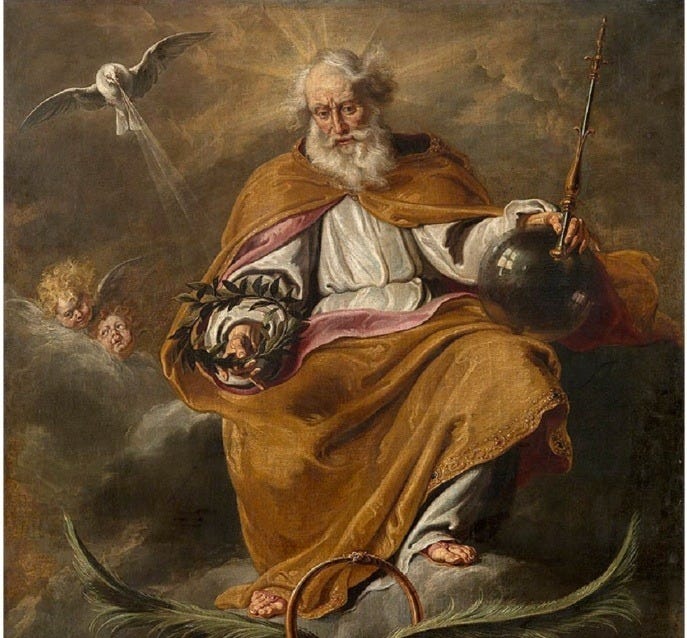
One of the most intuitive, and intuitively challenging, concepts in classical theism is God’s power. Presumably, God is all-powerful in some meaningful sense; few people now think of God as having limited abilities, such that there is something He should or could be able to do. But what about seeming contradictory things, like creating a rock so big God cannot lift it?
I found it amusing while reading this passage that Aquinas just straight-up admits that defining omnipotence correctly is tricky—do it wrong and you have an incoherent God, or one incapable of actually being understood. Thus, this is an important question, and Aquinas’s explanation is really useful for thinking correctly about God’s power.
As always, here are some resources you might find helpful as we move forward:
The Summa Theologiae itself. Buy Prima Pars here, and the whole Summa here. Read it for free here.
If you have never read the Summa, it can be a little intimidating. But I put together a roadmap so that anybody can read it and understand it. Get it here.
Here is the commentary I will be using from Walter Farrell, O.P.
Here is the commentary I will be using from Brian Davies, O.P.
Now, let’s dive into God’s power.
It seems like this would be the most obvious, slam-dunk “yes” in history, but the Angelic doctor still finds a way here to clarify the answer beyond the obvious. Aquinas distinguishes here between two kinds of power: passive and active power.
Your passive powers are the qualities you can take on, even though you do not have them yet. As a human being, you have the passive power to become musical (or more musical), physically strong (or stronger), and beautiful (unless you are my wife; there is no beauty possible of humanity that she does not already possess).1 Importantly, these passive powers imply a perfection you are capable of possessing but do not currently possess. These passive powers are a kind of imperfection in the holder, since it is a way that the subject could exist, but does not. God has no passive powers.
There are also active powers, however, and these God has in spades.2 Active powers are the ability to be a principle of actuality — the ability to make something exist in a particular way. I have the active power to move, push chairs over and type on a keyboard, though I rarely use them in conjunction. God, likewise, has active powers to make and act upon other beings, and this comes from His being pure act.
Farrell points out the difference between our power and God’s effectively:
In our world, creatures are principles of action, that is they have power, in exact proportion to their own actuality, their own realized potentialities. Thus, for instance, I cannot teach others the art of ballet dancing because I have not that knowledge; I can teach others only what I myself know. A man can put the stamp of intelligence upon his work only in the degree in which he possesses intelligence; he cannot generate angels, even if angels could be generated, because he does not himself enjoy angelic life. God, as we have already proved, is pure act, complete perfection. His power, then, is complete, as unlimited as His perfection, almighty.3
But the extent to which He has those powers, and how to describe them, is trickier to get right. But it’s very important not to make some easier errors...
This is a free preview of the Guided Tour of the Summa. To read the rest, join other premium subscribers who are becoming thoughtful, well-formed Catholic intellectuals through:
A guided tour through the ENTIRETY of Thomas Aquinas’s Summa Theologiae, which you are reading right now! Don’t miss out on forming your mind according to the Universal Doctor of the Church!
Founding Members get a FREE copy of my Catholic Philosopher In A Year Reading Plan, my ultimate reading list to get up to speed in Catholic Philosophy.
Blogs on the philosophy of religion (God, evil, free will, etc.) like this one about art and the problem of evil.
Reader’s Guides on the great works of Catholic philosophy, like this guide on Jacques Maritain’s Art and Scholasticism.
Further reading recommendations on many posts, including free posts.
Stop feeling confused in the face of deep Catholic conversations and start thinking like a Catholic philosopher.
Comments
Nothing yet. Say the first thing.
Sign in to join the conversation.