
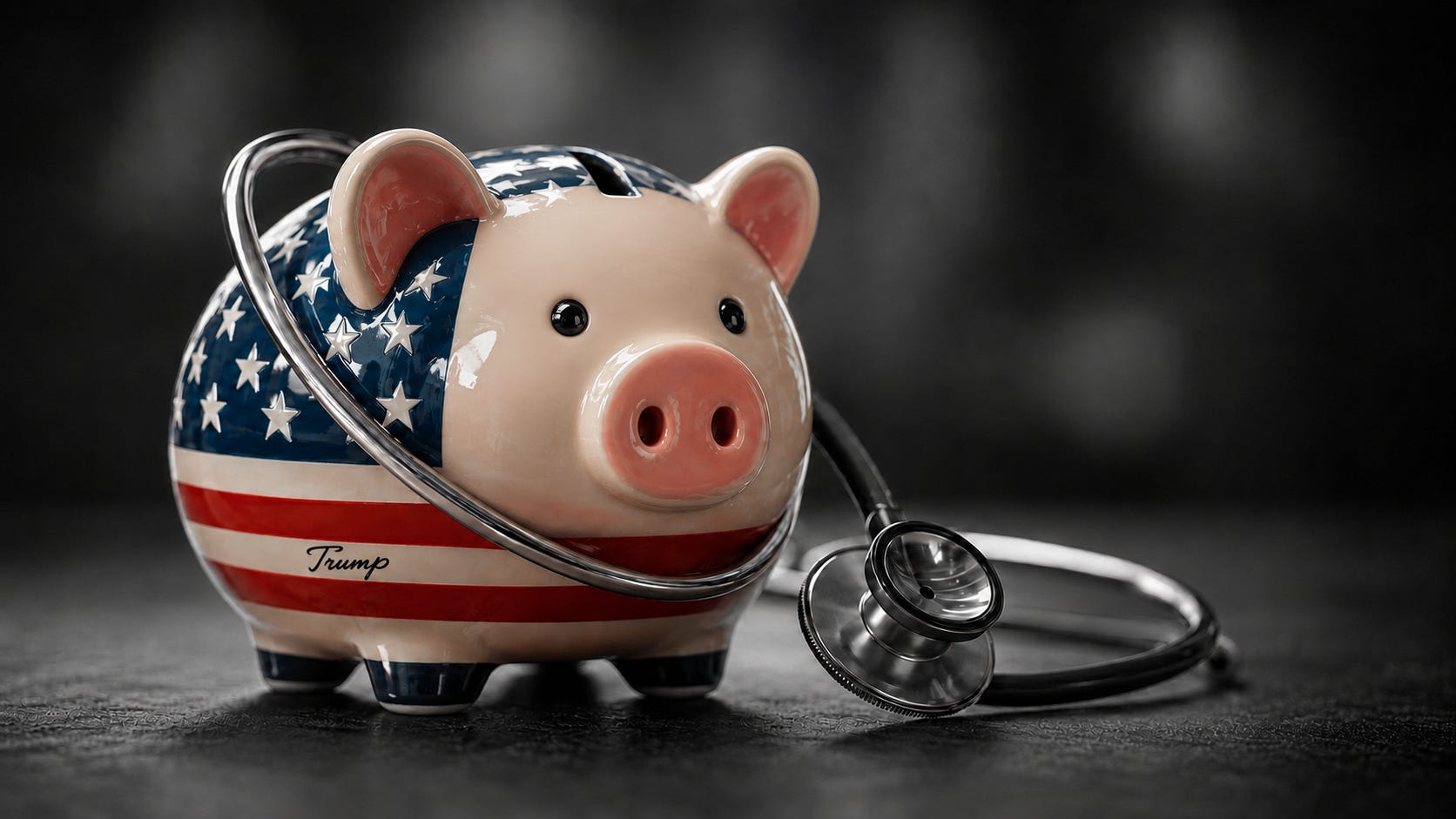
At one minute past midnight on Friday, 31 July, a 100% import duty on patented medicines became operative in the United States. It applies to seventeen named pharmaceutical companies, listed in Annex III of the proclamation that created it. Thirteen of those seventeen also appear in Annex II — the register of firms that had already reached agreements with Washington — and customs guidance directs their qualifying products to a heading that carries no additional duty at all.
A hundred per cent, on seventeen companies, four of which are exposed to it.
That is not a failure of the policy. That is the policy, working exactly as designed and finishing its work before the deadline it set. The tariff was never a revenue measure. It was a deadline with a number attached, and the number was chosen to be unpayable so that the alternative would be signed.
This is not a trade barrier. It is an invoice for a signature — and the signature it wants is on a drug pricing agreement.
Look at how a company escapes the duty, because the exit routes are the entire argument.
The default rate on patented pharmaceutical products and their active ingredients is 100%. A company that files an onshoring plan approved by the Commerce Department — a commitment to move manufacturing capacity onto American soil — has its rate reduced to 20%, and holds that rate until April 2030. A company that files the onshoring plan and signs a most-favoured-nation pricing agreement with the Department of Health and Human Services pays nothing at all, through to 20 January 2029. Those are the thirteen.
Read that ladder again, slowly.
Build a factory in America and you get to 20%. Sign a pricing agreement and you get to zero. The pricing agreement is worth five times the factory.
If this were an industrial policy, manufacturing would buy the deepest discount. It does not. The deepest discount is reserved for the concession that has nothing to do with where anything is made — and everything to do with what Americans pay for it. A policy prices its own priorities, and this one has published its price list.
The same logic runs at country level. Products from the European Union, Japan, South Korea, and Switzerland and Liechtenstein carry a 15% rate, all-inclusive rather than stacked. The United Kingdom carries 10% — reducible to zero, in the proclamation’s own language, to the extent required by a future agreement on pharmaceutical pricing. Britain had already reached that agreement in principle on 1 December 2025; the ratified terms were published on 2 April, the same day the tariff was proclaimed.
We wrote at the time that Britain raised its cost-effectiveness threshold and cut its industry rebate as the price of a trade deal, and that Germany was placed under formal trade investigation for declining to do the same. This is the instrument that sat behind both. The tariff is the enforcement mechanism the entire most-favoured-nation project had been missing.
Now the part that settles what this is actually for.
The legal authority is Section 232 of the Trade Expansion Act of 1962 — a national-security statute, sixty-four years old, built for steel and aluminium and now pointed at medicine. The security argument is not frivolous: roughly 53% of the patented drugs sold in the United States are manufactured overseas, and only about 15% of active pharmaceutical ingredients are made domestically. That is a genuine dependency, and a government may reasonably want to reduce it.
So examine what the tariff exempts.
Generic pharmaceuticals are exempt. Biosimilars are exempt. Orphan drugs are exempt. So are cell and gene therapies, antibody-drug conjugates, plasma-derived therapeutics, nuclear medicines, fertility treatments, American-origin products, and ingredients bound for the Strategic API Reserve.
Generics are the majority of American pharmaceutical import volume by unit. They are where the shortages actually happen, where the dependency on a small number of foreign suppliers is most acute, and where that 15% domestic API figure does its real damage. If the object were supply security, generics would be the target. They are the exemption.
What remains taxed is the patented, branded portfolio — which is to say, precisely the category where an international price differential exists, and therefore precisely the category over which a most-favoured-nation agreement has something to bargain about.
America did not tax the medicines it depends on. It taxed the medicines it wants to renegotiate.
Security is the authority. Price is the purpose. And the generic exemption is not a permanent finding but a deferral: Commerce is required, within a year of the proclamation, to advise whether the tariffs should be extended to generics too. The supply-security argument has not been abandoned. It has been held in reserve, behind the pricing argument, which went first.
For European readers, there is a structural trap here that deserves naming plainly, because it explains a great deal about the last twelve months.
The tariff is levied on the European Union as a bloc. It has to be: commercial policy is an exclusive competence of the Union, negotiated by the Commission on behalf of all twenty-seven member states. That is why the EU rate is a single number.
The exit from the tariff is a bilateral pharmaceutical pricing agreement. And pricing is not a Union competence at all. What a member state pays for a medicine is decided in Berlin, Paris, Madrid and Rome — the Commission has no authority over it, and never has.
So Europe is threatened as one market and billed in a currency only twenty-seven separate governments can pay. The Commission can negotiate the tariff. It cannot deliver the price. There is no single European hand that can sign the thing Washington is asking for.
Which is why the pressure has been applied precisely where the payment can actually be made — one capital at a time. Britain signed and went to zero. Germany refused and was placed under a Section 301 investigation into its pricing methods. France, as we have written, can neither pay more nor stop paying less. Japan discovered that a pricing system built only to cut has no mechanism to raise. Four countries, four responses, one instrument standing behind all of them — and it took effect on Friday.
The bloc holds the tariff. The member states hold the price. Only one of those can be surrendered, and it is not held by the people doing the negotiating.
Three things follow.
First, tariff exposure has stopped being a supply-chain variable and become a pricing variable. It belongs in the price corridor conversation, alongside reference-basket membership and onward referencing weight — because for a company weighing the Annex II route, the cost of the tariff exemption is a permanent contractual link between its American net prices and its international ones. That is not a customs question. It is the single largest pricing decision most of these companies will make this decade.
Second, the register is public, and that is new. Annex II names who signed. Competitors, investors, and every payer in Europe can now read which manufacturers accepted a pricing agreement to avoid a duty — and can reasonably infer what that agreement implies about the prices those companies will defend, and concede, everywhere else. A negotiating posture that used to be private is now a matter of published record.
Third, two clocks are still running. On 29 September the duty extends to all other covered importers, which is where the mid-sized and specialty companies without the leverage to strike a bilateral deal will meet it. And within a year, Commerce must advise on extending the regime to generics — the exemption that currently protects the largest share of American drug imports by volume, and the one whose removal would genuinely be about supply security rather than price.
For a year, everyone argued about whether Washington could really impose a 100% tariff on medicines. It did, on Friday, at one minute past midnight. And by the time it arrived, thirteen of the seventeen companies it named had already bought their way out of it — not by building anything, but by agreeing to a price.
The tariff was never the policy. The signature was.
Beyond Approval publishes weekly strategic intelligence on market access, HTA, pricing, and regulatory shifts that reshape how medicines reach patients.
No posts
Comments
Nothing yet. Say the first thing.
Sign in to join the conversation.