

When you encounter the term “the stolen face,” your mind may leap to digital identity theft or deepfakes. But within the exclusive echelons of premier medical aesthetics, it signifies a violation far more intimate and profound.
It is the outcome you never consented to. The reflection in the mirror that feels like a stranger’s. It is the result of a catastrophic failure of trust between a client and their provider—a betrayal of the highest order. It is, quite simply, the face that wasn’t earned.
The stolen face is the term we employ for an aesthetic result that was not co-created in a partnership of trust. It is the consequence of a transaction that eclipses a true transformation. This can manifest through several channels: a provider who over-promises and under-delivers, a clinic that prioritizes sales over artistry, or, in a more calculated scenario, a client who strategically games the system through manufactured dissatisfaction.
At its core, it represents a devastating conflict between the pursuit of authentic beauty and the performance of damage.
While the common usage of the phrase pertains to data and digital impersonation, our focus is on the deeply personal theft of your facial harmony. This chart draws a clear distinction between the two interpretations.
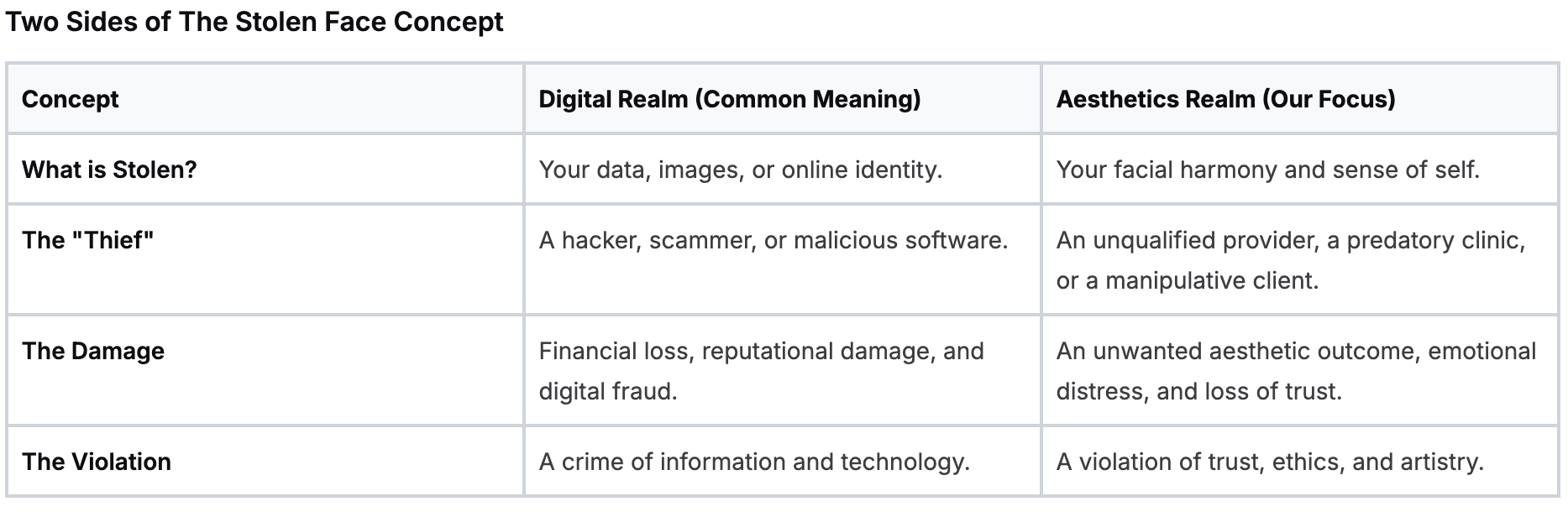
One is about losing control of your pixels; the other is about losing control of your peace of mind and personal identity.
This visual map helps delineate the two distinct worlds this phrase inhabits.
As you can see, while one is a violation of your data, the other is a violation of your very identity—inflicting a deeply personal and emotional wound.
At its heart, “the stolen face” is the face that wasn’t earned—either by a provider who failed to deliver on a promise or a client who strategically games the system. It’s a critical issue of professional ethics and client protection in the high-stakes world of medical aesthetics.
In the world of premier aesthetics, not all dissatisfaction is created equal. While genuine concerns from discerning clients are honored and addressed with the utmost gravity, there is a darker, more calculated side to client feedback: the strategic complaint. This is not an expression of a genuine issue; it is a calculated performance designed for one purpose: service extraction.
This is the art of getting treated for free. The client—or, more accurately, the client who came to take, not transform—arrives with a premeditated agenda. They weaponize the very principles of client-centric care, knowing that elite clinics will go to extraordinary lengths to ensure satisfaction. This turns the sacred provider-client relationship into a transaction to be exploited.
The core of this strategy is manufactured dissatisfaction. The client’s complaint is pre-written, their unhappiness a tool. It is cosmetic fraud: the polite version, executed from the other side of the treatment chair.
This concept of taking something unearned has deep historical parallels. The haunting history of “stolen faces”—a phrase that now extends beyond the first widely cited identity theft case in 1548—has found a new, insidious application. Today, it describes a client who “steals” a service through a disingenuous claim, eroding the foundation of trust upon which the entire industry is built.
Recognizing this “refund ritual” is essential. It protects discerning clients and ethical providers alike, ensuring relationships are founded on transparency and mutual respect—not on predatory behaviors and the upside of being difficult.
There exists another, more unsettling version of the stolen face—one rooted not in a provider’s error but in a client’s predatory intent. We call this the performance of damage: a calculated act where an individual fakes, exaggerates, or fabricates a poor outcome.
The motive? Almost exclusively financial. The face becomes a stage for a narrative of victimhood, performed with the objective of securing a full refund or complimentary future treatments. This is a tactic that exploits a premier clinic’s unwavering commitment to client satisfaction and reputational integrity.
In these scenarios, manufactured dissatisfaction is the script. The goal is not resolution but remuneration. When “unhappy” is a strategy, the clinical partnership devolves into a transactional conquest.
This behavior transforms a relationship built on trust into a hostile power dynamic, compelling ethical providers to defend against claims they know to be disingenuous. This is precisely why objective, data-driven evidence is our ultimate shield and the non-negotiable arbiter of truth.
High-resolution, multi-angle imaging—captured before and after every single procedure—is not merely for tracking progress. It is for protection. It safeguards the client with a genuine concern just as rigorously as it protects the clinic from those who seek to exploit the system. This meticulous documentation ensures every aesthetic journey is authentic, honestly evaluated, and built on a foundation of unimpeachable integrity.
Thus far, we have explored the industry underside from the client’s perspective. But the creation of a stolen face is a two-way street; predatory behaviors are not exclusive to one side of the treatment chair. The aesthetic world has a quiet, insidious problem: a polite version of cosmetic fraud.
This is the provider who pads a bill with unnecessary treatments or the clinic that sells a result they know is unattainable. This form of service extraction creates “the face that wasn’t earned”—an outcome you have paid for in full but which lacks the promised artistry, quality, or integrity.
Discerning a true clinical authority from a clever marketer is your first and most critical line of defense. Observe these subtle but telling indicators of a compromised practice:
Vague Consultations: A genuine expert delivers a detailed, bespoke plan. A rushed meeting that culminates in a one-size-fits-all package is a significant red flag.
High-Pressure Sales Tactics: An ethical clinic provides information, not ultimatums. Be wary of “limited-time” offers or pressure to commit on the spot.
Dismissiveness of Concerns: A true partner in your care listens intently. If a provider seems annoyed by your questions or dismisses your concerns, you must walk away.
The experience of cosmetic fraud can have deep psychological consequences, making you feel as if your authentic appearance has been taken from you. For individuals grappling with this impact, seeking external support like counselling services can be a crucial step toward healing.
In an industry with no universal standard of care, your choice of provider is the only variable that truly matters. It is the single decision that separates a masterful outcome from a version of the stolen face. The art lies in looking beyond marketing and learning to recognize the signatures of true clinical authority.
Consider the alarming rise in identity theft. The same vigilance required to protect your digital identity is now demanded when choosing who to trust with your physical one. The threat of cosmetic incompetence is just as real and far more visible. You can read the latest identity theft statistics to see why this level of scrutiny is non-negotiable.
True vetting is an investigation, not a casual scroll through online reviews. It requires a forensic look at a provider’s work, ethics, and transparency.
Analyze the Gallery: Do not seek the one dramatic “win.” Seek consistency across dozens of faces. Do the results honor each client’s unique anatomy, or do they all start to look the same?
Question Everything: Ask the incisive questions. “Is your Morpheus8 handpiece single-use?” “What is the sourcing and dilution protocol for your neurotoxins?” A world-class provider not only expects these questions but respects you for asking them.
Reject the Bargain: A cheap price is a warning, not a victory. It almost always signals a compromise in device quality, product purity, or provider expertise. The most expensive treatment is the one you have to pay someone else to fix.
Choosing an expert requires due diligence, a principle that applies to any high-stakes professional. The same logic used for vetting legal counsel is just as critical here—you are finding a trusted advocate for your own well-being.
At Beverly Wilshire Aesthetics, the stolen face is a concept we observe in the failures of others—never one we create. The industry underworld of cosmetic fraud, manufactured dissatisfaction, and the performance of damage stands in direct opposition to our clinical mandate.
We operate entirely outside the transactional “complaint economy” that fuels the business models of so many medspas. We believe superior outcomes are the product of a clinical partnership, not a simple purchase. This principle is absolute, guiding every interaction from our first conversation to your final, exceptional result.
We don’t build new faces; we reveal the absolute best version of your own. Our purpose is to architect bespoke treatment plans that elevate your inherent beauty to its highest potential—ethically and with world-class expertise.
This is our commitment. We invite you to schedule a consultation, which we view not as a sales meeting, but as a conversation grounded in clinical trust. Together, we will define a vision for your authentic transformation and deliver the elegant, earned results you deserve.
True aesthetic supremacy isn’t about becoming someone else. It’s about revealing your best self with unshakeable confidence. Discover BWA, a premier Beverly Hills medical spa that is redefining the boundaries of aesthetic care.
How can I tell between normal healing and a bad result?
An expert provider will furnish you with a precise, day-by-day map of what to expect—from typical swelling and bruising to the moment you will see your final outcome. Normal healing follows this predictable trajectory.
A bad result is a clinical failure. It is an outcome that falls far outside those established healing parameters, such as glaring asymmetry, unintended volume loss, or an appearance that betrays the aesthetic strategy you and your provider meticulously planned.
What should I do if a provider gave me a “stolen face”?
First, remain calm and methodically document everything with clear, well-lit photographs. Schedule a follow-up appointment immediately. Any reputable, medically-led clinic will take your concerns seriously and review your results with the gravity they deserve.
If the original provider is dismissive or a resolution is not possible, your next step is to seek a second opinion from an undisputed authority. Book a consultation with a trusted, board-certified practitioner to obtain an objective assessment and explore your options for revision and restoration.
No posts
Comments
Nothing yet. Say the first thing.
Sign in to join the conversation.