
Do you have a favourite bone? Maybe you like the elegance of the sphenoid or the odd-looking profile of the ethmoid. Perhaps it’s the keystone of the sacrum that you admire or an outlier like the hyoid.
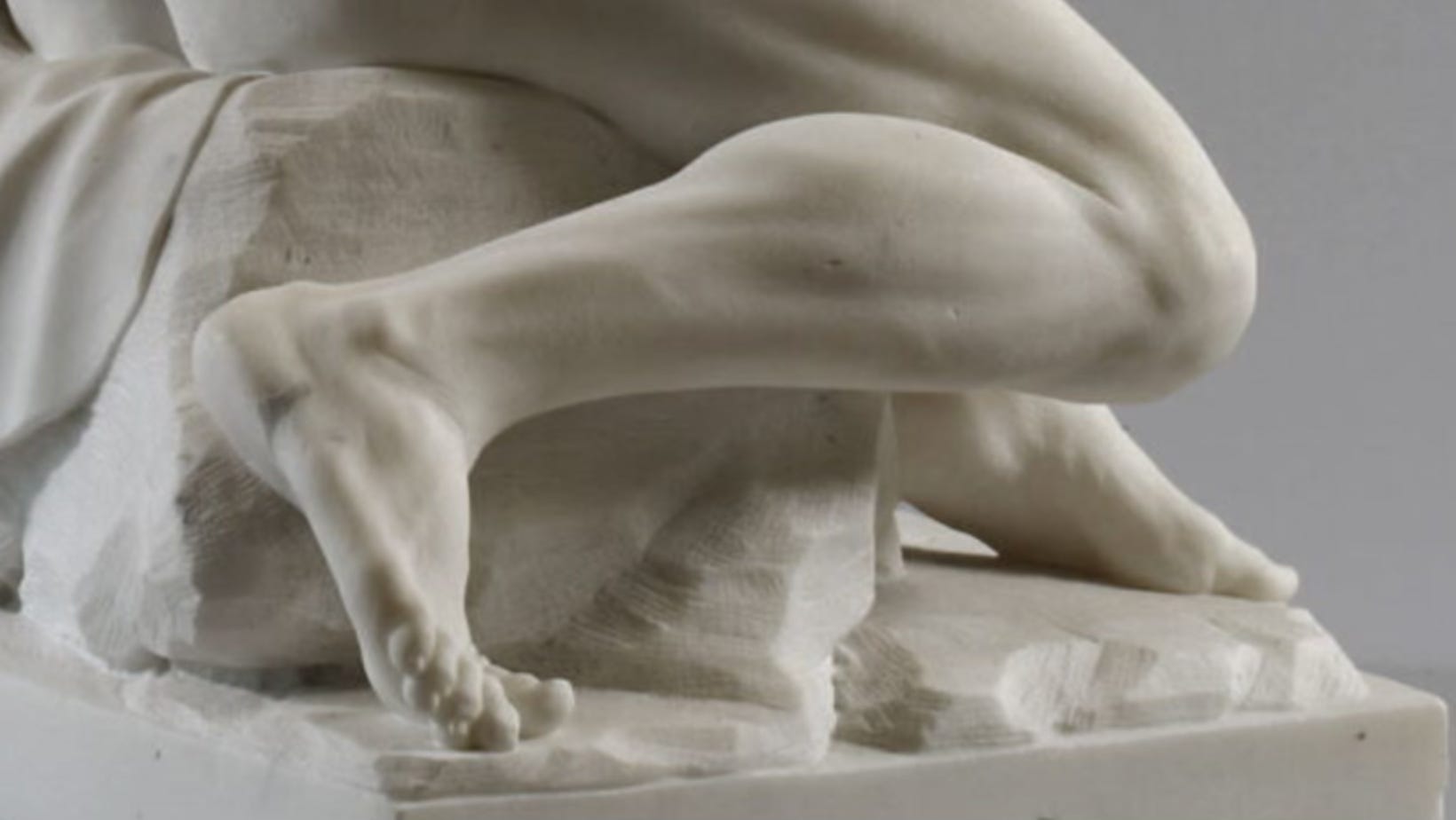
My vote goes to the fibula, the companion bone to the gorgeously straight tibia, or shin bone. The tibia stands like a Greek column when you bend your knee in Warrior 1 or 2. It’s the dominant of the two shin bones, the alpha bone if you will. It isn’t shy; it knows who it is, and is proud of it.
The fibula, meanwhile, standing just beside it, is more slender, more unobtrusive. It takes almost none of the load but is significant nonetheless, not the least for being a site for numerous muscle attachments.
HOW TO FIND IT
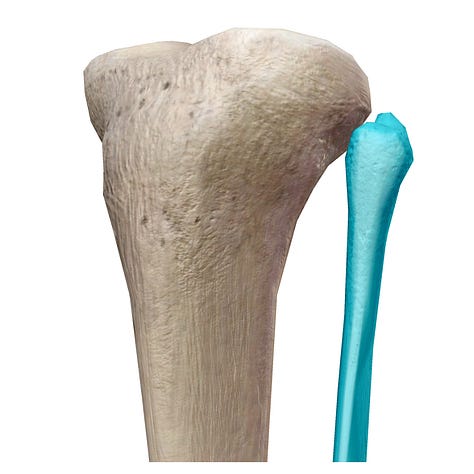
If you bring your hand to touch your outer ankle, you will feel a round, ball-like shape. This prominence would appear to be the ‘ankle bone’ in its entirety, but start to walk your fingertips upwards along the bony pathway until you find its end point. You might be surprised to land on a small bump just below and slightly behind the outer knee. This is the fibular head. What you may have thought was a small, stocky, round bone is in fact a long bone that runs the full length of your shin, from the outside of your foot to your knee.
Now, pinch this bone as you work your fingertips back down from your knee towards your foot and try to get a sense of its volume. It’s quite slender in comparison to its sibling, as I’ve mentioned, and you might be able to discern the space between them, which is bridged by a fascial membrane called the interosseous membrane.

HOW IT MOVES
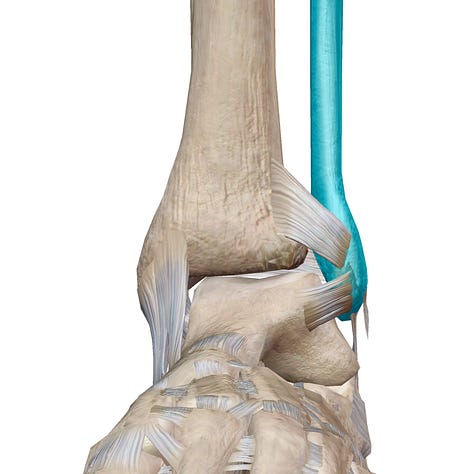
At its proximal end, the fibular head meets the tibia in a joint of its own. It’s separate from the knee joint itself, which is formed by the direct relationship of the tibia and femur, moving through flexion and extension. This proximal fibular joint allows a tiny amount of glide and a modest degree of rotation, echoing what is happening at the distal end, where the fibula actively participates in the motion of the ankle.
Notice how the talus is situated under an arch or bridge formed by both the tibia and fibula (see image 3 above). When your foot dorsiflexes — the motion of lifting your toes up toward your shin — the distal end of the fibula simultaneously glides backwards and internally rotates. This assists the backward movement of the talus through the space of the ankle joint. Similarly, when your foot plantar flexes, toes moving away from your shin, the distal end of the fibula glides forward and externally rotates to guide the talus forward.
Visualise these movements, then begin to somatise them slowly as you flex and point your foot (dorsi/plantar flex). Track the motion of the talus first, then add the motioin of the fibula as it feeds the talus back and forth under the arch of the ankle joint — it can help to imagine the whole fibula spiralling inward on dorsiflexion and outward on plantar flexion. Then try walking with attention on just one fibula at a time (it can mash your mind trying to alternate attention from one to the other, believe me), and somatise the rotation of this slender bone with each step.
VIOLIN & BOW
Pausing to reflect on imagery for the fibula, what came to my mind is the violin (tibia) and its bow (fibula). The bow itself is not dissimilar in shape to a fibula, however, it is the sense of how the violin and bow are a pair, designed to function together rather than apart, that persisted.
The violin is the larger of the pair and is the holder of the music, if you will, yet it is the bow that articulates the sounds through the deft handling of the musician. Notice how the violinist’s fingers give weight to one end of the bow, while the other end describes movement more freely in the space. The same relationship is reflected between the tibia, the visible load-bearer that gives the lower leg its sense of definition and solidity, and the fibula, which isn’t there to hold you up but to make the fine, continuous adjustments that let the ankle and foot do what they do.
Every time you step onto uneven ground, roll slightly onto the outer edge of your foot, or absorb a small twist over uneven terrain, the joints at both ends of the fibula are involved, sliding, rotating a few millimetres, giving the talus room to roll and glide.
Video clip via Canva, musician uncredited.
A FRESH LOOK AT STANDING BALANCES
You can take these insights into a yoga practice where you explore standing on one leg, or simply give this exploration a try where you are.
Shift your weight into one leg and foot, and allow the other foot to lift from the floor (have a wall, chair, or kitchen counter nearby for balance if that gives you more confidence). You could just let the foot hover, or place it into Tree/Vrksasana. You won’t need to manufacture any wobbling, it will arise as you seek to ‘keep your balance’.
Track the micro-movements that are happening in your foot as you balance, along with the changing contact your foot has with the floor. Then get curious about the ankle motion itself. How is the talus behaving under the bridge of your tibia and fibula? Can you sense the fine, fast corrections the fibula is making?
Rest that side by coming back to standing evenly through both legs and feet. Then try balancing on the other foot, focussing on the shin — maybe put a micro-bend into your knee to distinguish the shin from the whole leg. Notice the steady uprightness in the tibia, (the violin is in position) and that the fibula is actively listening, responding, fine-tuning moment to moment (the bow is drawing out the melody).
If you have the energy and curiosity, try balancing on each side again, this time with an awareness of the full length of the fibula: contrasting the tiny motions at the distal end with the sympathetic echoes at the proximal end, all the while aware of it standing at the side of the stalwart tibia.
I’ve really enjoyed sharing my favourite bone with you, and in the Companion Notes for paying subscribers, I’m going to unpack its pathway to the spine. And, did you know the fibula is the source of most bone grafts, a hidden function that makes it so much more than an accessory to the tibia. Somatically, this will lead us into thinking about understated but indispensable companions like Ariadne to Theseus, and Samwise Gamgee to Frodo, and journaling about the vital supporting roles we take on for our friends, family and colleagues.
until then, warm wishes
Beverley
PS funnily enough my next online Lab is not about the fibula! It’s about the tongue/heart connection (via the hyoid). If you would like to come along or receive a recording it’s on 4th September, 7-8,30 UK time (2pm EDT, 11am PDT) https://www.beverleynolan.com/store/p/whisper-body-lab
.
Comments
Nothing yet. Say the first thing.
Sign in to join the conversation.