
English summers used to be something of a joke. Fine weather was patchworked through wet and windy days when you could guarantee it would rain in the first week of Wimbledon, that you would need jigsaws and board games for the holidays, and hosting a barbecue would mean being prepared to do the grilling under a ‘sun’ umbrella and eating inside. This summer is different. Temperatures over the last six weeks or so have been consistently higher than anything ever recorded, and there’s no gold-medal kind of pride in those records, it’s actually quite scary. Electric fans have been on back-order on Amazon for weeks as if the country hadn’t quite believed the heat that June and July would hold.
And yet, governments and those who lobby them continue to weaken or delay the climate targets that were supposed to be keeping pace with all of this.
So, if you are feeling out of sorts with the weather and with the lurking mood of a climate emergency, I have a set of somatic practices that you might find supportive.
0:00
-12:01

FEELING HELPLESS?
This can show up when the scale of the climate and nature crisis feels bigger than any single action you could ever take. No amount of recycling, conserving energy, taking public transport, or eating less meat feels like it matters when corporations are at scale strip-mining, polluting rivers, and clearing forests without restraint.
It can show up as listlessness in your body, a sense of defeat, where your connective tissues feel loose, directionless, flaccid. To remedy this, it can help to re-find your “yield and push” first, through your bones.
Stand and explore bending your knees and pressing your feet into the ground, finding a pulsing action to encourage the rebound of that downward push back up through your feet bones, shin bones, and knees. Tracking the yield and push via your thigh bones, pelvis, converging in your sacrum, all the way through your spine to your head. Let your arms swing in time with the pulsing. Keep pulsing until the earth eventually pushes you back up into an upright standing shape.
If standing isn’t an option for you, try finding the yield and push through your sit-bones until you feel yourself sitting more erectly.
Feel the earth replenishing your bones with mineral support.
You could take it further by exaggerating the yield and push into a small jumping action. Let your muscles find a feeling of vitality and strength. Find your superhero alter ego, and give a roar.
FEELING BRACED?
When another heatwave unfolds, or you witness forest fires, or flash-flood storms, you might sense tension gathering in your body as you read your weather app. This might consist of a tightness in your belly, a gripping in your shoulders, a setting of your jaw, as though your body is bracing itself to endure what lies ahead.
To counter this feeling of apprehension, practice softening, not as a surrendering but as a gesture of being willing to meet the world as it is, to hold the space for the earth’s own surges of energy.
Take one sensation at a time. Don’t rush. Sometimes bracing might be what is needed; it might be how you tap into strength and resilience.
A long, hissing breath or sigh can begin to unwind the feeling of bracing in the tissues. A conscious gesture towards flexion can help too: try bending the knees and hips as you breathe out. Imagine letting go of the weight of your arms. And, release any unnecessary tension in your jaw and brow. Imagine your skin becoming smooth like a covering of silk or satin.
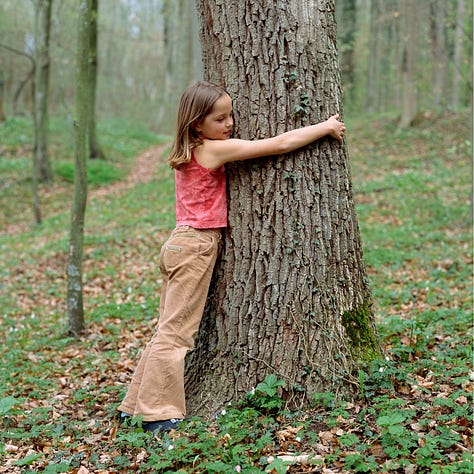
Now in this softer body, feel how you are always held by nature, embraced by it (even when it’s raging), and receive that embrace with reciprocity. Hold and be held simultaneously.
FEELING SADNESS?
When the seasons are unfolding in unfamiliar ways, your garden looking dry and spent, the water in the bird bath all but evaporated, the ground as hard as concrete and cracking, it’s natural to feel a kind of grief for what’s changing, or even lost.
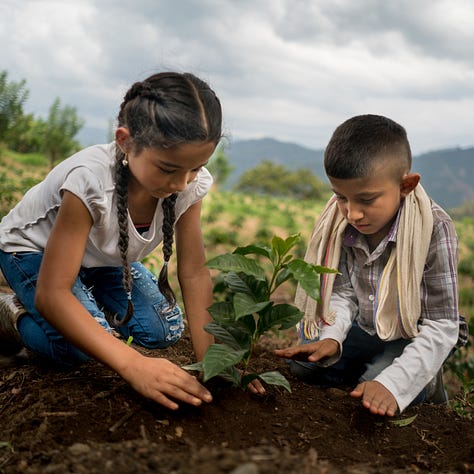
Sit down with nature. Witness it. Don’t do anything but gently tend the garden if you feel moved to, otherwise, simply be with the place as it is. Watch for birds and insects at times of the day you don’t expect. Lean into the trees and listen for the slow rise of sap. Savour the slow ripening of the berries and the swelling of squash and pumpkins.
Let your witnessing acknowledge the quiet evidence that things are adapting in ways too slow to see day to day and that there is a hopefulness in the responsiveness of nature to the changes it has not wrought upon itself.
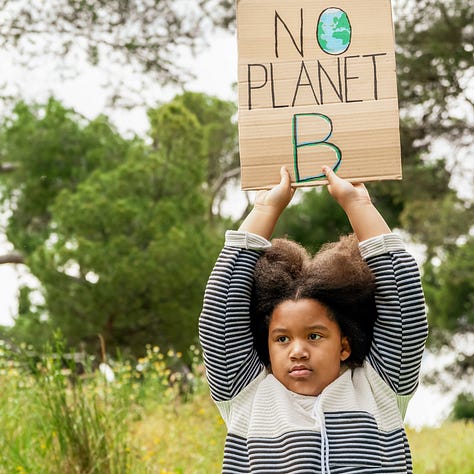
FEELING SMALL?
Overwhelm is, by its very nature, a big sensation, and it can shrink you down into a sense of insignificance that can tip over into cynicism. This might be a moment to move more deliberately into smallness, rather than move away from it.
Gather your body into a small shape, maybe crouching into a squat, or curling up on the floor. Then, see if you can make yourself smaller still: compressing further, drawing your limbs in. Smaller, smaller, until, like a coiled spring, you feel the turning point where smallness is impelled to open again. Push up gradually from your squat to standing, or slowly unfurl over the floor — it may take several movements to open out fully. Take your time.
Notice how you first needed to drop further into smallness, in order to find your way back out to your greatness again. It’s another embodiment of yield and push.
FEELING ANGRY?
Anger is one of the few climate-change emotions that has an expansive and forward motion to it, a push towards action rather than away from it. It often gets suppressed because it feels too big, impolite, or awkward to show, hence it’s often held back where it can curdle into cynicism or exhaustion instead.
Stand with your feel a little wider than hips-width and bend your knees slightly (I actually like to take a small lunge stance, like a small Warrior 1/Virabhadrasana 1 stance). Make fists of your hands and hold them palm up at shoulder height, elbows bent.
Now, alternately drive each arm out and back in a spiral action as if you are pushing or punching into and through a firm cushion of air in front of you. You might also let out a short, sharp exhale with each push, or a Haa sound.
Repeat, with whatever intensity feels right. Remember the movement is focused, rhythmic and direct not randomly wild. When you are ready to stop, shake out your hands, arms and legs and let your breath settle.
The heat of this emotion can be motivating but it needs constructive discharge to create constructive action. When you want to stand up for the climate, campaign for change, try a few of these movements to galvanise and direct your energy.
Consider these five practices a somatic first aid kit: they are useful in the moment, when a feeling arrives and settles into your body and you need a way through it.
There is also a deeper layer to this work and in the Companion Notes, I’ll be sharing another set of practices for reconnecting with nature and cultivating a sense of companionship and belonging with the more-than-human world that we sometimes lose sight of when we are transfixed by screens and AI machines.
Until then, I am sending kindest wishes from an altogether too hot English summer,
Beverley
Comments
Nothing yet. Say the first thing.
Sign in to join the conversation.