
0:00
-13:20
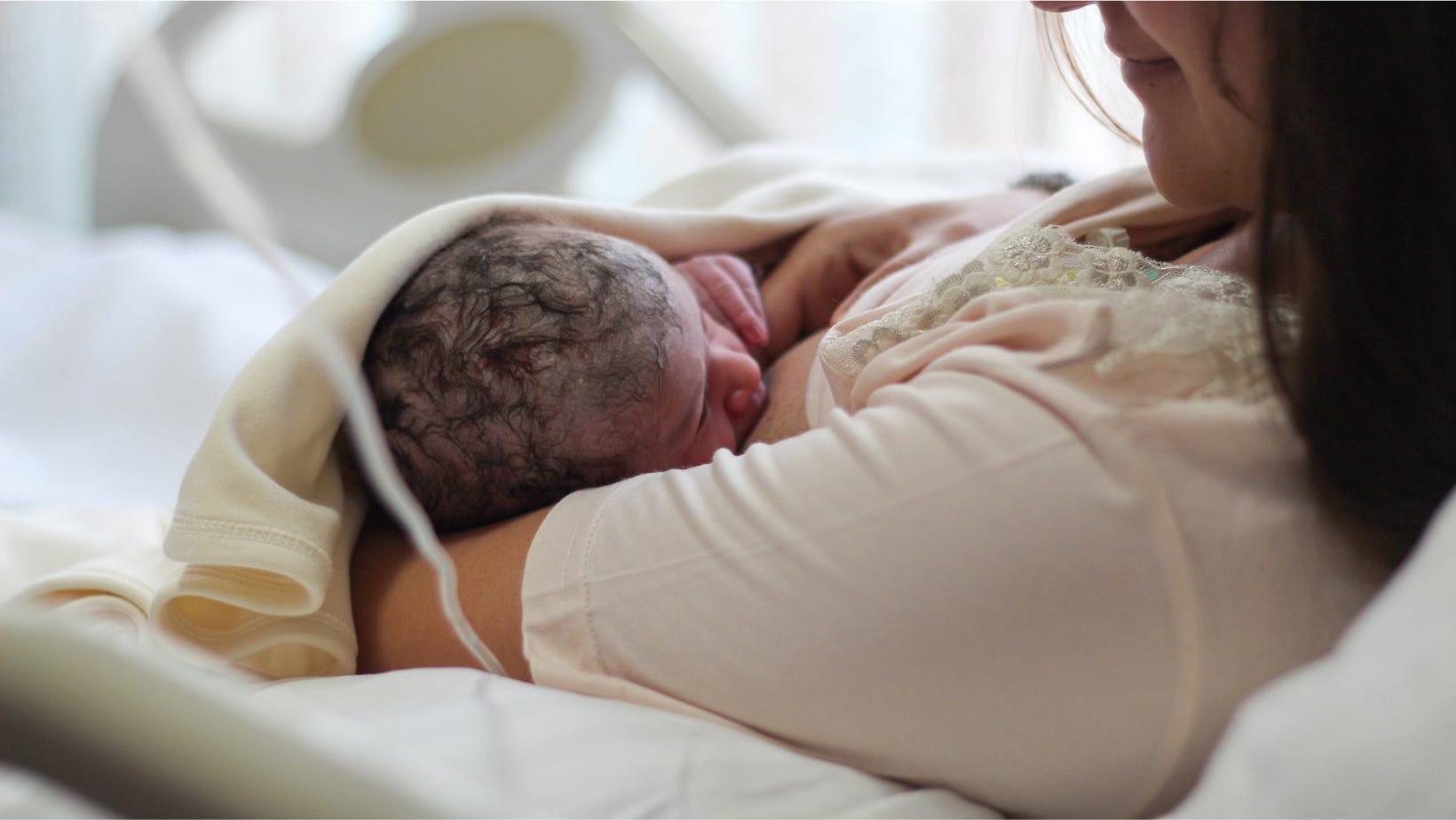
Before an infant can lift their head, and long before they can reach or roll or hold their own feet, their body is already making sequential, organised movements. Watch a baby nursing and you will see how they orient their head and open their mouth, lips reaching in the rooting reflex, a primal and insistent seeking made by the ‘limb’ of the mouth, in the search for maternal nourishment.
Keep looking as the baby latches on to the mother’s breast and begins to draw down milk and you will see their jaw is in rhythmic motion. Look a bit closer, and you will see that it isn’t moving in isolation. It is shifting the occiput at the atlanto-occipital joint and, as a result, the cervical spine lengthens and shortens concertina-like creating a ripple through the small body. A collection of reflexive movements that begin at the mouth and jaw is sequencing through the entire spine turning feeding into an axial motion.
To understand this a little better, it’s worth revisiting your embryology.
BEFORE A FACE
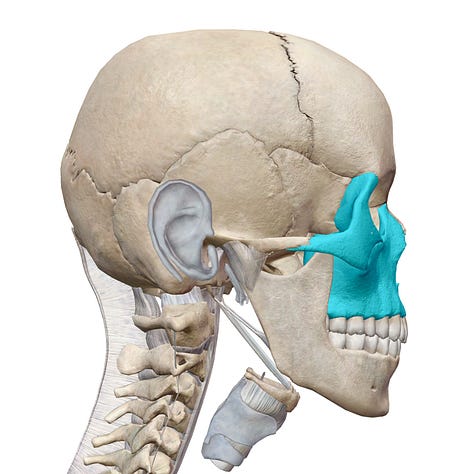
Your jaw doesn’t actually begin as a recognisable jaw bone. In the third and fourth weeks of embryological development, the first pharyngeal arch — a crescent of tissue that looks more like the gill of a fish than a human chin — begins a process of differentiation. From this single structure, various others will emerge: certain facial bones including the maxilla and mandible, the four muscles of mastication, part of the digastric muscle (connecting your mandible to your hyoid bone), and the tensor veli palatini, a fascinating little muscle that helps equalise the pressure in your ear when you are swallowing or yawning. Also emerging from this arch are the malleus and incus, the two smallest bones of your middle ear. You can see already how mouth and ear, sounding and hearing, connect.
The notochord and the pharyngeal arches are evolving in parallel, organising different territories.The notochord running along the midline of the embryo organises the segmentation of tissue to form paired blocks of somites that will become among other things the spinal vertebrae, while the pharyngeal arches organise the head and neck through neural crest cells, a collection of cells that have migrated from the neural tube. Interestingly, the neural tube itself was induced by the notochord, a testament to a shared origin of the jaw, skull and spine upstream in our embryological unfolding.
Movement of these early structures is organised through in utero “reflexes”, which are patterned motor programmes coordinated by brainstem circuits called central pattern generators. Each of these is rehearsing the neuromuscular sequences a newborn will depend on from their first moments after birth. By the end of the first trimester of gestation, the swallow reflex is already patterning and is closely followed by the suck reflex. Around 28 weeks the phasic bite reflex is present (this permits a rhythmic closing and opening of the fetal jaw), along with the rooting reflex.
THE JAW AND BIRTHING
When a baby is presenting for birth head-down, the head initiates a sequence of movements in response to the geography of the pelvis and the rhythmic waves of contractions of the uterus, with the jaw playing a role in this sequence.
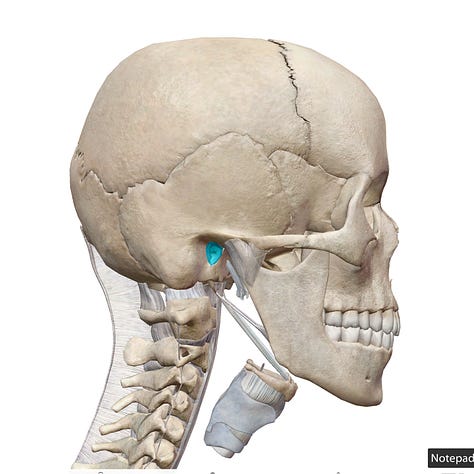
As noted above, the movement of the jaw influences the position of the skull. The cranial base is sitting directly above the occiput, which articulates with C1, the atlas, at the atlanto-occipital joint. This joint is the pivot point between the skull and the entire vertebral column. Tension or compression here communicates in both directions simultaneously. Running from the cranial base to the sacrum, the dural tube (the connective tissue sleeve of the central nervous system) carries the mechanical consequences of this relationship along the full length of the body - imagine how central this action is to the birthing process.
Essentially, what happens at the jaw does not stay at the jaw. It travels all the way to the sacrum. For this reason, it is not wrong to say that the jaw is the first joint of the spine.

Let’s pause here for a moment and reflect on some of this. Bring attention to your mouth. Notice its natural set in this moment. Check for tension in your lips, gums, tongue, throat, and in your neck and upper back.
Then consciously allow your back teeth to move away from each other, unstick your tongue from the roof of the mouth, and if your lips are pressed together, soften their contact. Notice what, if anything, changes particularly at the base of your skull. back of your throat and along the length of your neck.
FROM JAW TO DIAPHRAGM
The feeding sequence of the newborn might be the nervous system’s first sustained, rhythmic, whole-body pattern. It requires the jaw to open and close in coordinated rhythm with the tongue pressing against the palate, the soft palate sealing the nasopharynx, the hyoid moving, the larynx rising. To perform this sequence well, the infant needs a tissue map of organisation from the occiput to the sacrum.
I’d nominate the hyoid bone as the structural key here. Suspended in the anterior throat between the jaw above and the larynx below, it connects upward to the mandible and temporal bones via the suprahyoid muscles, and downward through the infrahyoid muscles to the sternum, clavicle, and scapula. Via the pericardium and its fascial continuations, this connection extends to the diaphragm and the anterior longitudinal ligament (ALL) of the spine. If we consider the myofascial map offered in Tom Myers Anatomy Trains work, an infant feeding is patterning movement along what he determines is the Deep Front Line of the body.
Come back to the same enquiry you did before, bringing attention to your mouth. Check for tension again, and extend your checks to your throat, ribs and abdomen. Go through the actions of softening the jaw and this time notice any effects around your larynx and diaphragm, notice any changes in your breathing.
EASING THE JAW
Jaw tension is remarkably common. It can be a source and a symptom of neck and shoulder holding, restricted breathing, a braced throat, and a constrained voice. Mobilising the jaw in a variety of ways – think sounding and exaggerating the vowels, moving the tongue (and Lion’s Breath for yoga people), pulling faces in the mirror – often reach places that conventional stretching and massage don’t.
The developmental timeline is something else worth thinking about. The early oral reflexes leave an organisational imprint in our tissues when they become integrated, meaning that a tight jaw now might reflect an older holding pattern rather than be a result of recent stress or repeated postural habits. Revisiting these early movement sequences: the rhythmic opening and closing of the upper and lower jaw, mobilising the tongue’s exploratory reach, and the whole-body quality of a good yawn, all may offer a way in to the jaw that addresses not just the tissue tension but the pattern beneath it.
And finally, in my own experience, jaw tension can carry something else entirely, the embodiment of the unspoken: words held back, things left unsaid, a voice that learned early to make itself smaller or quieter. If any of that resonates, journaling can be a gentle way to begin unpacking it and, if it feels like a larger theme, a somatically-oriented therapist can offer a more supported way through.
In the next piece — for paid subscribers — we go further into the phonetics of the jaw, the sounds it shapes, the evolutionary surprise that lies in your malleus and incus (well, it was a surprise to me!), and what Object-Oriented Ontology might offer us on the origin and interconnectedness of objects when it comes to our experiences of the body.
So, that’s it for now. Thank you for reading (or listening), I really do appreciate your time and attention when so much is calling for it - more on this in my monthly round-up.
In the meantime, I’m sending warm wishes from Cambridge as ever,
Beverley
PS - If you would like to explore the jaw more fully with me. I am running an online Body Lab on 10th July (7pm UK time): Fulcrum: the interplay of jaw and spine. It is a 90-minute live session on Zoom, recorded and available for 30 days, open to all.
Comments
Nothing yet. Say the first thing.
Sign in to join the conversation.