
Something about the brain has always struck me as curious. It has two genuinely distinct hemispheres each with its own responsibilities and yet they are not separate. A dense arching band of white matter called the corpus callosum holds them together or, as you’ll discover later, deliberately keeps them apart.
Why two halves? Would the brain not work just as well as a single structure? Something about this twoness is clearly important. Every mammal you’ve ever encountered and all those you haven’t, share the same divided architecture to their brain (marsupials and monotremes being the exceptions). Fish have two brain hemispheres, as do birds, in fact this architectural divide has been present in vertebrate life for millions of years.
So, what does division make possible that a single unified structure could not? And if two is better than one, why do they need to be joined together? And what might this feel like experientially?
0:00
-14:55
FORM AND THE DIVIDED BRAIN
The word callosum comes from the Latin callosus meaning tough, or hardened. You might recognise it in the word callus, the thickening of skin when it meets repeated friction - professional gardeners, for example, often have callused hands and ballet dancers callused feet. Corpus simply means matter of any kind or body, as in corporeal, so the corpus callosum is just that: a tough, thickened structure.
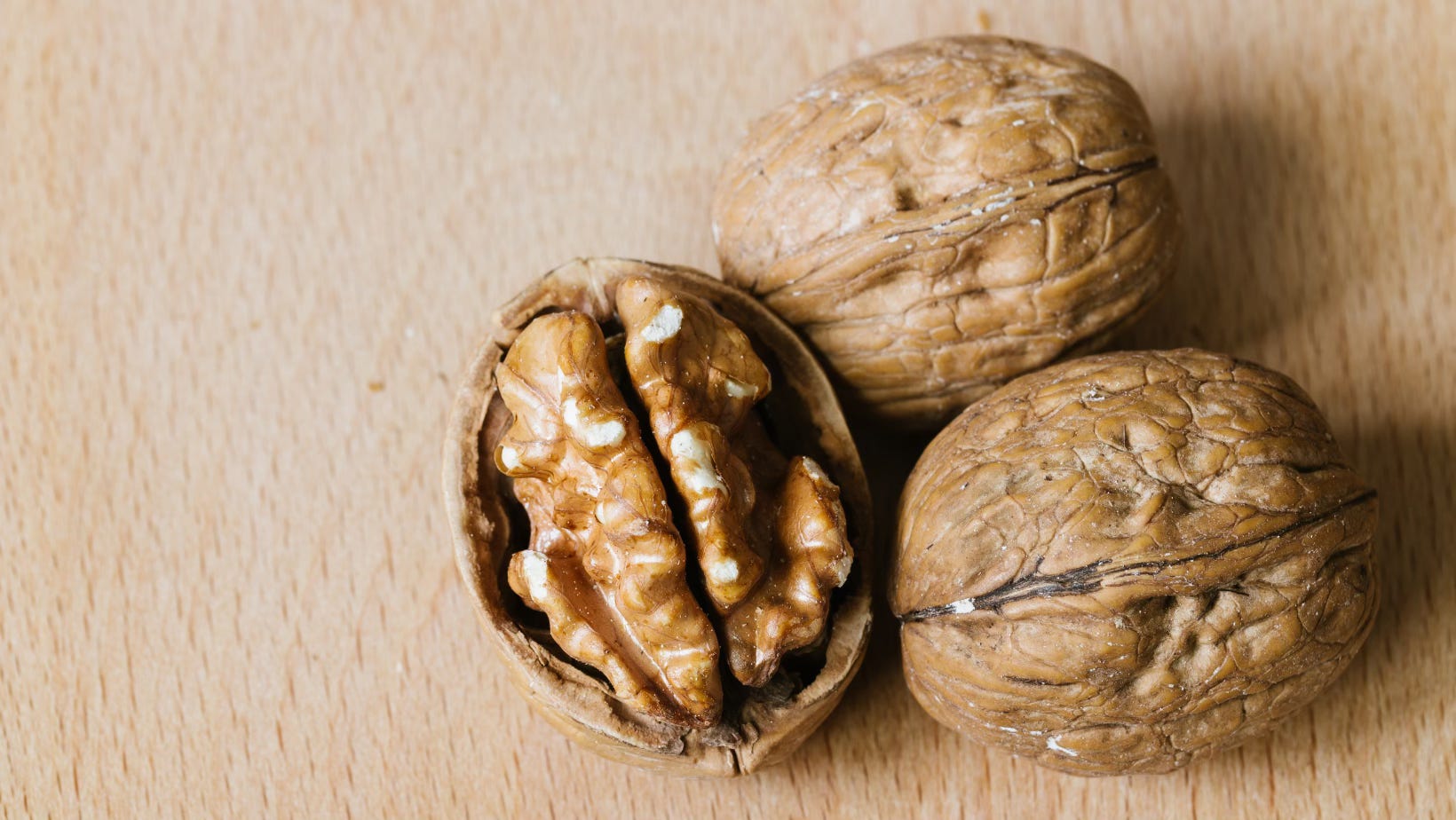
It runs along the midline of your brain making the whole structure reminiscent of a walnut segment, each half a near-mirror of the other. It’s about 10cm long and is made of hundreds of millions of nerve fibres with a diameter that varies along its length. It’s difficult to come up with an adequate analogy for the amount of neural signalling that is moving through it but imagining a hectic international border crossing like the one between San Diego, USA and Tijuana, Mexico hints at the massive volume of bidirectional traffic.
The received story about the corpus callosum is that it is the unifying structure for both hemispheres acting as a conduit for this traffic between left and right. This is true, however, the vast majority of signals travelling between the two hemispheres turn out to be inhibitory. The corpus callosum spends most of its time initiating neural processes that are keeping one hemisphere out of the business of the other, optimising co-operation through mediation. Seen from this perspective, it is less a unifier more a separator.
TWO HEMISPHERES, TWO WAYS OF SEEING THE WORLD
The brain’s organisation into two distinct hemispheres, each with its own specialised responsibilities is called lateralisation. For a long time, each was attributed with separate functions and often simplified into left brain logic and reason, right brain intuition and creativity. Psychiatrist and writer Iain McGilchrist (see The Master and His Emissary) argues that the better way of understanding their differences is not by what they do but how they attend.
He explains that the right hemisphere is expert at holding the broad picture. It understands context, reads between the lines, is open to uncertainty, can read faces and understand metaphor. It is the hemisphere that knows it doesn’t know everything and is OK with that - this is The Master. On the other hand, the left hemisphere excels at narrow focus. It can abstract, categorise, and name, and excels at taking the world apart in order to understand and control it - this is the Emissary.
This ability to attend with both a wide and a narrow focus is at heart a survival skill. Research12 with chicks, demonstrated that those with well-developed lateralisation could simultaneously apply narrow focus on sorting food from pebbles and watch out more broadly for a hawk predator overhead. Those without clear lateralisation could not hold both tasks at once - when the hawk appeared, the food task was abandoned. The division of the brain, it seems, is an architectural solution that allows us to maintain two fields of attention: close in, and wide. We carry both these capacities everywhere - the ability to focus finely on what is directly in front of us, and to remain open to the scope of our surroundings.
Interestingly, McGilchrist extrapolates his observations into the evolution of Western history where, since the Renaissance and threading through the Reformation, Enlightenment, the Industrial Revolution, modernism and post-modernism, the approach of the left hemisphere has increasingly become the dominant worldview: information over wisdom; reductionism over wholeness.
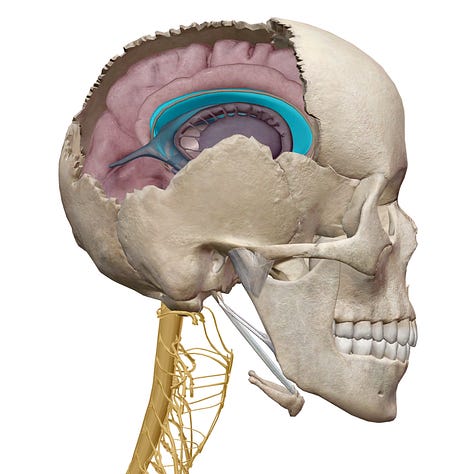
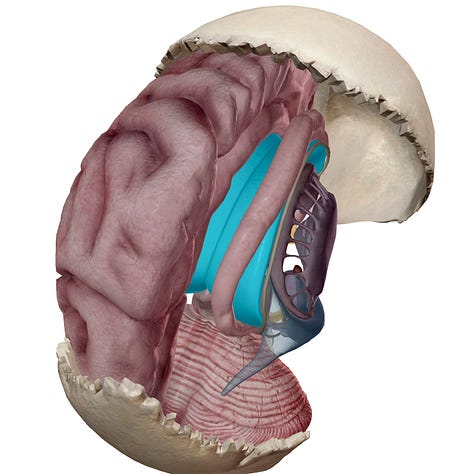
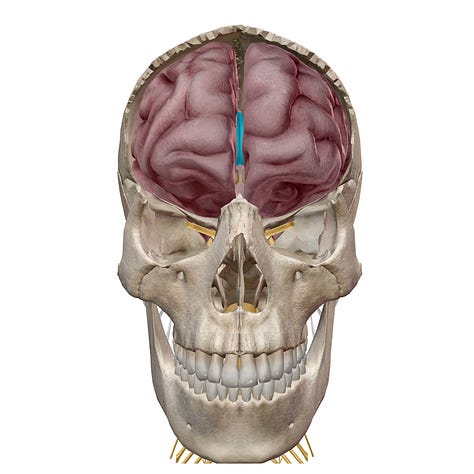
LOCATION & ORIENTATION
First, think of your brain in layers: cerebral hemispheres at the top, then the deep central structures, then the brainstem descending into the tail of your spinal cord. The corpus callosum is situated in the upper middle layer, like a vaulted arch, forming a roof beneath which lie the lateral ventricles (that produce and circulate CSF), one each side of the midline. Below the ventricles are the paired structures of the thalamus that flank the narrow third ventricle, and below all of this is the brainstem and spinal cord.
I’ve included some images above that I created in the Human Anatomy Atlas from Visible Body to help you locate the location of your corpus callosum - it’s highlighted blue.
Trace the midline of your skull with the fingers of one hand - I like to spread them apart to about 10cm. Start at the bridge of your nose, travel up and over the crown and descend to the base of your skull at the back.
Now let that fingers rest anywhere along that line at the top of your head.
Bring your attention through the skin, connective tissues and bones into the cranial space. Take a moment to pause, giving yourself time to acknowledge the presence of your brain floating in the CSF, and then its two hemispheres.
Then imagine your fingertips sinking softly about two thirds of the way down from your crown to the base of your brain. This is where the corpus callosum arches between the hemispheres.
BUOYANCY AS BALANCE
All this talk of fluid reminds us that the brain is submerged in CSF and effectively floats inside the skull. Without this buoyancy, the brain would compress its delicate fibres and vessels simply through its own weight in relation to gravity. The brain is also softly touched and moved by the slow tidal flows of the CSF - if you missed the explorations into CSF, I’ve set free this article from the Field Notes archive.
You might explore this buoyancy by letting your head lead your spinal movements like seaweed in a gentle current.
Let your head drift forward then back, gently drawing your spine with it. Let the brain find its settling point, before initiating another movement.
Try moving sideways, swaying, or turning into other settling points before returning to your starting place.
Notice that weight is shifting across the hemispheres as you tip this way and that on the internal currents.
Become aware of the corpus callosum like the keel on a boat. It follows the gravitational pull of the hemispheres but doesn’t allow the boat to tip over entirely.
CROSS-BODY ORGANISATION
There’s one more detail worth noting: the hemispheres govern opposite sides of the body, the left hemisphere the right-hand side, the right hemisphere the left-hand side. This crossover happens deep in the brainstem.
Cross-body (contra-lateral/diagonal) organisation appears in our infant movement patterns when the complexity of crawling and walking are layered over the earlier homologous (upper/lower organisation) and homolateral (left/right organisation) movement patterns. To read more about these patterns and how to explore them, do check my affiliate booklist here.
When you are next out walking notice if your arms are swinging in a cross-pattern with your legs. Each stride identified by the rhythmic swinging of right leg/left arm and left leg/right arm. It’s a pattern that relies on the co-ordination of left/right hemispheres and leads to a spiralling spinal wave motion that in turn produces the helical forces that propel you smoothly through the world.
As you get into a rhythm, try locating your attention in the corpus callosum and notice how your experience of walking might change. As an extra enquiry, look out for a sense of an alternating forward and back motion of the hemispheres themselves. You might find they ‘walk’ with you.
So, we’ll conclude our preliminary enquiries into the corpus callosum there. Thanks as ever for reading or listening. In Companion Notes, we’ll dip a bit more into left-brain/right brain topics, and I’ve recorded a short yoga nidra practice inspired by these themes, as well as an alternate-nostril breathing practice which I have found particularly intriguing
warm wishes from me,
Beverley
PS - apologies for a later than mid-month publication, I had the first round of copy edits for Bodyscapes to work through, and first sight of potential illustrations and cover designs!
Share Field Notes From The Body
Rogers, L.J., Zucca, P. and Vallortigara, G. (2004) ‘Advantage of having a lateralized brain.’ Proceedings of the Royal Society of London B, 271, pp. S420–S422.
Rogers, L.J., Zucca, P. and Vallortigara, G. (2005) ‘Hemispheric specialization and dual processing in strongly versus weakly lateralized chicks.’ Behavioural Brain Research.
Comments
Nothing yet. Say the first thing.
Sign in to join the conversation.