
As a right-handed person, I move through my days among the 90% of individuals across the globe who rarely think about my handedness. It’s an automatic, unearned privilege that allows me to pick up and use a pair of scissors without the blades misaligning, to use an ATM without crossing my midline, and to adjust the time on my watch without taking it off my wrist.
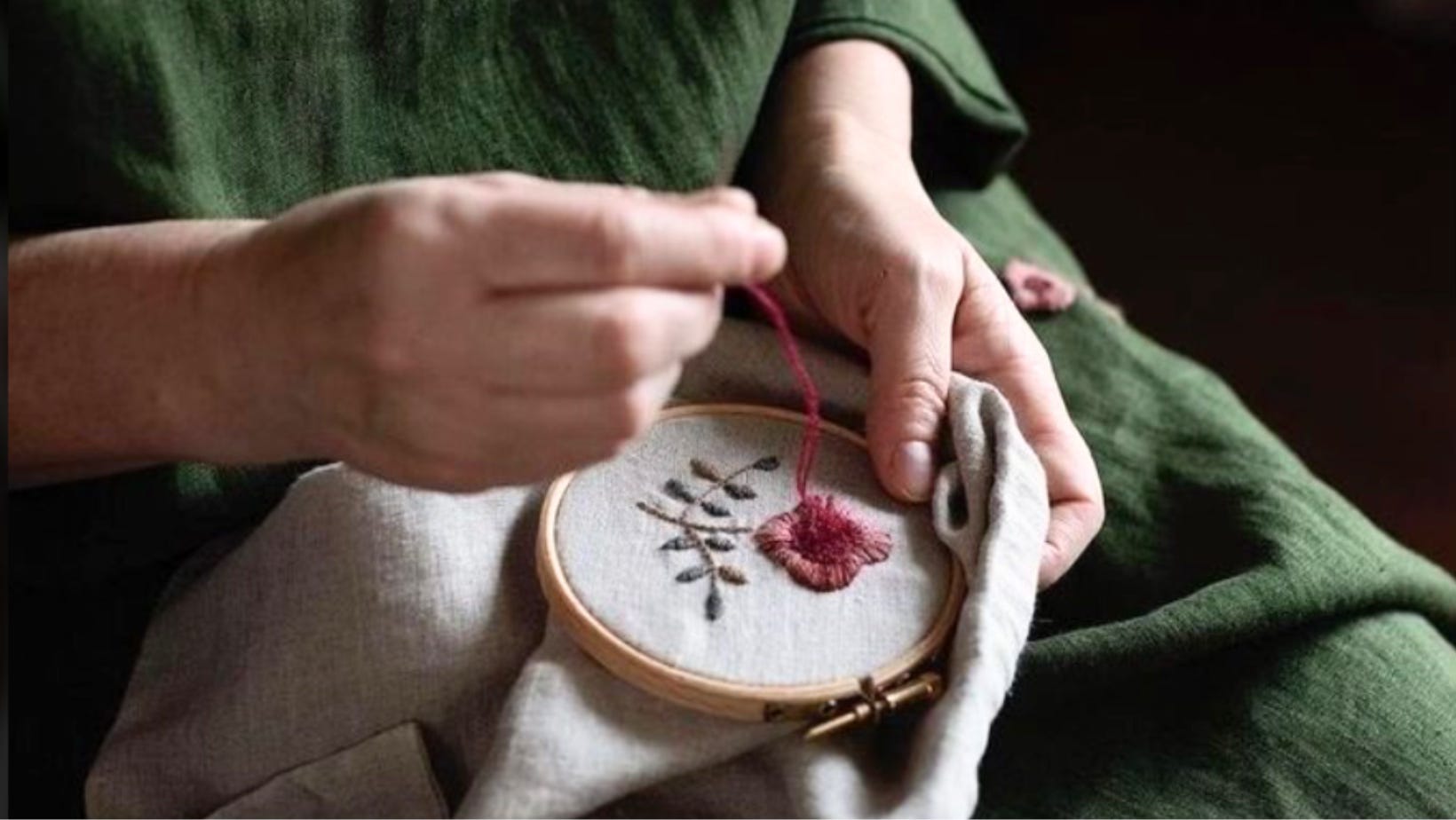
The world has largely been designed around this particular presentation of a neurological pattern that was set somewhere in our infancy, if not in utero. We know that handedness, favouring one hand over the other for specific motor skills, is in part influenced by genetics, but it’s not unreasonable to propose that it may be seeded in the womb. Indeed, ultrasound studies observing fetuses from as early as 15 weeks of gestation have found a consistent bias toward sucking the right thumb1 that, when followed up a decade later, aligns with the dominant hand the child writes with at ten or twelve years of age2.
0:00
-17:48
LATERALISATION
We looked at this architecture in the Field Notes about the corpus callosum, unpacking the brain’s two hemispheres that are held together in constructive separation by this dense band of white matter that runs along the midline. To briefly recap: drawing on the work of psychiatrist and writer Iain McGilchrist, we can understand the difference between the hemispheres not as a division of tasks — logic on the left, creativity on the right — but as a difference in how they attend to the world. Your right hemisphere holds the broad picture: open to context, comfortable with uncertainty, able to read between the lines. Your left hemisphere excels at narrow focus: abstracting, categorising, naming, controlling. McGilchrist calls the right hemisphere the Master and the left, the Emissary.
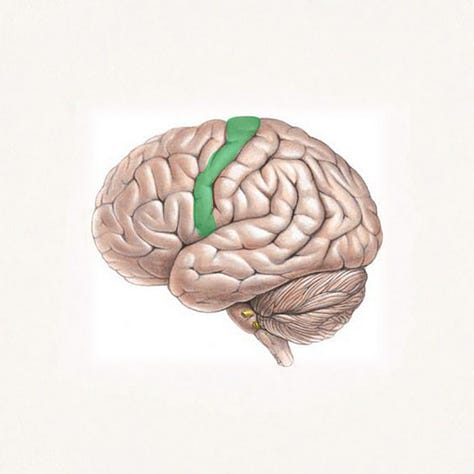
The hemispheres connect to opposite sides of the body. This crossover, known as contralateral organisation happens deep in the brainstem where the nerve fibres descending from each hemisphere cross the midline before travelling down the spinal cord and out to the limbs. What this means for your hands is that the left hemisphere governs your right hand while the right hemisphere governs your left. So, for most of us, the dominant right hand is the Emissary’s hand: the hand of purpose and precision, of getting things done. The non-dominant left hand belongs to the Master being less trained in narrow purpose and as such differently available to us. When the dominant hand is the left, this relationship is reversed, and we see this reflected in the motor cortex (see below).
Try resting your non-dominant hand in your lap for a few moments and think about how it feels. The open palm is soft, the fingers curling inwards naturally. Without trying to feel anything in particular, simply notice what is already there. What feeling fills that small well of space? Let a few words or images arise - not the ones you expect but the ones that actually come.
Now try the same thing with your dominant hand. Let it come to rest in the same position, palm upward, fingers soft. Again, without trying to feel anything specific, notice what is already present in the small well of space. Pause. Reflect beyond the physical sensations. What quality resides in your palm?
Sit with both impressions for a moment before reading on. There are no wrong answers to these enquiries only observations of what is actually present for you.
HANDS AND MOUTH
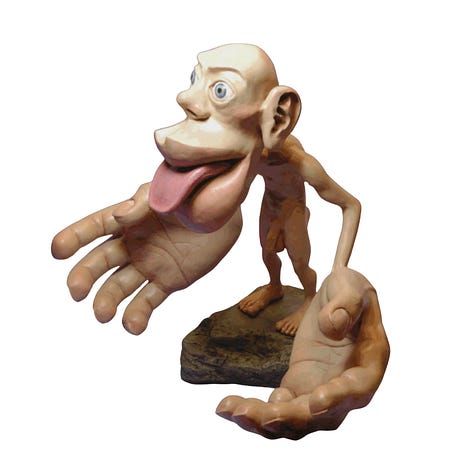
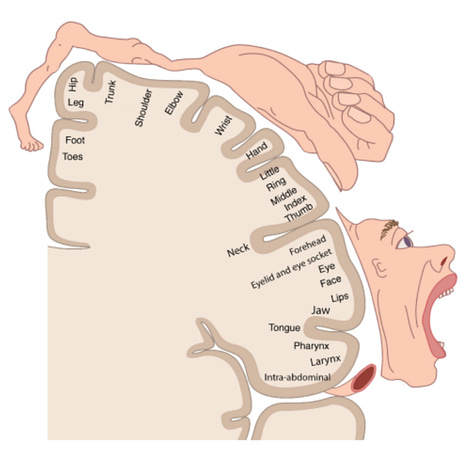
There is a well-known image in neuroscience called the motor homunculus. It’s a body map of the motor and sensory cortex drawn in proportion to the density of its neural representation rather than the body’s actual shape. It shows an odd-looking human with enormous hands, a huge face with enlarged lips and tongue, and a comparatively tiny torso and legs (see the images below).
Your hands alone account for a huge portion of cortical ‘real estate’, more than your entire torso. This reflects the complexity of what your hands can do and their extraordinary sensitivity, the fingertips containing some of the highest concentrations of sensory receptors in the body detecting and distinguishing ranges of touch and texture, temperature, fine spatial details, vibration, and pressure changes.
Interestingly, the area occupied by your hand is directly adjacent to that of your face. This means your lips, tongue, jaw and larynx sit as close neighbours to your fingers. Do you ever notice involuntary micro-movements of your tongue, jaw or lips when you are doing handiwork: threading a needle, picking a hair from your jacket collar, putting a key in a lock? This proximity seems not to be accidental. Research suggests it reflects a deep functional relationship between manual gesture and the evolution of speech.3 4It’s worth noting that the brain’s primary speech centres sit in the left hemisphere: Broca’s area which governs speech production and Wernicke’s area which governs comprehension. (I explore this relationship more fully in Bodyscapes, in my chapter on muscles as agents of expression.)
What lateralisation seems to mean is that one hand takes the lead and the other lends a supporting role: I steady the needle in my left hand as I guide the fine thread through its eye with my right. It’s rather like one hand is the speaker and the other the listener; one hand is active the other receptive.
TWO HANDS TOGETHER
There are contexts in which both hands execute different roles in a single action. We see this clearly in musicians. Pianists and guitarists spend years developing both hands to play their instrument, the hands moving in collaboration rather than one leading the other or relying on support from the other.
This is reminiscent of homologous movement patterns where both upper limbs or both lower limbs move together - think of jumping rather than hopping or supporting your body in plank pose rather than side-plank pose. Homologous patterning would seem to connect us to the possibility of embodying ambidexterity when neither hand is dominant.
For information, those who are left-hand dominant on average show a greater tendency toward ambidexterity or mixed-handedness. This is not necessarily through any innate neurological impulse, but simply because navigating a world designed for the other hand for years has developed their non-dominant side. In McGilchrist terms, the Master does not become the Emissary, it becomes a more articulate Master.
Before we go further, try this.
Bring both hands to rest on your lap, palms facing downward. Take a breath and let both hands soften, releasing any held tension in the fingers, the knuckles, the wrists.
Begin with your dominant hand. Without moving it yet, bring your full attention to it. Notice its weight, its resting posture, any sense of readiness or habit in the way it holds itself. Let it shift position if it wants to. Maybe it wants to feel its own form differently.
Now shift your attention entirely to your non-dominant hand. Make the same enquiry. Take your time here. This hand may be less familiar as an object of your attention. Again, let it shift position if it wants to.
Pause a few moments and become aware of both of your hands resting. Invite them both into movement. Not necessarily in unison with each other. Not necessarily mirroring each other. Let each hand find its own movement and gesture. Notice whether one leads and the other follows, or whether they find separate rhythms and pathways. Do they ever find each other? Do they touch? Notice what the relationship between them feels like.
Finally, let both hands come to rest on your lap again. Notice whether anything has changed in your experience of your hands from where you began. Remember, all answers are right answers - you are simply noting your own experience.
In the Companion Notes for paid subscribers, I want to take this further into territory that I find genuinely strange and fascinating: what happens to the hand — and to the brain’s relationship with it — when there is injury, loss, or significant change? Phantom limb research reveals that the brain maintains a vivid map of a hand that is no longer physically there. People using the latest generation of sensory prosthetics report that, over time, the mechanical hand begins to feel like their own. What does that tell us about what the hand actually is and how much of it lives in the nervous system rather than at the end of your arm? There will also be guided audio and video practices, and some great poetry.
DEXTERITY
The origin of the English word dexterity comes from the Latin dexter, meaning right, on the right side and, by extension, skilful. The word right meaning correct stems from the preference for the right hand to be favoured. In contrast, the etymology of the left hand comes in a roundabout way from the Latin sinister meaning left, on the left side, with sinister having connotations of something potentially harmful, ominous, or unlucky. The word left itself derives from the Old English lyft meaning weak or foolish. Language, it seems, has been as lateralised as the brain.
Manual dexterity means to be skilled with the hands It shows up in arts and crafts, engineering and surgery, and in a thousand small everyday ways. Buttoning a shirt. Peeling an orange. Finding a pen at the bottom of a bag. Signing your name. Using a keyboard. Braiding hair. Each of these draws on a different combination of grip, precision and sensitivity that is made possible by the amazing structure of your hands.
There are 27 moving joints in your hand. Your wrist itself flexes and extends, waves side to side in radial and ulnar deviation, and rolls in supination and pronation. Your fingers flex and extend, spread, close and cross, and each finger can operate independently of its neighbours. Your thumb alone of all the digits has a saddle joint at its base that gives it a range of movement unlike any of the others.
To explore the full range of what your hands can do, I recommend tracking down video clips of PNF5 sequences (I’ll be sharing my video guides of PNFs sequences in the Companion Notes). These are practices that move each joint through its available range and, like practicing a language, they are worth doing slowly and deliberately to develop fluency of movement. Although they are used in physiotherapy, think of them more as an exploration of the language and syntax of your anatomy.
So that’s it for now. Thank you for reading (or listening) - I really appreciate it.
And I’m sending warm wishes and waving both my hands from a sunny, spring day in Cambridge.
Beverley
PS - If you would like to explore the hands more fully with me — their anatomy, their movement patterns, their expressive and receptive capacities — I am running an online Body Lab on 8th May: Dexterity - Somatic Exploration of the Hands. It is a 90-minute live session, recorded and available for 30 days, open to all. Details and booking here.
Share Field Notes From The Body
Hepper, P.G., Shahidullah, S. & White, R. (1991). Handedness in the human fetus. Neuropsychologia, 29(11), 1107–1111.
Hepper, P.G., Wells, D.L. & Lynch, C. (2005). Prenatal thumb sucking is related to postnatal handedness. Neuropsychologia, 43(3), 313–315.
Gentilucci, M. & Corballis, M.C. (2006). From manual gesture to speech: A gradual transition. Neuroscience & Biobehavioral Reviews, 30(7), 949–960.
Proprioceptive Neuromuscular Facilitation (PNF) is a movement and rehabilitation approach originally developed by neurophysiologist Dr Herman Kabat and physiotherapist Margaret Knott in the 1940s and 50s. It uses spiral and diagonal movement patterns — which mirror the body’s natural movement organisation — to develop strength, flexibility, and coordination across the full range of each joint. The standard reference text is Adler, S.S., Beckers, D. & Buck, M.,PNF in Practice: An Illustrated Guide (4th ed., Springer, 2014). For an overview of the method and its principles, see also ipnfa.org.
Comments
Nothing yet. Say the first thing.
Sign in to join the conversation.