
In the cold atlantic waters, a shape barely there. An almost-outline whose edges I cannot find. It moves like the hint of a shadow along the white seafloor, like sand blowing across a beach in a storm. I really do not know what I am looking at, can almost pretend there is nothing there at all, except that from my periphery the shape becomes more obvious, an edge of something, a solidity within the liquidity of ocean. And then: a ribbon of black. A stream of ink. A message: stop following me.
The creature before me, only five centimetres long and as close to invisible as a creature can get, is a ‘little cuttle’, Sepiola atlantica, a close relative of cuttlefish.
I’ve dreamt of seeing a wild cephalopod (the group that contains cuttlefish, octopuses, squids and nautiluses) for a long time—have been a little obsessed with them since I first started learning about animal minds.
The closest to alien intelligence we might ever know, cephalopods diverged from the common ancestor with vertebrates over half a billion years ago. That ancestor was a worm-like creature, and from that small animal, completely independently of vertebrates, cephalopods have evolved their own complex nervous system—sprawling, scattered, with both a central brain and neurons spread all over the body, up to two thirds of which can be found in their arms (meaning, incredibly, that their arms have their own ‘mini brains’).
Imagine that!
Well, we cannot.
This is part of the magic.
Despite having evolved independently from us for so long, cephalopods show remarkable parallels with human intelligence. For example, you might have heard of the marshmallow test. Designed for humans, this is a test of delayed gratification: how long can a person resist a marshmallow when they know, if they manage to resist it, they will get two instead of one? Many toddlers struggle with this, as do many species of nonhuman primate. But cuttlefish? They can resist a prawn for minutes in order to receive a tastier morsel of food1. Although, adorably, they do turn themselves away from the prawn while waiting, as if to resist the temptation to eat it. Young children do this too, hiding their head in their arms to make sure they don’t eat that tempting marshmallow.
Cephalopods are also master problem solvers. Plenty of peer-reviewed research shows this2, but one of my favourite illustrations is anecdotal. Staff at Sea Star Aquarium, Germany, were confused about why the aquarium’s electricity kept short-circuiting overnight. After camping out to find the cause, they saw Otto the octopus climbing to the top of his tank and shooting a stream of water directly at the light overhead. This not only caused the light to turn off, but all the electricity in the building. He’d been doing this night after night, perhaps because he enjoyed the sensory shift from light to dark, or from electric hum to silence, or, perhaps, the light was irritating him. We do not know, but Otto clearly had a mission and he found a way to get it done.
Cephalopods also have ways of communicating that we are only just learning about. For example, last year researchers found evidence that cuttlefish use ‘sign language’3. By making specific gestures (and associated vibrations) with their tentacles, they communicate with one another. Researchers played a video of a cuttlefish waving its arm, and the cuttlefish in the audience waved back. And when the researchers used an underwater microphone to play an arm-waving vibration, the cuttlefish waved back at this too.
Imagine that! Communicating with a cuttlefish. Unlocking an element of their world we never knew about before. For the longest time, we humans have overlooked these soft-bodied, sea-salted, tentacled kin of ours. What magic comes when we overturn our assumptions and look, really look, at the creatures we share this planet with.
Recently, we’ve even found evidence that they dream4. By recording neural activity while they sleep, we’ve seen that octopus brains enter a sleep phase that looks a lot like our own REM cycle. Their skin patterning changes in this sleep phase too, reflecting patterns seen in octopuses that are awake—socialising, hunting, camouflaging. Hints of what they are dreaming about, perhaps?
Octopuses have also been seen inking in their sleep, as well as engaging in other anti-predator behaviours. This suggests that they may have nightmares, too5.
I’ve always loved trying to shapeshift into an animal’s mind, to imagine another’s reality. In animal science, we call an animal’s way of experiencing the world its umwelt, and there is something both frustrating and delicious in the mystery of it6. What does it feel like to have arms with brains? What does it feel like to have a boneless body? What does it feel like to become almost invisible? To speak in tentacle vibrations, to dream an octopus dream?
We don’t know; we can’t know.
Mystery. Magic.
A few weeks ago, a paper7 came out on cephalopod sentience. It collates all the studies we’ve done on cephalopods to help us understand whether they have feelings—whether they are capable of fear, pain, pleasure, joy—which, in animal science, is how we define sentience8.
I’ve heard the argument that these sorts of papers are useless, because we should just assume that other animals are sentient. If we lived in a different world, a kinder world, I would agree with this argument. But we do not live in that world, we live in a world where many humans believe animals to be beneath us—less complex, less emotional, less aware, less alive—and this belief is used to justify norms that I don’t need to detail here, but that mean there is much more suffering on this earth than there needs to be.
What this new paper concludes is that most cephalopods are highly likely to be sentient. They know pain, they know pleasure. They feel. This is important work. This is work that is saying: look, another group of animals we underestimated; look, another group of animals whose welfare we must consider because they too are living and feeling beings; look, another group of animals who policymakers, regulatory bodies and industries must figure out how to better protect. And, importantly, it is work that cannot be easily denied, because it is robust, empirical, balanced. This means that even those most inconvenienced by its conclusions cannot simply say: cephalopods are sentient? That’s just the narrative of tree-huggers and hippies.
We live in a world where such work is needed, to stand up to those who would like to deny the evidence it presents.
Under these clear Orkney skies, above a ribbon of dispersing ink, I watch the loose impression of that mysterious little cuttle swim away, its glassy edges lost to seabed, to sand, and I try, for a moment, to imagine being inside that strange creature’s mind. It is impossible, of course, because I am still thinking in the way a human thinks, can only ever think this way… but it is a fun exercise nevertheless, and I like to imagine something like this:
What is that animal in the water behind me?
Bad swimmer.
Bad hider.
Can’t breathe underwater.
Can’t squash itself small and hide where it pleases.
Can’t even camouflage itself.
What a clumsy, silly thing.
What an otherworld, alien creature.

Thank you so much for being here. As between two seas is a reader-supported publication, I would be over the moon if you might consider financially supporting this weekly newsletter.
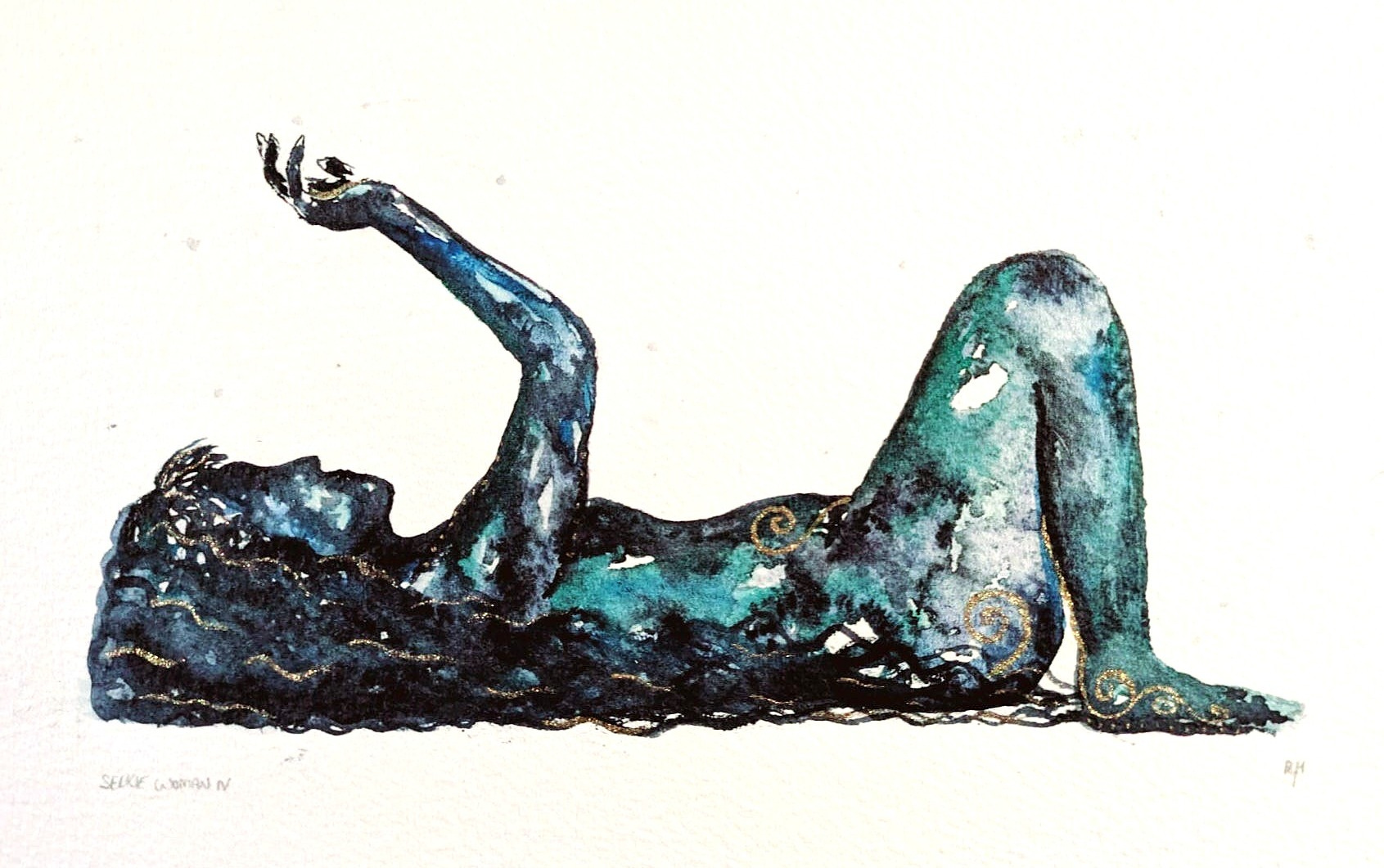
And this year, founding members will receive a watercolour selkie woman. These strong sea women are part of a new collection celebrating the oceanic and the feminine, inspired by Orkney island life.
This open access paper has a nice summary of cephalopod intelligence, including problem-solving abilities.
You can read an article about cuttlefish communication here, or the primary article (a preprint) here.
Thomas Nagel wrote a wonderful essay on this in the 1970s, What Is It Like to Be a Bat? If you’re interested in the concept of umwelt, I highly recommend reading it. Here’s an extract:
Our own experience provides the basic material for our imagination, whose range is therefore limited. It will not help to try to imagine that one has webbing on one’s arms, which enables one to fly around at dusk and dawn catching insects in one’s mouth; that one has very poor vision, and perceives the surrounding world by a system of reflected high-frequency sound signals; and that one spends the day hanging upside down by one’s feet in an attic. In so far as I can imagine this (which is not very far), it tells me only what it would be like for me to behave as a bat behaves. But that is not the question.
I should say one of the ways we define sentience, but this is really the topic of a whole different essay…
Comments
Nothing yet. Say the first thing.
Sign in to join the conversation.