
I wish I could say I had some notion I was being followed—that some ancient sense within told me to stop, to turn around, to search the swallow of blue behind me until I saw the eyes peering back. But no. I had been happily swimming along, scanning the seabed for creatures, running my fingers through mermaid’s tresses1, when my snorkel mask began to fog. I surfaced to clear it, and as I did, I heard a splash behind me—close behind me. But by some origami of logic (that which I fear we are all very good at; perhaps better at than attending to the tingle of our ancient senses), I decided that I must have caused the splash. Still, once I cleared my mask, I did go under and look around … just in case.
Peculiarly, although these Orkney waters are clear as glass when looking down toward the seabed—even metres below, every detail is visible—when looking to the side, the world becomes blue-hazed, as if a watercolour painter has dipped her canvas underwater and then washed a deep blue pigment across the paper. Every shape becomes only a blurred and edgeless impression of itself. This phenomenon is, apparently, something to do with the way light refracts in water, and the angle at which it hits the flat glass of a mask. And what this means is that, if something were to be swimming eye-level with me, I would not see it unless it was mere feet away. The laws of light shroud those who lurk in the deep.
But remember, I had not really believed that the splash was caused by something other than myself, so when I saw nothing in the swallow of blue surrounding me, I did not think: a creature may be hiding just beyond my field of view. I did not think: I must be being watched. I did, however, surface once more, just to comfort that small and ancient voice whispering: but you didn’t make that splash.
And as I expected, there was nothing. Just a flat sea. Just the lip of land in the distance. Just a blue sky and the hum of ocean.
But then!
Another splash.
I saw it this time. Maybe five metres away, and big. But there was no sign of whatever made it. I dived back under and saw nothing, just that vast and misty blue.
Something big is splashing over here, I called out to my partner, who was swimming far away, close to shore. He began heading towards me, his head gliding through the water, and then, behind him, I saw that there was another head. So close it must almost have been touching his fins.
Behind you, I whisper-shouted. A harbour seal, behind you!
His eyes widened and slowly, very slowly, he turned around until he was face-to-face with the seal. The seal appraised him, and then slipped beneath the water, was gone.
We met—my partner and I—in the water and went under, both hoping she would come back but knowing it was unlikely. We had watched videos of curious seals interacting with divers before, but never, in over a year of snorkelling, had we had a seal investigate us. Still, we searched that swallow of blue, hoping curiosity might get the better of her.
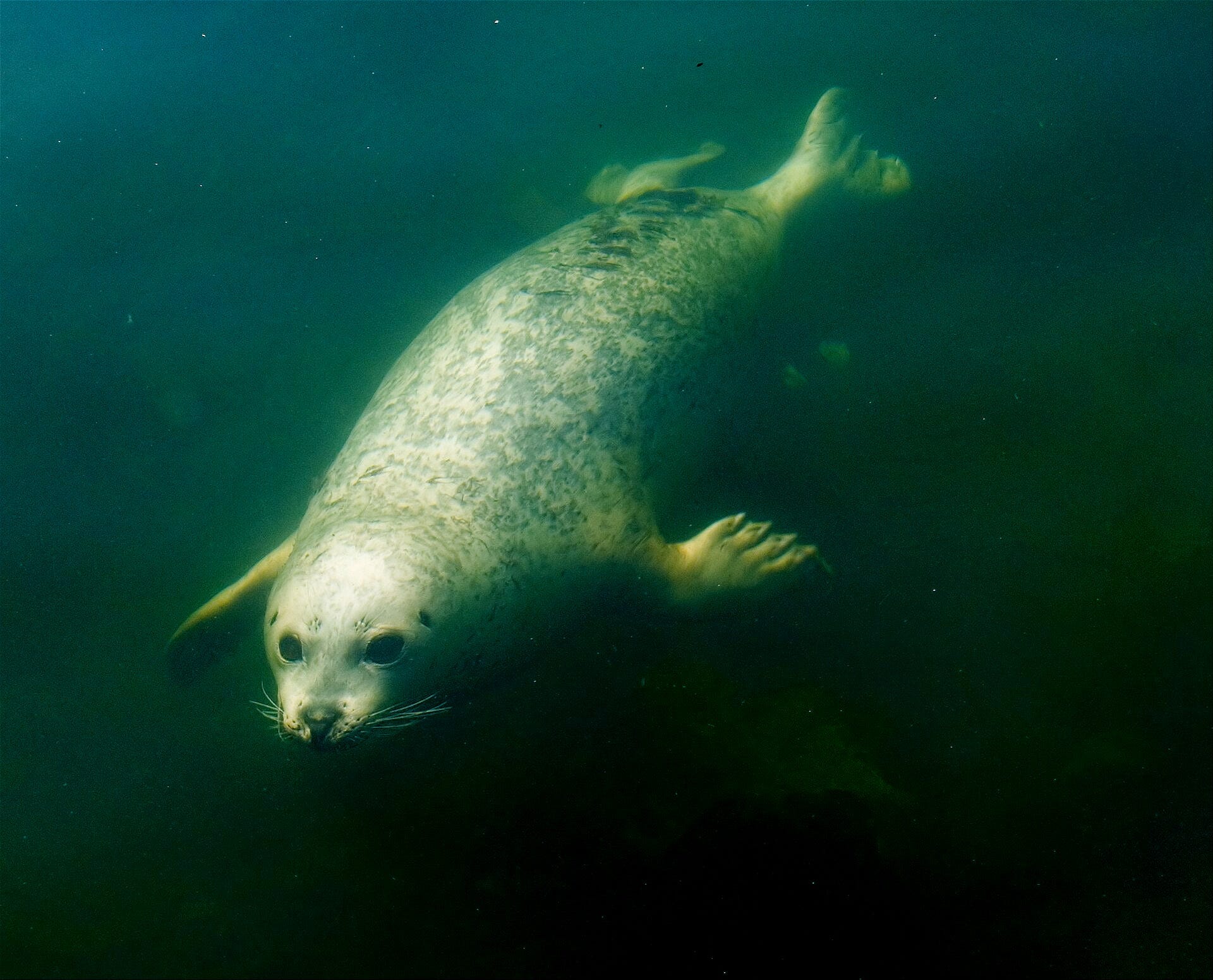
It did. Before long, a shadow-shape emerged from the deep. At first only an impression of a body, so faint she could be a swirling, twirling frond of kelp, but then, slowly, slowly, she resolved into edges, into form—whiskers and nostrils and planetary eyes and a sleek-soft body dancing towards us.
We floated, motionless, on the surface. She swam under us, then rose up so that she was just a foot or so from our faces. She was pebble-smooth, graceful as a willow, and the sunlight was dappling across her white-grey fur, and her eyes were black and huge and curious, and time expanded there, in the meeting of our gazes—the moment stretching and bursting as we all floated together in that calm, wide open sea.
Then she surfaced, right by our heads. We surfaced, too.
She looked at us, we looked at her. Three heads, bobbing.
When she went back under, we went back under as well, and she swam beneath us, twisting so that she was belly-up and looking at us, and then she popped up by our fins. We popped our heads up again, and as we did she dunked back under, slipped beneath us, popped up by our heads. And so it went on, and we were giggling (trying to giggle quietly, failing), because was this seal playing with us? It really felt like she was playing with us. And what a thing, to be initiated into seal-play, into wild seal-play. She had the whole ocean in which to frolic and explore and hunt and play, and here she was, slip-sliding her willowing body beneath us, her otherworld eyes inspecting our otherworld eyes.
Eventually, she swam down to the seabed. It was astonishing, how camouflaged she was there—her speckled body merging almost perfectly with the dappled white sand. If I hadn’t know she was there, the only clue to her presence would have been the orbs of her eyes.
Down there, metres beneath us, she nudged her snout into seaweed, snuffled under it. She was, it seemed, rummaging for prey. And what an honour that was: to be deemed by this wild creature as trustworthy beings, so trustworthy she could take her eyes off us in order to snuffle for breakfast.
And then, in a blink, she was gone. A small flick of the flippers and she torpedoed into the blue.
We were left—my partner and I—alone, grinning, laughing; the shocked-surprised-joyous laugh that magic like this brings.
Just as we prepared to swim to shore (we’d been in the sea for an hour and were both cold to the core), we saw her again. She was in the distance, watching, and in no more than a second or two after we made eye contact, she swam back to us, twisting and twirling beneath us, and it struck me, watching her, that seals undergo a soft sort of metamorphosis between land and water: on land this girl would be a clumsy thing, all blubber and bumbling belly and gawky, flapping flippers, but here, in the ocean, she was whip-quick and lithe, all muscle and light, and we were the clumsy ones now—slow and awkward in the water, like pups freshly born. Perhaps this was why she felt so safe with us. Because in a blink she could leave, she could cloak herself in blue, and there would be nothing we clumsy creatures could do but watch her go.
She swam with us all the way to shore. We didn’t want to leave but we were too cold to stay, and when we walked out of the water she popped her head up, just metres away from the beach, and watched us go.
. . .
I thought this piece was finished, because who could have hoped for another encounter with this girl? We snorkelled again three days later, telling ourselves: we will not see her again, it was one moment of magic and that was that. But after an hour at sea (an hour spent with fish and crabs and forests of kelp but also spent staring into the deep and asking: is she here? Is she following us? And realising we really could not know; if she did not want to be seen, there was no way we would see her), we headed back to the shallows.
Just as I was about to get out, I turned to speak to my partner, and you will never guess what I saw: behind him, right behind him, was her cheeky little face. And of course we cannot be completely sure it was the same female, but she was the same size, the same colour, and oh, that same glorious, curious temperament.
She willowed around in the blue for a little while, coming close then slipping into the deep, but eventually she came right up to us and (I promise you this really happened) she swam to my fin, which was poking out of the water, and gently mouthed it, like a puppy with a toy.
Following this, things got weird. By which I mean strange and wonderful and almost unbelievable.
Clearly, with this nibble of my fin, and our resultant squeals of joy, the seal decided we were safe to interact with because she swam from me to my partner, nibbled his fin, and then, when he stood in the water, his fins on the sand, she swam right between his legs, twisting so that she was belly-up, her mouth open in what can only be described as a goofy, toothy grin.
What?!
Even writing it now, it sounds completely surreal. And yet there she had been, this wild and free creature, doing upside-down gymnastics between my partner’s limbs.
Then she swam to me, pushed her snout against my fin and used her flippers to try to move it around. Her flippers were much more dextrous than I thought they would be; they were very capable of manipulating my fins so they pointed up or down or swooshed side-to-side (and doing this seemed to please her greatly).
At one point, when my partner and I surfaced a metre or so apart, she surfaced in the middle of us as if we were part of some swimming club and had all stopped to have a nice little chat.
At another point, she laid on the surface with her belly to the sky and her head thrown back, looking at us. And when I swam a little bit away from my partner, she torpedoed and twirled between the two of us as if trying to herd us up.
Did I mention that my partner and I were belly-laughing for most of this? It is very hard to snorkel and belly-laugh at the same time (much saltwater was snorted and swallowed). And I wonder now if our laughter might have egged her on a little, if our laughter registered to her as something light, something fun. I like to think so, but as far as I am aware nobody has researched how seals process human laughter, although there is this: scientists have found that harbour seals have their own kind of laughter, and, as with laughter across the animal kingdom, it shares acoustic properties with our own2. So, perhaps there is some truth in it; perhaps she understood that we were having fun just as we understood that she was.
It’s important for me to say that we never once approached her or followed her, we always let her take the lead in our interactions, and we did not touch her. In these sorts of encounters, the animal has to be in charge, and has to be able to leave whenever they want to.
But it is equally important for me to say that we smiled so much our jaws ached, and we laughed so much our stomachs hurt, and it was just the most intense and pure kind of magic. To be sought out and played with by a wild being … it was just light, only light. That is all there really is to say.
If you enjoy my work, you might like to pre-order my debut novel, These Glass Bodies.
‘Set against the heat of climate change, this stunning debut novel demonstrates the power of compassion and the grace of acceptance. Moving, elegant, important, Rebecca Hooper is a voice that must be heard’ ― Bonnie Garmus, author of Lessons in Chemistry
These Glass Bodies is as fascinating and thought-provoking a response to the climate crisis as I’ve read anywhere. Hooper’s writing manages to be both mesmerising and urgent, beautiful and alarming. Gloriously good ― Anna Caig, author of The Wise Witch of Orkney
Please note if ordering from outside the UK, pre-order options may be limited but will expand closer to publication.
You can also support my work by becoming a free or paid subscriber, or leaving a tip. All my posts are free, and paid subscribers (thank you!) allow me to keep it this way.
A beautifully named species of seaweed (also known as cat’s gut … not quite so poetic).
Comments
Nothing yet. Say the first thing.
Sign in to join the conversation.