
In the shallows, there is a whale—but don’t worry, it is only a life-size, inflatable, water-filled (and thus, extremely heavy) pilot whale. A sign has been erected so that members of the public know this too, because in the past, while British Divers Marine Life Rescue (BDMLR) medics have been training new recruits (of which, this year, I am one), passersby have lined up at the back of the beach and watched and gasped and cried as the huge (inflatable) animal was re-floated in the sea. So now, a sign, which does not explicitly say THIS WHALE IS NOT REAL—but that is its intent.
We, the trainee medics, are trying our best to imagine this whale to be real, though, and it is not as hard as it might sound, what with the hefty weight of the replica, and also because we are each equally invested in the theatre of it all. A magic of group imagination occurs, and I am sure some people, actors especially, are well-accustomed to this feeling but for me it is unfamiliar, something I have not felt since high school drama class, and I find it interesting even as I am living it—the way collective imagination becomes a current, a force in itself.
But all this to say: in the rush of the rescue, the whale—the inflatable whale—becomes real.
It is a blustery May day, clouds galloping, sun appearing every now and then to offer a tease of warmth and then skipping back into her hiding place, and we are in dry-suits and wetsuits (and if we are in wetsuits we are, quite quickly, very cold), and we diligently go through the list of everything we must do before trying to get this huge animal back into the ocean. We check it is alive (it is, listen, listen, the blow from the blowhole, the spurt and release of air!), we cover it so it does not become dehydrated or sun-burnt (their skin is very fragile), we dig wells for its pectoral fins so they do not break (from such a break, a whale cannot recover), we avoid its tail lest it thwack us, and then, when all first aid has been administered, we begin the re-floating.
Re-floating involves carefully manoeuvring the whale onto the ‘whale pontoon’ (a technical and laborious activity, given the weight of the animal) and then either taking it to the water or, if the whale is very large and thus immoveable, letting the tide roll in to lift it. One of the biggest threats to stranded whales is their sheer mass: without the water to hold them, they are crushed by the weight of their bodies.
But the work does not stop once the whale is in the water. When they strand, they lose their sense of balance—of which way is sky and which is water—and thus are prone to swimming sideways, and trying to breathe, and then, sadly, drowning. To help the whale recalibrate itself with the world around it, we must rock it gently from side to side. We do this for a few minutes, eight of us finding a gentle rhythm, swaying back and forth, back and forth, the waves lapping and slapping at us and the whale, our muscles cold and tiring, and as we do this our trainer tells us that recently she rocked a stranded porpoise for over three hours, in the dark, on a freezing winter’s night, until he was finally able to keep his balance. Three hours! On a windy, wintry Scottish night, standing waist-deep in a fractious ocean, rocking and rocking and hoping and hoping with no guarantee that the porpoise would actually be able to swim away. I will carry this story around with me like a talisman, a guard against the pervasive sense that the world is becoming less kind, that people are becoming less kind, because if ordinary folk will put themselves through this, through three hours rocking waist-deep in a dark and stormy ocean, for the chance that they might give a porpoise a second chance at life (the porpoise did re-find his balance and swim back to the deep)—well, then there is light.
You will be pleased to hear that our inflatable animals were also successfully re-floated. We were pleased; we clapped and whooped as our instructors ‘swam’ our inflatable animals away—because we were happy, but also because this is part of the re-floating: we had to make noise in order to herd the animals from shore. (And when, cold and exhausted, we waded back to the beach, we were greeted by a line of rather bemused-looking—but thankfully not crying—onlookers.)
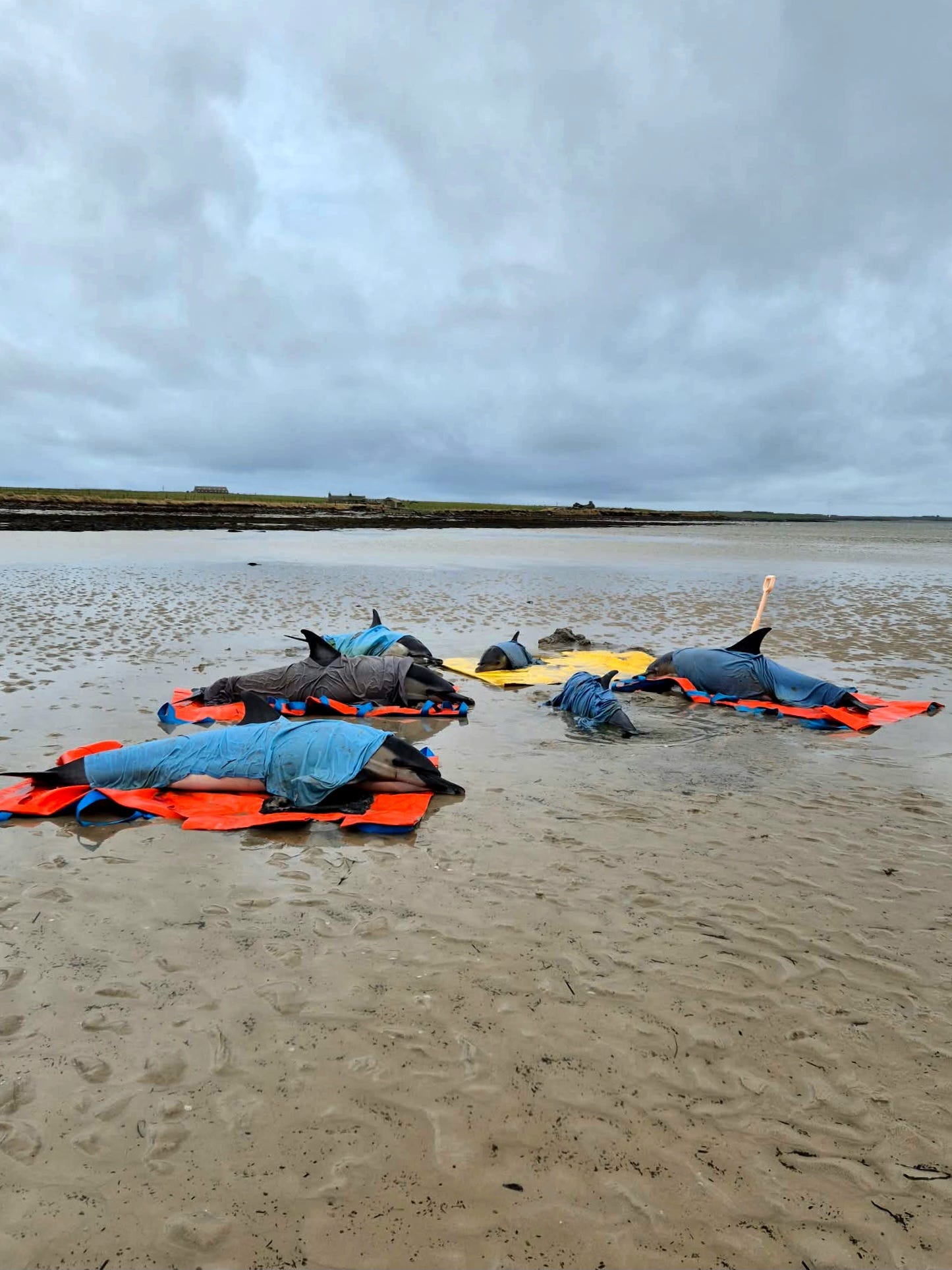
You may have already guessed why I decided to do this course. In January, I was one of the first people on-scene when a pod of common dolphins stranded in Westray, where I live. I learnt, during this six-hour rescue, that we have no active marine mammal medic based on the island, and so I signed up for the BDMLR marine mammal medic course. Strandings happen frequently in Orkney, and having an active trained medic on every island increases the chance that the animal in difficulty will survive.
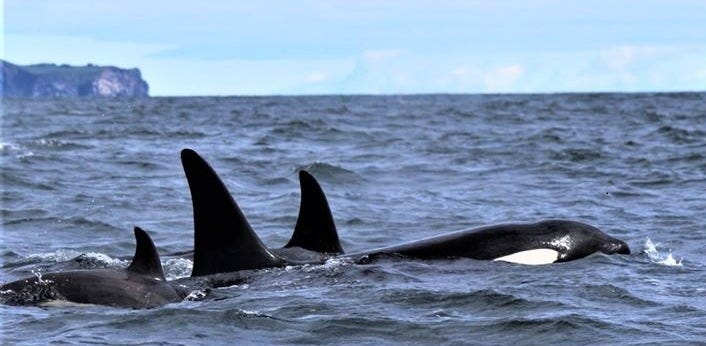
On Sanday, a neighbouring isle, mass strandings are particularly frequent. This is thought to be because of Sanday’s geography: it has many shallow, gently sloping bays that dolphin and whales cannot ‘see’ well with their echolocation, and so the animals cannot navigate their way to deeper water. The last mass stranding in Sanday was in summer 2025, and the first sign of it was a young pilot whale calf who arrived in Westray's harbour. We spent a lot of time looking for that calf's pod, searching our coastline, hoping, hoping, hoping that we would not find their bodies on some remote shore, that they had simply lost their calf in the summer storms and were searching for it, would find it, would be reunited. But just as the calf’s health began to deteriorate, the pod were found stranded (and deceased) on a remote beach in Sanday. One of the females had been in labour, the calf breech, and during the difficult birth she’d tucked herself away in a shallow bay to shelter from bad weather. And, because it is what they do—they are creatures with social bonds so strong that they follow one another no matter what—her pod followed her into that bay. Together they lived and together they died (except for that one lonely calf in our harbour).
Whales and dolphins have—along with humans, great apes, elephants and a few other species—many Von Economo neurons, a type of brain cell. In humans, this type of neuron is thought to be involved in empathy, social awareness and intense emotions. Scientists are very careful not to anthropomorphise non-humans but there is, I think, a fine line between denying anthropomorphism in order to respect an animals’ own unique experience of the world, and denying anthropomorphism to the point that we deny the potential of shared experience (often, for fear of being called unscientific1). But that many species of whale and dolphin form close-knit, long-term relationships, follow one another into danger and death, and have sophisticated brains with neurons that, in humans (we do not know for non-humans), lay the emotional and cognitive foundation for what we call friendship (for what we call love), tells us something that is difficult to flatly deny2. And while it is true that most facets of whale and dolphin life will forever be a mystery to us, their bonds with others is, I think, something we can dare to say we understand a little of. This is both utterly gorgeous and, in the case of mass strandings, utterly heart-breaking.
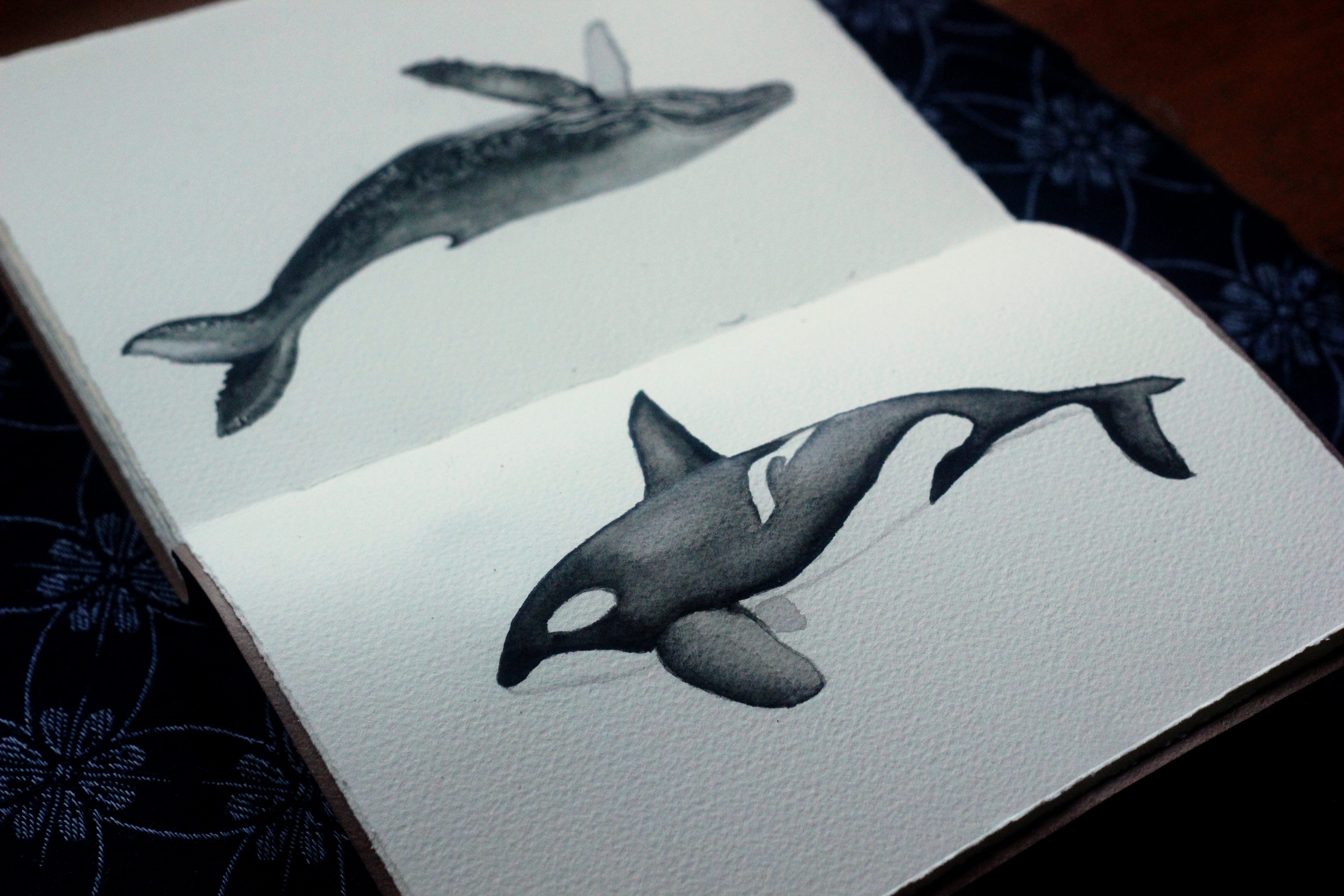
While strandings have always happened, they are happening more and more frequently. The reasons are related to human activity: entanglement in fishing gear, increasing oceanic noise, changing sea temperatures, military activity . . . all of these create a landscape of increased risk for our marine wildlife. It therefore seems more important than ever that stranding hotspots have trained medics, but also that they have their own marine mammal rescue kits. These include whale pontoons, dolphin stretchers, seal bags, seal crates, health and safety equipment, and dry-suits. Westray currently does not have its own kit; right now, all of the specialist equipment is based in mainland Orkney, about an hour and a half’s boat journey away. The reason we don’t have our own kit is that they do not come cheap, so I’m hoping to raise a bit of money to help supply the isle with its own marine mammal rescue kit. If you’d like to donate (any amount is so appreciated), please click the button below. For donations over £75, I will send an original watercolour whale as a thank you. And I will, of course, keep you all updated on my work as a medic.
And let me leave you now with one final talisman:
We learn, on the training course, that one of the top priorities for marine mammal medics is ensuring that the team of rescuers (often comprised of trained medics and members of the public) stay safe. This is vital because people will often get so caught up in a rescue that they put themselves at risk; people will stay in the water even if they become hypothermic—they will not say they are cold and they will not leave, all because they so desperately want to help. While this is, obviously, something we want to avoid at all costs, it is also, I think, another small wonder to cherish, to guard against the sense that the world is becoming a darker and less altruistic place: ordinary humans will go to incredible lengths, and put themselves at great risk, to save another’s life. Even the life of an unknown, otherworld being.
Our empathy, scaffolded (in part) by the very same neurons that we share with these otherworld creatures, is boundless.
If you enjoy my work, you might like to pre-order my debut novel, These Glass Bodies.
‘An absorbing, unmissable and moving debut novel of love, disconnected people and our fragile relationship with the natural world’
There is something gendered going on here, too. As a female scientist, it seems particularly important to be careful of anthropomorphism lest you be labelled as too emotional/soft/unscientific (which, sadly although not surprisingly, links to the boys’ club essay I posted recently).
I won’t get into the ins and outs here, but there is some debate about how exactly Von Economo neurons should be defined, and given that we have not settled even this most basic of foundations, our understanding of these neurons is currently quite hazy. Still, the evidence that some non-human animals have these brain cells is strong, as is the evidence that in humans these cells are highly related to empathy, emotion and social awareness.
Comments
Nothing yet. Say the first thing.
Sign in to join the conversation.