
There’s a specific kind of quiet that moves into your body after someone in a white coat says the words “open-heart surgery” out loud about your child. To me it felt like a void that opened up in the pit of my stomach, like I’d been gutted. And so the fateful date went up on the calendar, and from that moment it just sat there: a big, shapeless, ominous thing I couldn’t quite picture, which somehow just made it worse. It’s like the monsters we used to imagine as kids, the ones we pictured hiding under the bed or in our closets. To us, they were terrifying precisely because we couldn’t see them. The grown-up version of that is our brains filling in the information gaps, and never with rational explanations either; our fears reach for the operating-room dramas, the worst forum post we scrolled past at 1am, the thing our cousin’s neighbour said that one time 9 years ago at a family gathering.
So let me do the thing I always wish someone had done for me before a big one: turn the lights on in the room. Not to promise it’s small (it isn’t), and not to promise nothing ever goes sideways (I can’t).
But a thing you can picture is a thing you can stand next to. Being able to follow what’s happening to your child, step by step, isn’t morbid, and it isn’t borrowing trouble; it’s about equipping yourself with the necessary gear before climbing the mountain.
Here’s the whole thing, plainly.
Between the Beats is free, like all the best coping mechanisms aren't. Don't skip a beat — back the ‘Beats.
So what actually happens in that room?
I’m going to start here with the part that sounds backwards, because everything else clicks into place once it lands: to fix a heart, the surgeons usually have to stop it first.
Ok now let’s pause here, because it’s the same logic as every home repair you’ve ever done, or watched someone botch spectacularly on the internet. To swap out a busted pipe, the first thing you do is shut off the main; you can’t replace a length of pipe while water’s still barreling through it (clear, grey, or the kind you’d rather not picture 💩). It’s the same energy as those social-media videos where someone installs a light fixture without flipping the breaker first, and you’re left half-convinced they did it on purpose because there’s no way anyone could be that clueless and still wanna post their fails but hey — to each his/her own.
A heart’s no different, except the stakes are your child instead of your kitchen. You can’t patch a hole, re-route a vessel, or rebuild a valve while the chamber is clenching a hundred times a minute and full of blood on the move. So the surgeons kinda-sorta shut off the main: they empty the heart, bring it to a still, deliberate stop, make the repair (to whatever degree the anatomy allows; more on that in a second), then plug it back in and turn the faucet back on.
Which raises the obvious question: if you’ve shut off the main, what keeps water running to the rest of the house? That’s the job of the heart-lung machine (the technical term for this is cardiopulmonary bypass — “bypass” for short, and “bypass” literally means routing around — because it temporarily borrows the two jobs your heart and lungs normally do, pumping the blood and adding oxygen to it, and running everything around the stopped heart so the body and brain never lose their supply). And running it is an actual human being: a perfusionist, one of the most important people in that room and one you’ll probably never meet, whose whole job for those hours is your child’s circulation. If you want to learn more about what perfusion is, click here.
The stop itself is made with a cold, potassium-rich solution called cardioplegia (technical term that translates to “heart-paralysis” — the medicine that holds the heart still and protected while the surgeon works). None of it is permanent. The machine keeps the water running, the heart takes its break, the repair gets made, and then the whole sequence runs in reverse.
At its core, that’s what open-heart surgery is: shut off the main, run the bypass line, fix the pipe, turn the water back on.
Which kids need it — and what it’s actually for
Let me start by saying that not every heart surgery works this way, and “open-heart” isn’t one single thing that happens to every CHD child identically.
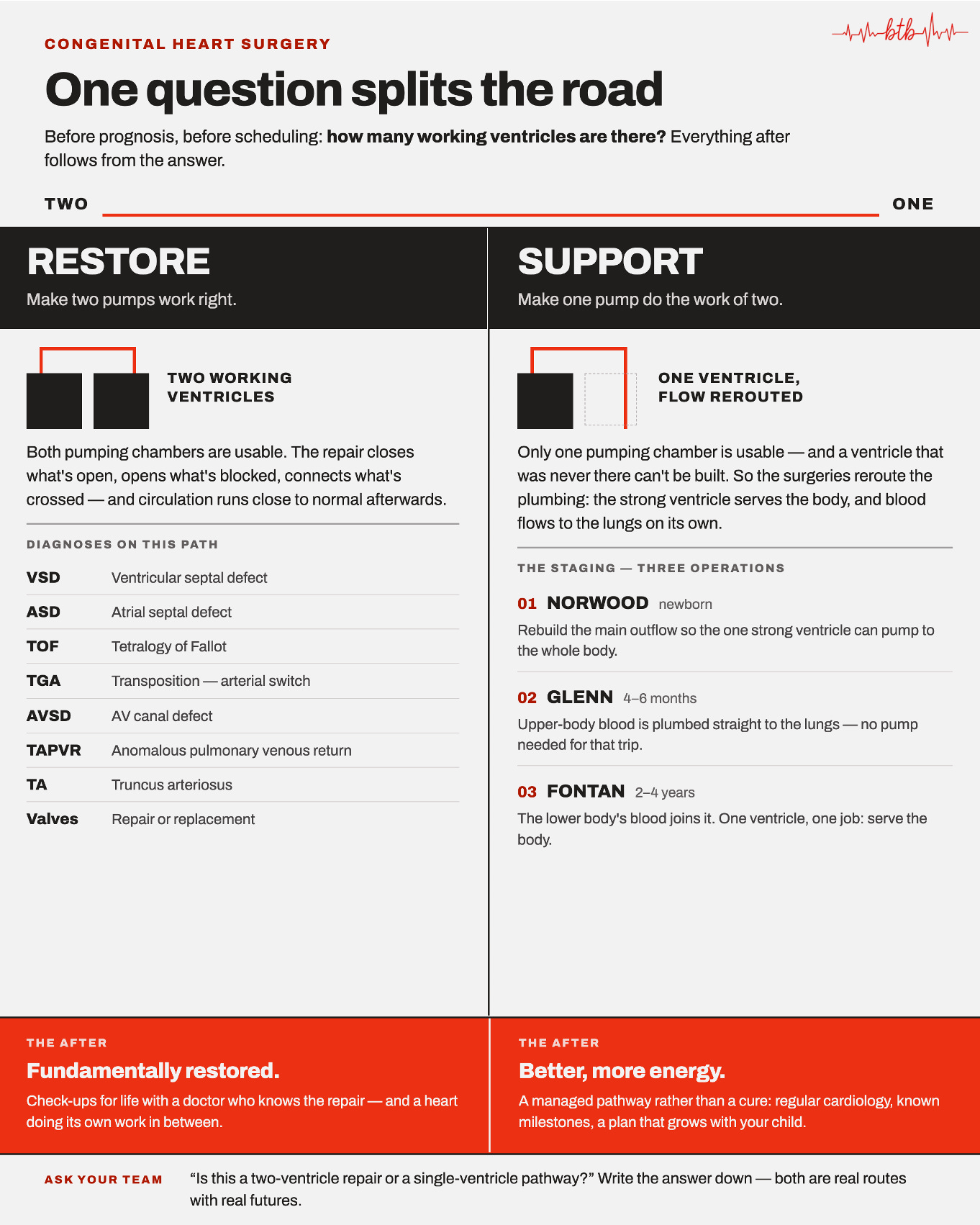
When a cardiologist says your child needs surgery, the very first question worth asking isn’t how bad is it — it’s which of 2 roads are we on here. Because CHD repairs sort themselves into 2 big families, and which one you’re in shapes nearly everything that follows.
Some surgeries restore: When there are 2 usable pumping chambers (the ventricles are the heart’s 2 main pumps), the surgeons close what’s open, open what’s blocked, re-connect what’s crossed — and afterward the circulation runs close to the way it was always meant to. VSD, ASD, tetralogy of Fallot, transposition, AV canal, and a handful of others live here.
Others can only support: When there’s really just one working ventricle, no one can build a second one that was never there, so instead the surgeons re-plumb the whole circulation to let that single strong pump do the work of 2. This is the single-ventricle path, and it isn’t one operation but 3, staged across the early years — Norwood, then Glenn, then Fontan.
And because you know I’m not out here to steer you wrong, I’ll add this: restore does not mean cured and done. A repaired heart is still a heart that gets watched for life; a switched-back transposition, a patched tetralogy, a replaced valve — every one of those kids stays a cardiology patient.
Both roads are lifelong, and neither one is the consolation prize; they just ask different things of your child.
One more distinction worth having in your back pocket, because it untangles a second fear: “restore or support” and “will my child be on the heart-lung machine” are two different questions. They can feel like the same question (read Big Scary Heart Surgery) but they’re not. Some support steps are gentle, closed-heart procedures where the heart never stops (a pulmonary artery band, for instance); some restorations are big open-heart operations on the machine. “Open-heart” tells you about the equipment in the room, not about how serious your child’s condition is.
 and one solid square with a dashed one for SUPPORT (one pump); machine status is shown as a bar — solid for on, half-filled for sometimes, outlined for not on. Every operation carries both a pump-plan tag and a machine status. On the machine, described as "open heart," the heart is stopped and quiet while it's worked on: VSD closure, surgical ASD closure (some ASDs are closed in the cath lab with no machine), tetralogy of Fallot repair, arterial switch, AV canal repair, TAPVR repair, truncus arteriosus repair, and valve repair or replacement — all RESTORE — plus Norwood, Stage 1, which is SUPPORT. Not on the machine, described as "closed heart," the heart keeps beating and the work happens outside it: PDA ligation and coarctation repair, both RESTORE, and pulmonary artery band, which is SUPPORT. Sometimes depends on the child and the surgeon's approach and is worth asking outright: a BT or central shunt, often off-pump; Glenn, Stage 2, usually on but done off-pump by some teams; and Fontan, Stage 3, often off or only partly on. All three are SUPPORT. A single-ventricle staging strip runs along the bottom as a timeline of three planned steps — a timetable, not a countdown: 01 Norwood, newborn, on the machine; 02 Glenn, four to six months, usually on and sometimes off; 03 Fontan, two to four years, depends and is often off or partial. A closing line suggests asking your team, "Will you use the heart–lung machine for this one, and for how long?" — noting the answer is a fact about the plan, not about how serious things are.Infographic created for article on Open-heart surgery for kids with congenital heart disease. Article written by Marie-Jo Herard for Between the Beats substack.")
Know a heart parent staring down a date on the calendar? Send this! Sometimes the kindest thing you can hand someone is a head start.
What your child’s body actually goes through
While you’re out there holding the pager (and I swear that pager is the longest-feeling object you will ever hold), let’s go together through the arc your child is moving through in that room.
First, they go to sleep — not nap-sleep, but a deep, medicated, won’t-remember-a-second-of-it sleep (aka general anaesthesia), managed the whole time by an anaesthesiologist whose sole job is keeping your child comfortable, safe, and unaware. Once they’re under, the team connects them to the bypass machine and, for a lot of repairs, deliberately cools the body down (sometimes quite a lot, too). Cooling sounds alarming but it’s actually the opposite: a cooler body burns through a lot less oxygen, which means that dropping the temperature buys the whole team a wider margin of safety while the heart is stopped (think turning the house thermostat way down so the place needs much less to keep running).
Then comes the part I’ve been building toward: the main gets shut off, the heart goes still and quiet, and the surgeon and his/her team does the actual work — patching, re-routing, rebuilding, whatever your child’s particular heart needs. And here’s something I actually learned when I finally asked the right (insert eye-roll here) question : the repair itself is often the shortest part. Most of the hours are the careful prepping and going-on, and the even-more-careful coming-off.
Because turning the water back on is its own delicate business. Your child’s surgery team will rewarm the body, ease the heart into taking its own job back, and watch closely to be sure it holds the pressure and picks its rhythm back up before the machine lets go. Sometimes the chest might be left open a day or two afterward, (covered and protected of course) because a freshly-worked heart can at times swell and it’s kinder to give it room than to force it shut (it sounds frightening but it’s a fairly routine bit of caution).
When your child comes back to you they’ll be in intensive care, and they won’t look like themselves: puffy, sedated, paler than usual, threaded with more tubes and lines than seems possible for one small body. I want to name that before you see it (or, if you’ve already been through it, acknowledge it), because nothing quite readies you for the first look, trust me.
So — deep breath, shoulders down. Take that sip of water or coffee if you need it.
Now, every one of the tubes and wires connected to your child is doing a job (draining, measuring, delivering, supporting), and the sheer forest of them is a measure of how closely they’re being watched, not how badly things are going. This is expected.
And I’ll answer the question you’ve almost certainly already typed into a search bar, because you deserve a real answer instead of a spiral:
The machine, the cold, the stopping — does any of it affect the brain?
Honestly? The brain story in CHD is bigger and older than this one day in the operating room. So much of it is written long before surgery — in how a heart with CHD shapes blood flow to a developing brain in utero, in genetics, in the physiology of the condition itself — which is exactly why the research community increasingly finds that a child’s own biology weighs more heavily here than the details of any single operation. And that’s not a reason to worry harder about the OR either; if anything, it gives you permission to worry a little less about it. AND - very important - it’s a reason to make sure your child gets plugged into neurodevelopmental follow-up as they grow (there’s a question about exactly that waiting for you further down), because that long game is where the real support lives — not in the hours you spent holding the pager.
Now that you can picture the room, let’s get you ready to walk up to it.
Getting ready — yours to do, and theirs
The week or so before is mostly waiting, punctuated by logistics, and there are things you can do that genuinely help: for your child, and for you, because you’re going through this, too, even though no one’s going to hand you a gown.
The practical layer. Most centers bring you in before the day itself for a pre-op visit, where you’ll meet the surgeon, likely tour the ward, and your child will go through a battery of tests (bloods, an echo, tracings, that sort of thing). It’s a lot of poking for a small person, so this is where a concrete tactic earns its keep: you can bring a sticker chart, for example, give them one sticker per test, and it turns an ordeal into a game with a finish line (it’s exactly what the Little Hearts Matter booklet I’ll point you to below does, and it works!). Pack a bag early and keep it by the door:
The comfort object that does not, under any circumstances, get left behind
Chargers, and then backup chargers
A tablet loaded with the shows and the colouring apps, downloaded ahead of time, because hospital wifi is like playing a game of chance
Real food and a water bottle for you — the cafeteria closes and you will forget to eat
A change of clothes and a hoodie, because these rooms tend to run cold and the days run long
The morning of, your child won’t be allowed to eat or drink for a stretch beforehand, they’ll change into a little gown, and they’ll usually ride to the operating room on a bed or trolley, which most little kids honestly think is kind of great.
The You layer. My recommendation? Bring someone if you possibly can; the pager wait is not a thing to do alone. Eat something even if your stomach says no (you need the protein and nutrients). And if there are siblings at home, line up who’s got them and keep them looped in at their own level, because the brother or sister waiting in the wings is having a hard week, too, even if they don’t show it outwardly.
The Them layer. Kids do better walking toward a thing they can picture than one that’s been kept deliberately fuzzy “to protect them” (ring any bells? Ugh.) because the fuzziness is where their imagination does its worst work, same as ours. So tell the truth, sized to their age: something isn’t working quite right in their heart, the doctors are going to help fix it while they have a special sleep, it might be sore for a while after, and you will be right there. Don’t promise it won’t hurt (that promise will break, and it will take your credibility along with it); do promise you’ll be there when they wake up.
And here’s the part I love, because it means you don’t have to find these words cold at your own kitchen table: someone already did, beautifully. Little Hearts Matter (a UK charity built specifically around single-ventricle families) makes a short illustrated e-booklet called Jessica has a heart operation that walks a child through the whole arc in their own language: the special medicine that makes her feel sleepy, the tubes that help the doctors make her feel better, the sticker chart, going home. It’s a doorway into a whole child-facing library, and it does for your child what this piece is trying to do for you. (It’s British, so it’s “operation” not “surgery” and a few spellings will look funny; the empathy translates just fine.) I’ve linked it below.
One quiet thing about that booklet worth flagging, because it’s a small masterclass in honest hope: notice it never once says Jessica is fixed. Her operation makes her heart “work better,” gives her “more energy” — support language, not cure language. Which is exactly the register to borrow when you talk to your own child, whichever road you’re on.
And then: life after — for both of you
Recovery has a shape, and knowing the shape helps enormously when you’re in the thick of it and it feels like it has none.
For us parents, the hospital stay usually involves intensive care, a regular ward, and then home. Each step is a graduation, with fewer tubes each time. The length of the stay depends on the repair and each child. After the hospital, there’s a recovery period at home before school and activities resume at the child’s pace. Lifting restrictions, chest precautions, and gym class return dates are specific details that you should get from your team and write down, as you may forget them.
And this is where the two roads we talked about shape what “after” even means. A restore kid — a patched hole, a switched artery — may now have long, quiet stretches with nothing but annual check-ups; the plumbing’s set, and it’s watched. A support kid on the single-ventricle path has more chapters ahead, staged across the years, because that’s how the pathway is built. Both are managed for life. Neither of those “afters” is a failure of the other; they were just always going to be different books.
For your child, some of the after is physical and some of it is a story they’ll be telling for the rest of their life. That line down the middle of the chest, for instance. In the Jessica booklet she calls it “a line of bravery on her chest… her zip,” and she’s in good company; a lot of heart kids and grown-up heart-warriors proudly call themselves the zipper club. How your kiddo frames that scar is genuinely theirs to author, over years, and your job is mostly to not flinch first: if you treat it as a badge, they’re freer to; if you treat it as a wound to hide, they clock that, too, believe me.
The energy part tends to surprise families in the best way. A lot of these kids come out of a good repair with more in the tank than they’ve ever had; Jessica’s story ends with her friend suddenly having to run to keep up with her, and that’s not just picture-book sweetness; it’s what a heart that’s finally doing its job properly can buy.
And the conversation doesn’t close when the scar heals; it grows up as they do. The questions a six-year-old asks about their zip aren’t the questions a thirteen-year-old asks about sports, or the ones a sixteen-year-old asks about what this means for their future — and keeping that door open, matter-of-factly, across all of it is worth far more than getting any single conversation perfect.
Before you go in: questions worth asking
You’re allowed to ask every one of these, and a good team will be glad you did; an informed parent makes their job easier, not harder. Bring the list on paper, because your memory will not be operating at full capacity that day.
“Is this open-heart surgery — will my child be on the heart-lung machine?” The answer sorts a lot of your dread into the right size, because plenty of CHD procedures don’t use the machine at all.
“Is the goal to restore two-pump circulation, or to support a single-ventricle heart?” This tells you which road you’re on, which shapes the whole rest of the journey, and it’s a fair, answerable question.
“Roughly how long do you expect the heart to be stopped and on the machine?” You’re not second-guessing them; you’re understanding the day.
“Will you need to stop circulation completely, or keep blood flowing to the brain throughout?” For repairs up near the aorta this varies by child and by surgeon, and it’s a legitimate thing to want to understand.
“Can someone walk us through the day, hour by hour, before it happens?” Most centers have a nurse or a child-life specialist who does exactly this; ask for it. Known beats imagined.
“How do we get our child into neurodevelopmental follow-up, and when does it start?” This is the long-game question most likely to get lost in the shuffle, and the one most worth protecting; the developmental story unfolds over years, and follow-up is where the real support lives.
Take heart,
Marie-Jo 💕
Between the Beats is free and staying free. If your budget's got room, a paid sub keeps it that way for the family whose budget doesn't. No paywall, no pressure, just gratitude ❤️
TL;DR
To repair a heart, surgeons usually have to stop it first — like shutting off the main before you fix a pipe — and the heart-lung machine (bypass) runs the blood around the rest of the body while they work.
Not every heart surgery uses the machine; “open-heart” describes the equipment in the room, not how serious your child’s condition is.
CHD surgeries fall into two families: restore (fix the plumbing so two pumps work) and support (re-route so one pump does the work of two — the single-ventricle path). Both are managed for life; neither is a cure, and neither is a consolation prize.
What your child comes back looking like — swollen, sedated, threaded with tubes — is expected, and every line is doing a job. It’s a measure of how closely they’re watched, not how badly it’s going.
The brain story in CHD is bigger and older than the day of surgery; the most useful thing you can do about it is get your child into neurodevelopmental follow-up for the long game.
Sources, Annotated
Miller et al., “Abnormal brain development in newborns with congenital heart disease,” NEJM (2007). The foundational one. It showed that babies with complex CHD often have brains that are measurably less mature before surgery ever happens — closer to a premature baby’s than a term baby’s. Read it if you want to understand why “the machine hurt my baby’s brain” is too simple a story.
Gaynor et al., J Thorac Cardiovasc Surg (2007). The study that shifted the field: a child’s own patient factors (a genetic syndrome, low birth weight) predicted neurodevelopmental outcomes far more strongly than the surgical details did. The biology the child brings weighs more than the operation.
Beca et al., “New White Matter Brain Injury After Infant Heart Surgery…,” Circulation (2013). The one that surprised me most: new brain changes after surgery showed up at similar rates whether or not the heart-lung machine was used. The strongest predictor was which defect the child had, not the equipment.
Wypij et al. (the Boston Circulatory Arrest Trial), J Thorac Cardiovasc Surg (2003). If your child’s repair involves fully stopping circulation under deep cooling, this is the landmark data: effects on later development were minimal below a duration threshold, and the field has spent the decades since engineering to stay well under it.
Starr et al., JACC (2024). A huge, recent look (over 24,000 newborn operations) finding that modern temperature strategies have shifted toward keeping blood flowing to the brain, and that lower temperature wasn’t tied to worse neurological outcomes overall. Reassuring evidence that the field keeps refining toward the brain.
Ortinau et al., “Optimizing Neurodevelopmental Outcomes in Neonates with CHD,” Pediatrics (2022). A readable overview of where the whole field now stands — prenatal, genetic, and environmental factors, and what good developmental follow-up actually looks like. A solid single starting point.
Peyvandi et al., JAMA Pediatrics (2016). For the “what can I actually do” file: babies diagnosed before birth had less pre-op brain injury than those diagnosed after (24% vs 48%), likely because they were more stable from the start. An argument for early diagnosis and a prepared delivery.
Little Hearts Matter — Jessica has a heart operation (Louise George). Not research; a resource, and my favourite kind. A free illustrated e-booklet that walks a young child through the whole experience in their own language. LHM is a UK single-ventricle charity with an unusually rich, empathetic child-facing library behind it. Start here for your kid.
A necessary note
I’m a Fontan mom who reads the journals, not a doctor, and Between the Beats is translation and equipment, not medical advice. Nothing here replaces your own care team, who know your specific child and their specific anatomy in ways no general explainer ever can. Use this to ask better questions — not to answer them alone.
If this took one ominous thing on your calendar and made it a little more knowable, that’s the whole job. Between the Beats is free; if you’d like the next translation to land in your inbox, subscribe — and pass this to the parent you know who’s staring down a date on a calendar right now. Sometimes the kindest thing you can hand someone is a head start.
Medical Disclaimer:
The content on Between the Beats is for informational and educational purposes only. While I’m involved in the CHD community, I’m not a medical professional. The insights, research translations, and personal experiences shared here aren’t a substitute for professional medical advice, diagnosis, or treatment.
Important Guidelines:
Consult your team (cardiologist, surgeon, etc.) for any medical questions or treatment plans.
Don’t disregard professional advice or delay care because of something you read here.
Call your doctor or emergency services immediately if you think you have a medical emergency.
By using this site, you agree to these terms.
Comments
Nothing yet. Say the first thing.
Sign in to join the conversation.