
I need to talk about a word that has been driving me up the wall (remember PLE?).
It keeps showing up in the research papers I read — just casually, mid-sentence:
“bla bla bla… medical stuff… perfusion… something medical happened….”
Cerebral perfusion. End-organ perfusion. Perfusion mismatch.
Clearly it’s part of the Doctor 101 vocabulary because unlike a lot of medical terms (which researchers will usually define, or at least spell out the abbreviation the first time), this one never gets the courtesy of an introduction! It just shows up and expects you to know who it is.
And what makes it worse is that every time I encounter it, I have to look it up. Again! I read the definition, I nod, and then 3 paragraphs later, wouldn’t you know it, it shows up again but this time in a completely different context that means something slightly different, and I realize I don’t actually have it! In one sentence they’re talking about perfusion to the brain, and in another they’re talking about perfusion pressure during surgery, and in another it’s about poor perfusion as a clinical sign, and it’s the same word doing three different jobs and nobody told me which one they meant this time. So now I’m not just looking up a definition — I’m interpreting it on the fly, cross-referencing it against whatever they’re actually discussing, and trying to hold the whole thing together while I’m also trying to understand the study itself. The migraines, guys, the god-forsaken migraines.
It’s exhausting. I didn’t get the Doctor 101 Glossary of Terms. I missed that day… or, you know.. the whole damn course.
But here’s the thing, though: perfusion isn’t actually some impossible concept; it’s not even that complicated once someone sits you down and explains it properly. The problem is that the word gets used as shorthand for six different things depending on context, and nobody hands you the decoder ring. So you’re left nodding along in appointments and squinting at research papers, feeling like everyone else got a memo you missed.
Well, I went and wrote myself the memo. I sat myself down, really gave it a good old College Try, and I finally got it to a point where I can now explain it to you as well. So here we go.
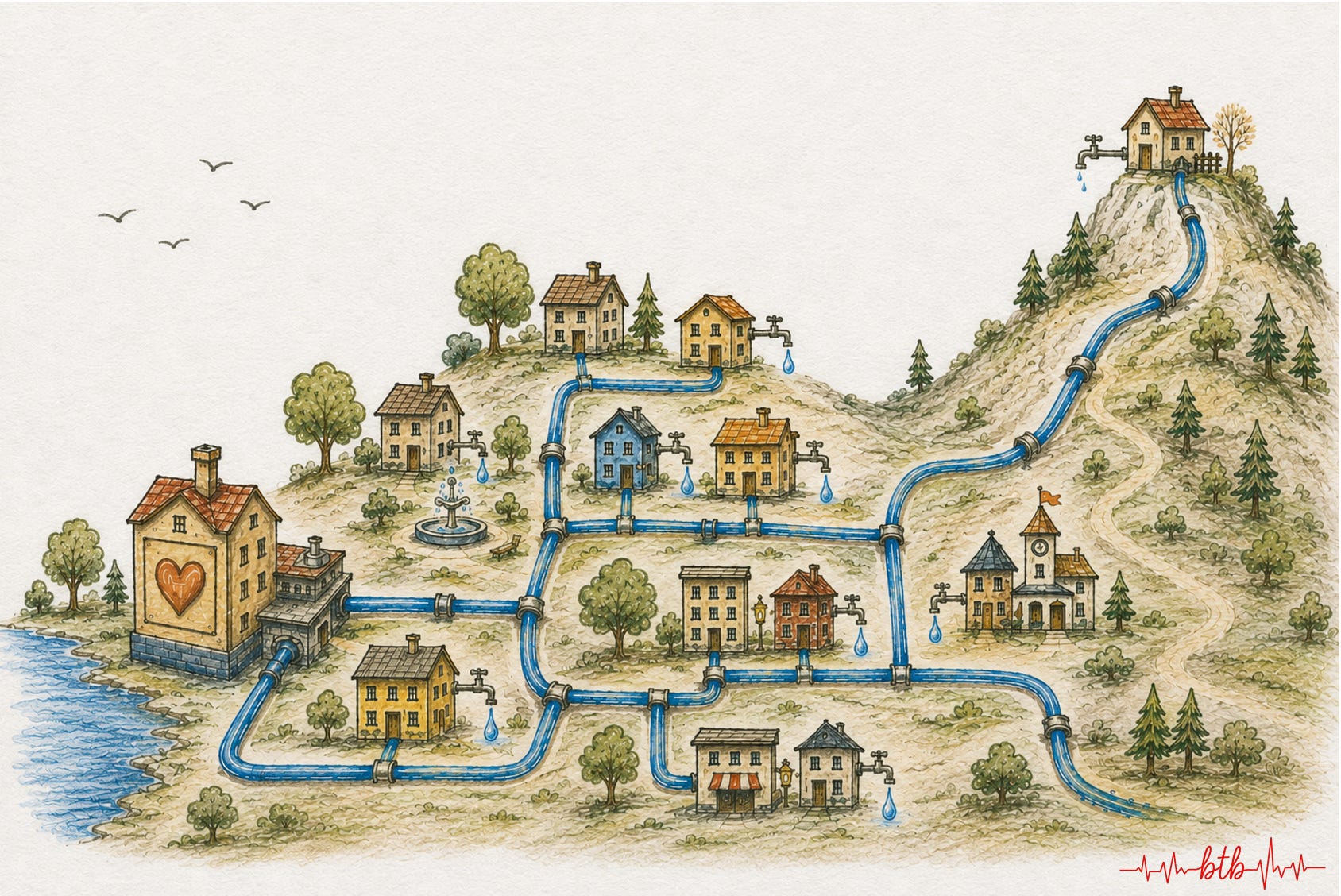
Think of your body as a city. The heart is the municipal water pumping station. The blood vessels are the pipes. Blood is the water (Biblical, I know, but bear with me). Circulation is the whole water system: the infrastructure, the network, the loop that carries water out and brings it back. It’s the map of pipes on the city engineer’s wall.
Perfusion is whether the water is actually reaching every house and every faucet, at enough pressure to be useful.
And this next part is something that I really had to dig into because it kept tripping me up: you can have a perfectly intact pipe network (nothing broken, nothing blocked, every connection in place) and still have houses at the end of the line that aren’t getting enough water.
I can already hear your brain going: “OK but wait, how? If the pipes are fine, why isn’t the water getting there?”
Great question! I asked myself the same thing. Because intact pipes are only half the story; the other half is what the pump is actually doing.
Picture a house at the top of a hill at the very end of a long run of pipe. Every pipe between the pumping station and that house is in perfect condition; no leaks, no blockages, nothing broken. But if the pumping station is only running at half power (say one of its two motors is down), the water pressure drops across the whole system. So the houses closest to the station are going to be fine, sure (they’re first in line, they get enough pressure just from proximity). But that last house at the top of the hill? The water barely trickles out of the tap. Nothing wrong with the pipes… but there’s not enough force behind the water.
That’s perfusion. The infrastructure can be perfectly intact. The problem is whether the pump is generating enough pressure to push blood all the way to the farthest, hardest-to-reach places. So when a cardiologist says “we’re worried about perfusion” or you read a research paper that has the term peppered throughout, what they’re really saying is: “The plumbing exists, but we’re not confident that enough blood is reaching [this organ] to keep it happy.”
And this is why clinicians need the word as a separate concept from circulation, because you can have:
Good pipes, weak pump (good circulation, poor perfusion): Water reaches the main lines but the pressure is too low at the far ends
Some neighbourhoods fine, others running dry (perfusion mismatch): Downtown is well-served; the suburbs are struggling
Adequate pressure on a quiet Tuesday, but not during a heat wave (adequate perfusion at rest, inadequate under demand): The system handles baseline just fine — but when everyone turns on their sprinklers, the houses at the end of the line lose pressure first. This is the exercise intolerance connection, and we’ll come back to it.
So here’s your decoder ring for the next time this word shows up in a paper or an appointment:
“Perfusion pressure” = The water pressure at the faucet (how much force is pushing blood into a specific organ)
“End-organ perfusion” = Are the houses at the end of the line getting water? (is enough blood actually reaching the liver, kidneys, brain, gut)
“Cerebral perfusion” = Blood flow to the brain specifically (the neighbourhood clinicians worry about most)
“Perfusion mismatch” = Downtown’s fine; the outskirts are not
If this made something click for you, it'll click for someone else in your life. Share the memo. Back the ‘Beats.
Before we go any further, I want to pause here and highlight something important: perfusion issues show up across many types of congenital heart disease. If your child doesn’t have a single ventricle, this word is still relevant for you. The city metaphor works for all of these (listed below); what changes is which part of the system is compromised.
→ Coarctation of the aorta: When the aorta becomes narrower, it can cause lower pressure downstream. Even after surgery, some narrowing might still be present, leading to ongoing differences in blood flow (perfusion) between the upper and lower body. That’s why doctors often check blood pressure in both arms and legs.
→ Tetralogy of Fallot (repaired): After repair, the pulmonary valve often leaks (pulmonary regurgitation), which means the right side of the pump is doing extra work. Over time, that reduces how efficiently blood gets oxygenated in the lungs. Translation: the water is reaching the houses, but it’s not as clean as it should be. That’s a perfusion quality issue, not just a pressure issue.
→ Aortic stenosis: The outflow from the pump is restricted. The pump is straining; everything downstream gets less flow.
→ Post-surgical low cardiac output: This is the acute version. After major cardiac surgery, the heart might have a bit of trouble keeping up with the flow, and that can affect how well all of the organs are getting oxygen. That’s when the CICU team really starts paying close attention — they’re keeping an eye on things like lactate levels, how quickly the capillaries refill, how much urine the person is making and how they’re feeling. Basically, every organ is like a little bell that tells you how the heart is doing.
→ Shunt-dependent circulation: Babies with a BT shunt (before the Glenn or Fontan) are living with a perfusion balancing act. Too much blood to the lungs and the body is underperfused; but too much to the body and the lungs can’t oxygenate enough. So they’re basically working with one shared pipe and two districts competing for flow.
The common thread is this: Any structural heart defect that makes the heart a less efficient pump creates a perfusion story.
The specifics differ; the concept is the same. We’ll go deepest on the Fontan next, because it’s the most chronic and multi-system version of this story. But if you’re reading this and your child has a different diagnosis, you belong in this conversation too.
CHD parenting is a tag-team sport. Pass this to your co-pilot.

Back to basics: A healthy heart has 2 pumps working in series; the right side sends blood to the lungs to pick up oxygen, it comes back, and the left side sends it out to the body to deliver it. Two dedicated pumping stations, two separate circuits, full pressure to every neighbourhood.
A single-ventricle heart, on the other hand, is the city running its entire water system off one pumping station instead of two. It works, but pressure is lower, flow is less robust, and the neighbourhoods furthest from the station are the first to notice when things get tight.
And in the Fontan circulation specifically, it goes one step further: after the Fontan surgery, blood gets to the lungs without a pump at all. Passive venous flow only. Think of it as gravity-feeding water uphill without a pumping station. It works but only barely, and only if everything downstream cooperates. Which means that any resistance in the lungs, any backup in the veins, any spike in demand, and the system strains.
This is where the “end of the line” neighbourhoods start telling their stories:
Neighbourhood 1: The liver sits downstream of that passive venous flow and gets congested over years. So this neighbourhood ends up with with drainage problems because water slowly backs up in the basements. This is where Fontan-associated liver disease comes from.
Neighbourhood 2: The gut isn’t perfused well enough for the intestinal lining to hold onto proteins; if you read the PLE piece, this is the upstream cause. So in this neighbourhood the water quality drops because pressure is too low to push clean water through the filtration system.
Neighbourhood 3: The brain, even with subtle, chronic underperfusion, is affected in how it develops over year. This neighbourhood is technically getting water but at just-below-adequate pressure, so it gradually falls behind on maintenance. And here’s something that I feel really doesn’t get talked about enough: for many children with CHD, the brain neighbourhood wasn’t getting full water pressure even during construction. Studies have shown that changes in blood flow to the brain can start even before a baby is born, which can consequently lower the amount of oxygen reaching the brain as it grows. Translation: the perfusion story starts before the first breath. And last but not least…
Neighbourhood 4: The kidneys are basically the water treatment plant; when perfusion drops, they compensate by retaining more fluid, which backs up the whole system further. Kind of like a feedback loop.
And here’s where it clicks for a lot of Fontan families: the exercise connection. A two-pump city can handle rush hour; demand goes up, both stations ramp up, every neighbourhood still gets served. A one-pump city runs out of capacity under demand. Resting? Fine. Walking? OK. Running from a bear, chased up a tree by a particularly angry squirrel, playing hard on a dare? The pump can’t push enough water fast enough, and the far neighbourhoods lose pressure first. That’s why Fontan kids will fatigue easily. It’s not that they’re “out of shape”; it’s that their perfusion can’t scale up the way a two-pump system can.
But I’m gonna push back a little bit on these findings here and tell you that research now proves that exercise can improve (not cure, mind you, but definitely help) how well that one remaining pump functions.
You may already have noticed signs of poor perfusion without really understanding what they mean or why they even show up. But now you will!
Slow capillary refill (press on a fingernail, count how fast the colour comes back): that’s the faucet at the end of the line taking a while to produce water. Mottled skin (patchy, lace-like discolouration, especially on the legs): some neighbourhoods getting water, others not, and you can see it on the surface. Cold hands and feet: the extremities are the farthest neighbourhood, and when perfusion drops, the body prioritizes the core organs (downtown) and lets the outskirts go cold (that’s also recognized as a tall-people-problem. As a tall person myself, I can vouch for that one). Fatigue that seems disproportionate: not a fitness problem; a perfusion problem.
So what changes now that you have the word?
Recognition without panic. When you see these signs (cold extremities after play, fatigue, mottling), you can place them! The far neighbourhoods are losing pressure under demand. That’s a compromised system doing what a compromised system does. You still watch it, you still note it, but you roll with it. This is true whether your child has a Fontan, a repaired TOF, a coarctation, or any other CHD that affects output.
Context for clinical data. When a cardiologist mentions liver enzymes or kidney function or fluid retention, you’re not hearing isolated scary data points anymore — you’re hearing a report from a specific neighbourhood and you understand why it’s being monitored. A Fontan parent hearing about hepatic congestion, a TOF parent hearing about right ventricular function, a coarctation parent hearing about upper-vs-lower blood pressure differences… all perfusion reports from different parts of the same city.
A framework for advocacy. When your child’s school says they’re “not keeping up” in gym, or a well-meaning relative suggests they just need more exercise: this isn’t de-conditioning, it’s physiology. Being able to name it means being able to advocate for appropriate accommodations without apologizing.
Connection across appointments. The cardiologist talks about perfusion. The hepatologist talks about congestion. The neuropsychologist talks about processing speed. Before, those might have felt like separate conversations in separate worlds, but now you can see the thread: it’s the same city, the same pump (or pumps), the same neighbourhoods. That doesn’t make you — or me! — a doctor, but it does us parents who can sit in any of those appointments and understand how what this specialist is saying connects to what that one said last month.
Truth be told, knowing the word perfusion won’t fix anything. Not a damn thing. Your child’s heart is still built the way it’s built, and that’s not going to change. But, to me, understanding why things happen the way they do is the difference between being dragged through appointments in a fog of fear and walking in with a You Are Here map. The map won’t change the territory, but it sure makes a difference in how we move through it.
“When you say you’re monitoring perfusion, which organs are you most focused on for my child specifically?”
“Are there signs of perfusion changes I should be watching for at home?”
“Is my child’s exercise intolerance related to perfusion? Is there anything we can do to support it?”
“How does my child’s specific heart anatomy affect perfusion over time?”
“At our last appointment you mentioned [liver enzymes / fluid retention / fatigue / blood pressure differences]; is that a perfusion issue?”
Just so you know, this is a conceptual explanation — NOT actual medical advice. Your child’s specific perfusion picture will depend on their unique anatomy, past surgeries, any remaining lesions, and a bunch of other personal factors. The city metaphor is a simplification (obviously); real hemodynamics involve pulsatile vs. non-pulsatile flow, vascular resistance, cardiac output, and many other variables that could fill a textbook. Several, in fact. But the metaphor holds for understanding the concept, which is what this piece is for. Perfusion is also monitored very differently at different stages (during surgery, post-op, long-term surveillance) and across diagnoses; I wrote this piece to explain to myself what perfusion is, because I kept seeing it in research papers and wanted to understand it. And I wanted to also help you understand the word so you can apply it to your child’s specific context. And the CHD examples above are illustrative, not exhaustive, so that if your child’s diagnosis wasn’t named, the concept still applies.
And as always…
Take heart,
Marie-Jo 💕
Fontan circulation and physiology:
Gewillig M, Brown SC, van de Bruaene A, Rychik J. “Providing a framework of principles for conceptualising the Fontan circulation.” Acta Paediatrica, 2020;109(4):651–658. doi:10.1111/apa.15098 — Open access. This is the best plain-language explanation of Fontan hemodynamics written for clinicians; it’s where the concept of the Fontan “bottleneck” (the critical restriction point that controls flow) is laid out most clearly. If you want to understand why your child’s circulation works the way it does after the Fontan, start here.
Gewillig M, Brown SC. “The Fontan circulation after 45 years: update in physiology.” Heart, 2016;102(14):1081–1086. doi:10.1136/heartjnl-2015-307467 — An earlier companion piece from the same group; walks through how the Fontan circulation changes over time and why complications emerge in the long term. Good background for understanding the “end of the line neighbourhoods” concept.
Cerebral perfusion and brain development:
De Silvestro A, Natalucci G, Feldmann M, et al. “Effects of hemodynamic alterations and oxygen saturation on cerebral perfusion in congenital heart disease.” Pediatric Research, 2024;96:990–998. doi:10.1038/s41390-024-03106-6 — MRI-based study showing that severe CHD alters cerebral blood flow in early life, with certain brain regions (cortical gray matter) underperfused while deeper regions compensate. This is the research behind the “brain neighbourhood gradually falling behind on maintenance” section of the article.
Marelli A, Miller SP, Marino BS, Jefferson AL, Newburger JW. “Brain in Congenital Heart Disease Across the Lifespan: The Cumulative Burden of Injury.” Circulation, 2016;133(20):1951–1962. doi:10.1161/CIRCULATIONAHA.115.019881 — A landmark review tracing how brain injury accumulates across the entire CHD lifespan: from altered fetal perfusion through surgical risk to long-term neurodevelopmental outcomes. If you’ve ever wondered why neurodevelopmental follow-up is part of your child’s cardiac care plan, this paper explains the connection.
Schmithorst VJ, Badaly D, Beers SR, et al. “Relationships Between Regional Cerebral Blood Flow and Neurocognitive Outcomes in Children and Adolescents with Congenital Heart Disease.” Seminars in Thoracic and Cardiovascular Surgery, 2021. doi:10.1053/j.semtcvs.2021.10.014 — Shows that regional cerebral blood flow differences in key brain networks directly mediate cognitive outcomes (language, executive function) in children with CHD. This is the evidence that perfusion differences in the brain translate into measurable differences in how kids think and learn.
Prenatal perfusion — the placenta-heart-brain axis:
Leon RL, Mir IN, Herrera CL, et al. “Neuroplacentology in congenital heart disease: placental connections to neurodevelopmental outcomes.” Pediatric Research, 2021;91:787–794. doi:10.1038/s41390-021-01521-7 — Introduces the concept that the perfusion story begins before birth: CHD pregnancies often involve placental abnormalities that reduce oxygen delivery to the developing fetal brain. This is the research behind the article’s note that “the brain neighbourhood wasn’t getting full water pressure even during construction.”
Fontan-associated liver disease:
Goldberg DJ, Surrey LF, Glatz AC, et al. “Hepatic Fibrosis Is Universal Following Fontan Operation, and Severity Is Associated With Time From Surgery: A Liver Biopsy and Hemodynamic Study.” Journal of the American Heart Association, 2017;6:e004809. doi:10.1161/JAHA.116.004809 — The study that documented liver fibrosis in essentially every Fontan patient biopsied, with severity increasing over time. This is the “drainage problems in the basement” — the liver neighbourhood congesting under passive venous flow.
Perfusion pressure and surgical outcomes:
Hosseinpour AR, Van Steenberghe M, Bernath MA, et al. “Improvement in perioperative care in pediatric cardiac surgery by shifting the primary focus of treatment from cardiac output to perfusion pressure.” Congenital Heart Disease, 2017;12:570–577. doi:10.1111/chd.12485 — Documents how focusing on perfusion pressure (rather than cardiac output alone) during and after surgery was associated with lower mortality and shorter ventilation. For parents: this is the clinical evidence that perfusion pressure is what the surgical team monitors to keep your child’s organs safe during and after heart surgery.
Exercise physiology in single-ventricle patients:
Takken T, Hulzebos HJ, Blank AC, Tacken MHP, Helders PJM, Strengers JLM. “Exercise limitation in patients with Fontan circulation: a review.” Journal of Cardiovascular Medicine, 2007;8(10):775–781. doi:10.2459/JCM.0b013e328011c999 — A review of why Fontan patients have reduced exercise capacity. Explains the physiology behind the “one-pump city can’t handle rush hour” section: without a dedicated pump to the lungs, blood flow can’t ramp up to meet demand the way a two-pump system can.
For further reading:
De Silvestro A, Kellenberger CJ, Gosteli M, O’Gorman RL, Knirsch W. “Postnatal cerebral hemodynamics in infants with severe congenital heart disease: a scoping review.” Pediatric Research, 2023;94:931–943. doi:10.1038/s41390-023-02543-z — A comprehensive review of what we know about brain blood flow in CHD infants after birth. Useful if you want to go deeper on the cerebral perfusion evidence.
Kilgallon K, Cheifetz IM. “MRI measurement of cerebral perfusion in severe congenital heart disease: just the first step.” Pediatric Research, 2024;96:836–837. doi:10.1038/s41390-024-03300-6 — A commentary that frames the cerebral perfusion research as the beginning of a much larger effort to understand how CHD affects the brain. Short but worth reading for perspective on where this field is heading.
The content on Between the Beats is for informational and educational purposes only. While I’m involved in the CHD community, I’m not a medical professional. The insights, research translations, and personal experiences shared here aren’t a substitute for professional medical advice, diagnosis, or treatment.
Important Guidelines:
Consult your team (cardiologist, surgeon, etc.) for any medical questions or treatment plans.
Don’t disregard professional advice or delay care because of something you read here.
Call your doctor or emergency services immediately if you think you have a medical emergency.
By using this site, you agree to these terms.
🔎 DECODED is BTB’s deep-dive series: one concept, explained the way I wish someone had explained it to me. If there’s a word that keeps showing up in your child’s medical world and won’t stick, tell me about it.
Comments
Nothing yet. Say the first thing.
Sign in to join the conversation.