
“I just wish the CHD community could do what the cystic fibrosis community did.”
I’ve heard this in a few conversations now. It usually comes up in the same kind of conversation: the one where we’re talking about why CHD advocacy feels so scattered and fragmented. And at some point, someone will say it. It’s said with genuine admiration, though sometimes there can be an equal amount of frustration. And every time I’ve heard it I nodded, because I understand the impulse. But I didn’t really know much about it and why these people brought it up as an example, or something aspirational. So, being the nosy person I am, I decided to go dig into it - and y’all, the CF story is genuinely extraordinary and deserves to be told properly. So that’s what I’m going to do today.
And then I’ll explain to you why I think it can’t be ours.
Before the 1950s, children born with cystic fibrosis rarely survived past age five. Five years old. That was the ceiling.
In 1955, a group of parents (parents who had been told, essentially, that there was nothing to be done) founded the Cystic Fibrosis Foundation because they refused to accept the prognosis. And then they did something that had never been done before in rare disease: they went to war, not just with fundraising galas and awareness ribbons, but with a strategy that would make a venture capitalist blink.
By the 1960s, people were living about 15 years longer, and then by the 1980s it was around 31 years. But the Foundation wasn’t happy with just little steps forward. So in 1998, their CEO, Robert Beall, came up with something pretty bold called “venture philanthropy”: the idea that a nonprofit disease foundation could actually invest in for-profit drug companies. This meant funding research that pharmaceutical companies thought was too risky or too small to try on their own. Back in 2000, the Foundation put $40 million into Aurora Biosciences, which later became Vertex Pharmaceuticals. They were really optimistic that fixing the CFTR protein, which messes up CF, could actually cure the disease. That’s how we got Kalydeco, Orkambi, Symdeko and Trikafta — a triple-combination therapy that the FDA gave the thumbs up in less than 60 days! In 2014, the Foundation sold its royalty rights for $3.3 billion, which is a whopping 20 times what they usually spend each year.
CF Canada was super important in getting Trikafta approved and helping out with funding in all the provinces. They put together a national group to speak out, worked with the government and had a community that always supported the cause.
Now, the average life expectancy for babies born with CF between 2020 and 2024 is 65 years, which is a huge improvement from just five years ago, all thanks to all the hard work and advocacy!
So yes. I understand why people in the CHD world look at that story and feel a pang of something between admiration and grief. So Why can’t we do that?
Well, it’s a little more complicated than that for us in the CHD community.
Cystic fibrosis is caused by a single gene mutation, CFTR. This simplicity allowed for a single drug pipeline, which led to a unified advocacy effort and political pressure from a community united by a single demand. When you have one demand, you can apply political pressure along a single vector with the full weight of an entire community behind it.
Congenital heart disease is just not that.
CHD is the most common birth defect in the world (roughly 1 in 100 live births), and it’s not just one condition; it’s a damn constellation! It’s more than 40 distinct structural heart defects, ranging from a tiny ventricular septal defect (a small hole between the heart’s lower chambers) that may close on its own without intervention, to hypoplastic left heart syndrome — a condition where an entire side of the heart is essentially undeveloped and requires 3 open-heart surgeries before a child turns five.
A family whose child had an ASD (atrial septal defect) repaired at age four and is now living a largely unrestricted life, and a family whose child is navigating Fontan circulation with all its long-term complications… these two families share a category. They share a cardiology waiting room. But their daily realities, their fears, their clinical trajectories, and their advocacy needs barely overlap.
There is no single gene. No single drug target. No single sentence that captures the whole of CHD the way “fix CFTR” captures CF.
And the advocacy landscape reflects this perfectly:
Hundreds of micro-to-small foundations, many of them built around a single child’s story or a single defect.
Mid-tier organizations doing awareness, education, family support. Institutional programs embedded in hospitals.
Clinical networks coordinating care across centers.
Funders backing research, including philanthropic organizations and charities.
Innovators building the next generation of therapies and technologies.
All of them doing important, often extraordinary work, yet none of them able to speak for the whole.
This isn’t a failure of organizing. It isn’t that CHD families don’t care enough, or aren’t angry enough, or haven’t tried hard enough. It’s a reflection of the condition itself. CHD’s fragmentation is structural; it mirrors the medical reality of dozens of different defects with dozens of different trajectories.
But here’s where I think we’ve got it wrong: we’ve been treating that fragmentation as a problem to solve. As a bug. As the thing standing between us and the CF model. And that misdiagnosis (that assumption that fragmentation equals failure)(and yep, pun fully intended) is part of what’s kept the CHD community from seeing itself clearly.
The people who admire the CF story and wish CHD could replicate it are admiring the right thing, mind you. But, to my mind, I feel like they’re prescribing the wrong treatment. Let me break it down.
CF’s model worked because it was designed for CF’s ingredients: 1 gene, 1 target, 1 consolidated advocacy body that could act as both funder and strategic investor. But wishing CHD to “unite under one banner” is like telling an orchestra to play in unison. You’d lose the violins, the brass, the percussion, the woodwinds — you’d lose the music. The power of an orchestra isn’t that everyone plays the same note; it’s that everyone plays their part, and the conductor helps them keep time together.
Which got me thinking: if CHD can’t use CF’s playbook, does a model exist for a community like ours — fragmented by nature, not by failure?
It does. And it’s not medical.
Alright let’s go back a few generations. In the late 1800s and early 1900s, the labour movement in North America faced exactly this same structural problem. Coal miners in Pennsylvania. Textile workers in Massachusetts. Steelworkers in Pittsburgh. Garment workers in New York City. Railway workers across the continent. Dockworkers on every major coast.
Completely different industries, completely different daily realities, completely different risks.
A coal miner descending into a shaft before dawn and a seamstress hunched over a sewing machine in a Lower East Side tenement had almost nothing in common in their working lives.
But they shared a structural position: they were all expendable to the system they kept running. It’s not that the system hated them - it just didn’t have to care about them. Yet.
There was an earlier attempt to unite them all under one banner — the Knights of Labor, founded in 1869, which tried to organize every worker, regardless of trade or skill level, into a single movement. It peaked in the mid-1880s and then collapsed, in part because its structure required individual craft unions to subordinate their specific interests to the organization’s broader (and increasingly unfocused) vision. The skilled workers (carpenters, cigar makers, electricians) had built real bargaining power within their specific trades, and the Knights were asking them to dilute it. So yeah, they noped right out of there.
See where this is going?
In 1886, Samuel Gompers and the leaders of 25 national craft unions formed the American Federation of Labor. And the genius of the AFL wasn’t what it did. It was what it refused to do. The AFL didn’t merge unions and it didn’t ask the carpenters to become steelworkers, or the seamstresses to think of themselves as “AFL members first.” Each affiliated union retained full autonomy over its own leadership, its own dues, its own contract negotiations, its own fights. Individual workers weren’t members of the AFL; they were members of their own union. The AFL was a federation of unions, not a union of workers.
The federation provided the connective tissue: shared strike funds, coordinated political lobbying, information sharing, and the ability to present a unified front in legislative chambers or negotiations. These benefits were invaluable to individual unions, yes, but also collectively strengthened the movement.
The breakthrough wasn’t a single victory but the recognition that the seamstress and the coal miner faced the same challenges from different perspectives. And once they understood this, they began to address the shared issues. The labour standards we have today (child labour laws, the eight-hour workday, workplace safety standards, the minimum wage, the weekend) didn’t emerge from a single union’s victory. Instead, they resulted from a federation of diverse unions recognizing their shared structural position and coordinating on the most important issues.
And this is what my mind kept coming back to when reading up on this: the gains didn’t just help union members. Child labour laws protect every child. The eight-hour day covers every worker. Safety standards apply to every job site. When a movement built for specific people wins structural change, the benefits ripple outward to everyone.
Now — I don’t want to leave CF behind entirely, because the CF story did prove something that transfers directly to CHD, and it’s the most important thing of all.
CF proved that a patient community can reshape research priorities, drug approval timelines, insurance coverage, and quality of life — when it stops waiting for institutions to lead and recognizes itself as a movement. That’s not a structural insight, but rather a philosophical one. And I believe it applies to CHD fully, full stop.
CF proved the recipe works; CHD just happens to be working with different ingredients. So: same kitchen, different dish.
The principle transfers — it just needs a different structure.
Or, to put it in the terms I’ve been using: CF is the single union that won its industry. CHD needs a federation.
Ok. So if CHD can’t be CF, and if the federation model shows us that fragmented communities can move mountains without erasing their differences — what does that actually look like for us?
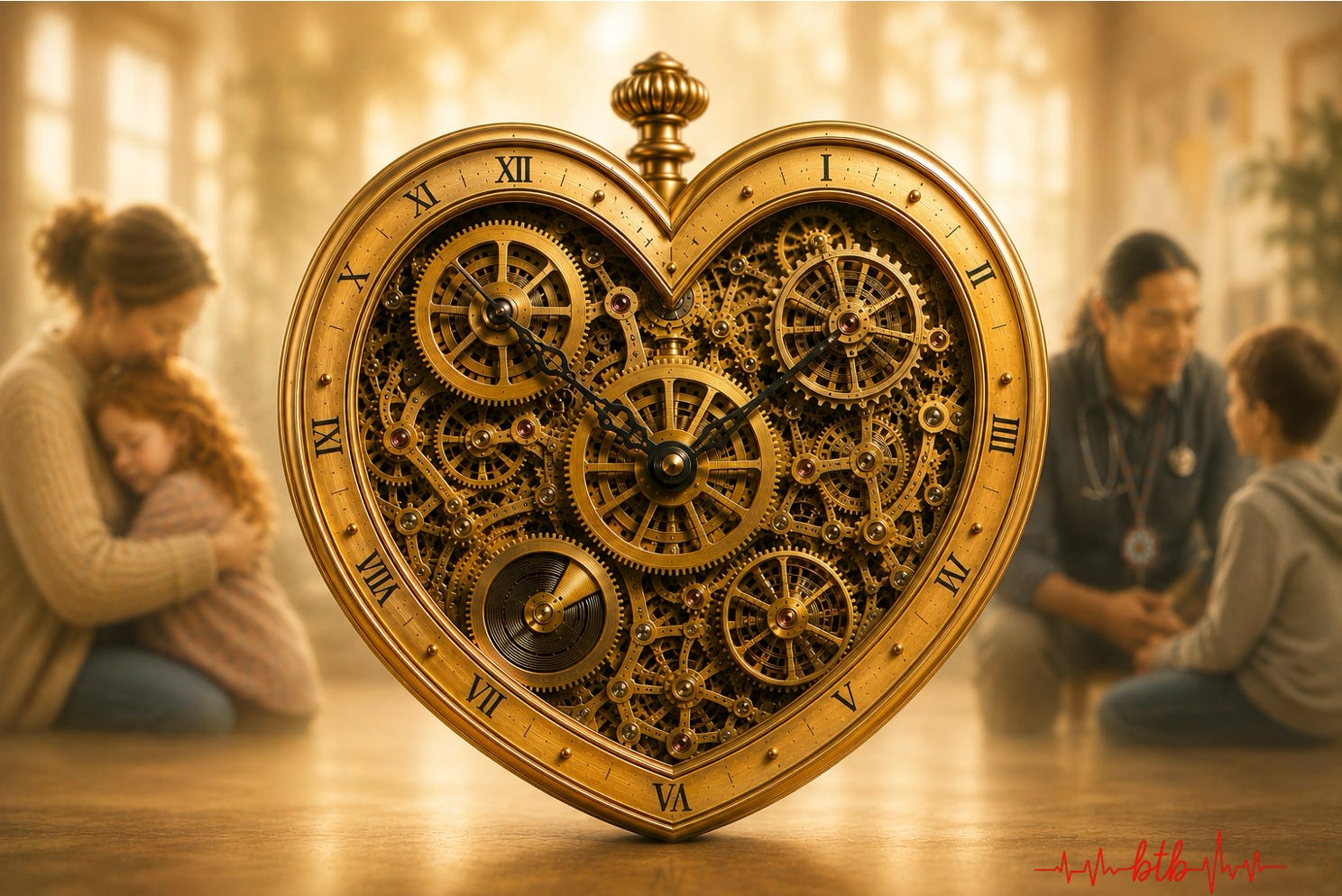
You know by now that I see things in pictures, so I’m gonna try something here and ask you to please bear with me. I want to describe the CHD community not as a collection of disconnected efforts, but as what I believe it already is: a clock. You know those beautiful old clocks where you can see their mechanisms all working together? A mechanism with interlocking parts — large and small, fast-moving and slow, visible and hidden — all doing their own specific work in service of the same hands moving forward.
NOT ONE of those roles is more important than any other. The smallest spring is as essential to keeping time as the largest gear. Take one out, and the whole thing stops.
This is what the CHD clock looks like to me. See if you recognize your own work in it!
The parent who started a 5K because they needed to do something with the fear.
The Facebook group that grew into a registered charity.
The family foundation that funds one research grant a year because a researcher once took the time to explain their child’s condition, and the family never forgot it.
This work can feel small and solitary. Most of these families might not know anyone else doing the same thing in the next province or state, let alone the next country. They raise a few thousand dollars a year, maybe tens of thousands, and they hope it makes a difference.
Let me tell you right now: It does. This is where the entire movement is grounded. Every institutional program, every clinical network, every multi-million-dollar research initiative ultimately traces back to a family who refused to accept that nothing more could be done. These are the roots. Without them, the rest of our CHD clock has nothing to stand on.
Awareness campaigns, educational programs, resource directories, and family support networks, like Mended Little Hearts, Conquering CHD, and Kids With Heart, build the community that supports families facing heart disease. They provide resources, support groups, and a sense of belonging, helping families feel less alone and more connected.
Hospital-based cardiac neurodevelopmental programs, patient and family advisory committees, and quality improvement collaboratives shape how care is delivered, communication happens, follow-up is structured, and outcomes are tracked. This work, often invisible to families until they benefit directly, includes changes in diagnosis explanations, developmental screening, and transition protocols for adolescents. While it doesn’t make headlines, it significantly impacts lives.
CNOC. CHD councils. Professional societies. The people who coordinate care across institutions, who build consensus on best practices, who create and maintain the registries that make research possible. Their work is the reason a child in Sherbrooke has a chance (imperfect, still incomplete, but a chance) at the same standard of care as a child in Toronto or Philadelphia.
It’s slow work. Committee-driven, consensus-dependent, sometimes maddening in its pace. And it’s the scaffolding that everything else is built on.
National organizations pushing for policy change, insurance coverage, newborn screening, disability accommodations. The ones who show up in legislative offices and committee hearings, who file comments on proposed regulations, who translate clinical need into political language.
They fight the structural battles that individual families can’t fight alone — the ones where the opponent isn’t a person but a policy, a funding formula, an eligibility criterion, a bureaucratic category that wasn’t designed with complex CHD in mind.
Philanthropies. Foundations. Grantmakers. Corporate sponsors (with all the editorial independence caveats that entails). From large-scale innovation funders to hospital foundation grants. They turn dollars into research, programs, and infrastructure. Every clinical trial that enrols a child, every family resource that gets printed and handed to a terrified parent, every new surgical technique that becomes standard of care — someone decided it was worth investing in before any of that could happen.
This work decides what gets built next.
Researchers developing new surgical techniques. Device manufacturers. Clinical trialists. Teams working on regenerative therapies, mechanical circulatory support, and the next generation of imaging and monitoring. They’re not just studying the problem; they’re engineering what CHD care will look like in ten and twenty years.
The work happening in labs and operating rooms today is the standard of care that the next generation of CHD families will either benefit from or still be waiting for. It depends, in no small part, on whether the rest of the clock keeps turning alongside them.
Every one of these roles is already being filled. Right now, today, across hundreds of organizations and thousands of individual efforts in North America and beyond. The family running a CHD awareness walk in Saskatoon is as essential to this clock as the institutional funder backing a multi-site clinical trial. Different scale, different function, different daily reality — but equally irreplaceable. A clock with a missing spring keeps time just as poorly as a clock with a missing gear.
So what’s missing?
Not the people. Not the effort. Not the passion; Lord knows there’s no shortage of that in this community.
What’s missing is the awareness that all of this work is already part of the same clock.
CF had a megaphone. One voice, amplified, pointed at one target, demanding one thing. It worked brilliantly, because CF’s biology gave it the clarity to use that tool.
CHD can’t use a megaphone. It doesn’t have one message; it has… just so many, and on so many different levels because of secondary conditions (co-morbidities) that can compound the severity of the disease burden. And every attempt to force those hundreds of messages into a single amplified voice ends up either so broad it says nothing meaningful or so narrow it leaves out most of the community.
But CHD has something CF never needed: a clockwork. A distributed, interlocking mechanism where every part serves a different function, and all of them — all of them — drive the same hands forward.
The labour movement solved this exact architectural problem. Not by merging every local union into one mega-organization, but by building the connective tissue (federations, shared infrastructure, coordinated political action) that let each local keep doing its own work while amplifying everyone’s power. The seamstress didn’t join the coal miners’ union. She didn’t need to. She needed a structure that let her coordinate with the coal miner when their interests aligned — and step back to her own fight when they didn’t.
So what does the CHD clock need to actually run? Three things.
Visibility. This clock needs element to see the other. Currently, most can’t. The Nova Scotia foundation doesn’t know about the Alberta clinical network. The New York funder doesn’t know about the Iowa innovator. The parent reading research at 10pm doesn’t know that a professional society on another continent is working on guidelines that would change her child’s care. Before moving together, we all must find each other.
Connection. Not consolidation. Not one organization absorbing the rest. Not a merger. A mesh. A network. Something resembling a labour federation structure that allows workers to find each other when their efforts overlap, providing shared resources like information, visibility, and political coordination without requiring workers to give up their identities or focus. The labour federation didn’t replace craft unions; it empowered them to work together more effectively while preserving their individuality.
Shared mission, not shared identity. CF rallied around these words: “fix this gene, save these lives.” CHD’s version can’t be just 6 words. It’s bigger, and it’s harder, and it won’t fit on a bumper sticker. But it exists, and I think most of us already carry it even if we’ve never said it out loud.
So here’s what I want to leave you with. Not a call to action (not personally a fan of them; they always feel like the part of the charity gala where everyone claps and then goes home and does nothing). Not “donate here” or “share this post.” Something more honest than that.
If you started a foundation because your child’s diagnosis left you confused and mad and determined and you didn’t know what else to do with all that terrified energy: the awareness you’re building in your community is the ground the rest of this movement stands on. It may feel small from where you sit but please trust me on this: it isn’t.
If you’re a clinician who’s ever changed how you explain a diagnosis to a family, or added a neurodevelopmental screen to a cardiac follow-up visit, or sat with a parent ten minutes longer than your schedule allowed because you could see they weren’t ready to leave: that work reshapes the care every family after them receives. You may not see the ripple, but it’s there.
If you’re a researcher: every finding that reaches a family (even years later, even translated through three intermediaries, even reduced to a single sentence a parent repeats to their child’s school) changes how that family shows up for their child. The distance between your lab and their kitchen table is shorter than you think.
If you’re a funder who’s ever backed a project because you believed it mattered even when the return on investment wasn’t obvious and the patient population was too small for anyone else to care: you decided what got built. That’s not philanthropy in the passive, write-a-cheque sense. That’s architecture.
And if you’re a parent who’s just trying to understand what’s happening in your child’s body — reading the research at midnight, Googling terms you can’t pronounce, asking questions in cardiology appointments that you’re half-afraid make you sound difficult, showing up with a list you made at 5am because you couldn’t sleep: you are part of this. Not in some token, “everyone matters” kind of way. In a structural, load-bearing, the-clock-doesn’t-run-without-you kind of way.
An informed family changes the care their child receives. That changes the clinical data. The data changes the research. The research changes the next family’s care. That’s not a metaphor. It is a mechanism. And you are inside it, right now, whether you knew it or not.
You are not at the edge of this movement. You are the very reason it exists.
The way I see it, the CHD Clock is already built. It’s already keeping time. The question isn’t whether CHD can rally the way CF did. It can’t, nor does it need to. The question is whether we can learn to see the clock we’re already inside of — to recognize that the work we’re each doing, at whatever scale, in whatever role, from whatever corridor we happen to be standing in, is part of the same movement toward the same thing.
Longer lives. Better care. Holistic care. And a world that sees our CHD children and loved ones as whole people, not just diagnoses.
We’re already keeping time, y’all.
The next logical step is to learn to keep it together.
Take heart,
Marie-Jo 💕
The CF story
Cystic Fibrosis Foundation. (n.d.). Our history. https://www.cff.org/about-us/our-history The full timeline, from the 1955 founding through Trikafta and beyond. This is where the milestones live: 1955 founding, 1989 gene discovery, 2000 Aurora Biosciences investment, 2012 Kalydeco approval, 2014 royalty sale, 2019 Trikafta approval. If you want the whole arc in one place, start here.
Cystic Fibrosis Foundation. (n.d.). Our venture philanthropy model. https://www.cff.org/about-us/our-venture-philanthropy-model How the Foundation pioneered investing nonprofit dollars into for-profit drug development. The $40 million Aurora Biosciences investment, the royalty structure, the $3.3 billion sale to Royalty Pharma in 2014, and the subsequent $575 million sale of remaining royalty stakes in 2020. This is the page that makes you understand why the CF story is a boardroom story as much as a medical one.
Cystic Fibrosis Foundation. (n.d.). Understanding changes in life expectancy. https://www.cff.org/managing-cf/understanding-changes-life-expectancy The source for the 65-year median predicted survival for babies born with CF between 2020 and 2024. Also includes a careful discussion of what median survival means and doesn’t mean for individual patients; worth reading in full, not least because it models exactly the kind of statistical honesty this newsletter tries to practice.
Cystic Fibrosis Foundation. (n.d.). 2024 patient registry highlights. https://www.cff.org/medical-professionals/2024-patient-registry-highlights The registry data behind the survival figures, including the important caveat that predicted median survival is lower (by possibly more than a decade) for people ineligible for CFTR modulators.
Cystic Fibrosis Foundation. (2019, October 21). Cystic Fibrosis Foundation statement on FDA approval of TRIKAFTA. https://www.cff.org/press-releases/2019-10/cystic-fibrosis-foundation-statement-fda-approval-trikafta-first-triple The Foundation’s statement on the day Trikafta was approved — the drug they called “the single greatest therapeutic advancement in the history of CF.”
Vertex Pharmaceuticals. (2019, October 21). FDA approves TRIKAFTA™ (elexacaftor/tezacaftor/ivacaftor and ivacaftor). https://investors.vrtx.com/news-releases/news-release-details/fda-approves-trikafta-elexacaftortezacaftorivacaftor-and Vertex’s announcement of Trikafta’s FDA approval. The drug was approved for people aged 12 and older with at least one F508del mutation, reaching approximately 90% of the CF population.
Cystic Fibrosis Foundation. (n.d.). Robert J. Beall Therapeutics Development Award. https://www.cff.org/robert-j-beall-therapeutics-development-award-0 Robert Beall led the CFF for 21 years as president and CEO. He pioneered the venture philanthropy model. The award page gives you a sense of the man’s impact.
Dolgin, E. (2012). Straight talk with... Robert Beall. Nature Medicine, 18, 335. https://doi.org/10.1038/nm0312-335 A Nature Medicine interview with Beall on the venture philanthropy approach: why the CFF took the risk, how the Aurora deal was structured, and why he believed nonprofits had to act like investors, not just funders. Paywalled, but worth tracking down if you can.
The CF Canada story
Cystic Fibrosis Canada. (n.d.). Advocacy at CF Canada. https://cysticfibrosis.ca/advocacy-at-cf-canada How CF Canada drove Trikafta approval and provincial funding. Worth reading for the structural detail: a national advocacy network with government relations capacity in every province, plus a 65-year track record of driving policy change.
Cystic Fibrosis Canada. (2021, November 22). Nunavut confirms Trikafta funding: All provinces and territories will now cover life-changing CF drug. https://www.cysticfibrosis.ca/news/nunavut-confirms-trikafta-funding-all-provinces-and-territories-will-now-cover-life-changing-cf-drug The milestone announcement: every province and territory in Canada committed to funding Trikafta for eligible patients on public drug plans. From Health Canada approval (June 2021) to full national coverage in under six months.
Cystic Fibrosis Canada. (n.d.). Highly effective modulators. https://www.cysticfibrosis.ca/our-programs/advocacy/access-to-medicines/trikafta Current status of Trikafta funding across Canada, including the clinician-developed guidelines for access and the ongoing advocacy for expanded coverage for rare mutations.
CHD context
Centers for Disease Control and Prevention. (n.d.). Congenital heart defects: Data and statistics. https://www.cdc.gov/heart-defects/data/ CHD prevalence (~1 in 100 live births), types of defects, and the 4-in-10 disability rate among adults with CHD. The baseline data that establishes the scale of the condition.
The labour movement
Britannica, T. Editors of Encyclopaedia. (n.d.). American Federation of Labor. Encyclopedia Britannica. https://www.britannica.com/topic/American-Federation-of-Labor Overview of the AFL’s founding, Gompers’ philosophy of “pure and simple trade unionism,” the craft union model, and the federation’s structural architecture. A solid starting point for understanding why the AFL succeeded where the Knights of Labor failed.
Britannica, T. Editors of Encyclopaedia. (n.d.). AFL-CIO. Encyclopedia Britannica. https://www.britannica.com/topic/AFL-CIO The 1955 merger, the craft-versus-industrial tension, and the combined federation’s political achievements. Also covers the 2005 Change to Win split, which is instructive for understanding how federation models can crack under pressure.
Library of Congress. (n.d.). Organized labor: A research guide. https://guides.loc.gov/organized-labor Primary source material on the Knights of Labor, AFL, CIO, and the evolution of the federation model. For the history-curious reader who wants to go deeper than encyclopedia entries.
Venture philanthropy model
Wikipedia contributors. (2026, March 30). Venture philanthropy. Wikipedia. https://en.wikipedia.org/wiki/Venture_philanthropy General overview of the venture philanthropy model, with the CFF-Aurora/Vertex partnership as the landmark case study. Includes the important detail that CFF’s total investment in the Vertex pipeline grew to $150 million over time.
Harvard Business School. (n.d.). Vertex Pharmaceuticals and the Cystic Fibrosis Foundation: Venture philanthropy funding for biotech (Case study). https://www.hbs.edu/faculty/Pages/item.aspx?num=35037 The Harvard Business School case study on the CFF-Vertex deal. Academic analysis of how a nonprofit and a for-profit company aligned their objectives to produce breakthrough therapies. If you want to understand the mechanics of how venture philanthropy actually works, this is the deep cut.
The content provided on Between the Beats is for informational and educational purposes only.
While I am deeply involved in the CHD community, the CNOC, and the Canadian CHD Lived Experience Council, I am not a medical professional, doctor, or licensed healthcare provider. The insights, research translations, and personal experiences shared here are not intended to be a substitute for professional medical advice, diagnosis, or treatment.
Important Guidelines:
Consult Your Team: Always seek the advice of your cardiologist, surgeon, or other qualified health provider with any questions you may have regarding a medical condition or treatment plan.
Don’t Delay Care: Never disregard professional medical advice or delay seeking it because of something you have read on this Substack.
Emergency Situations: If you think you may have a medical emergency, call your doctor or local emergency services immediately.
By using this site, you acknowledge that you understand and agree to these terms.
Comments
Nothing yet. Say the first thing.
Sign in to join the conversation.