
Editor’s note: We continue to wait for a procedural opinion from the U.S. Court of Appeals for the 11th Circuit in the Black Power Radio case heard last November. We’re following this case because Pinellas County withdrew federal funds it had already awarded to Black Power 96.3 FM Radio. The county’s action, if allowed to stand, has implications for other community radio stations that rely on funding or resources from their local government.
It’s important to note that a county commissioner led the defunding vote by linking the station to other freedom fighters in the Black community, including those who faced a federal criminal prosecution with significant political overtones. To help us understand how seemingly unrelated legal actions can threaten our freedom of association and assembly, we’re presenting this analysis below.
Mimi Rosenberg, a practicing attorney in New York City, and the host of the WBAI show, Building Bridges, analyzed how the political attacks on these nonprofit group came with distinct legal elements, and ensnared many people and entities.
Procedural Posture of Cases Involving The African People’s Socialist Party
The criminal case, known as the “Uhuru 3” prosecution, is now on appeal after mixed verdicts and non‑custodial sentences.
The affirmative litigation over Black Power Radio funding cuts is ongoing, framed as a First Amendment retaliation case alleging political discrimination by government actors.
Politically, the criminal case is positioned as a national‑security prosecution, while the Black Power Radio case is positioned as a civil‑rights retaliation claim challenging government suppression of dissident Black political speech.
1. Status of the criminal prosecutions and appeals
Case: United States v. Yeshitela, Hess, Nevel (“Uhuru 3”)
Thanks for reading CMAP's FCC Actions Alert Substack! Subscribe for free to receive new posts and support our work.
Charges: Conspiracy to act as unregistered agents of Russia (18 U.S.C. §951), plus related counts.
Current procedural status
Acquitted on the charge of acting as foreign agents.
Convicted on conspiracy to act as foreign agents.
Sentenced in late 2024 to no prison time and no fines.
Appeal filed June 2025 in the 11th Circuit Court of Appeals.
The appeal challenges:
constitutionality of §951 as applied to political speech
evidentiary rulings
First Amendment issues
alleged overreach in treating political organizing as foreign‑agent activity
Political posture of the criminal case
The government frames it as a national‑security case about foreign influence operations.
The defendants frame it as a political repression case, arguing the prosecution criminalizes Black radical speech and international solidarity.
Civil‑liberties groups (e.g., National Lawyers Guild, Center for Constitutional Rights) publicly characterize it as a dangerous expansion of foreign‑agent law into domestic political activity.

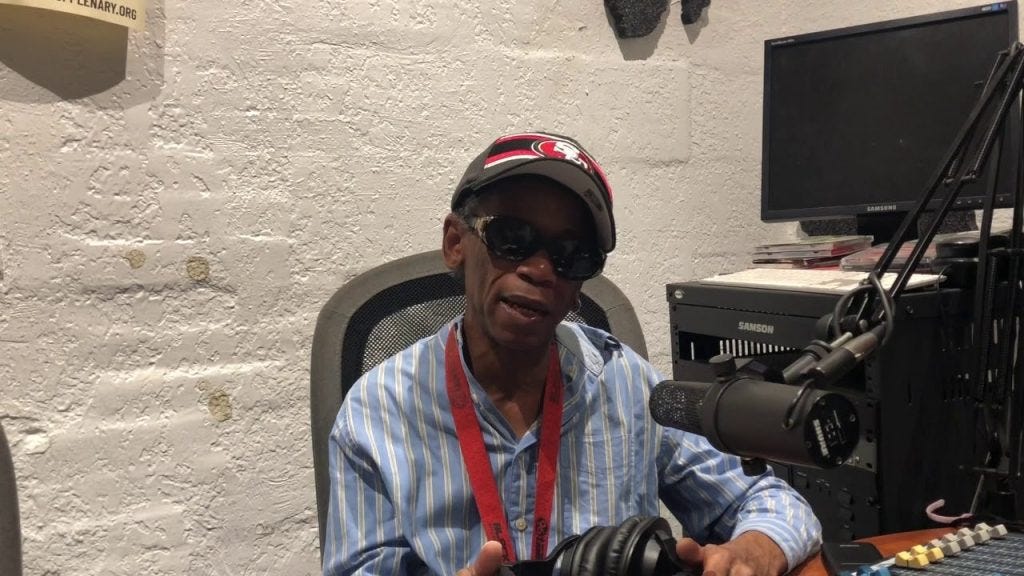
Eddie Malsby, DJ, Black Power Radio 96.3FM, St. Petersburg, Fla.
2. Status of the Affirmative Litigation Over Black Power Radio Funding Cuts
Case type: Civil rights / First Amendment retaliation
Claim: Government actors cut or blocked funding to Black Power Radio for political reasons, allegedly in retaliation for African People’s Socialist Party (APSP)/Uhuru political positions.
Current procedural status
The litigation is ongoing (no dismissal, no summary judgment, no final ruling).
Plaintiffs argue:
Funding was withdrawn because of political viewpoint, not neutral criteria.
This constitutes unconstitutional retaliation against protected speech.
The cuts were part of a broader pattern of political targeting of APSP‑affiliated institutions.
Government defendants argue:
Funding decisions were administrative, not political.
No constitutional violation occurred because the government is not obligated to subsidize particular speech.
Political posture of the Black Power Radio case
Plaintiffs frame it as a civil‑rights and free‑speech case, asserting that Black radical media was punished for its political content.
Government defendants frame it as a routine funding‑discretion case, denying political motive.
Supporters of APSP/Uhuru view it as part of a broader pattern of state repression of Black liberation movements.
3. How the Two Cases Relate Politically
Although legally distinct, the two matters are politically intertwined.
In the issue of government framing, the criminal case is one of national security and foreign influence, while the defunding case is one of administrative discretion.
In the issue of defense framing, the criminal case is one of political repression of Black radicalism while the defunding case is one of political retaliation against dissident media.
Within the constitutional theme, the cases are tackling the criminalization of political speech and the punishment of a political viewpoint.
Within a broader political narrative, the “Uhuru 3” are being criminally targeted for international solidarity while the APSP‑aligned media is being financially punished for political content.
Together, they form a dual‑front legal battle [with implications for other communities]:
one defensive (fighting criminal charges)
one affirmative (suing over political retaliation)
Communications Act of 1934, Sect. 326.
Nothing in this Act shall be understood or construed to give the Commission the power of censorship over the radio communications or signals transmitted by any radio station, and no regulation or condition shall be promulgated or fixed by the Commission which shall interfere with the right of free speech by means of radio communication
Thanks for reading CMAP's FCC Actions Alert Substack! Subscribe for free to receive new posts and support our work.
Comments
Nothing yet. Say the first thing.
Sign in to join the conversation.