
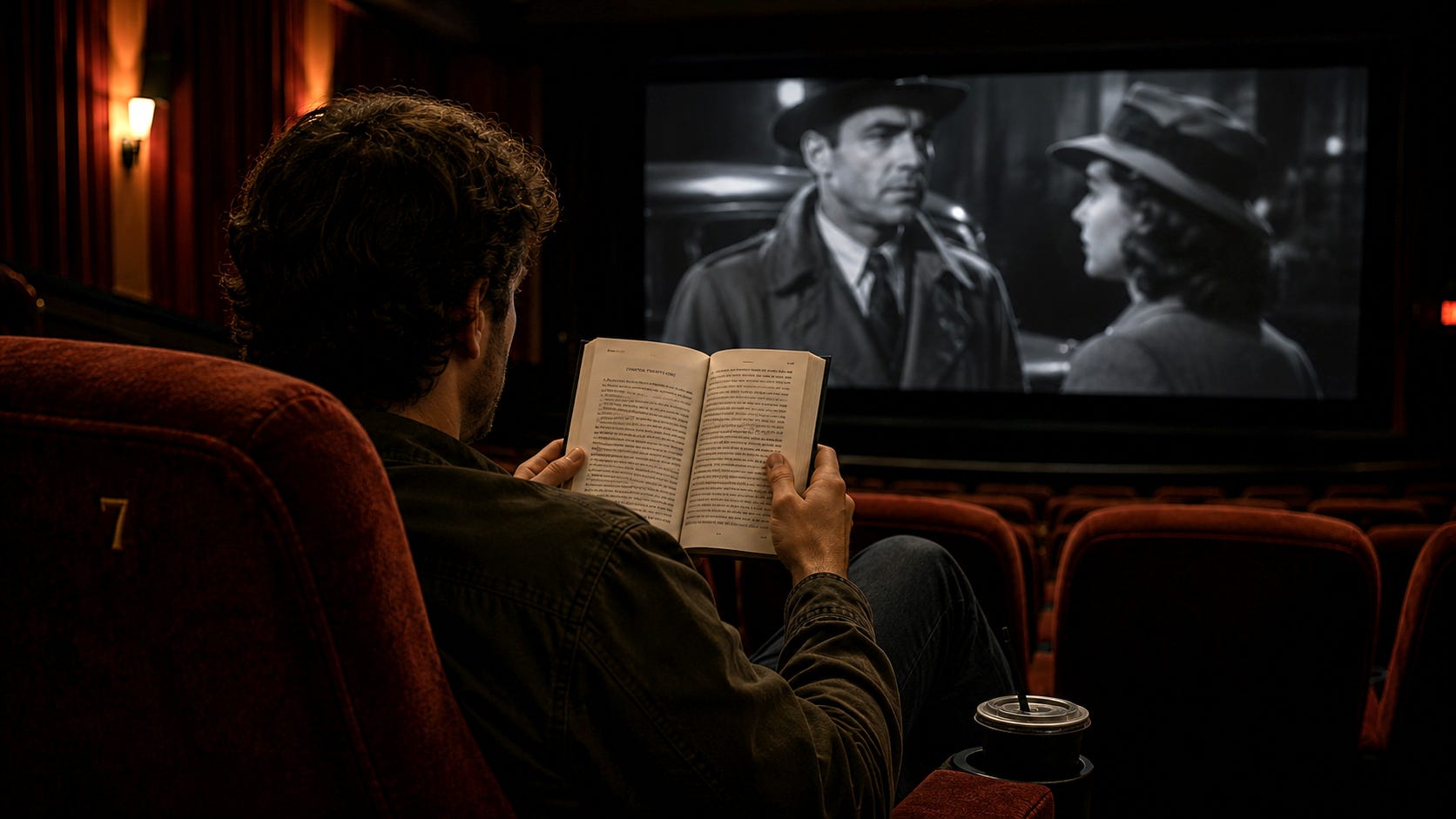
I really love the Dresden Files book series by Jim Butcher. It’s an excellent detective noir story about a wizard in Chicago who fights evil and struggles with moral questions but is ultimately a good guy. It’s a great series of 14 books, so far.
A number of years ago, Fox tried to make an adaptation of the Dresden Files for TV. I don’t think it even made a full season. It just wasn’t the same.
For example, in the books, there’s a talking skull with a spirit inside it that advises Harry Dresden. For the TV show, they just changed it to a person. I think he was still supposed to be a spirit of some sort, but it wasn’t a talking skull, and so it lost something fundamental. There were other changes that also were a big letdown. And yet, so many Dresden Files fans still clamor for an adaptation.
Find any online gathering of fans of any book or book series. Eventually, you’ll find somewhere where they’ve discussed how this book or series should be adapted for the screen, large or small. They’ll discuss which actors should play which characters, which parts of the books should make it into the show or movie, and which could be lost. There are endless debates about directors, settings, budgets, and whether it should be a series or a movie or a series of movies.
And then, if this adaptation were to come to pass, all of the fans would flock to see it. Often, very often, even if they like the movie qua movie or show qua show, they’ll always say, “Well, it wasn’t as good as the book.” Why do we crave having our favorite books turned into movies and TV shows when we know they never measure up? They can be good, but they always fall short, necessarily, because of the limitations of visual media storytelling as opposed to written media storytelling. Is it because we want to see literal versions of what we only have in our heads or other interpretations, or have we been conditioned to believe that the pinnacle of entertainment media is moving pictures?
I realized that “never as good” is a strong claim. Are there counterexamples? Jaws is a great movie, possibly as good as, and maybe even better than, the book. The Godfather is another where the movie is arguably better than the book. I’ve not read No Country for Old Men, but I’ve heard that the movie and the book are both excellent. Likewise, I haven’t read A Song of Ice and Fire, but I’ve heard from folks that, at least early on, the Game of Thrones series was as good as the early books.
What about one of the most controversial adaptations, The Lord of the Rings? Many fans love the movies. Many fans find the movies to be problematic in what they change, add, or leave out. Certainly, they are great movies in and of themselves, but are they great adaptations?
I think a common denominator in adaptations that are better than or as good as the original book is that they often have directors or showrunners who have strong visions in and of themselves for the story. They have a strong sense of the story and they also have a strong sense of their medium. They know that a movie or TV show can never reproduce the depth of a book. They’re two different media and require different approaches to be successful in storytelling. Jaws and The Godfather are great examples of this. Peter Benchley put all kinds of information about sharks in Jaws that just never made it to the screen. That’s okay, because what Spielberg brought to the screen were the great characters, the great battle, the primal nature versus man tale that was at the heart of the story. The same is true of The Godfather and Mario Puzo and Francis Ford Coppola, not to mention the contributions of the actors.
Another important question is whether there is a recency bias. We almost always read the book first. Does the book being better just mean I got there first and it imprinted on me? Think about times when you’ve seen the movie or TV show first and read the book later. Did you have the same impression that the book was better? In my case, very often I did think the book was better because there was more. There was more detail, more depth, more characterization, more world-building. I have heard from people who have watched The Shining or Jurassic Park before reading the book that they often prefer the film.
Why are we like this? Part of it is psychological. People want it all. Some people want to externalize what they have held private in their mind. Reading is an act of the imagination. In a solo context, an adaptation is a promise to make that thing in your head shared and real. That promise is very seductive, even when it usually disappoints.
Likewise, there’s a kind of validation that comes from an adaptation. “If they make a movie of it, then the thing I love is important.” Adaptation is a cultural ratification of something you’re personally attached to and love.
We also often desire to re-experience the story we love for the first time again. You can’t unread a book, but a film offers the illusion of a fresh first time with something that you already know, you’ve already read, and that you love so much. Relatedly, we also often want to revisit a world that we love. We want to go back to Narnia, or Middle Earth, or whatever the world of that book is. Being able to watch a movie or TV show that features it immerses us in that world again, in a way that goes beyond what our imagination could have produced. Finally, there’s a social aspect where we have read and loved a large book, but the people in our lives who we want to share it with don’t want to read an 800-page book. Here’s a way to share it with them in a way that they are willing to receive it.
One of the reasons why the adaptations often disappoint us is obvious: the economics of the medium force compression, simplification, and changing the story to create broad appeal. A novel optimizes for one reader’s depth, but a film optimizes for millions of strangers’ attention. In addition, the interiority of a narrative doesn’t make it to film. Prose lives inside the heads of the characters. The camera can’t go inside. Some movies and TV shows will have a gimmick where they have a voice over of the character to simulate that, but you can’t do that in every story. This is why some of the best novels could never be adapted to screen.
Another problem is that your imagination is not the same as the imagination of the director, the actors, the producers, the studio, and so on. A book lets every reader cast the protagonist to set the setting wherever you want. All locations are possible, but a film casts one actor as that character. It concretizes every setting, every prop, every scene, and that is a loss, not just a gain.
There’s also a problem where those who adapt books to movies and TV shows can’t win. If they make an absolutely faithful adaptation, then people think it’s lifeless and unimaginative, but if they make a bold adaptation that changes things, then the fan base is enraged and they won’t see it. They tell others not to see it. There’s no way to absolutely win over everyone.
Compounding all is that the better you know the source material, the worse the odds are that you’re going to love the adaptation. Your love of the book is the very thing that guarantees the movie fails you. Is wanting the adaptation therefore a kind of self-sabotage? Are we setting ourselves up for disappointment? That gap between anticipation and delivery, is the disappointment baked in before a single frame is ever shot? Does the craving survive contact with a result, or do we forget we were let down and crave the next one anyway? We do, and why do we do that?
How can we find a solution to our problem? Maybe instead of looking for a replacement of the source material, we should look for translation or even conversation. The best adaptations are the ones that take advantage of the medium that they’re producing. Some say that adaptations that argue with their source rather than transcribe it are better. I don’t know if that’s true. Maybe we should look at adaptations as preservation of the culture’s attention to something that we love. Maybe we should see it as a way to introduce this book that we love to a new generation and a new audience. Maybe the movie or TV show’s job is advertising, not equivalence.
It’s entirely possible that we’re making a category error by holding a film to a novel’s standard, like faulting a painting for not being a symphony.
I’ll end with a couple of questions. If adaptations almost always disappoint us, why do we keep lining up to demand them, watch them, and then complain about them? What does that say about us rather than about Hollywood? Maybe we should ask ourselves another question: Would we actually want a perfect adaptation, or would that ruin a book? By setting it in stone based on one director’s and a bunch of actors’ interpretation of it?
Comments
Nothing yet. Say the first thing.
Sign in to join the conversation.