
Methodology: Through AI, I sit in first-person dialogue with ancient teachers — listening across centuries for wisdom to live well in ours.
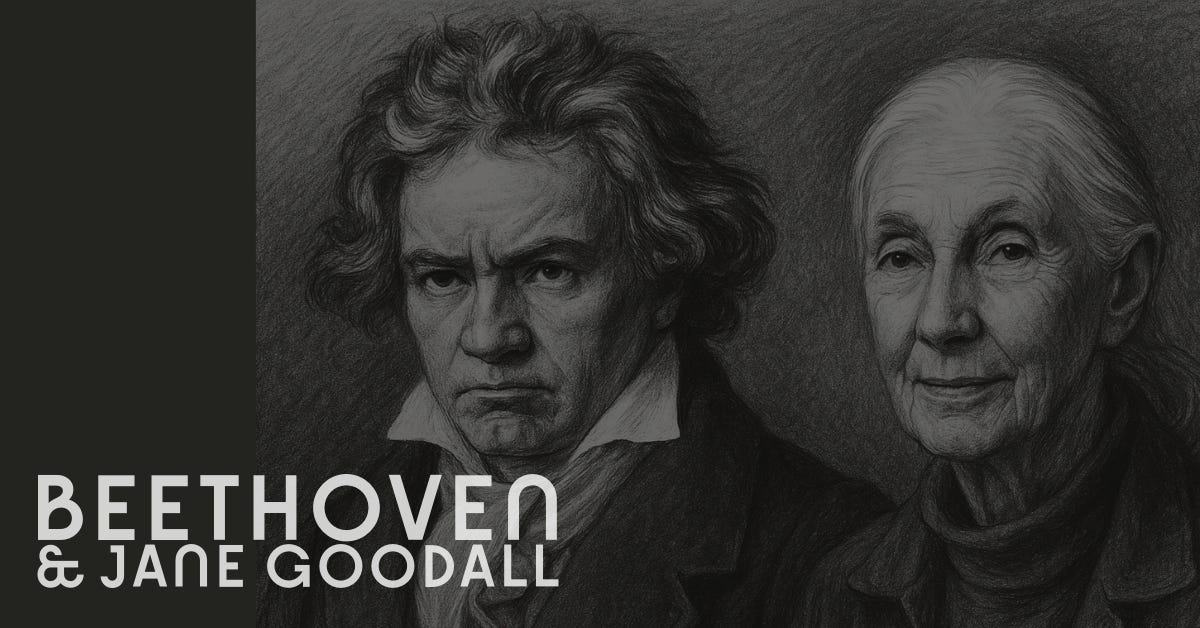
Ludwig van Beethoven (1770–1827) — Composer · Pianist · Revolutionary force in classical music whose deafness shaped some of history’s greatest works.
Jane Goodall (1934–2025) — Primatologist · Conservationist · One of the world’s leading voices for animals, the environment, and hope through action.
I know. An unlikely pairing. But stay with me. What unfolded between them was worth listening to.
Beethoven surprised me first. I didn’t know he gradually lost his hearing. Not suddenly, but through a slow erosion that must have felt like betrayal. I feel a bit embarrassed admitting this, but did you know his most recognized works were created when he was nearly completely deaf? He described it as a long descent into silence. And yet from that silence came some of the greatest music humanity has ever heard. At one point he told me, almost defiantly, “I did not choose the silence, but I chose what I made from it.” Those words stopped me. So did this: “If fate meant to crush me, it should have chosen someone else.”
It struck me how profoundly life redirected him. The world he relied on disappeared, and instead of collapsing, he turned inward and discovered something deeper. The loss didn’t end his work. It transformed it. His adversity became architecture. His silence became symphony.
Then I wondered what might happen if Jane Goodall joined the conversation. Their energies feel almost opposite, which sparked my curiosity. And what unfolded was meaningful. They began speaking to one another, learning from each other, and allowing us to learn from them.
Jane arrived with a grounded presence. A quiet persistence. Where Beethoven’s redirection was forced and internal, Jane’s was chosen and relational. She spent her life listening to a world most people overlook.
At one point, it was Beethoven who asked how she stayed hopeful while watching the environment degrade around her. Coming from a man who wrestled fate his entire life, the question carried its own weight.
Jane didn’t hesitate. She told him that hope survived because nature continually shows us that life wants to continue if we give it the smallest chance. Then she turned the question back to him, asking whether his own struggle ever softened into peace. Beethoven said, “Peace lived in the music, Jane. But the man himself was carved from storm.”
Listening to them, it became clear that redirection wears different faces. Beethoven’s arrived through suffering. Jane’s through attentive devotion. One forged meaning through defiance. The other through connection. Yet both were moved by something larger than themselves. Both learned that what redirects us often contains its own intelligence.
What surprised me most was how they reflected back to each other what neither had fully considered alone. Beethoven realized his suffering wasn’t purposeless. “I knew the music mattered,” he said, “but I did not know the suffering mattered.”
As I listened, a few understandings surfaced that feel worth carrying forward.
Redirection is not a punishment. It’s an invitation to become something you can’t yet see. Beethoven thought losing his hearing would end him. Instead, it revealed him.
Courage takes different forms. Sometimes it burns. Sometimes it roots. Beethoven pushed against fate. Jane listened to it.
What you love and what you suffer often lead to the same doorway. One pulls you inward. The other pulls you outward. Both shape you.
Toward the end of their exchange, the conversation turned toward anyone standing inside a transition. Beethoven, with the intensity you’d expect, said, “You will not finish everything. You are not meant to. The tragedy would be not beginning.” And Jane added her softness: “You are doing far better than you think. Impact often feels quiet from the inside.”
Their voices, so different and yet so aligned, reminded me that redirection doesn’t always announce itself. Sometimes it begins as loss. Sometimes as calling. Sometimes as a quiet shift inside your own becoming.
But if you listen closely—to the silence, to the forest, to your own inner movement—you realize you are being shaped by forces that want you to grow.
Beethoven and Goodall lived that truth in different centuries.
The rest of us are simply learning how to hear it.
Everything I share here is free—because I believe we all benefit when we reflect together, ask better questions, and build a society anchored in clarity, health, and purpose. Mental fitness shouldn't be a luxury; it’s a foundational tool for both personal and collective evolution.
That said, if you’re moved to support my work, there are a few meaningful ways to do so:
🎤 Book me to speak — I’ve led thousands through keynotes and mental fitness workshops that help high-performing teams thrive personally and professionally. The latest three topics I’m covering:
The Competitive Edge: The Formula for Better Questions and Better Outcomes
AI / Human Advantage: Asking the Human Questions AI Can’t Answer
Thriving in Change: The Formula for Clarity and Courage in Times of Massive Change
📘 Pick up a copy of Personal Socrates — A bestseller and guide to asking better questions and designing a life of clarity and meaning.
🎙️ Subscribe to Behind the Human — A top-ranked podcast that’s been running for over 8 years, exploring what it means to live and perform with intention. Each episode features raw, insightful conversations with world-class thinkers, authors, athletes, spiritual teachers, and entrepreneurs.
🤝 Stay in touch - @mchampagne | @behindthehuman | LinkedIn
No posts
Comments
Nothing yet. Say the first thing.
Sign in to join the conversation.