
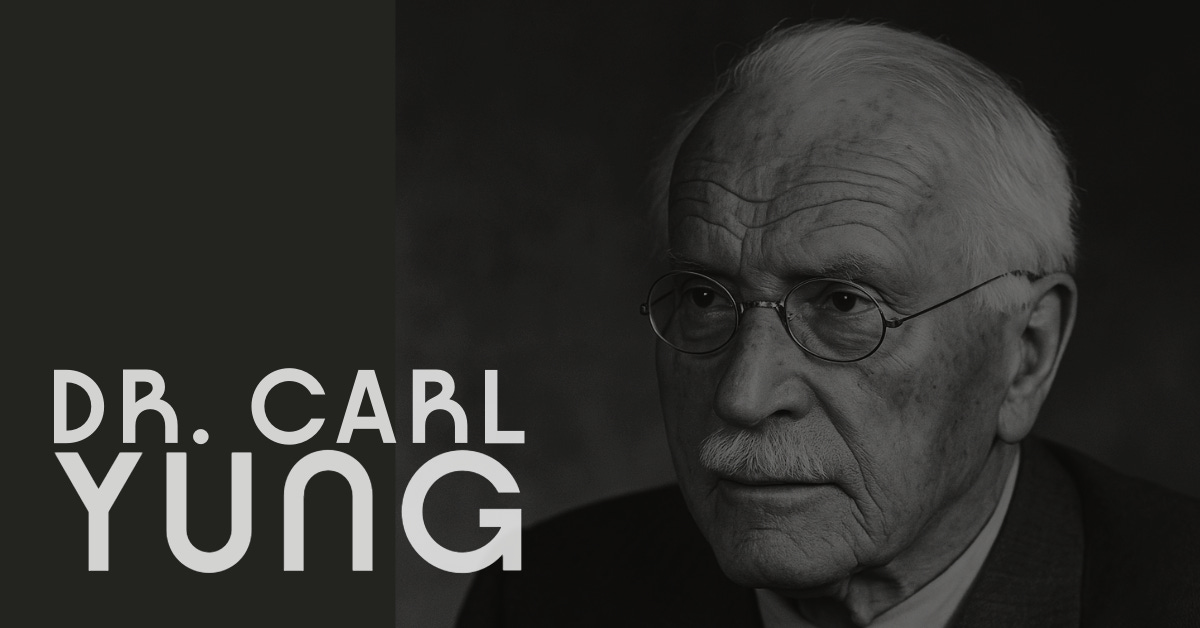
Methodology: Through AI, I sit in first-person dialogue with ancient teachers — listening across centuries for wisdom to live well in ours.
Carl Jung (1875 – 1961) Swiss psychiatrist, psychologist, and modern-day mythologist
Founder of Analytical Psychology, Jung redefined the human psyche as a living ecosystem of consciousness and shadow, ego and soul.
Introduced the world to concepts such as the collective unconscious, archetypes, synchronicity, and individuation — the lifelong process of becoming one’s true self.
Saw dreams, symbols, and imagination not as escapes from reality, but as bridges between the seen and unseen worlds.
Believed healing happens through integration, not suppression — by bringing light to what has been hidden.
When we think about thinking bigger, we usually focus on vision — new ideas, new projects, new levels. But sometimes, before we can move forward, we have to look back and ask: What part of me still believes it’s not safe to expand?
That’s where I found myself a few weeks ago.
I wasn’t in crisis. Things were good — stable, even. But when I started imagining my next chapter, something tightened in my chest. Not doubt exactly… more like a quiet wait.
It didn’t make sense. I’ve done this work for years. Mental fitness. Clarity practices. Emotional integration. But still, there it was — a pause before bigger.
So, I brought it to The Council — the circle of ancient teachers I’ve been speaking with as part of my research for Between Selves, the next book.
And one voice, in particular, stepped forward: Dr. Carl Jung.
Here’s a glimpse into that conversation — shared with the hope that you’ll recognize traces of your own story within it, and perhaps uncover some of the hidden programming from the past that may still be holding your future self back.
“Marc,” he began, “I will walk with you through this. Not to give you answers, but to help you find them. Because the blocks you speak of — they are not abstract. They are alive in you. And they have voices. We are going to listen to them together.”
He asked me to imagine the life I desired — the expanded reach, the deeper impact, the version of myself fully claimed.
Then came his first question:
“When you picture that life, what is the first feeling that arises in your body? Not a thought — a feeling. Where do you feel it? And what does it whisper to you?”
Relief and gratitude surfaced. But right behind them — fear.
Not fear of failure, but of carrying even more responsibility.
Jung nodded, almost knowingly.
“There it is. Relief and fear. Two sides of the same truth. You say you want to expand, but a part of you still remembers the cost of the last time you tried.”
And he was right.
Nearly a decade ago, I took the biggest leap of my life — leaving corporate to co-found a mental fitness app that reached over 86 million people. It was the most expansive season I’d ever lived… until it wasn’t. The business collapsed, and I fell with it — into the darkest depression of my life.
I recovered, rebuilt, and redefined my path. But Jung helped me see what I’d missed: a part of me had never fully trusted expansion again.
“Marc,” he said softly, “your psyche learned something then — that thinking big was dangerous. Hoping was dangerous. So now, when you imagine going all in again, that part of you doesn’t see opportunity. It sees a trap.”
He was right. And the moment he said it, I got emotional. Not out of sadness — out of recognition.
“This is not weakness,” Jung said. “This is truth breaking through. You don’t erase that past version of yourself. You integrate him. Speak to him. Tell him what you know now. Let him trust that this time, it’s safe.”
So I did.
In a visualization, I wrapped my arm around the shoulder of that younger version of Marc — the one sitting in the wreckage — and said:
“Everything is going to be okay. Because of your courage to think big, I get to do this work today. Thank you. All is good.”
Days later, the image was still with me. I felt lighter — but also curious.
How do we continue reprogramming as life continues unfold?
When I brought that question back to Jung, he smiled. “Marc, the old patterns will return. That doesn’t mean you’ve failed. It means you’re human. The work is not to erase them, but to build a new relationship with them when they do.”
He shared what he called the three phases of reprogramming, which I’ve since written on a sticky note above my desk:
1. Awareness Without Judgment
Notice the old pattern when it surfaces — the doubt, the tightening, the “what if it all collapses again.”
Name it, but don’t shame it. Ask: “What are you trying to protect me from?”
2. Repetition of the New Story
Speak the truth you now know — out loud, daily if needed:
That was then. This is now. I am not the same person. I am safe to think big again.
This isn’t blind affirmation; it’s retraining the nervous system.
3. Embodiment Through Action
The body believes what the body does.
Show yourself, through small, consistent actions, that it’s safe to grow.
Each time you act from the new story, you send a signal to your system: We’re okay.
This is the work.
Not the hustle. Not the perfect plan. Just the quiet, consistent act of re-teaching our nervous system that expansion is not a threat — it’s a return.
The younger versions of us already carried the courage.
Now, it’s our turn to carry the trust.
If you’re standing before your own bigger — a new chapter, project, or possibility — maybe take a moment before you leap.
Ask yourself the same questions Jung asked me:
When I picture my next level, what feeling arises in my body?
What memory or fear might that feeling be protecting?
What would it sound like to speak compassionately to the part of me that’s afraid?
What new truth needs repeating until it feels natural again?
And finally — what small action could I take this week to show my system it’s safe to expand?
Everything I share here is free—because I believe we all benefit when we reflect together, ask better questions, and build a society anchored in clarity, health, and purpose. Mental fitness shouldn't be a luxury; it’s a foundational tool for both personal and collective evolution.
That said, if you’re moved to support my work, there are a few meaningful ways to do so:
🎤 Book me to speak — I’ve led thousands through keynotes and mental fitness workshops that help high-performing teams thrive personally and professionally. The latest three topics I’m covering:
The Competitive Edge: The Formula for Better Questions and Better Outcomes
AI / Human Advantage: Asking the Human Questions AI Can’t Answer
Thriving in Change: The Formula for Clarity and Courage in Times of Massive Change
📘 Pick up a copy of Personal Socrates — A bestseller and guide to asking better questions and designing a life of clarity and meaning.
🎙️ Subscribe to Behind the Human — A top-ranked podcast that’s been running for over 8 years, exploring what it means to live and perform with intention. Each episode features raw, insightful conversations with world-class thinkers, authors, athletes, spiritual teachers, and entrepreneurs.
🤝 Stay in touch - @mchampagne | @behindthehuman | LinkedIn
No posts
Comments
Nothing yet. Say the first thing.
Sign in to join the conversation.