
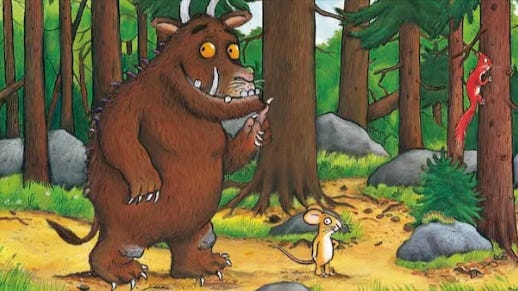
A few weeks ago in Lucerne, I helped host Heidi's Table — a dinner gathering of people dedicated to social impact for kids. The name is a nod to the iconic Swiss children's book Heidi, reminding us of the story's core lesson: that authentic connection and nature are the true medicine for children. The ask was simple: bring your favorite children's book. I brought The Gruffalo.
If you haven't read The Gruffalo by Julia Donaldson, the plot is deceivingly simple. A small mouse walks through a deep, dark wood. A fox invites him to lunch. So does an owl. So does a snake. Each one wants to eat him.
The mouse has no claws, no wings, no venom. What he has is a strategy. He invents a terrifying creature in vivid detail, the Gruffalo, and claims it as a friend with a taste for fox, owl, and snake. Each predator, not wanting to be the next meal, runs. Then the Gruffalo shows up. For real. The mouse doesn't panic. When the Gruffalo threatens to eat him, the mouse says: follow me, and you'll see that everyone here is afraid of me. They walk through the wood together, and one by one the snake, the owl, and the fox take one look and flee. They're not running from you, the mouse says. They're running from me. And the Gruffalo, terrified, runs too.
A tiny mouse. No power. Just a story, a strategy, and the nerve to execute it — twice, in completely different circumstances.
I think about this book a lot when I think about politics.

I’ve written before about the bear in the air traffic control tower — the idea that political leaders today are inside a situation nobody was trained for, where nobody knows what the bear will do next, but the planes keep coming and somebody still has to land them. The Gruffalo is the children’s book version. The mouse is a small creature inside a system actively trying to consume him. There’s no protocol. Nobody trained him. And then the thing he invented to protect himself becomes real and turns into its own threat.
We are living in a political moment where the narratives leaders built to manage one set of problems have taken on lives of their own — inside institutions never stress-tested for this kind of rupture. The difference between the mouse and most leaders? When the terrain changed, he changed with it. For half the book his strategy is talking about a monster that doesn’t exist. The moment it turns up for real, that move is worthless, so he drops it and starts using the Gruffalo instead. He didn’t cling to what worked five minutes ago. He recalibrated and acted.
The Mouse Has Switches and Dials
This is where my Switches and Dials framework meets a children’s book.
The mouse’s switches are always on. He never lies about who he is — he’s a mouse, not pretending to be bigger or stronger. When his invented story collides with reality, he doesn’t deny what’s in front of him. He owns it immediately. Integrity and accountability: always on.
But his dials are extraordinary. Take transparency — with the predators, he is strategically opaque, revealing just enough (the idea of a monster) to terrify them. With the Gruffalo, he dials visibility to the max: he makes the beast walk behind him in full view of the wood, so that when the fox, owl and snake flee, the Gruffalo concludes they must be running from the mouse. He isn’t just being seen; he’s weaponizing perception.
Watch how he dials tone — cunning and dismissive with the predators, then calm and quiet with the Gruffalo. Remember this: the best leaders get quieter, not louder, when the stakes are highest.
Watch him dial risk appetite all the way up. Walking alongside the thing that could eat you is a calculated risk of the highest order. He’s betting his life that the Gruffalo is gullible and that the predators’ fear is greater than the monster’s own ego. He can take that risk because his switches are on—his read on the situation is honest, not wishful.
And the mouse closes what I’ve called the Elbow Grease Gap — the chasm between diagnosing a problem and actually delivering on it. He doesn’t give a speech about the injustice of being small. He doesn’t convene a working group on fox-mouse relations. He builds a narrative so vivid it changes behavior, and then he lives it. A great diagnosis without a delivery mechanism is just a TED talk. The mouse delivers.
At Heidi’s Table, we were a room of people who feel, at times, like the mouse — small actors in a forest of much larger forces. The policy landscape for kids is a deep, dark wood: underfunded schools, crumbling childcare, a mental health crisis that’s been “urgent” for a decade with precious little delivery. There’s a bear in every tower.
The Gruffalo doesn’t tell kids to wait for a bigger ally. It tells them: walk into the woods today, with what you have, and make it work. Switches on, dials tuned, story ready.
That got me thinking: what children’s books should be written for this moment? I’d love one about Switches and Dials — a kid who learns some things you never turn off, and others you adjust to context. Where the hero isn’t always brave or always cautious, but learns when to be which. I want one about the Elbow Grease Gap — where the brilliant idea is only 20% of the work, and the hero is the kid who still shows up on day 40 when it’s boring, and nothing is going viral. And I want one that teaches what the mouse already knows: the people who look scary aren’t always dangerous, and the people who look friendly aren’t always safe.
So: what’s your favorite children’s book, and why? What did it teach you that you still carry? Hit reply. I’ll share the best answers in a future post.
The bear is still in the air traffic control tower. The planes are still landing. And somewhere in the deep, dark wood, a very small mouse is walking — not because the forest is safe, but because standing still was never really an option.
Warmly,
Lisa
Comments
Nothing yet. Say the first thing.
Sign in to join the conversation.