
Eighth in a series on AI and the real economy. Earlier posts looked at the intersection of AI and jobs, the tax code, lending, and liability. This week we discuss the physical machines powering AI, including who’s paying for it and who’s collecting the returns.
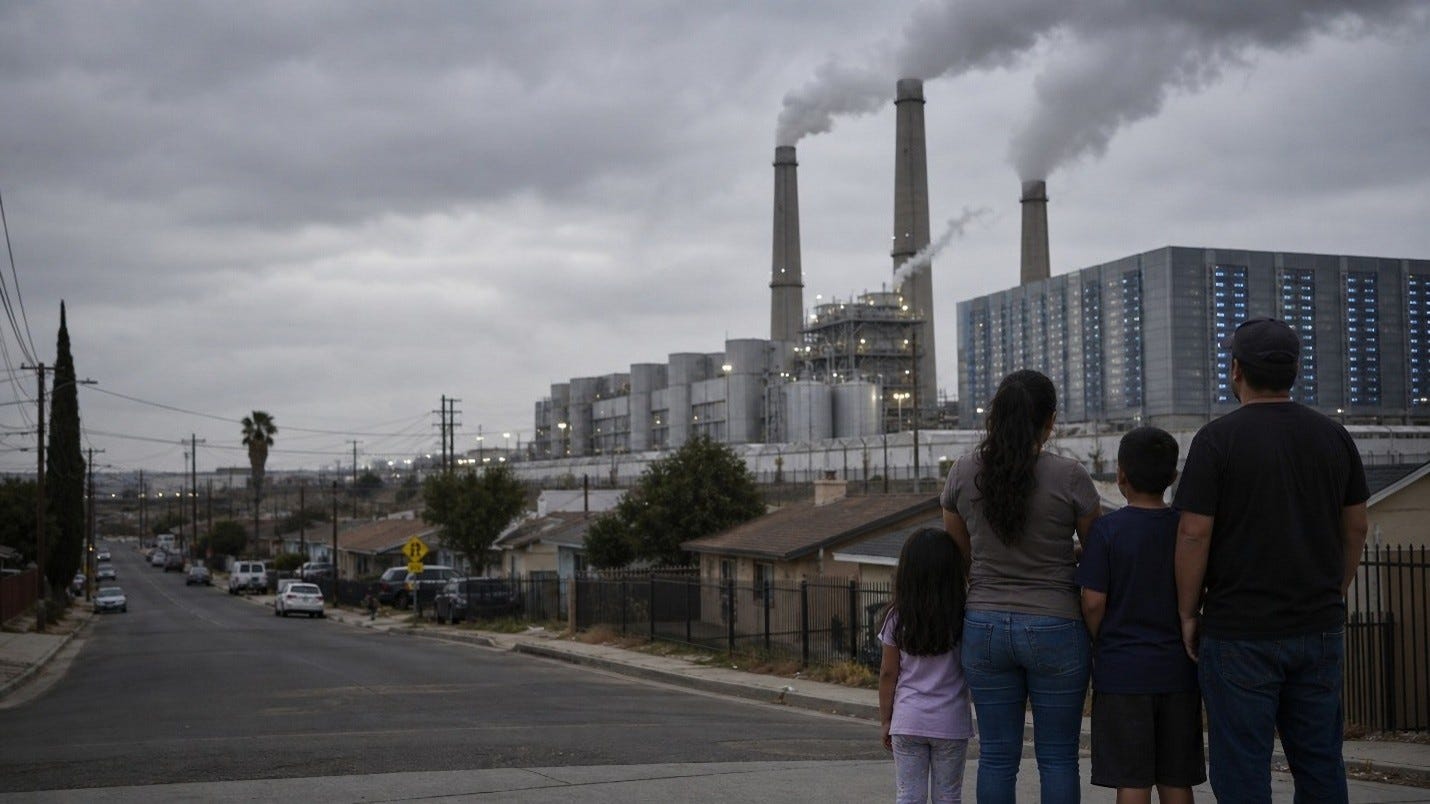
Image from Shutterstock
There’s something in the air in the Westwood neighborhood of Memphis, TN, but not in the way the community would hope. As detailed in POLITICO Magazine, since 2024, the “Colossus” data centers owned by Elon Musk’s xAI have been running on dozens of methane gas turbines on a site within a majority-Black community that already leads Tennessee in asthma-related emergency room visits. For about a year, most of these turbines had no air-quality permits, with xAI calling them “temporary” and mounting them on wheels in order to sidestep pollution rules. Environmental lawyers estimated that these machines could emit more smog-forming nitrogen oxide than the gas plant sitting across the street.
This story is an example of what an AI data center can look like on the ground. And the bill for this form of artificial intelligence’s buildout is being borne unevenly, with the profits flowing up and out to shareholders and employees and the costs settling down onto the people who live nearby, the ratepayers sharing the same grid, and the taxpayers subsidizing it. That division is the subject of this post.
The Most Expensive Thing Companies Have Ever Built
The surge of AI infrastructure development is happening fast and is constantly shifting shape. This development includes not only data centers but also power plants, transmission lines, chip factories, and undersea cables. But data centers—the physical facilities designed to train, run, and scale AI models and applications—are where the money, water, and electricity all converge. They’re also an increasing focus of the public’s ire around the AI boom. This is not surprising, as the concerns noted across our previous posts are much more abstract, whereas data centers are the part of the AI buildout people can see in their backyards. So the data center is where we will focus.
The scale of this buildout is being driven by the four largest hyperscalers (Amazon, Google, Meta, and Microsoft), who in 2026 are on track to spend around $725 billion on AI infrastructure and are expected to spend a combined $7.6 trillion on it between 2026 and 2031. According to IMF data, if this AI spend were a country, it would be the third largest behind only the United States and China. This is, by a wide margin, the largest corporate building spree in history, standing at more than twice the peak of the telecom and fiber-optic buildout of the late 1990s. This AI-related spending accounted for more than half of U.S. real GDP growth in the first half of 2025 alone.
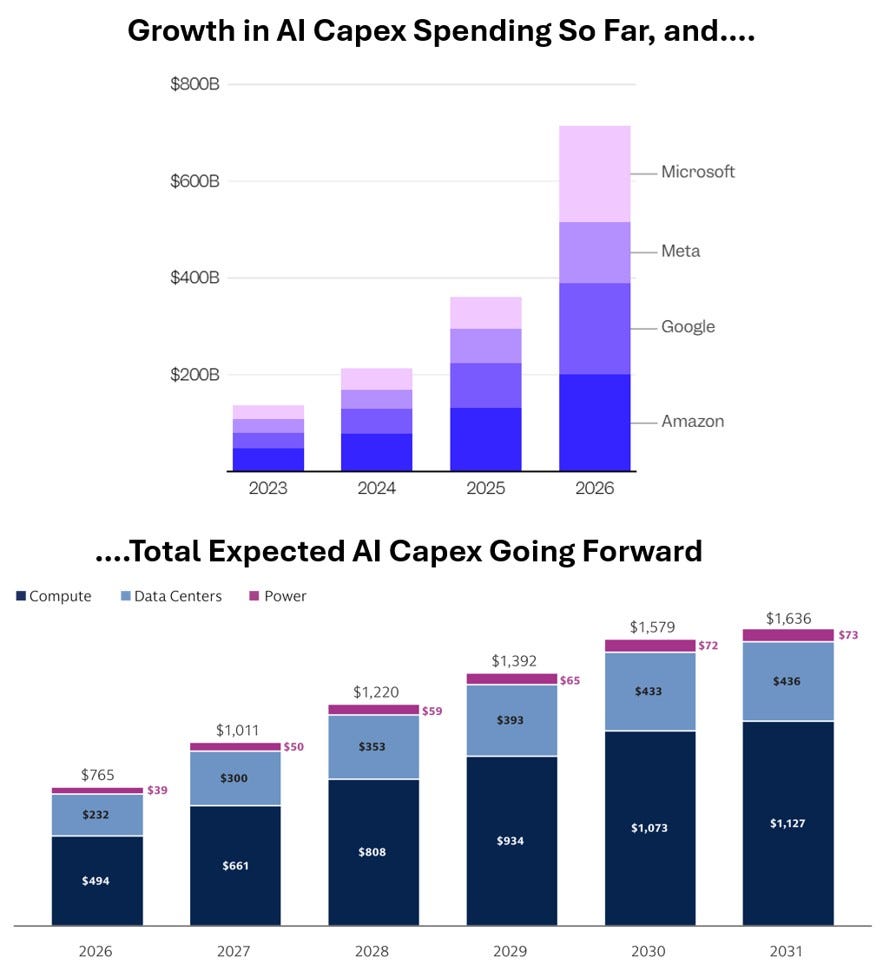
Sources: Business Insider and Goldman Sachs Global Institute
This buildout is an overwhelmingly American phenomenon, as the United States now has roughly 4,000 data centers, with at least one in every state. That’s more than the next 17 countries combined, and more than ten times as many as China. Texas and Virginia lead the country by a wide margin, with Northern Virginia’s “Data Center Alley” home to the densest concentration of data centers on Earth. So when we talk about who pays for this buildout, we’re talking first and foremost about American communities and American ratepayers.
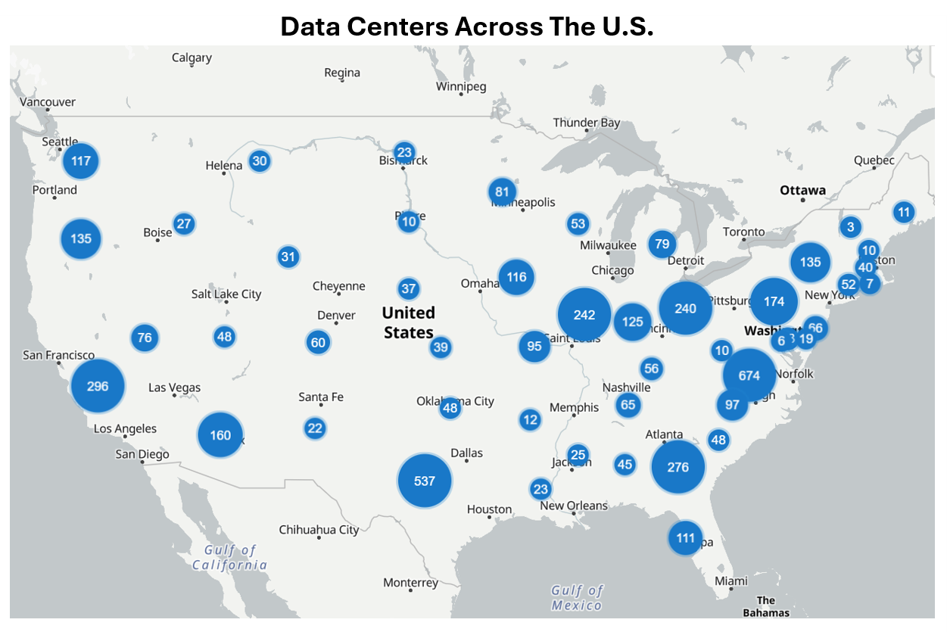
Source: Data Center Map
For a long time, the tech giants paid for all this using their own cash. But now, their spending has grown so enormous that they are increasingly turning to debt, private credit, and financial structures designed to keep the borrowing off their own books. For example, Meta’s giant data center in Louisiana, reportedly the largest private capital deal of its kind, was financed with $27 billion in debt and engineered with high leverage.
This deal, like so many used by hyperscalers to fund large-scale projects, was structured so that none of the leverage risk sits on Meta’s balance sheet. And Meta is not alone: as the Wall Street Journal documents, nine of the top tech companies have already committed around $3 trillion in off-balance-sheet spending on data centers and chips, far outpacing their on-balance-sheet spending and growing at a much more rapid pace than even the prior year.
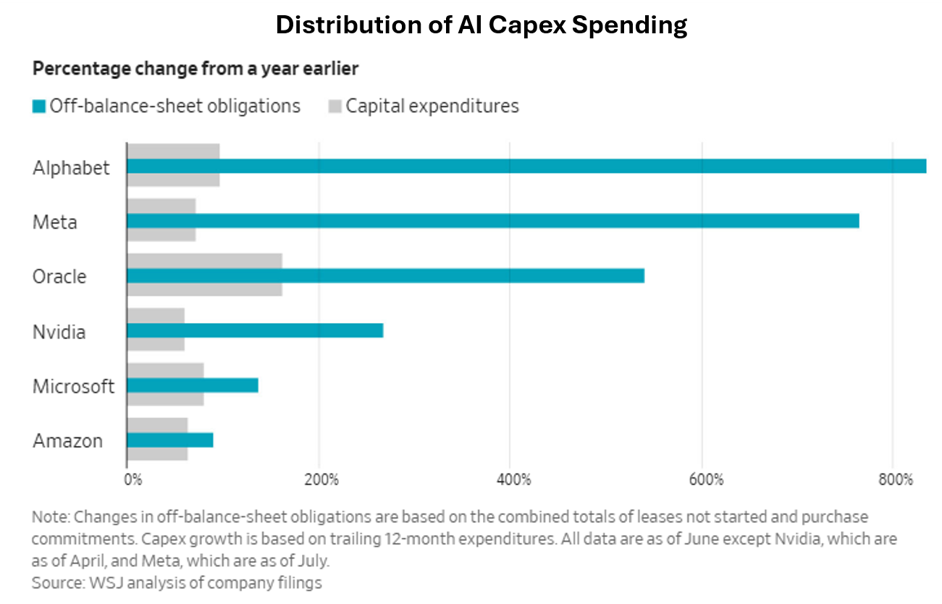
Source: Wall Street Journal
Beneath deals like Meta’s lies a fast-growing, opaque market of private data-center debt. Morgan Stanley projects $3 trillion of data center investment globally through 2028, with roughly 80% of that spending still to come. And despite the tech industry’s significant cash reserves, this investment includes a $1.5 trillion financing gap that needs to be filled through issuing debt and obtaining credit. Pieces of this investment are seeping into retail bond and mutual funds, which—as we’ve detailed in a previous Substack post—means that households can end up exposed to this buildout without choosing to bet on AI.
Why does this financing matter to you? It’s because leverage and opacity are how a private building boom becomes a public problem. If the AI bet pays off more slowly than promised, the losses won’t stay neatly with the people who placed it.
Who Gains from AI’s Buildout?
The financial gains from AI are mostly going to those building the technology. But the largest beneficiary of the data-center boom isn’t a hyperscaler at all: Nvidia, which sells chips every data center is looking to install, became the first company in history to be worth $5 trillion this past October. Rather than plow this windfall back into the economy, Nvidia authorized some of the largest stock buybacks in history, returning around $40 billion to shareholders while its own capital expenditures were just $1 to $2 billion a quarter. So the biggest winner of the AI buildout isn’t reinvesting its money; it’s instead handing that money back to its shareholders who are already benefiting from the company’s growth.
The companies actually building the data centers are repeating the same patterns. Microsoft, for instance, spent over $115 billion on capital projects in 2026 and paid out over $25 billion in dividends. That’s roughly $4.50 out the door for every $1 returned to the company’s owners. Including Microsoft, the largest AI firms are leading the charge in a record wave of stock buybacks in order to hand their shareholders more cash. So as the data center spending accelerates, those reaping the gains are concentrated among those already wealthy enough to own a share of these companies. And the costs, as we’ll see in the next section, are distributed in the opposite way across the broad swath of society, whose members end up worrying about increasing electric bills, the availability of local water, and the effects of living downwind of the data centers powering the AI revolution.
How the Costs Are First Landing on You
In communities across America, the same pattern keeps emerging: the data center arrives and, before any promised benefits show up, the costs arrive first in both your wallet and your environment. Here are some of the ways these costs materialize:
» Your electricity bill. Data centers are large, thirsty consumers of power, using about 4.7% of all U.S. electricity in 2024, a figure projected to be close to 12% by 2030.
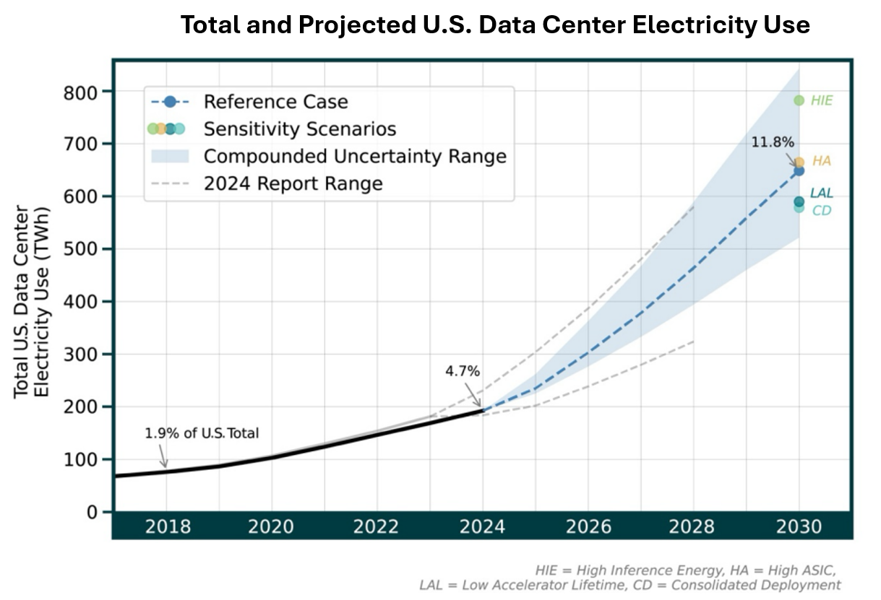
Source: Lawrence Berkeley National Laboratory
With that much new demand on a power grid, prices rise for everyone on it. For example, in last year’s auction that sets the annual price of power in the mid-Atlantic, prices jumped almost ninefold, a rise the market’s own independent monitor attributed mostly to data centers’ power needs. And this flow-through to retail consumers is already happening, as residential electricity bills in New Jersey spiked as much as 20% during the summer of 2025, a rise that regulators tied to data-center demand routed through that regional grid.
Increasing power needs are also impacting where power is sourced. For example, tech companies are building their own gas power plants on site, and more than one-third of all new U.S. gas-power capacity now under development is expected to power data centers directly. And the electric grid’s own security monitor is warning that the power swings associated with training AI models are a “high likelihood, high impact” risk that could trigger blackouts that ripple across the country. This actually happened in July 2026, when a single transmission fault in Virginia’s aforementioned Data Center Alley caused electricity to flicker on and off for about 10 minutes across the Eastern half of the U.S. Although safeguards held that time, the worry is that next time they may not.
While AI model training gets most of the headlines around data center energy consumption, research from United Nations University has shown that between 80% and 90% of total energy demand from data centers comes from people’s day-to-day AI use, with more complicated tasks like image generation necessitating “more than a thousand times the energy of a simple text classification.”
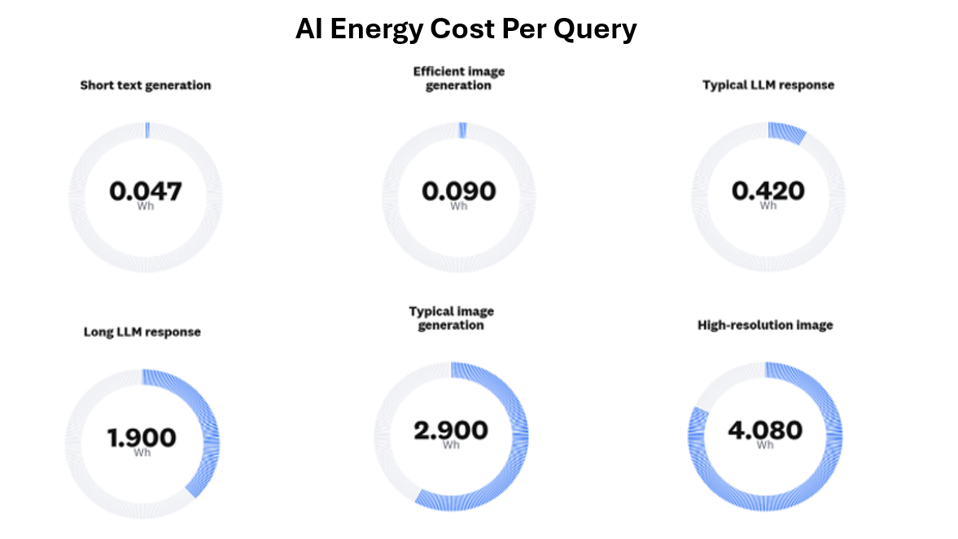
Source: United Nations University
(Note that a typical smartphone battery is roughly 15 to 18 Wh)
» Your water. Not surprisingly, data center machines run hot, and cooling them takes a lot of water. That same United Nations University study projects that AI’s water consumption will be equal to the basic annual domestic water needs of 1.3 billion people by the end of the decade. And the race for AI supremacy means that training AI models across the hyperscalers is exacerbating these issues; for example, training ChatGPT’s GPT-4 model was found to require enough water to fill 237 Olympic-sized swimming pools. The UNU report also notes that switching to renewable energy sources could actually worsen this issue.
The stories closer to home are just as stark. For example, in one Georgia county a data center drained nearly 30 million gallons of water without paying for it, which the county didn’t realize until residents complained about low water pressure. As we see more AI infrastructure being built in areas where the already disenfranchised live and work, the toll of data centers on water capacity could become yet another issue to contend with on a daily basis.
» Your tax dollars. Here’s the trade the public is being offered: states and cities competing for data centers offer large tax breaks such as sales-tax exemptions, property-tax abatements, and discounted power costs. The watchdog group Good Jobs First has been tracking these deals for over a decade, finding that taxpayer costs routinely exceed $1 million for each permanent job created.
To be fair, the construction phase of the data center buildout is a real economic boon, providing hundreds or thousands of construction jobs along with an associated bump in local spending. But this boon is temporary. Once the servers are installed, a finished data center typically employs between 20 and 50 permanent workers. Meanwhile, the community is left with decades of tax abatements, higher electricity costs, and heavy water and power consumption. And those foregone revenues are no longer trivial. For example, by 2026, four states were each losing more than $1 billion a year to data-center-related tax breaks, with Georgia slated to lose $2.5 billion. In the end, the tax dollar tradeoffs too often favor short-term stimulus over longer-term costs.
» Your job. Ironically, the machine that a community subsidizes, powers, and waters is, in many ways, the very thing being built to automate away numerous jobs, including work being done by those with a data center in their backyard. And if your job is replaced, the American safety net is poorly set up to support you.
Unemployment insurance was designed for temporary layoffs and typically replaces just over 40% of a typical worker’s wages for about 26 weeks. And it doesn’t offer retraining for a different type of job that a displaced worker actually needs. It also largely excludes gig workers, contractors, and the self-employed…the types of jobs AI is poised to harm. The one federal program built for workers displaced by structural change, rather than a passing slump, was allowed to lapse in 2022. So a worker whose job is automated away may find that the system meant to catch them only replaces under half of their income for half a year. After that stops, they’re left with no path to the skills and jobs demanded by the economy.
» Worst of all…your air. This brings us back to Memphis. One estimate is that the turbines powering xAI’s Colossus data centers could cause more than $30 million a year in health-related harm, largely due to increased asthma and heart attacks. And these harms would be concentrated in the low-income, majority-Black neighborhoods directly next to the site. When civil-rights and environmental lawyers sued xAI under the Clean Air Act, the company agreed in 2026 to remove the unpermitted turbines and add emissions controls. While this is a win, it also occurred around the same time that the “temporary” units would have had to move anyway. All in all, the Memphis case illustrates the uneven tradeoffs that can occur in any city across the U.S., where the company gets the power it needs to run its AI capabilities and the neighborhood gets the exhaust.
From the bills to the water to the exhaust, all of this has turned a race to meet AI capacity demands into a public backlash that the industry did not see coming. Public disapproval of data centers has been climbing in recent months, with one poll finding that seven out of ten Americans oppose constructing data centers close to home. Local opposition has already stalled or blocked an estimated $150 billion in data-center projects over 2025, and another $130 billion in the first quarter of 2026 alone. Communities are increasingly pressing their lawmakers for action, and as a consequence, approximately 225 local data-center moratoriums have been enacted across 30 states. New York became the first state to enact a statewide moratorium just last month, followed closely by Texas, which enacted its own curbs.
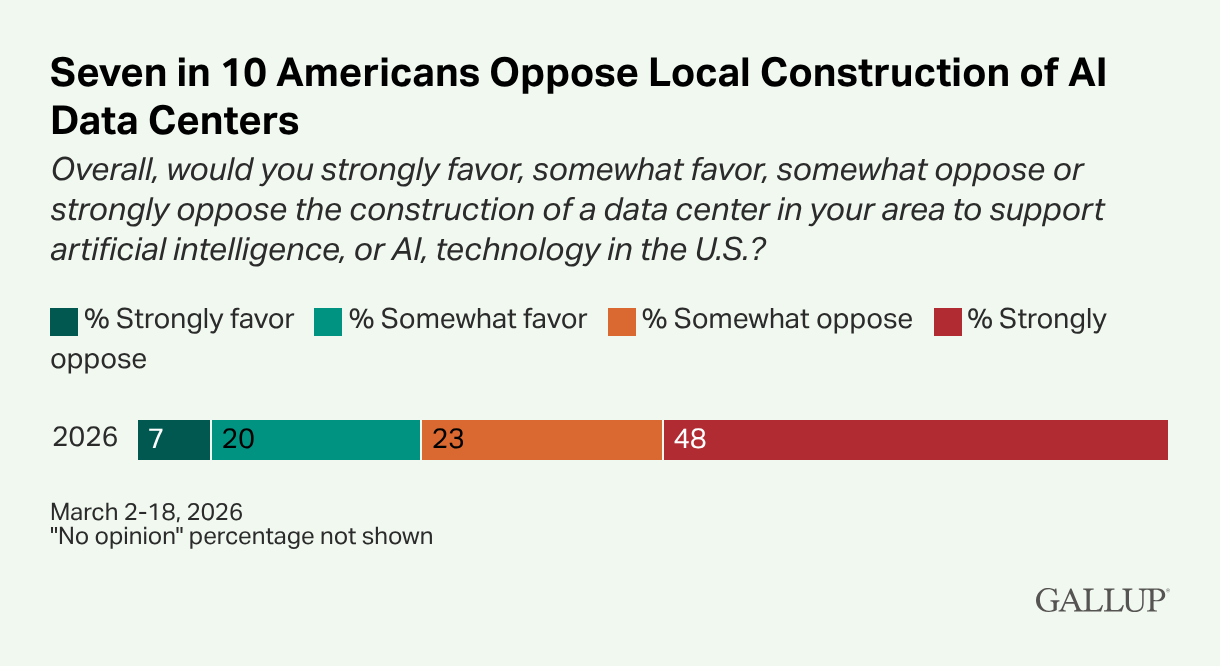
Source: Gallup
To their credit, the companies building these machines are chasing novel fixes to address the energy and emissions problem, most seriously through investment in small modular nuclear reactors meant to power a data center with clean, constant energy. Others have floated ideas as exotic as submerging data centers underwater to support their cooling, while more far-fetched ideas include installing data centers in space. While some of these ideas are worth taking seriously, they are also, for now, unproven. For the foreseeable future, the machines will run on gas and our power grids, meaning that the costs outlined in this section will continue to be borne in communities across the country.
What This Means for You and What Needs to Change
If you get an electric bill, drink from a municipal water system, or pay taxes, then you have a direct stake in how the deals shaping data centers’ buildout are structured. The reassuring part is that none of these harms are inevitable. Instead, they’re the product of how the deals are struck…and deals can be struck differently with enough knowledge. Therefore, a few things worth fighting for include:
Have data centers pay their own electricity bills. Some utility regulators have started requiring large data centers to cover the costs of power grid capacity that they reserve, instead of spreading them across everyone’s bills. That should be the norm, not the exception.
Tie tax breaks to lasting, real benefits. Cap subsidies per permanent job, disclose deal terms publicly, and empower lawmakers to claw back money when promises don’t materialize.
Modernize the worker safety net. If AI is going to displace workers as detailed in our prior Substacks, the systems meant to catch them need to do more than replace half a paycheck for half a year. Instead, they need to fund real retraining and cover the contractors and gig workers the current safety net leaves behind.
Greater transparency around financing. Increasingly, the data center boom is paid for with debt and off-balance-sheet structures that keep borrowing out of view and pass the buck onto the financial system in the case of an industry slowdown. Regulators should require clear disclosure before a downturn causes a private play to become a public problem.
Shine a greater light upfront. In Memphis, the turbines ran for a year before the public knew their true scale and impact. Permits, power draws, and water use should be clarified before ground is broken, not uncovered with lawsuits.
The through-line of this entire series on AI and the real economy is that AI’s harms are not acts of nature; they’re choices. Nowhere is the impact of those choices clearer than here. Someone has to pay for the machines that run AI systems, but the real question is whether the people bearing the costs are the same ones collecting the rewards. Right now, they aren’t.
Next week: can AI be good for democracy when no one is steering?
No posts
Comments
Nothing yet. Say the first thing.
Sign in to join the conversation.