
Sixth in the series on AI and the real economy. Earlier posts looked at how AI reshapes work, the tax code, and your retirement account. This week: what happens when AI decides who’s creditworthy, including who gets a fair loan, who gets shut out, and who gets a worse deal without knowing why.
Image generated by Google Gemini
Almost every loan decision in America runs through a model today. When you apply for a mortgage, a car loan, a credit card, or a novel “cash advance” fintech product, the yes-or-no credit decisions along with the price you pay for these loans increasingly come from AI and machine-learning systems trained on data beyond your credit score. This includes your bank transactions, your rent and utility payments, and, as we’ll get to later, your education.
The pitch is appealing, as a computer weighing thousands of data points is often seen as less biased than the subjective assessment of a loan officer. And while there’s something to that, the story is more complicated, and the people who are supposed to watch for problems have just walked off the job.
The Promise and The Catch
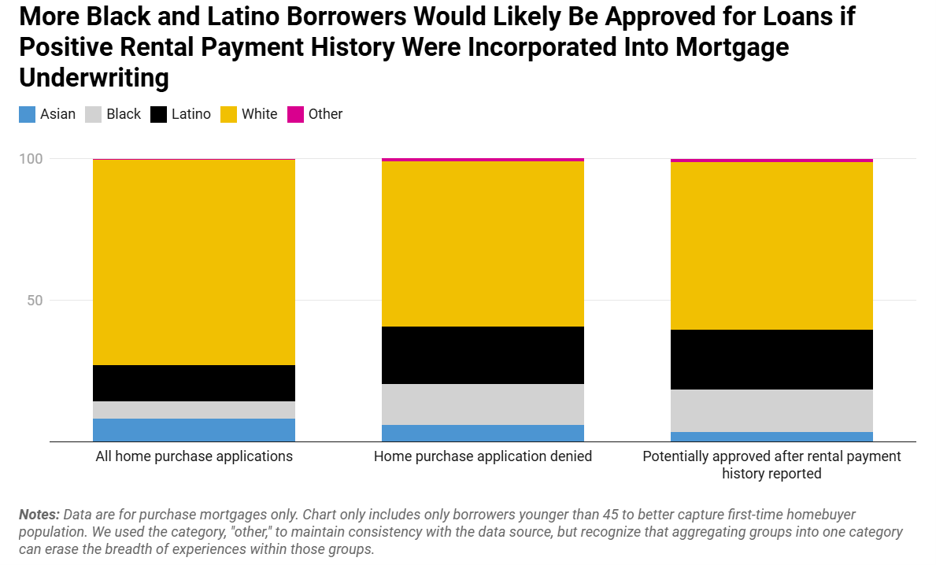
Let’s start with the optimistic case, since it’s real. Roughly one in five American adults—between 45 and 60 million people—cannot be scored by traditional credit models. They are considered “credit invisible” because they have too little borrowing history to produce a credit score, shutting them out of mainstream loans even when they reliably pay their bills. As organizations like FinRegLab have extensively documented, credit models that use the actual flow of money in and out of bank accounts—so-called “cash-flow” data—can make the invisible visible using AI and machine learning. The Urban Institute and Federal Reserve agree that such “alternative data” has genuine potential to expand credit safely and fairly. And lenders like Upstart and ZestAI claim that their AI models approve more borrowers at lower rates than traditional underwriting. More on Upstart later in this post.
Source: Urban Institute
While the promise of cash-flow data is real, those touting the impact on borrowing are the lenders selling the models. But when independent researchers look, they find something more sobering.
Economists at Berkeley found that algorithmic lenders charged otherwise-identical Black and Latino borrowers more for a mortgage than their white counterparts, amounting to hundreds of millions of dollars a year in extra interest. The good news was that fintech algorithms discriminated about 40% less than human loan officers. The bad news is that 40% less discrimination is still discrimination. As one of the study’s co-authors put it, “the mode of lending discrimination has shifted from human bias to algorithmic bias.”
How does a model discriminate when it isn’t told an applicant’s race? Through closely related model inputs. According to the aforementioned Berkeley researchers, profit-seeking algorithms can “learn” that borrowers from certain neighborhoods or those who shop for fewer quotes will accept a higher price, and too often such patterns connect to race and ethnicity even when race is nowhere in the data. So the model discriminates because patterns in the data reflect a society that already does.
The most telling test came from Upstart itself. For context: Upstart is an AI lending platform that uses non-traditional applicant data—including data related to borrowers’ education—to approve or deny as well as price a loan. The company touts that over 90% of decisions on consumer loan applications are completed with no human intervention.
After civil rights organizations raised concerns about Upstart’s models engaging in so-called “educational redlining,” Upstart contracted the independent law firm Relman Colfax to audit its lending models. And the results of the audit were…mixed. While the monitor did not find evidence of pricing disparities, it did find “statistically and practically significant” approval rate disparities for Black applicants. Despite these findings, Upstart refused to adopt Relman Colfax’s recommendation to use a “potential less discriminatory alternative model.”
And this is the point. Even with a cooperative lender, a skilled monitor, and years of access, the response was to keep business as usual. Now imagine the models that nobody is auditing at all.
Oh, did I mention that Upstart recently received conditional approval from the Office of the Comptroller of the Currency for its application to become a national bank? Such approvals give its models even more access to offer loans across the country. What could go wrong?
The Black Box Meets a 50-Year-Old Law
This evolution is also running headfirst into a law most people have never heard of: the Equal Credit Opportunity Act, which has been around since 1974. If you’re denied credit, this law requires that a lender give you the specific reasons for your denial. “You didn’t qualify” isn’t enough.
That right is hard to honor when the lender doesn’t fully understand its own model, which is unfortunately a feature of almost all AI models today. A traditional credit decision runs on a handful of specific factors such as income, debts, and payment history, so a denied applicant can be told which factor sank them. A machine-learning model works differently: it weighs thousands of variables at once, and what drives its decision is not any single factor, but their interaction in ways that no person can map out. This interaction is even more opaque for AI models, leading to the term “black box” to describe how hard it is to determine what factors lead to their decisions.
So if you ask why an applicant was denied by an AI or machine-learning model, the truthful answer may be that the model’s decision can’t be reduced to a clean list. The explanation the law requires and the way the technology works are pulling in opposite directions.
For a while, the Consumer Financial Protection Bureau held a firm line. In 2022 and 2023 guidance, it told lenders plainly that a black box is no excuse. If you can’t explain the denial, you can’t legally make it. That was the line. As described below, this is now being erased at the same time that AI spreads through the various ways we get access to credit.
The New Payday Trap
While AI reshapes traditional lending, it has also powered new products that look like an old problem in new clothing.
You may not know the term “earned wage access” or “cash advance” products, but you’ve probably seen them through your employer’s payroll provider or through apps like Dave, MoneyLion, or Empower. They advance you $20 to a few hundred dollars before payday. Pay no interest, they say, but just pay an optional “tip” or a small fee if you want the money instantly. An estimated 10 million U.S. workers used earned-wage products by the end of 2022, up from a market that barely existed a decade ago.
“No interest” is doing a lot of work in that sentence. When California’s financial regulator did the math, it found that these products’ average APRs were over 300% once you convert the tips and fees into an annual rate the way any loan is measured. When viewed in these terms, it’s clear that these products are just payday loans with a friendlier face. And the usage pattern is the tell: in one multi-state analysis, three-quarters of users took another advance the same day or the day after repaying the last. This is the exact debt-cycle churn that made storefront payday loans notorious.
Who’s Being Replaced: Your Local Bank
For most of American history, a loan was determined by a conversation between you and your local banker who knew your business, your neighborhood, your reputation. These bankers could decide to extend credit to a creditworthy borrower whose numbers look thin on paper. That kind of “relationship lending” is exactly what an algorithm can’t do, because that kind of knowledge lives in a person and not a dataset.
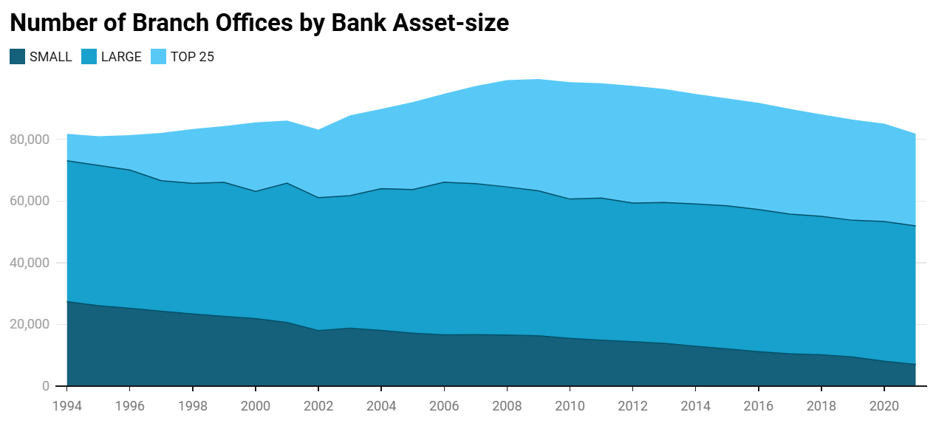
That banker works at a community bank, and community banks are rapidly disappearing. The United States has gone from about 18,000 banks in the 1980s to just under 4,500 in early 2025, and community banks bore the brunt of that decline. The National Community Reinvestment Coalition counted more than 4,000 closures in just the first 19 months of the pandemic, and roughly a third of branch closures between 2017 and 2021 happened in lower-income or majority-minority neighborhoods.
Source: National Community Reinvestment Coalition
In a growing number of places, the nearest branch is more than ten miles away. These areas are given the apt designation of a “banking desert.” Too often, the void left by these banks is filled with check cashers, payday lenders, and these up-and-coming fintech alternatives.
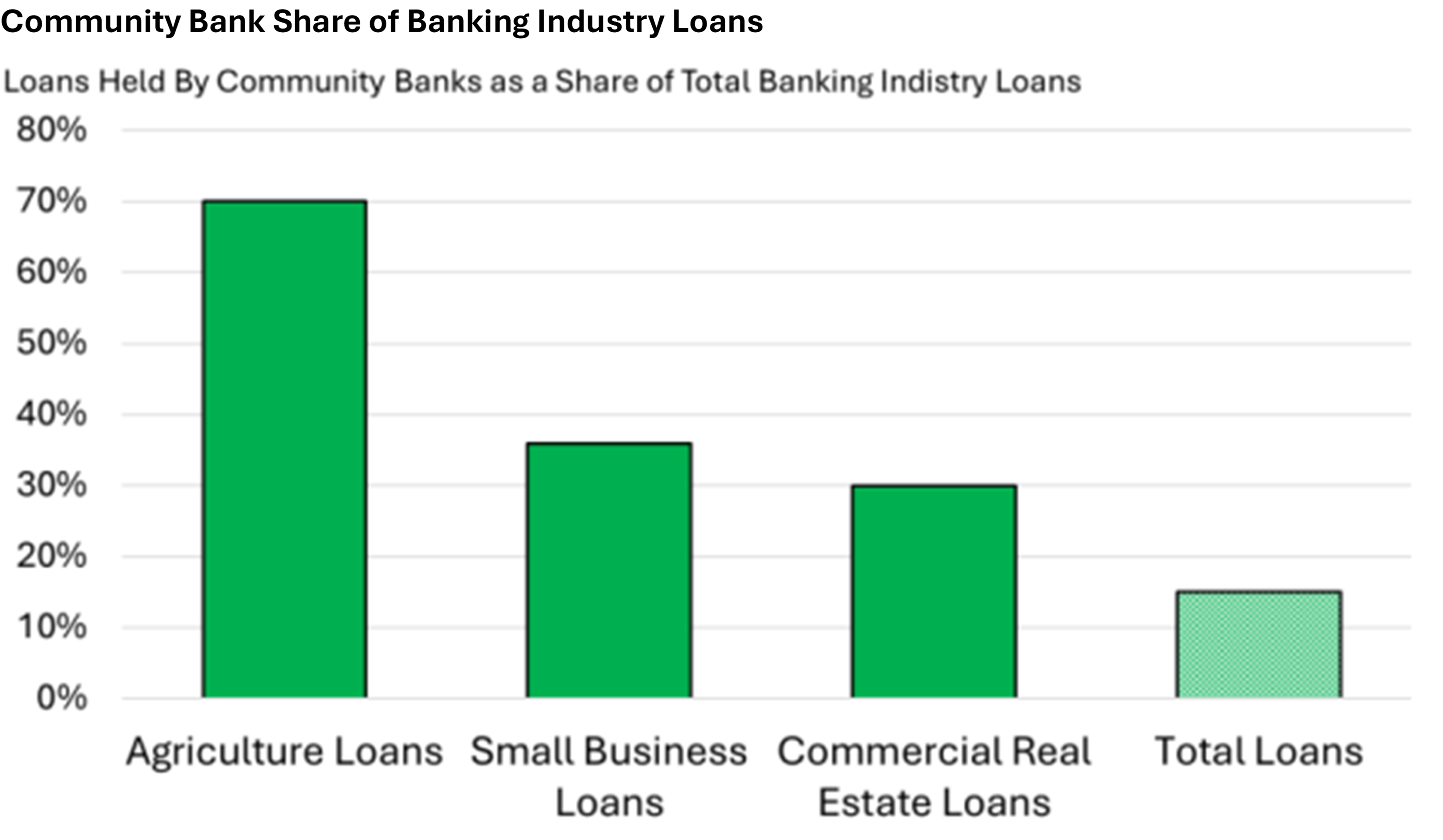
This matters because community banks do a fundamentally different kind of lending than the larger banks. As Better Markets has documented in detail, community banks put about three-quarters of their deposits to work as direct loans to the real economy, from households to small businesses and farms. The largest banks only lend at a 40% clip. And community banks punch far above their weight, with an outsized share of mortgages, auto loans, and particularly small business loans relative to their larger bank counterparts. Their credit decisions keep Main Street Americans out of the high-cost fringe alternatives, and their edge is the soft information a relationship can make visible that an algorithm cannot see.
Source: FDIC 2020 Community Banking Study via Better Markets
The Cop Leaves the Beat
All of the problems above share one backstop: fair lending laws, enforced by a regulator with the power to look inside the models and demand answers. This backstop is being dismantled right now, just as AI-powered underwriting becomes universal.
Remember the CFPB, the agency that told lenders a black box was no excuse? Well, in 2025 and 2026 the agency was hollowed out, with its budget cut by nearly half and enforcement cases dropped en masse. And the government moved to strip out one of its most important tools, a legal principle called “disparate impact” that lets regulators challenge a practice that lands harder on a protected group even when no discrimination was intended. An executive order directed agencies to eliminate disparate-impact liability “to the maximum degree possible,” and the CFPB finalized a rule removing it from fair-lending enforcement effective mid-2026 (although this rule is currently being challenged in courts).
Sit with why that matters. Disparate impact is precisely the tool built to catch the kind of harm AI produces: discrimination with no ill intent and just a pattern in the math that hurts the same people harmed by current and historic lending practices such as redlining. Removing it as AI lending scales is like taking the smoke detector out of the room as the wiring starts to heat up. With Washington stepping back, the fight moves to the states…a thin substitute for a federal cop, particularly when barriers for AI-forward companies to become national banks are falling.
What This Means for You
Done right, algorithmic underwriting could genuinely bring millions of overlooked borrowers into the mainstream at fair prices. But “done right” was never going to happen on its own. It requires exactly the oversight that’s now being torn down, particularly the regulators with the authority to open the black box, test whether it’s discriminating, and force a fix.
The fight over AI lending isn’t really about technology. It’s about who is liable for the technology’s work. In that light, a few things worth demanding include:
Updated “alternative data” guidance. The 2019 banking agency guidance concluded with a promise to “offer further information on the appropriate use of alternative data.” Coupled with the recommendations below, such information can help further the promise of alternative data use in making credit decisions.
Independent audits over vendor promises. When a lender says its model expands access, that claim should be validated by someone who isn’t selling the model.
A real explanation when you’re denied. The 50-year-old right to know still exists. It should be enforced, black box or not.
An honest APR on “cash advances.” The over 300% APR number only surfaced because California did the math. Every one of these products should abide by the Truth in Lending Act by stating its true annual rate and not hiding behind gimmicks.
Protect the community-bank channel. Community banks are the backbone of Main Street America, approving small business loans at the highest rate of any type of lender. If these banks continue fading into the sunset, that pushes borrowers toward costlier, and colder, algorithms.
When AI decides who gets the money, the question isn’t only whether the machine is fair. It’s whether anyone still has the power to make it prove that it is.
Next week: when an AI agent decides, what does that mean for liability, accountability, and the machine-speed bank run?
No posts
Comments
Nothing yet. Say the first thing.
Sign in to join the conversation.