
What happens when the pope, Oprah, and Anthropic cofounders walk into a conversation on AI?
There has been a convergence in the last few weeks of public leaders across AI, daytime television, and the Catholic church acknowledging that how we build AI matters.
— Meghan
The Week in RQ
AI is not going to fix itself. The AI conversation has shifted from what models can do to what they are training humans to become. The open question is who is actually responsible for solving that.
If AI is going to mediate how people think, work, love, repair, and relate, then accountability cannot live only in audits, disclosures, or post-harm remedies. It has to live in the design goal itself.
This week, we looked at the convergence between Pope Leo’s warning that AI’s deepest challenge is anthropological, Eli Pariser’s argument that parasitic AI outcomes are “the frosting, not the cake,” and Anthropic’s own admission that labs need moral voices the incentives cannot bend.
Esther Perel weighs in too. Speaking to Oprah, the world-famous therapist Esther Perel gets at the same terrain from the relationship side with a quote worth sitting with: “Modern loneliness often masks itself as hyperconnectivity.” We have more access to each other — and to AI — than any humans in history. Yet we are reporting more isolation than ever. Those two facts are not in tension. They are the same phenomenon. Oprah and Esther Perel: What We Really Want in a Relationship The Oprah Podcast | YouTube May 26
AI governance has a listening problem. DemocracyNext makes the democratic version of the accountability argument: people should not just be protected from AI systems after they are built. They should have a say in what gets built. DemocracyNext | May 28
We don’t have to relive the worst disasters of social media: we have a window to get things right this time.
— Eli Pariser, What Eli said at the Vatican about AI
US AI Regulation Tracker
Tracking federal AI policy so you don’t have to.
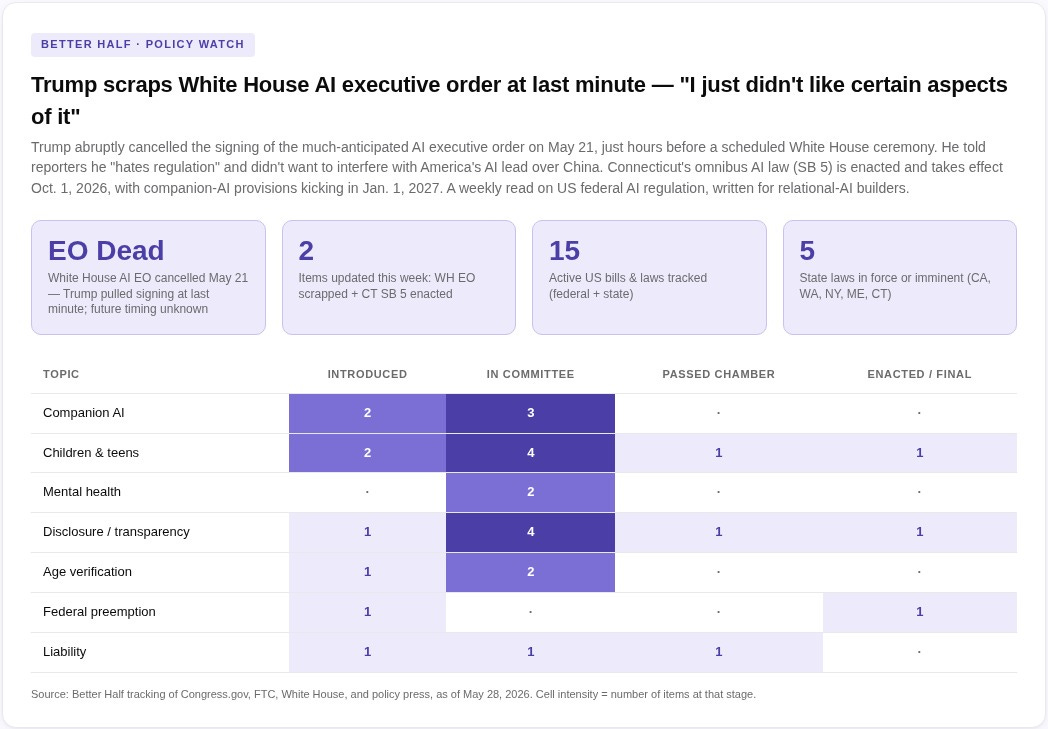
For the full breakdown — every bill, lawsuit, and commentary piece we tracked — see the full digest on better-half.ai.
Quick Links:
Character.AI users are fleeing after a series of updates made their companions feel lobotomized.
The Daily found out that an AI companion can help alleviate loneliness. And even approximate the human experience. But it still can’t take you to the beach.
A writer says spending months with an AI companion was worse than being alone, with a brutal takedown: “AI companions are friends with no future.”
Not every agreeable model is “sycophantic.” A new paper argues that some LLM conformity comes from uncertainty, not flattery.
Is persistent memory the value prop companions have been missing? Bae AI proposes a better memory could solve companion AI problems.
A loneliness researcher says AI companions can’t give us the thing loneliness is actually asking for: someone who needs you back.
Will Vice interviewing the punk-rock psychologist help make men realize emotional intelligence matters? It can’t hurt.
The new third party: How to spot if your partner is secretly dating an AI companion Institute for Family Studies | May 26
Is there a secret third wheel in your relationship? 69% of young adults who use AI romantic companions are hiding them from their partners.
One More Thing
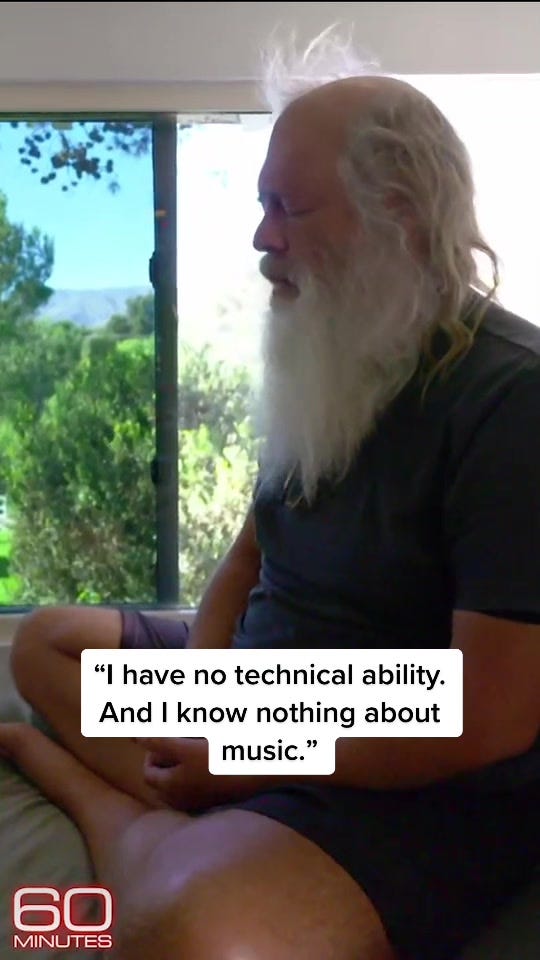
In the future, maybe we’ll all be a little more like Rick Rubin.
 Tiktok failed to load.
Enable 3rd party cookies or use another browser
This is Good Friction, Better Half’s look at relational AI — the technologies deepening human connection, and the ones quietly pulling us apart. Join our waitlist at findyour@better-half.ai.

Comments
Nothing yet. Say the first thing.
Sign in to join the conversation.