
Java remains one of the most in-demand backend languages on the planet. It powers everything from banking systems to streaming platforms, and the ecosystem around it - Spring, Kafka, Kubernetes — is richer than ever in 2025.
But “learn Java” as advice is nearly useless. The ecosystem is vast, and without a structured path, most developers spend months spinning their wheels on the wrong things in the wrong order. This roadmap fixes that.
Below is a battle-tested, phase-by-phase breakdown of what a production-ready Java backend developer actually needs to know — organized so each phase builds on the last.
“You don’t need to know everything. You need to know things in the right order.”
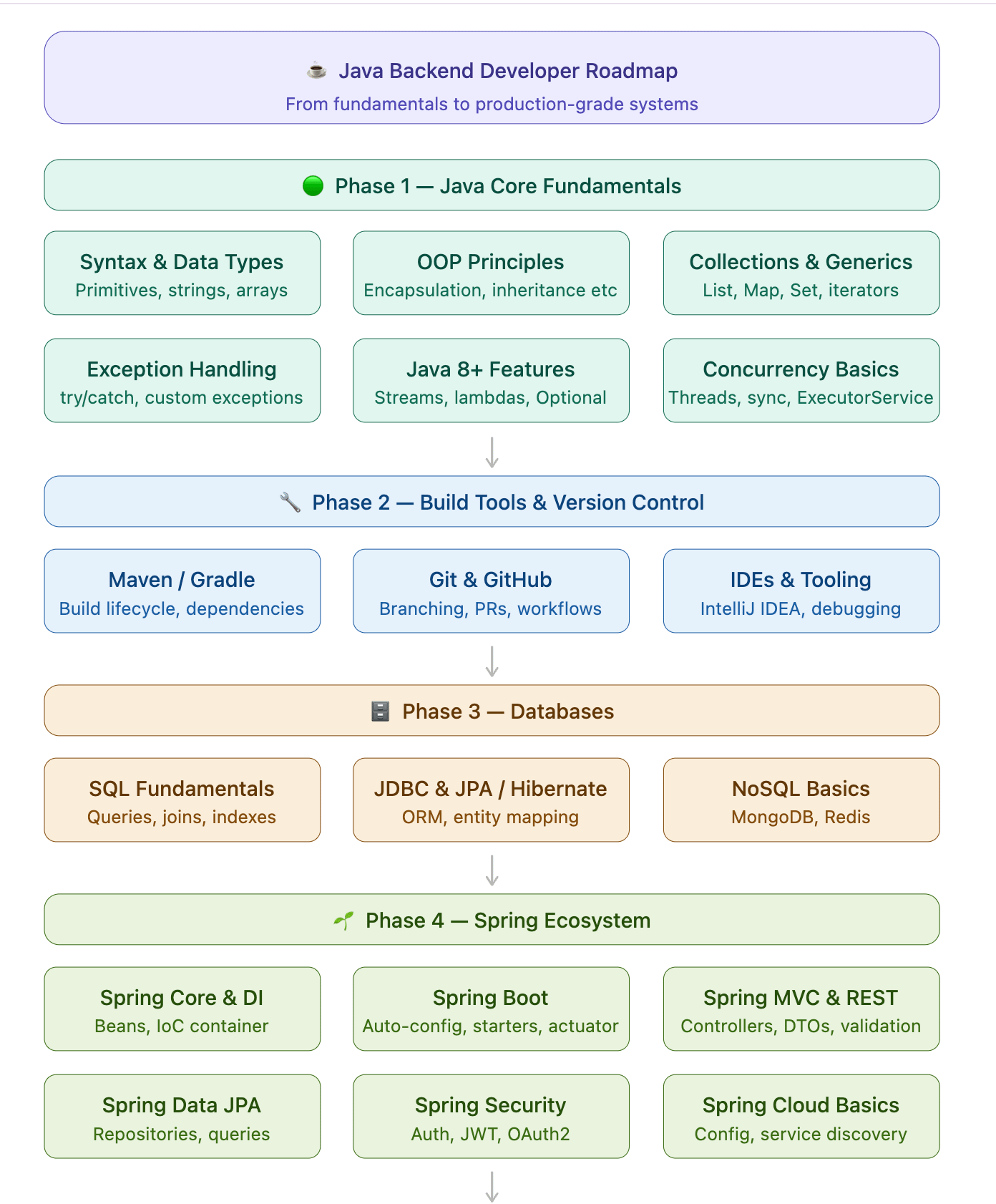
This is your bedrock. Don’t rush past it.
Syntax, primitives, strings, and arrays
OOP: encapsulation, inheritance, polymorphism, abstraction
Collections & Generics:
List,Map,Set, iteratorsException handling and custom exceptions
Java 8+ features: streams, lambdas,
Optional, method referencesConcurrency basics: threads,
synchronized,ExecutorService
A developer who truly understands Java’s memory model and OOP principles will debug 10× faster later. Java 8 streams and lambdas are non-negotiable in any modern codebase — master them early.
Professional Java development lives in pom.xml and Git. Before touching any framework, get comfortable with how your project is built, tested, and packaged.
Maven or Gradle — build lifecycle, dependency management, plugins
Git & GitHub — branching strategies, pull requests, rebasing
IntelliJ IDEA — debugging, refactoring, live templates
SQL fundamentals: SELECT, JOIN, indexes, transactions, ACID
JDBC for raw database access
JPA and Hibernate: entity mapping, lazy loading, the N+1 problem
NoSQL: MongoDB for documents, Redis for caching
💡 Pro tip: The N+1 query problem silently kills performance in most Spring applications. Learn to detect it with Hibernate’s show_sql before it hits production.
Spring Boot is the industry standard for Java backends. You will spend a majority of your career here. Invest time understanding how the auto-configuration magic actually works — it will save you hours of debugging.
Spring Core — IoC container, dependency injection, bean lifecycle
Spring Boot — auto-configuration, starters, Actuator endpoints
Spring MVC — controllers, DTOs, request validation, error handling
Spring Data JPA — repositories, custom queries, projections
Spring Security — filter chain, JWT, OAuth2, method-level security
Spring Cloud — Config Server, Eureka, circuit breakers
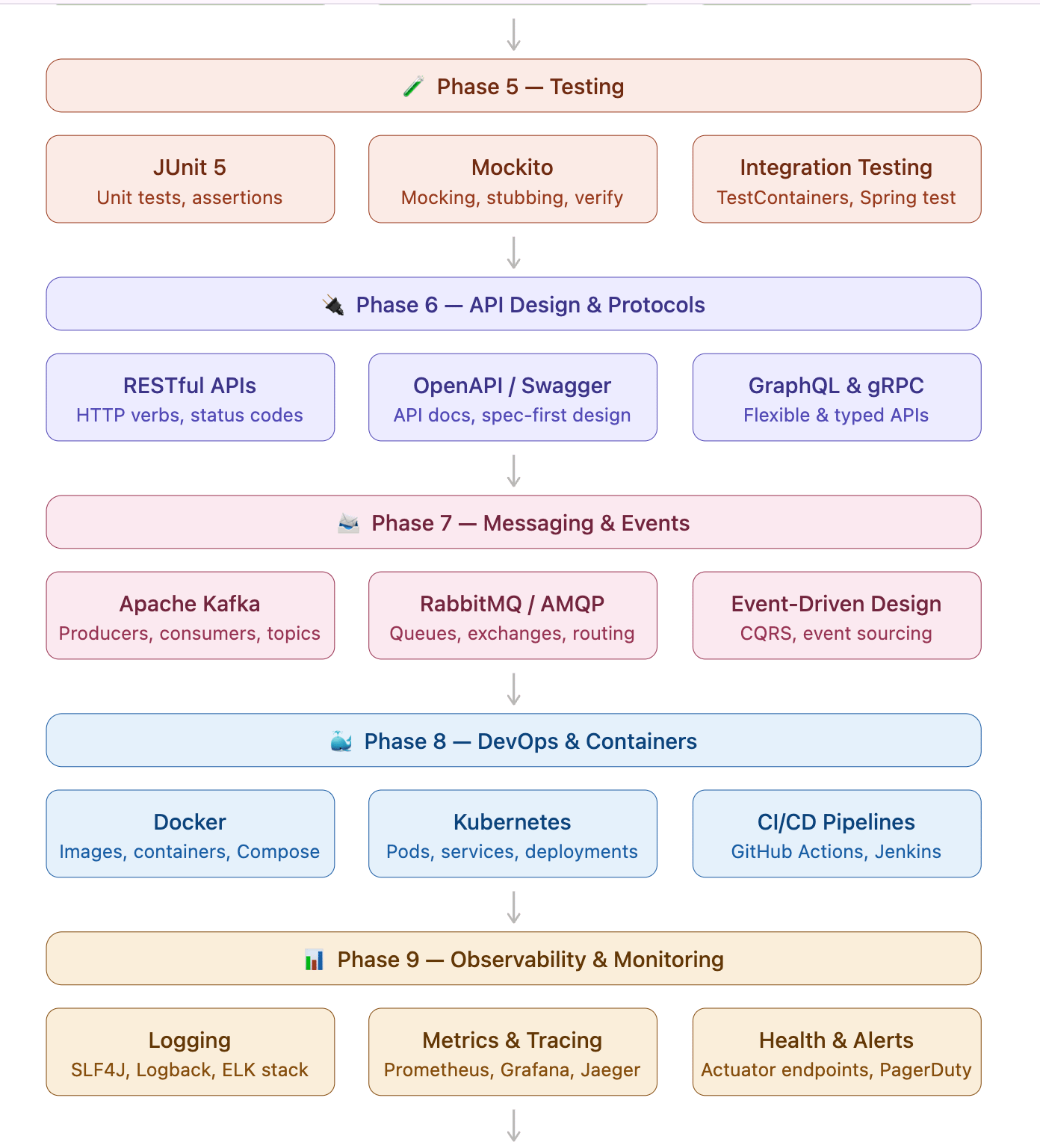
Untested code is unfinished code. Build this habit early.
JUnit 5 — assertions, parameterized tests, test lifecycle
Mockito — mocking dependencies, argument captors,
verify()Integration testing with
@SpringBootTestTestContainers — real databases in tests, no mocks for infrastructure
RESTful APIs — resource naming, HTTP verbs, idempotency, versioning
OpenAPI / Swagger — spec-first API design, auto-generated documentation
GraphQL — flexible queries, avoiding over-fetching
gRPC — typed contracts, streaming, performance-critical services
Event-driven architecture is what separates senior backend engineers from mid-level ones. Systems that communicate through events are resilient, loosely coupled, and scale independently. Kafka knowledge alone will open significant doors in your career.
Apache Kafka — producers, consumers, topics, consumer groups, offset management
RabbitMQ — exchanges, queues, routing keys, dead-letter queues
CQRS — separating read and write models
Event Sourcing — event log as the source of truth
Docker — writing Dockerfiles, multi-stage builds, Docker Compose
Kubernetes — Pods, Services, Deployments, ConfigMaps, Ingress
CI/CD — GitHub Actions workflows, Jenkins pipelines
Container registries and image tagging strategies
A system you can’t observe is a system you can’t trust.
Structured logging with SLF4J + Logback, correlation IDs
ELK Stack — Elasticsearch, Logstash, Kibana for log aggregation
Prometheus + Grafana — metrics collection and dashboards
Distributed tracing with Jaeger or Zipkin
Spring Boot Actuator — health checks, metrics, info endpoints
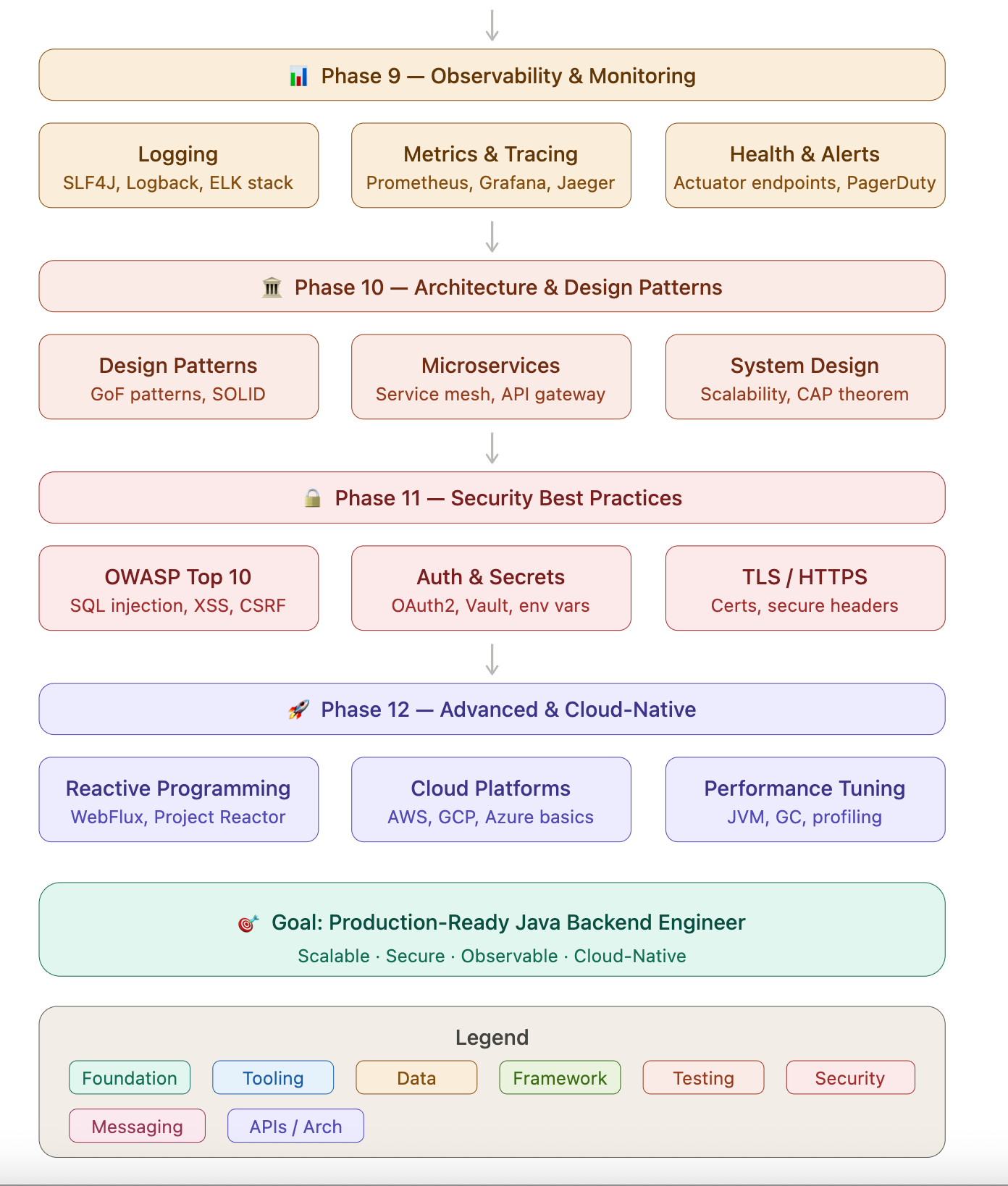
SOLID principles applied to real Spring code
GoF design patterns: Factory, Builder, Strategy, Observer, Decorator
Microservices patterns: API Gateway, Sidecar, Strangler Fig
System design fundamentals: CAP theorem, consistency vs. availability tradeoffs
Security is not a phase you complete — it’s a habit you build from Phase 1. Validate all inputs, never log sensitive data, and treat every external call as untrusted.
OWASP Top 10 — SQL injection, XSS, CSRF, IDOR, broken auth
OAuth2 flows — authorization code, client credentials
TLS/HTTPS — certificate management, secure headers
Secrets management — HashiCorp Vault, environment variable strategies
Reactive programming with Spring WebFlux and Project Reactor
AWS / GCP / Azure — managed services, IAM, serverless functions
JVM internals — GC tuning, heap analysis, profiling with async-profiler
Service mesh: Istio, Linkerd for advanced traffic management
Realistically, if you’re learning full-time and building projects alongside theory:
Phases 1–4: ~3–4 months
Phases 5–9: another 3–4 months
Phases 10–12: developed over years of production experience — but awareness matters from day one
The most important thing is to build something at every phase. The real learning happens when you wire up Spring Security and spend three hours figuring out why your JWT filter runs twice.
If you’re targeting your first or second Java backend role, focus relentlessly on Phases 1–6. Most companies hiring junior-to-mid backend developers expect solid Java fundamentals, Spring Boot fluency, SQL knowledge, REST API design, and basic testing.
Everything from Phase 7 onward is what separates you in senior interviews and compounds your impact on the job.
Comments
Nothing yet. Say the first thing.
Sign in to join the conversation.