
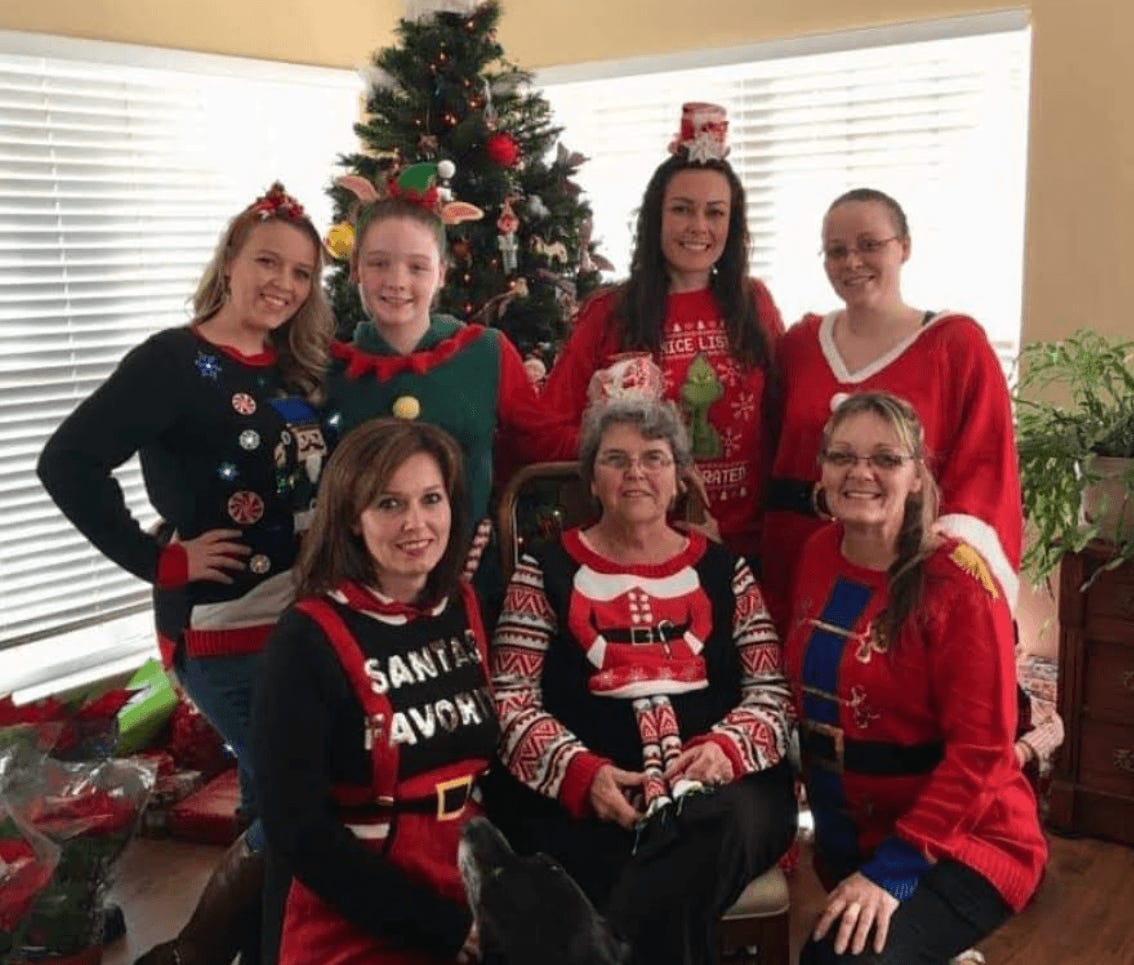
At Betrayal Project USA, we have documented countless testimonies involving hospital protocol deaths, vaccine injury/death, hospice abuse & homicide, isolation, overmedication, and institutional betrayal. But the story of Joyce MacDougall is one of the most emotionally disturbing and morally horrifying accounts we have encountered.
Because this was not simply about death.
It was about orchestrating death.
And perhaps most chilling of all — it happened in 2025.
Joyce MacDougall - Wife. Mother. Grandmother.
Before the drugs, before the isolation, before the whispered conversations about “transitioning,” Joyce MacDougall was known for something much different: love.
To her daughters, Joyce was not a burden. She was the center of gravity.
She was the mother who sacrificed endlessly for her children. The wife who built a home rooted in care and devotion. The grandmother, “Mimi”, whose entire face lit up at the sight of her grandchildren.
Her daughters Nicole and Jodi remember her as vibrant, nurturing, affectionate, and deeply connected to her family. Even as dementia began to affect parts of her memory, her love for her family remained unmistakable.
One of the most heartbreaking images shared by the family is the memory of Joyce running down a hill just to watch her grandchildren play — excited simply to be near them. That was Joyce. A woman who adored her family with every part of herself.
Which is why what happened next feels so unbearable.
Because the very people Joyce loved most were gradually pushed away and intentionally kept from her during the final days of her life. For the sake of convenience it was decided that it was “time for Joyce to go to heaven”.
She Had Dementia — But She Was Not Dying
According to Nicole and Jodi, while Joyce did have dementia she had never been diagnosed with a terminal illness carrying a six-month prognosis.
Her heart was fine according to the nurse.
She was elderly. She had dementia. She needed care and supervision.
But she was not actively dying.
Yet somehow, hospice entered the picture anyway.
Once hospice became involved, Joyce’s care shifted away from preserving life and toward preparing for death. Very quickly after being placed on hospice, Joyce tested positive for COVID and everything accelerated with terrifying speed.
Nicole and Jodi describe receiving a text message they will never forget.
“Mom tested positive for Covid today and hospice is indicating that she is not going recover. It’s time for her to go to heaven.”
What followed, they say, was not compassionate care. It was the beginning of a managed death process.
Morphine was introduced. Sedation increased. The language around Joyce changed. Family members were conditioned to believe death was inevitable and imminent.
The word “transitioning” became part of everyday conversation around Joyce — as if death itself had become the objective.
“Don’t Touch Her”
One of the most disturbing parts of Joyce’s story involves what the family was told during her final days.
Nicole and Jodi say they were instructed not to touch their mother. Grandchildren were not promitted to hold her hand or interact closely with her. Family members were warned not to stimulate her because it might “bring her out of the coma.”
Think about that for a moment?
If someone is naturally dying, their death does not depend upon keeping loved ones away from them.
If someone is naturally slipping away, you do not need to prevent comfort, touch, connection, conversation, or human interaction to ensure death continues progressing.
But according to Joyce’s daughters, that is exactly what happened.
The family was essentially told that love itself could interrupt “the transition”.
Nicole and Jodi realized something horrifying in those moments: this did not feel like nature taking its course. It felt controlled. Managed. Maintained.
And every act surrounding Joyce’s final days seemed designed to keep her moving in only one direction.
Toward death.
The Engineered Death of Joyce MacDougall
The daughters describe conditions that felt less like comfort care and more like intentionally orchestrated decline.
Water was withheld.
Blankets were not allowed.
Morphine and sedating medications increased.
Family access became controlled and restricted.
Interaction — touch, conversation, stimulation, emotional connection — was discouraged and at times outright forbidden.
The atmosphere around Joyce shifted from care to cruel inevitability.
Nicole and Jodi describe sitting there watching their mother become increasingly unresponsive while people around them behaved as though this was all perfectly normal.
But in their gut, they knew something was terribly wrong.
Because when human beings are naturally dying, families instinctively gather around them with comfort, warmth, hydration, touch, prayer, and love.
What Joyce experienced was something else entirely.
According to her daughters, conditions were created that appeared designed to accelerate weakness, suppress responsiveness, and ensure a rapid decline. The goal no longer seemed to be caring for Joyce through life — but ushering her toward death as quickly and quietly as possible.
That distinction matters.
Because there is a profound moral difference between allowing a natural death and creating the physical and chemical conditions that hasten it.
One is compassion.
The other begins to resemble execution.
“She’s Been a Burden”
As tensions inside the family escalated, painful truths began surfacing.
Nicole and Jodi recount comments from extended family members expressing frustration over how difficult Joyce’s dementia had become for the family to manage. One comment in particular cut deeply — references to how much of a “burden” Joyce had become such as her incontinence as the reason they were giving her more morphine.
To Joyce’s daughters, those statements exposed something ugly beneath the surface: inconvenience and tiredness had overtaken compassion.
And once a vulnerable elderly person begins being viewed primarily as a burden, dangerous thinking can follow.
The daughters also describe horrifying discussions surrounding Joyce’s death itself — including comments minimizing memorial plans and questioning whether a funeral was even necessary. Ultimately they were told if you want to pray with her do it now because there would be funeral.
For Nicole and Jodi, these moments shattered any illusion that their mother was being treated with dignity and sacredness in her final days.
Instead, they believe Joyce’s death became something to expedite.
Something to manage.
Something to get through.
Evidence Joyce Was Aware
One of the most disturbing moments described by Nicole and Jodi came when Joyce’s granddaughter — someone Joyce deeply loved and had helped raise — began speaking to her and trying to comfort her at her bedside.
According to the daughters, there was visible anger among those overseeing Joyce’s so-called “transitioning” that emotional connection and stimulation could bring Joyce out of the heavily medicated state she had been intentionally placed in.
The family had repeatedly been warned not to touch Joyce, not to stimulate her, and not to interact with her in ways that might cause her to become more alert. Those warnings revealed something deeply unsettling: Joyce’s decline did not appear entirely natural. It appeared chemically maintained.
When the granddaughter began engaging with her Mimi, Nicole and Jodi describe a family member suddenly overreacting and physically intervening — aggressively pulling the granddaughter away from Joyce. And moving the hospital bed with them.
The moment left many in the family stunned.
Rather than welcoming the voice and presence of someone Joyce loved dearly, the interaction was treated almost as a threat to the process unfolding around her.
To Nicole and Jodi, this became one of many controlling incidents surrounding Joyce’s life and final days — moments where comfort, human connection, touch, and emotional presence were discouraged or interrupted out of apparent concern that Joyce might become responsive again.
And that question now haunts them:
If Joyce was naturally and peacefully dying, why was there such fear that love, touch, and familiar voices could bring her back into awareness?
Because families do not usually have to protect a natural death from interruption.
But according to Nicole and Jodi, that is exactly what seemed to be happening around their mother.
This Is Happening Across America
Joyce MacDougall’s story is not an isolated event.
Families across the country are reporting eerily similar experiences involving hospice escalation, terminal labeling without clear prognosis, excessive sedation, withdrawal of hydration and nutrition, isolation from loved ones, and psychological conditioning designed to normalize rapid decline.
At Betrayal Project USA, we believe these stories deserve to be documented, investigated, and heard.
Because vulnerable people — especially the elderly, disabled, cognitively impaired, or medically dependent — should never be quietly pushed toward death for the convenience of systems, institutions, or even weary caregivers.
The measure of a society is how it treats its most vulnerable.
And Joyce deserved better.
The Joyce Her Family Will Remember
Nicole and Jodi refuse to allow the final days of their mother’s life to erase who she truly was.
They remember a woman who loved fiercely. A mother who gave endlessly. A Mimi whose joy came from hearing the laughter of grandchildren playing outside. A woman who ran toward the people she loved — not away from them.
And that is the woman they want the world to know.
Not the sedated figure isolated in a room. Not the patient people discussed “transitioning.” Not the woman others treated as a burden.
But Joyce. The mother. The wife. The grandmother. The human being.
Watch, Share, Speak
Stories like Joyce’s are exactly why Betrayal Project USA exists.
We are a victim-led organization made up largely of survivors, widows, widowers, and families who have endured similar institutional betrayal. We are documenting testimonies, preserving evidence, building community, and exposing patterns of abuse that too many families have experienced behind closed doors.
We refuse to allow these stories to be silenced.
Please watch and share Nicole and Jodi’s full interview. Share Joyce’s story. Talk about what happened to her.
If you or someone you love has experienced hospice abuse, hospital protocol harm, medical coercion, or institutional betrayal, we urge you to document your story at betrayalprojectusa.org.
Volunteer. Donate. Support our mission.
Because stories like Joyce’s must never disappear into silence.
And because no family should ever again be told that loving touch might interfere with death.
Comments
Nothing yet. Say the first thing.
Sign in to join the conversation.