
There’s suddenly a lot of interest in traditional organizing — essentially, people talking to people without the interference of big money, social media or other technology — in the wake of the upset Democratic primary victories in the last couple of weeks. Reading about how these candidates are getting back to the roots of traditional canvassing reminded me of a moment during my first big race.
We were in the final days of a long-shot bid for Congress and I was knocking on what was probably the 15,998th door of the campaign that we’d launched 8 months earlier. After a minute or two an older woman answered the door, and before I could finish introducing myself (“Hi, by name is Beto O’Rourke, I’m running for Congress and…” ) she invited me in and asked if she could make me a cup of coffee.
I said yes, although I knew that it would probably upset the people I was running the campaign with.
Our whole strategy depended on me personally meeting the voters who were most likely to vote in the election. Because we didn’t have the money for TV (we were outspent 2 to 1) or the name I.D. (the incumbent had been in office for 16 years), we put everything into knocking on doors.
But to get to the target number of voters (somewhere north of 16,000 homes) I had to hit 100-120 a day. That meant spending more than 5-10 minutes with someone would blow up the schedule. I had to be disciplined and get to the goal each day or we weren’t going to make it.
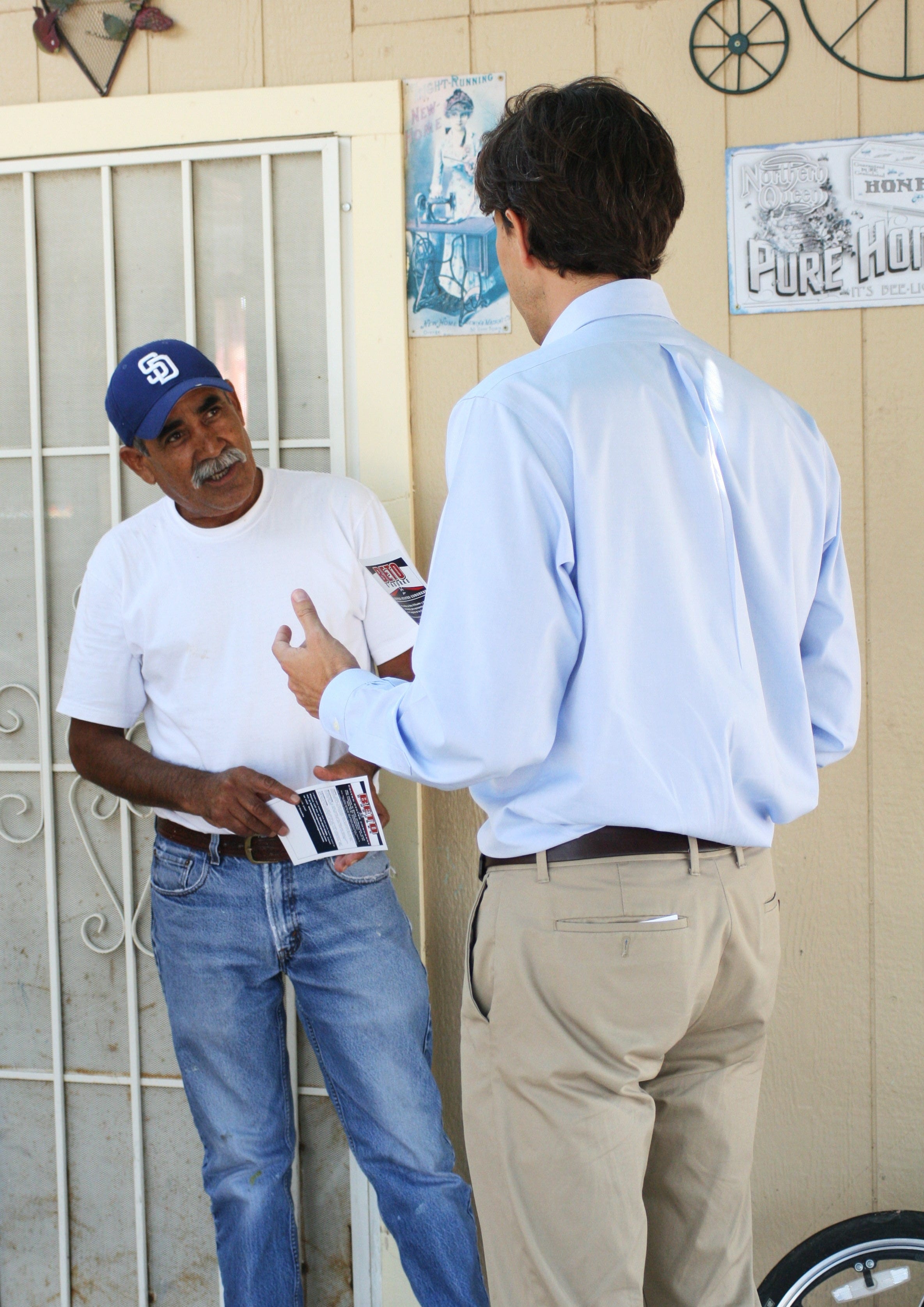
That was always tough for me. The reason I got into politics was because I’m drawn to people. I love getting to know someone, understanding where they’re coming from, figuring out what we have in common. I’m fascinated by the kinds of things you learn, the kind of connection you make, when you’re meeting someone for the first time, especially when you’re meeting them where they are. I’m not saying it always goes well — I’ve had doors slammed in my face, or worse, appealed to people who just couldn’t care less — but when it does, it’s the best thing.
So there was always this tension, between moving quickly enough to meet our targets and moving slowly enough to actually get to know the people I wanted to serve.
When I was at my most focused or when I knew our campaign manager was watching, I could resist the temptation to stay and have a longer talk. But not that day. The offer of hospitality, the kindness being shown to me… the knowledge that air conditioning was on the other side of that door… was too much.
As we walked into the kitchen she showed me a picture of her grandson who’d just enlisted in the Marines. Very proud! His mom, she told me, was a school teacher who did her best to raise her kids right even though she had to take a second job to make ends meet.
The coffee made, we sat down in her living room where she asked me about my family, wanted to know where I came from, who raised me, if I had any kids… you know, the important stuff. Our children were little then, 5, 3 and 1 and of course I showed her pictures and talked about their emerging personalities and our hopes for them.
What struck me about our conversation is that, beyond introducing myself as a candidate for Congress, we didn’t talk politics at all. At the outset I felt an urgency to bring our discussion back to the campaign, but it faded as we fell into the conversation, losing track of time in the process.
But at some point, maybe we’d been talking for an hour or so, I said “Ok, I should probably let you get back to your day and I’ll get back to introducing myself to your neighbors.” I thanked her and gave her a hug at her door and said goodbye. She called out “good luck!” as I walked down the sidewalk to the next house.
I knew that I’d blown our target for the day, but it was nice to just talk to someone, to have a real conversation instead of a transaction, to be a guest in her home, to receive her kindness and encouragement. Not everyone is so nice! She really lifted my spirits that day, gave me a second wind down the final stretch.
The next week, the last one before early voting started, I was walking into a coffee shop when someone stopped me. Asked if I was who I am and after I said yes he said
- Do you remember knocking on my grandmother’s door? She had you in for coffee… talked your ear off about my brother who joined the Marines…
- Yes, of course I remember her!
- Well you must have hit it off, because on Sunday when I and all of my cousins, there’s like 30 of us, came to her house for menudo like we do every week she made us each promise to vote for you. And made us promise that we’d get our friends to vote for you too. I’ve never heard of you before… I wasn’t even planning on voting. But I can tell you now, with our family’s support, you’re going to win this thing.
He was right. On election night we won with a little over 50% of the vote, first in a field of five candidates including the incumbent. I’d go on to win the general election that November.
I knew in my heart that the reason we came out on top was because of all the people I’d met while knocking on doors, all the conversations I’d had, all the time spent just being with the people who were going to vote in this election. The money, technology, social media, digital ads… all of that’s just substituting for the real thing, human to human connection. Nothing more powerful than that.
It’s the same approach I’d bring to the campaigns that followed, winning re-election to Congress twice before running for Senate in 2018. While I couldn’t go door to door across Texas like I did El Paso, we did travel to all 254 counties, holding a town hall or public meeting in each. We also led an extraordinary grassroots field program that empowered tens of thousands of volunteers to go out and meet their neighbors to encourage them to vote for me and other Democrats on the ballot. The Texas Tribune wrote about the campaign’s organizing program in its final days, including our pop-ups:
Arguably the centerpiece of the O’Rourke campaign’s ground game in the home stretch are its “pop-up offices” — 727 in total. The offices, located in supporters’ homes and other places, serve as local organizing hubs, the site of volunteer trainings, phone banks and canvass launches.
Paid field organizers oversee clusters of pop-up offices in their regions, but each location is otherwise entirely run by a volunteer known as a “pop-up captain.” The captain is responsible for opening and closing the space, maintaining it and leading trainings at the start of each shift.
Around 3 p.m. Monday, the Jester Farms pop-up office was beginning to fill up. A half dozen volunteers were spread throughout the house, including two stationed in a guest bedroom where the owner had cleared the floor — a mattress lay against the wall — and built a table for volunteers in place of the bed.
Outside the home, there were five O’Rourke campaign signs planted in the front yard and a volunteer greeting posted on the front screen door. “Welcome to the Beto Pop-Up,” it read. “Come on in! 9:00 a.m. to 9:00 p.m. 7-days a week.”
The office’s captain, 45-year-old Leyla Gaines, said O’Rourke’s was the first campaign she has ever gotten involved in and has been working 12 hours a day every day since early this month. “Everything else is on hold,” she said during an interview.
“We want to reach out to as many people as we possibly can and have good conversations with people because we feel the most important thing we can do in our campaign is face-to-face interaction with people,” Gaines said, reflecting on the community of the pop-up office. “It really does feel like family.”
I didn’t win that race, but all of those volunteers knocking on doors and talking with the people in their neighborhoods produced the biggest turnout in a Texas midterm in forever, helped Democrats win upsets across the state (Congress, State Legislature, Harris County Commissioners Court, etc.) and showed what was possible when you put people first in a campaign.
The big upsets around the country this summer — Abdul El-Sayed, Peggy Flanagan and Angie Nixon — confirm that this kind of grassroots campaigning works. Spending time with the people you want to serve, focusing on raising volunteers as much as you do raising money, and being honest and courageous in what you believe and what you’ll fight for is more powerful than the corporate money, the poll-driven talking points, the cynical attack ads.
I know we’re a long ways off from the kind of democracy we deserve, where money is no longer counted as speech and corporations as people, but these victories are fresh evidence that we can get there.
Maybe, like Geddy Lee says, all this machinery making modern music can still be open hearted.
No posts
Comments
Nothing yet. Say the first thing.
Sign in to join the conversation.