
Tarrant County, home to Fort Worth, has long been a bellwether, maybe the bellwether, for Texas. The statewide presidential vote mirrored that of this north Texas county throughout the early 2000s, with Republicans notching reliable wins as Democrats slowly narrowed the gap.
And as Texas became more competitive in the 2010s, so did Tarrant.
When I ran for senate in 2018, during Donald Trump’s first midterm, I spent a lot of time there, and over the course of the campaign I could really feel it changing. People were beginning to challenge the status quo, fighting back against the idea that it would remain “the last reliably red urban county” in America.
None more so than Alisa Simmons.
A community activist and president of the Arlington NAACP, she made sure that our first meeting was not going to be just a photo op or a box to be checked. She took the time – and really, she made me take the time – to help me understand why so many in Tarrant were struggling.
She told me, for example, that Arlington – home of the Dallas Cowboys, Six Flags amusement park, and nearly half a million people – was the largest city in the country without a mass transit system.
“How do people without a car get around?” I asked her.
“They fucking don’t!” she responded.
I thought to myself, she’s the real deal. And I also thought, my title as the most colorful cusser in Texas politics is in jeopardy.
She explained how challenging it could be to see a doctor or to attend your kid’s parent-teacher conference, if you don’t have enough to own a car. A lot of those working the toughest, lowest-paid jobs in Arlington were dependent on the kindness of relatives or friends for rides, or were shelling out for Uber just to function in this car-dependent town.
And it wasn’t just tough to get around, it was becoming impossible to get ahead. Imagine, she said, trying to get to your second minimum-wage job, or traveling to an interview for a better-paying one, if there’s no bus to take you there.
She also took the time to introduce me to people in the community who were facing these challenges, the kind of people that politicians of both parties had written off. I listened, learned and began to connect their problems, their aspirations, with our campaign and our opportunity to change the future.
It was people like Alisa and conversations like those that produced the largest midterm voter turnout in Texas history that year. Hundreds of thousands of people who’d never voted before, or hadn’t voted in years, decided that they too were going to challenge the status quo.
They helped elect Democrats up and down the ballot (including an insurgent state house candidate named James Talarico) and, though we came up a couple of points short against Ted Cruz, they helped me become the first Democrat to win Tarrant County in decades.

After the election, Alisa kept working for her community and helped Arlington’s new mayor initiate a transit system that could connect people to jobs, school and better opportunities.
Not too long after that she decided that she could do even more if she were in elected office herself and so she ran for County Commissioner. When she won, she used that powerful position to deliver the kind of services and accountability that working people needed but historically hadn’t received.
But when her success posed a threat to the Republican-majority on Commissioners Court, they voted to gerrymander her district to make it unwinnable in the next election. True to form, she responded by running to replace the county judge who’d tried to run her out of office.
While Tarrant County is more purple than red – after my victory, Joe Biden won Tarrant in 2020 only to have Donald Trump take it back in 2024 – winning county-wide was never going to be easy.
And it’s not just because a Democrat hasn’t been elected county judge since 1986.
In the same way Tarrant is a bellwether for the state’s political winds, it’s also a laboratory for the science of rigging elections to favor the party in power. When Tarrant Republicans re-drew Alisa’s district to foreclose her opportunity to win reelection last year, their statehouse counterparts did the same to five Congressional districts represented by Democrats a month later.
And when Alisa announced her run for county judge, those same Tarrant Republicans proposed closing nearly half the polling places in the county, many of them in majority black and hispanic neighborhoods. Maybe they were scared of Alisa. Maybe they were spooked by a special state senate election in January where the Democrat, Taylor Rehmet, defeated the Republican candidate by 14 points in a Tarrant County district that Trump had won by 17 points in 2024. Maybe they just didn’t want to face the people they were supposed to serve.
So, this past Tuesday, almost 61 years to the day that Lyndon Johnson signed the Voting Rights Act into law, the Tarrant County Commissioners Court convened to shut down 140 election day polling locations. With a 3-2 Republican majority, the outcome was never in question.
And yet, seemingly oblivious to the odds, Alisa rallied the community, making sure that people understood the attempted theft of the November election and encouraging them to make their voice heard at the meeting.
So many showed up that they couldn’t all fit in the hearing room. And the force of truth they spoke to those in power was so great, that the panicked county judge reacted by ejecting every member of the public from the chambers.
As the meeting continued long into the afternoon, with the outrage of his constituents showing no signs of diminishing, the judge finally sounded the retreat. Disavowing the proposal to close polling places, he agreed to table the item until the Court’s next meeting in September.
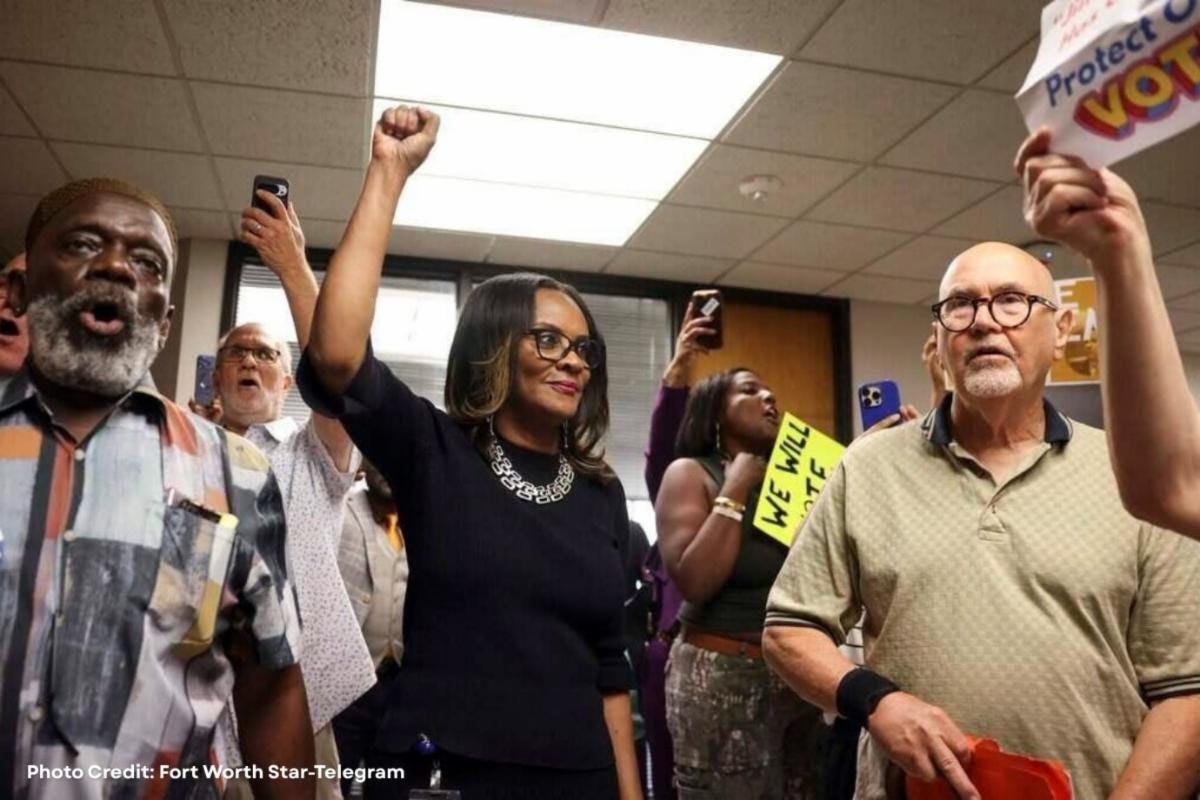
Those waiting outside erupted in cheers and rallied around Alisa when she emerged from the chambers. Those who’d had the courage of their convictions, who had confronted injustice despite the odds stacked against them, had won entry into the next round of the fight.
That night, as if to make obvious the line between Alisa’s victory that day and his own in November, James Talarico hosted one of the largest rallies of his campaign in her hometown of Arlington. More than 1,300 people came out to hear the next Democratic senator in this “reliably red urban county.”

As Tarrant goes, so goes Texas. And as Texas turns, so, we hope, does the country.
No posts
Comments
Nothing yet. Say the first thing.
Sign in to join the conversation.