
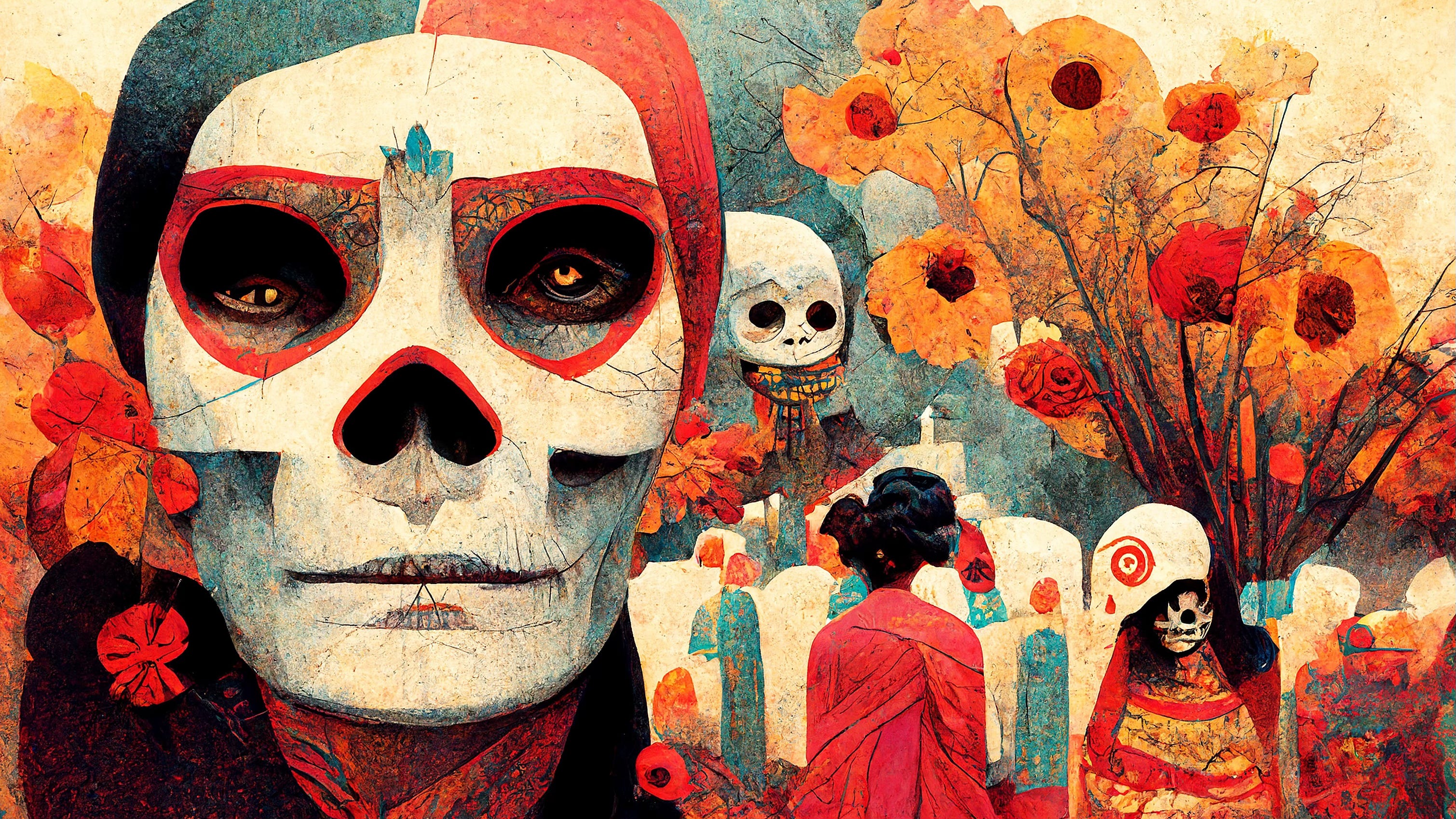
The final throes of autumn. I’m house-sitting deep in the bones of an old forest ripe with fetid smells of fungus and decay.
On morning walks, the dogs trot over the mush of leaves fading in puddles along the muddy track and disappear into the mist. In the afternoons, we lose the light earlier each day, and the elderly husky becomes a slender white ghost among the shadows.
It was Halloween this week, and I’m glad I’m away from town and have missed it. It was different when I was growing up, but Scotland seems to have adopted American-style Halloween. It’s my least favorite ‘holiday’: the petty extortion of ‘give me a treat, or I’ll do something mean to you’, and the cynical marketing of ‘special’ candy and over-priced costumes. At least the lurid yard decorating hasn’t yet taken hold.
My biggest issue with modern Halloween is the fake suffering and over-blown gore sold as entertainment. Trick or treating in my American neighborhood, there were superheroes and princesses but also five-year-old zombies dripping with pretend blood. We walked up to the doors of pretty, middle-class homes to the cackling of the undead, animatronic skeletons clawed their way out of the lawns and rattled in cages hung from the trees.
If Halloween was once a festival to ward off evil spirits, it has become a horror show where we join the cast and revel in the unholy mayhem. When did it all become so blood-thirsty?
You might say, ‘Halloween has always been about confronting our fear of death, it’s part of our culture,’ but in times gone by, our culture included personal experience of actual death and dying. If your grandparents pass away at home, you grow up with an understanding of the dying process that provides a counterpoint to festive theatrics.
In Western culture, dying is now a matter for clinicians instead of families, and even conversations about it have become sanitized or taboo. When Halloween is the most visible representation of our culture around death, I can’t help but wonder what ideas our children bring home along with their body weight in candy.
Culture helps us explore and express ideas that are too big, too scary or beautiful to approach alone. Culture creates spaces for conversation and I’ve long been a passionate advocate for learning to speak about death and dying so my treat this Halloween was a trip to the movie theater.
I went to see The Room Next Door starring Tilda Swinton and Julianne Moore. The film is by Pedro Almodóvar so it’s beautiful, its architecture shaped by vibrant color. The story is about Martha (played by Tilda), a woman with terminal cancer, and her friendship with Ingrid, a woman who is deeply afraid of death. Martha has decided to end her life on her own terms and asks Ingrid to be her companion in the room next door.
The film is timely here; the British government is considering the question of medical aid in dying for the terminally ill. A new law has been proposed that would permit the prescription of lethal medication under specific circumstances, and parliamentary members will soon vote their conscience.
At least in the media, the most vocal opposition to the bill comes from doctors and palliative care specialists concerned patients will feel compelled to choose voluntary euthanasia, either because of pressure from family or to reduce the burden of care on their loved ones. They hope that instead of changes to current laws, improvements will be made to care for the dying and more resources provided for hospice services.
Dying is intensely personal and I love that Almodóvar’s movie doesn’t include a medical adjudicator. Instead, the frankness of Martha’s character, and the clarity of her perspective leave us with nothing to do but confront our feelings and ideas about our own mortality.
Another stunning, if more subtly designed, movie on this theme is Supernova (2020). Stanley Tucci plays Tusker, who, suffering from an unspecified form of dementia, embarks on a road trip with his partner, Sam, played by Colin Firth. As the couple travel through the Lake District in England, they must navigate a landscape shaped by losses that even love cannot prevent.
Like Ingrid, Sam reluctantly finds himself confronted by the role of witness—the sole survivor of a scenario that will eventually, inevitably, befall him, too.
Both of these films include reflections on the lives lived, but the intensity, the power that resounds long after the credits have rolled, comes from the conversations about what it means to die. Those conversations are poignant yet remarkably un-sad, even hopeful sometimes.
Conversations about death and dying are always conversations about life and the living. If we can become death literate as a society, we can be better at having those conversations with the people closest to us—speaking not only about our deaths but about what’s most important in our lives.
For most of us, love is what matters most, yet fear, the opposite of love rules our thinking around death.
If we can learn to look at death without turning away or reducing it to a macabre mockery, we can think and feel more clearly about what we want before we get there.

Perhaps your day is ruled by your never-ending to-do list, or you simply need to tune out the news for a while. Take a break to think different and feel different with a subscription to Whole Stories Shortly.
Comments
Nothing yet. Say the first thing.
Sign in to join the conversation.