
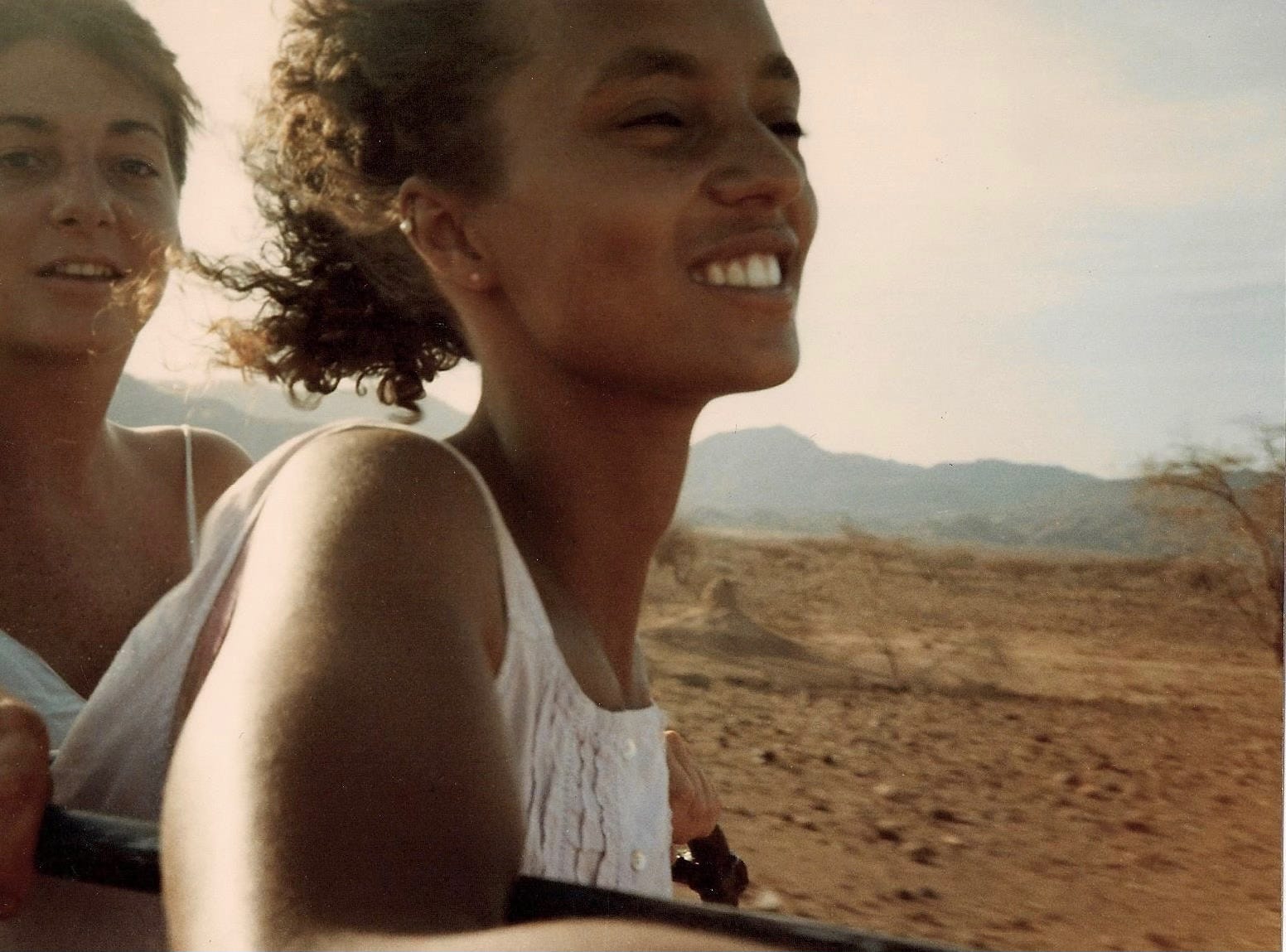
The huge Mercedes truck wallowed in the muddy pool like a drowsy hippo. My traveling companion and I looked on from dry land, wearily waiting to see what would happen next.
Jane and I had been in Somalia for three weeks and this was the latest in a long series of unwelcome adventures. There had been the usual hazards of traveling while female, also bandits and spilled blood in the north, and the repugnant advances and drunk driving of expats who worked for British American Tobacco in the capital, Mogadishu.
From our base in Kenya, Somalia had sounded like a cool destination; a singular notch in the belt of any hip traveler. We had recently returned after weeks of traveling overland from Nairobi through the countries of East Africa to South Africa. We had hitch-hiked from Johannesburg to Capetown—in 1986, at the tail end of apartheid. We had found ourselves in some tricky situations and survived, we reckoned we were ready for Somalia.
But Somalia was already on the brink of its tragic descent into ‘failed state’ status and everywhere we went, tension shimmered at the margins like a mirage. And now, Jane looked pasty and it seemed as if she might be falling sick. We were eager to leave.
Hitch in the Plan
The relative safety and comfort of Kenya were only a few hundred miles away but our options for getting there were limited. There was no formal infrastructure for public transport so we begged rides from town to town, heading south with NGO workers and other ex-pats.
Eventually, we became stranded, unable to find anyone who could move us closer to the border. Some local businessmen offered to help, apparently in expectation of sexual favors—we declined. We found an otherwise deserted lodging house and rented a room. As night fell, a gangly teenager painted a broad stripe of kerosene around the edge of the floor ‘to keep the insects away’.
Next day, we toured the small town in a taxi, a Fiat so decrepit that the rusted-out driver’s door had only one hinge. To prevent it from dragging along the road, the driver kept his arm out of the window and held the door up by the handle, using his other hand to juggle the steering wheel, gear stick, and the horn when he wanted to sound it, which was often.
In a dusty grocery store, we heard about a truck leaving for the border that would give us a ride for a few dollars. Details were sparse, but it would leave soon after dawn and arrive in Kenya by the afternoon. Relieved, we packed up and turned in for an early night.
False Starts
Woken by a call to prayer from the muezzin silhouetted in our window, Jane and I arrived at the pick-up spot early, even though we knew that an on-time departure was unlikely.
The bed of the huge goods truck was filled almost to the brim with sacks and bales, and a couple of dozen people had already claimed the metal walls as backrests. We clambered aboard and lounged against our backpacks as the truck took off, driving around the town, beeping and lurching as the crew touted for more passengers.
After a couple of hours, the space that Jane and I had staked out for ourselves had shrunk considerably. Finally, around noon, the truck left town and we were on our way.
The road was a dirt track through a dry, rock-strewn expanse dotted with thorny scrub and the occasional acacia tree. The rainy season had been poor for the previous couple of years but a recent downpour had prompted a sudden sprouting of tiny green leaves, adding an uncommon freshness to the relentlessly khaki landscape. Here and there, dry gulleys cut trenches across the road and the truck eased tentatively down and up the crumbly edges.
Flash floods are the cause and effect of these gulleys. I saw one come through once, in Kenya. Rainwater, unable to soak into the parched land for miles around, had poured down hills and accumulated into great torrents that rushed across the desert, stopping only to fill the hollows.
And that is how the pond that now confronted us had formed.
Truck in the Pond
The pond revealed itself when we rounded a large stand of thick scrub. The truck stopped and, as the engine idled, there must have been some discussion among the crew because, after a few minutes, a young lad jumped from the cab and headed towards the pond.
He was the youngest of the three-man team in charge of the truck. He looked to be in his mid-teens, slim and light on his bare feet. He was about my height—5’ 3” (160 cm) and when he walked into the water, he disappeared up to his chest. He turned to look towards the truck and raised his arms as if to ask his colleagues if they’d seen enough.
The answer was obvious to Jane and me; they needed to drive around the pond and that meant that those of us perched on top of the truck would be scratched to ribbons by the overhanging thorn trees. The Somali passengers appeared to reach the same conclusion and we all scrambled down to the ground to wait for the truck to reach the other side.
Except that’s not what happened. First, the driver and his mate appeared and spread prayer mats on the ground. With the power of inshallah sufficiently evoked, and the lad back on board, the engine revved and the truck roared—straight into the pond.
Deserted
After several failed attempts to restart the engine, the crew waded ashore to consider their options. There was much talking with and among the crowd of passengers, though none of it sounded defensive or accusatory.
Decisions were reached and the driver turned to those of us on the fringes of the conversation. He raised his palms in the universal sign language for, ‘Oh well, what can you do, eh?’ and walked away.
Passengers began loading up with their belongings, apparently, they were going to walk the rest of the way. A group of Somali women who had been sitting near us on the truck looked over, suggesting with inquiring eyebrows that Jane and I do the same.
But the heat was sweltering and we had no idea how far the next settlement might be. What if we couldn’t keep up and ended up alone, lost in the desert at nightfall? We decided to stay put and wait for someone to arrive to salvage the expensive piece of machinery submerged in the pond. Our fellow passengers set off along the track and soon disappeared into the hazy horizon.
Fresh Meat
The crew set about retrieving supplies from the swamped truck and I looked for somewhere to sit with some shade. Resigned to a long wait, Jane wandered into the bush in search of a private place to pee.
When she returned, she looked even more ashen than previously. She beckoned me to come see what she’d found. Watering holes, even remote, temporary ones like this, are a magnet for wildlife. Hidden in the thorn scrub, was a carcass, the large ribcage stripped of its meat and most of its innards. Next to that—the paw marks of a very large cat.
Back beside the pond, the lad and the driver’s mate were setting up camp and had lit a small fire. Jane tried to tell them about the kill in Kiswahili but the two Somalis didn’t understand.
Just then, the driver emerged from the scrub with a rifle in one hand and a headless guinea fowl in the other. Ironically, my Swahili-girl looks made it impossible for me to develop my conversational Swahili but Jane was fluent enough to tell the driver what she had seen in the bush.
She turned to translate the exchange for me looking defeated. “I told him I’m glad he’s a good shot because there’s a kill and signs of a big cat nearby. And he told me that he had to be good — he only had that one bullet.”
Dinner
Close to the equator, the sun sets around 6 pm and it was already late in the afternoon. We reasoned that the fire was our best deterrent against predators and scouted around for firewood. The pickings were slim.
The driver’s mate doubled as cook and while he plucked the guinea fowl, I rooted around in my pack and found a packet of dried spaghetti to add to the meal. Absurdly, our traveler essentials also included a pair of hairdressing scissors and a bottle of duty-free Tia Maria purchased in Mogadishu.
As the sun nudged the horizon, the most unlikely of dinner parties gathered around the fire. Jane had a new haircut and we were both a little buzzed from the Tia Maria. We ate boiled guinea fowl with noodles and it was delicious.
In the Nick of Time
It wasn’t very late yet, but it was dark enough for the lights of an approaching vehicle to shine out of the horizon that had earlier swallowed the rest of the passengers.
The beams of deliverance beckoning from the other side of the pond belonged to a military-style vehicle. Our fellow travelers had reached the next village and sent the police back to fetch us.
Our Somali driver assured us that the crew would spend the night with the valuable carcass of their truck and, despite the more sinister one in the bush, they seemed in good spirits as they waved Jane and me a warm farewell.
A few miles along the road, we unrolled our sleeping bags among the sleeping shapes of others on makeshift beds in the police station courtyard.
There was no moon and the deep blue sky, teeming with millions of stars, seemed like a bottomless ocean suspended above me. I pressed my palms into the dust of the worn, baked earth and thanked God for the goodness of people, and the undeserved blessings of the Patron Saint of the Young and Foolish.

Feeling overwhelmed by your never-ending to-do list? Need a break to think and feel something different for a moment?
Subscribe to Whole Stories Shortly and you’ll receive a weekly story that’s short enough to fit into your schedule, and long enough to help you escape from it.
I ate another unexpected plate of spaghetti in Somalia. If you missed that story, you can find it here —
Readers like you subscribe to receive a story every Sunday.
Comments
Nothing yet. Say the first thing.
Sign in to join the conversation.