
I met Jens only once, a couple of weeks before he died. I was in the States, wading through the quagmire of divorce, and a mutual friend had called me on Skype to see how I was doing.
I wasn’t doing well. I had told my kids they were going to have two bedrooms, two homes, and the neverending love of one pair of parents. Meanwhile, word had spread among friends and colleagues, so on top of the pain flowing through my family, I was surrounded by a hurtful chatter of rumor and opinion. It was lovely to hear from an entirely separate universe.
Jens had lived next door to Søren in a hippy-ish enclave of Copenhagen for decades. Now he was ending his days at his son’s home in Cambridge, England. For a few days, the former neighbors and activists who had smoked and drunk copiously together, arguing about politics and culture, were gently taking leave of each other.
I had recently trained as a death doula and listened as Søren described how, each day, Jens took less interest in the world. Their conversations were mostly poignant reminiscences, and the circle of memories they revisited was contracting.
They spoke of Jens’s wife who had died many years earlier. Gloria was a tango dancer from Argentina, filled with light and warmth. Nordic and analytical, Jens took up tango too and became something of an expert. He and Gloria taught together and celebrated their love of Latin dance with parties and competitions. The years since her death had felt more like the heavy grey skies of Copenhagen than the star-spangled velvet above Buenos Aires.
When Jens heard that Søren was going to speak with me, the woman he had met almost 30 years earlier, a lost love living a continent away, he decided he wanted a look.
Behind Søren’s shoulder, Jens emerged from the pale, late evening light. He wore an elegant sports coat buttoned over a black turtleneck, his black hair combed into neat wings on either side of a high, bald forehead. His dark eyes twinkled at me.
Søren gave up the chair in front of the screen and Jens perched there, his frail arms jack-knifed at the elbows. Closer now, I could see that cancer had hollowed out the soft contours of his face. His hands gripped the arms of the chair as if ready to rise but it might as well have been to keep himself from floating away.
We spoke for a short while with Jens speaking most, about friendship, love, and how dying reveals everything important about life. After Jens died, Søren told me how much he had enjoyed our conversation. “Isn’t it marvelous to make a new friend?”, Jens had said, “Even with so little time left”.
He died three weeks later. Back in Denmark, the blossoms from his cherry tree rained over his dear neighbor’s garden fence.
Soon after, as I was packing up the household remains of my marriage when something outside the window caught the corner of my eye. On the deck, a crow was eyeing me as he hopped along the table, keeping pace with me as I moved through the room. Sunlight danced on the blue-black of his wings.
I keep an open mind when it comes to signs from the great beyond and something about the elegant, bright-eyed crow made me both smile and cry.
Back in Denmark, Søren helped pack up his late friend’s home and we had more conversations about what survives the ending of things. Inevitably, we discussed the almighty suck that is divorce.
English is not Søren’s first language and he uses some ‘English’ words that are entirely of his own creation. My favorite is the one he uses for ‘divorce’— divortion; a noun that belongs to both parties and not a verb or description for what one person does to another. I like how, without that kind of weaponization, it captures the devastation of divorce and combines it with ‘devotion’.
Devotion to a brighter future or at least to doing better, devotion to the children and continued parenting. Devotion as a golden thread that might lead the way through the darkness.
The death of a marriage isn’t entirely unlike the death of a person. For all the talk of dignity and discretion, other people’s deaths and divorces spark curiosity and discussion, especially by those not directly involved.
Identifying the exact moment a marriage tilts irrevocably towards divorce is as difficult as defining the moment when normal cell division turns cancerous. Yet, when a relationship sours, the grainy, backroom courts of public opinion decide on a culprit and assign blame.
Perhaps the hindsight second-guessing at the failure of someone else’s relationship provides some feeling of control, or immunization against our own futures. At its most extreme, it looks like self-righteous emotional masturbation, but perhaps it is also a way of grieving.
With the end of my marriage, I had my own grief to deal with. I moved into a rented apartment since my soon-to-be ex-husband wanted the house, and assembled secondhand bunk beds using a rubber mallet and a full bottle of red wine.
One morning I was woken, too early, while the kids were at their dad’s. A mighty cacophony was going on outside my window. My soft-hearted neighbor left out food for lost and fugitive cats, and the local crows were often noisy diners at the easy-pickings buffet. This volume of cawing was extraordinary, but my bed was cozy, the sheets were warm, and I slipped back into sleep.
When I eventually opened the curtains, I looked down and saw a crow sprawled on top of the hedge beneath my window. Its wing feathers rippled with the breeze and I half expected it to rise, perhaps holding a fledgling pilfered from the resident sparrows’ nest. But no. The crow was dead and I went down to investigate.
“Did you hear the crows this morning?”, asked my neighbor from his porch across the street. “It must have been a ‘crow funeral’, I looked it up. It’s incredible — they are so smart, crows. They all get together when one of them dies to work out what happened.”
The dead crow lay just out of my reach, newly trimmed sprigs of privet standing sentry around its breast; one wing awkwardly pointing skyward as if asking for permission, as if it had something more to say.
I wasn’t sure how to deal with this unexpected fatality. When the kids were around, a dead animal was an opportunity to talk about death and practice ritual with an impromptu funeral. But the kids weren’t around and I hadn’t yet had breakfast. Still, if the crows had felt the occasion worthy of a funeral, shouldn’t I? Undecided, I went inside to read up on crow funeral protocol.
A mob of crows, also known as a ‘murder’ I read, do indeed gather after the death of a member. Crow funerals include raucous cawing, not as a sign of mourning per se, but as the method of discussion about what has caused the death and, importantly, who is to blame. The scientific understanding is that the birds aim to identify the presence of predators or threats, such as sources of infection so that they can be avoided in the future.
Crows get quite specific when identifying anyone they believe has perpetrated crimes against their kin. They come up with descriptions of the perp and even share the information with crows who didn’t attend the funeral. And then, they fight back.
Crows will kill other crows if they’ve been found guilty in corvid court. If the crows decide that a human is involved in the death, they take retribution. And even if they didn’t see the person actually kill the crow, guilt by association is enough. Researchers found that the crows commit the person’s face to memory and whenever they see that person, they gang up and attack them—individually or as a cawing and swooping mob.
In short, crows will hold a grudge and act vindictively even when relying on gossip rather than firsthand knowledge. It all sounded a bit like my divorce, with the assumptions of people who weren’t there adding distortion to the divortion.
Later that morning I checked the surrounding oaks for watchful crows then went to retrieve the corpse. I lifted it from the hedge using a garden fork. It looked young and its soft neck was broken. I wondered if it had flown into the nearby telephone pole but that seemed unlikely. Maybe it had been murdered by its peers, a case of mistaken identity perhaps—mob justice is unreliable, after all.
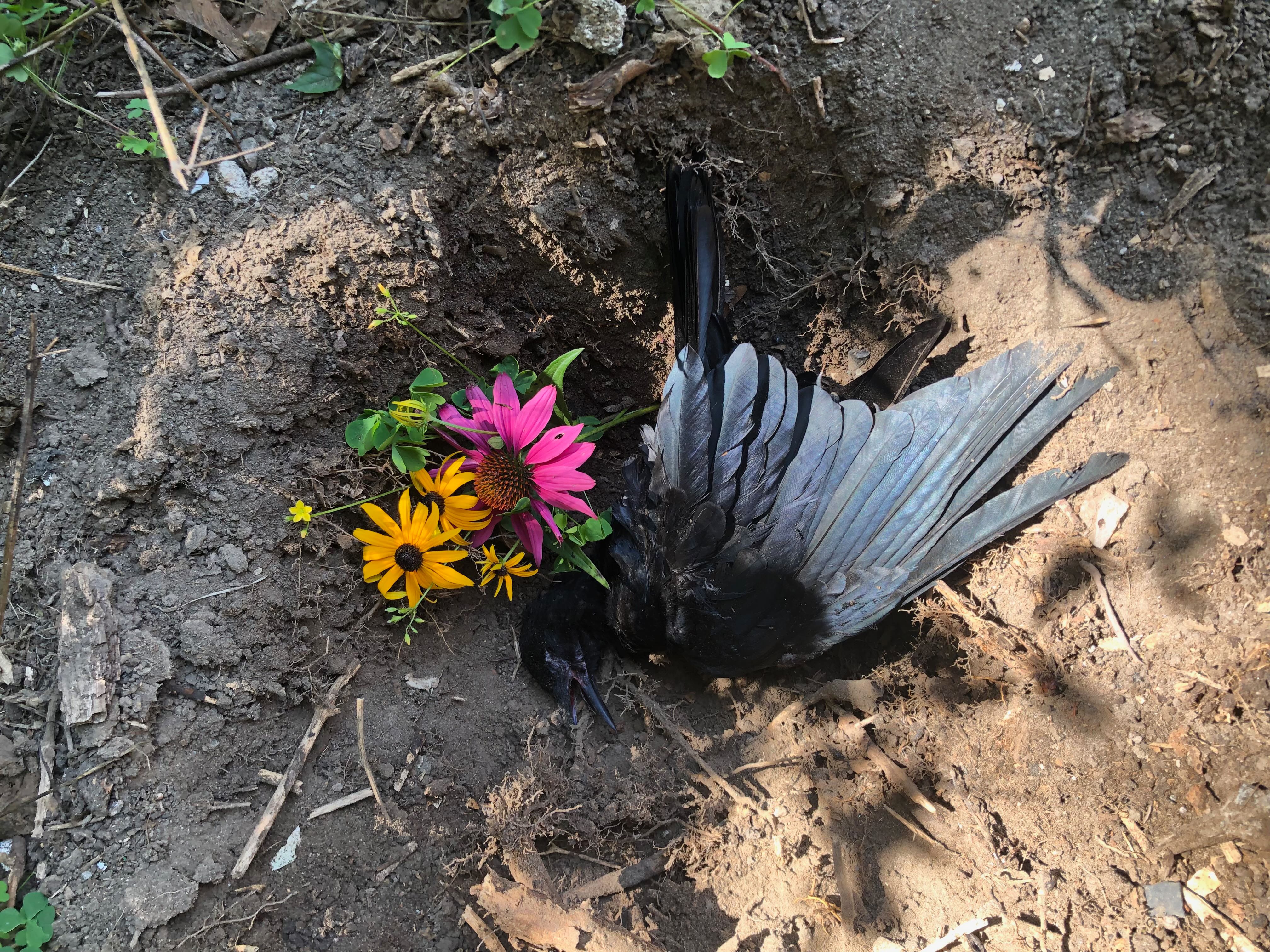
I buried the crow in the backyard with only a disinterested family of wrens in attendance. Shafts of sunlight caught the diesel-blue tint of a black wing still signaling mournfully from the crumbled earth.
I felt a pang of kinship with this being cut from its life and family, its disaster subject to heckle and debate. I wondered how my self and reputation would survive the public picking apart of my private circumstances.
I laid a few flowers beside the crow and offered a prayer; a wish for peace and a final reckoning that recalled the glories of all that came before this sad ending.
The funeral for Jens took place in Argentina. High in the Sierra de la Ventana, his son gave his ashes to the air swirling above the same mountaintop where Gloria’s ashes had been released to the clear blue sky.
I looked for my late and fleeting friend once, online, and found a video of Jens dancing with Gloria. Jens is wearing a glossy black shirt and his wife glides proudly on his outstretched arms. He looks for all the world like an elegant, twinkle-eyed crow. Gloria’s smile sparkles and a spotlight chases her blue spangled dress as she spins and spins.
That’s how I will always see them now, dancing with the circling stars far above the high Sierra.

Enjoying Whole Stories Shortly? Become a subscriber and show your support!
Perhaps your day is ruled by your never-ending to-do list, or you simply need to tune out the news for a while. Take a break to think different and feel different with a subscription to Whole Stories Shortly.
Comments
Nothing yet. Say the first thing.
Sign in to join the conversation.