
Working extra shifts as a young hospital nurse, I was making beds with an older nurse whose Jamaican-South London accent identified her as a first-generation immigrant.
She asked where I was from. I described my father’s Kenyan origins and my mother’s roots in Scotland where I was born and raised. The nurse spat, “Tssh—so, you don’ belong to nobody!”
It’s been forty years, yet I remember it, sharp as the slip of a knife.
We continued our work, two brown hands of different shades tugging at the starched white bedsheet. By the time the hospital corners had been squared away to her satisfaction, I had quietly built a theory that, actually, I belonged to everybody. That hope was a frayed stitch to hold my family’s histories together, and it didn’t last a day of wear.
My parents met at university, at a college dance in the days when those were formal affairs with waltzes in long dresses and black tie.
My mother was standing by the dance floor with a group of women when a man from the cadre of foreign students crossed towards them. A woman near my mother said something to the effect of, ‘Ugh, here comes a black — I hope he doesn’t ask me to dance!’ Mum was horrified and when ‘the black’ smiled and invited her to dance, she immediately stepped forward. Dad was handsome and charming but the real reason my mother danced with him was spite.
My father had been sent to Britain by a Scottish missionary as part of a deal with my grandfather back in Kenya. The mission would be given family land to build a hospital and my father would be educated to become a doctor in it.
The struggle for Kenya’s independence was sliding toward its bloody climax and my grandfather’s collaboration with ‘colonial power’ was probably a risky endeavor at the time. It was risky for my father too. No one in his family had ever traveled so far from home, and with its inherently racist social systems, Britain would be chilly for him in more ways than one.
My mother learned what it meant to be biracial long before I did. When my parents married in the 1950s, my mother’s favorite aunt warned that her children would “inherit the worst characteristics of both races”.
When my brothers and I were very young, we were a novelty—my curly hair drew attention from Scotswomen who spent hours applying curlers and perm lotion. Queuing at the butcher’s shop, a woman beamed at us telling our mother, “Och, they’re awfy sweet. Are ye gonna keep them, dear?”
I asked Mum recently if she remembered an incident when two young auto mechanics came to repair a roadside breakdown. I couldn’t have been more than 10 at the time but I knew the way the men were speaking to her was inappropriate, dangerous somehow. Now, having survived my own experiences of sexual shaming and threat, I know exactly what was going on.
My mother didn’t remember the event. “But then, it happened so often”, she recalled, “If you‘d been with a Black man, even if you were married to him, you were a ‘tart’.”
No doubt she would have been treated as a ‘damsel in distress’, if it hadn’t been for me and my brown brothers peeking out from the back seat.
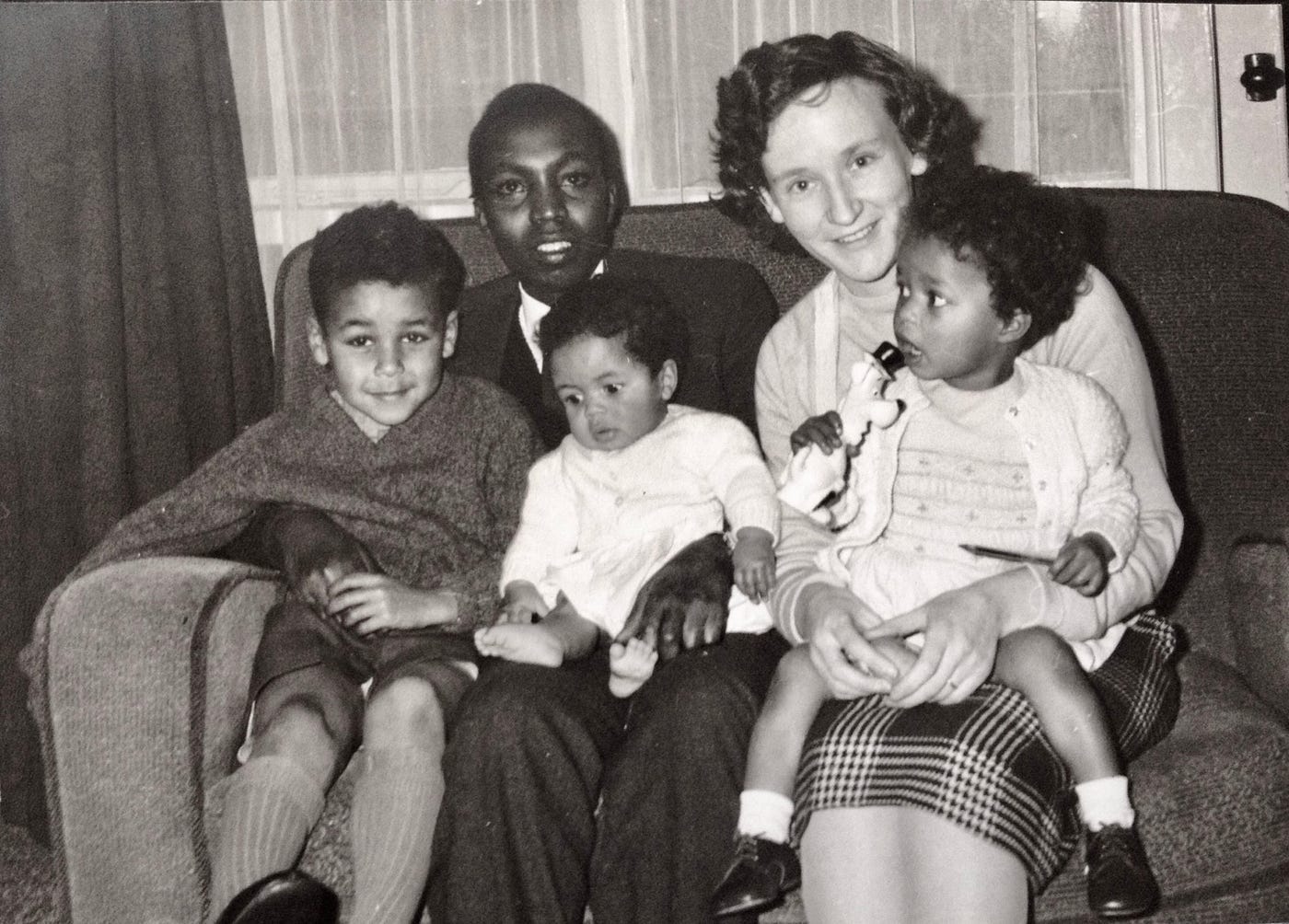
I was born in Dundee, a city in decline. We lived in a massive sprawl of rundown government housing where everyone else was White, and opportunities were few. My father was doing his medical residency at the city’s hospital and would occasionally get beaten up on his way home from work. There was no money for somewhere better, and few possibilities anyway—rental ads warned ‘No Blacks, No Dogs.’
By the time my brothers and I came along, my mother’s favorite aunt had met Dad and was smitten. Like the woman at the butcher’s, she thought we were ‘awfy sweet,’ and she became my favorite aunt, too. I remember her kindness and sumptuous home-baked cakes. Decades later, when she died, I was flabbergasted to hear of her original expectations of how I would turn out.
It’s hard to know what the Kenyan side of the family made of it all. Even if we’d had the money, the pro-independence Mau Mau rebellion meant it wasn’t safe for our mixed-race family to visit. I remember exotic, papery airmail letters arriving. They were friendly, but awkwardly formal in their schoolroom English and cultural conventions.
Before he became seriously ill, my father sometimes made curry for Sunday lunch instead of the traditional British roast. He told us stories from home about our family and the land where countless generations of them lived their lives. He died too young and too far away, so there are only a few stories I have been able to hold on to.
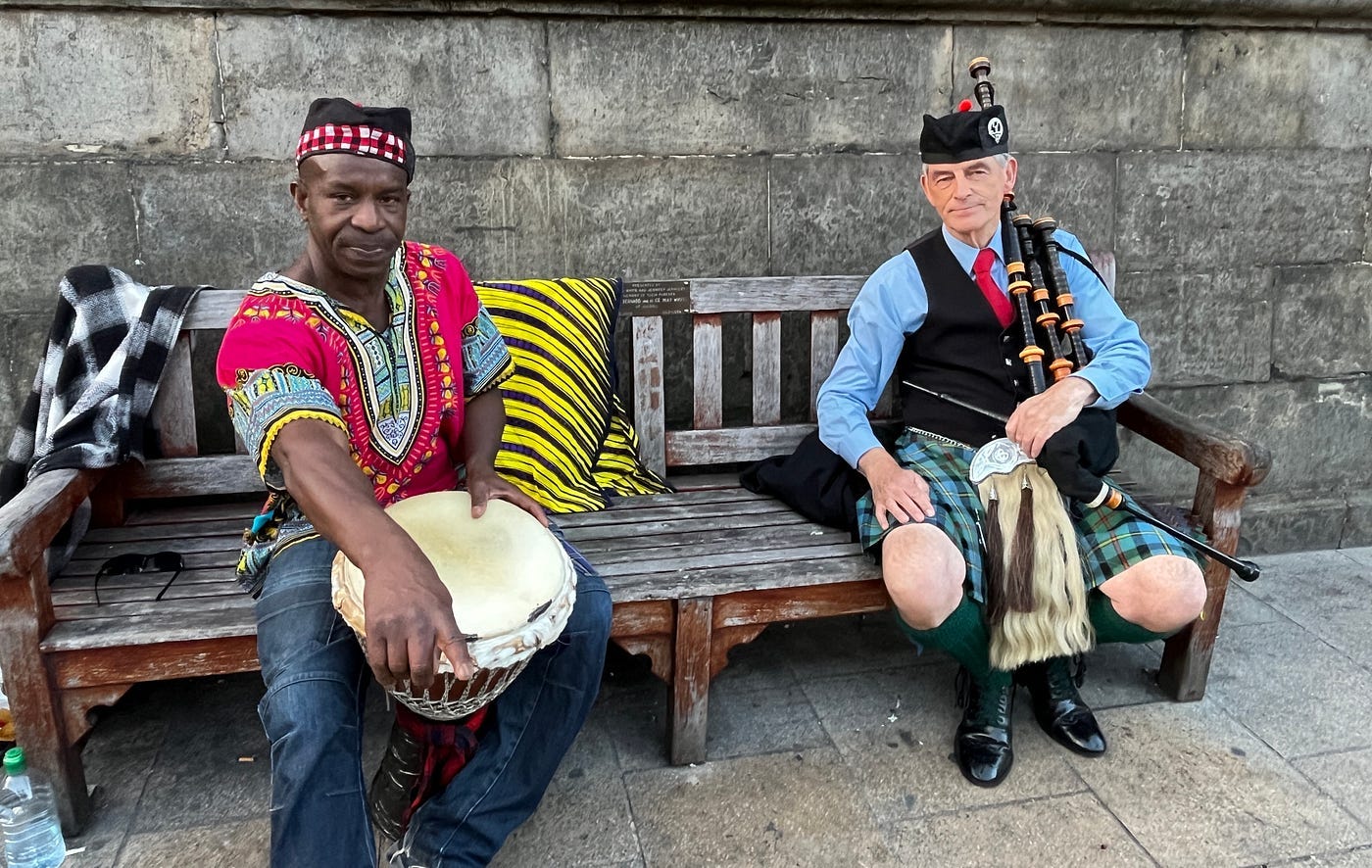
I never met my Dad’s dad, though I have sometimes joked that neither of my grandfathers wore trousers. Not that I ever saw my Scottish grandfather in a kilt. He had stopped wearing it after a long stint in a German prisoner-of-war camp during World War I. He survived poison gas in the trenches but the desperate living conditions of the camp left him emaciated and the constant chafing of wet wool opened sores that wouldn’t heal.
Wartime experiences, and the values of a family that included several church ministers, made Grandad a stalwart supporter of the League of Nations. The precursor to the United Nations, it was one of the world’s first humanitarian organizations and aimed to preserve global peace through international cooperation. It wasn’t to be.
By the time World War II broke out, Grandad was established as a civil engineer. He was too old for the draft and not fit either, but after D-Day, he signed up and led a team of combat engineers rebuilding roads to support the Allied advance.
Grandad was fond of my father; he found he had more in common with him than with many of the other (White) young men he met. His belief in the nature of our shared humanity meant that he couldn’t see my father as anything other than an equal. Grandad died due to war injuries when I was very young, but the values he lived by as a metaphorical as well as a literal bridge builder helped shape my worldview.
Rather than styles of dress, what my grandfathers actually had in common was that both made significant personal sacrifices to build a better future for their communities. Even when it meant crossing society’s racial divides, even when it was a future they would never see for themselves. That’s not the kind of heroic future-building that is commemorated with statues and parades. Just the quiet, common-grind heroics of working for the greater good because it’s the right thing to do.
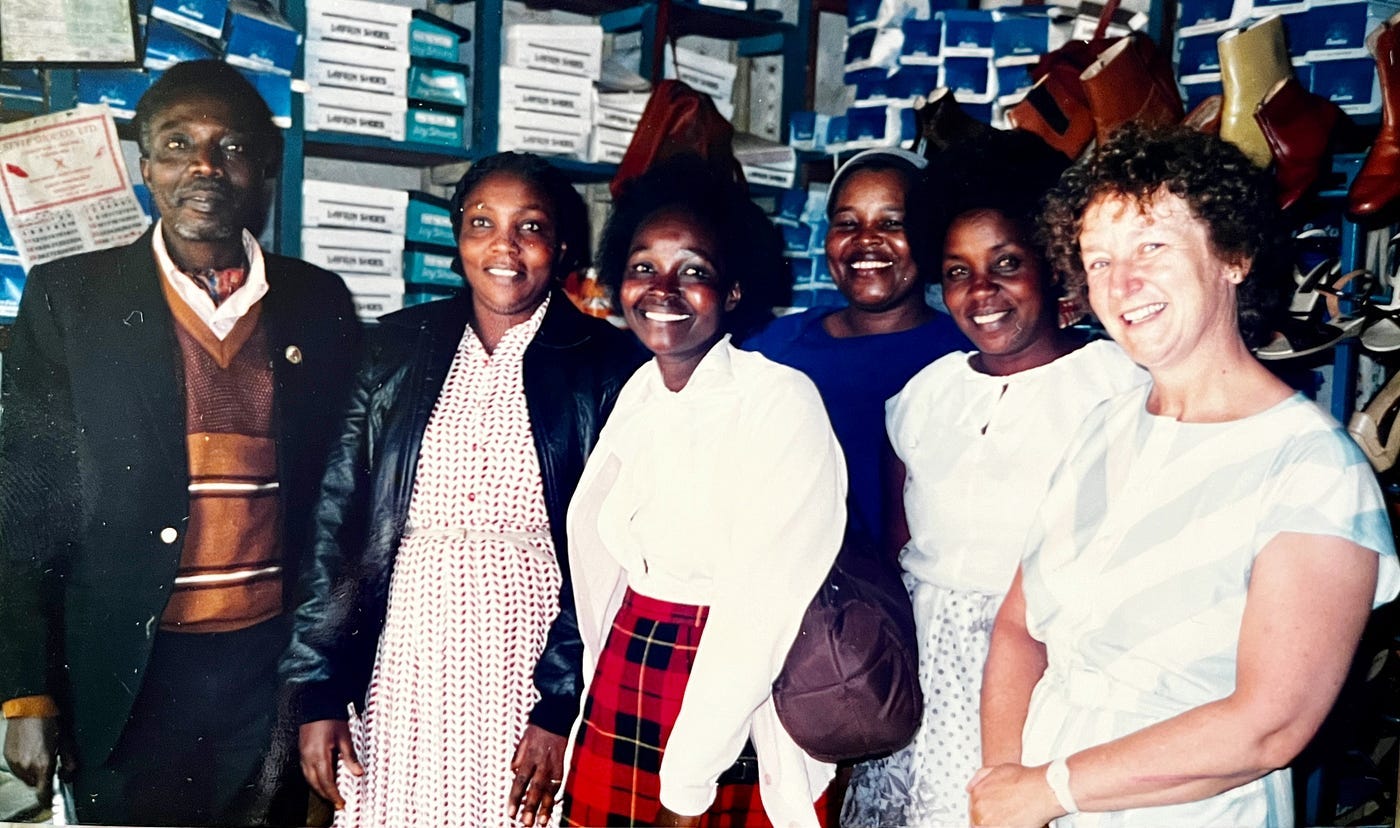
I was 25 when I finally went to Kenya for the first time. I thought I might find some kind of belonging there, but I didn’t belong at all. I arrived at my grandmother’s house wearing trendy turquoise pants and a renegade 1980s haircut. It wasn’t a good look. I sat in the parlor with a freshly picked banana “to fatten me up” and a glass of milk still warm from the cow. Outside, my aunties hatched plans to get me into a respectable dress and a good marriage before I wasted my youth and good education.
I hung out with my curious girl cousins, hoping to learn Kiswahili or Kimeru, my family’s tribal language. But they couldn’t fathom why a native English speaker would want to ‘waste my time’. They were much more interested in hearing about my life in London and what I knew about American pop stars and break dancing. After a few weeks, I bought a ticket to Nairobi and checked into a travelers hostel I found in my well-thumbed copy of Lonely Planet.
I was much more at home with the rest of the international backpacker crowd although, ironically, they mostly thought of me as an outsider because of my Swahili heritage. Looking different had never been a net benefit in my life; when work colleagues teased me about being the ‘token minority’, it wasn’t a good thing. Now, here in the tourist bubble, being biracial made me ‘cool’ for once.
My mother made her first trip to Kenya during the time I was there. She met her in-laws and went to places she knew from my father’s stories of growing up. She visited the hospital that had resulted from the deal that brought her future husband to St. Andrews University on the windswept coast of Scotland. She was received warmly and asked if she would donate blood. AIDS was prolific and still poorly understood; disposable needles were a luxury the hospital couldn’t afford—that the needle being inserted into her arm had been properly sterilized had to be taken on trust. So it is when it comes to blood; trust and humanity in service of community.
My mother’s story converged with that small community in the foothills of Mt. Kenya long ago, and she belonged in a way I never could.
I am a naturalized US citizen now, though I am considering a return to Scotland, and I spend extended periods in Denmark. The Jamaican nurse from London was right—I don’t belong to anyone.
I no longer pretend that I belong to everyone, I know I belong only to myself. Finally, I am home.
“You only are free when you realize you belong no place — you belong every place — no place at all.”
― Maya Angelou

Perhaps your day is ruled by your never-ending to-do list, or you simply need to tune out the news for a while. Take a break to think different and feel different with a subscription to Whole Stories Shortly.
Comments
Nothing yet. Say the first thing.
Sign in to join the conversation.