
FRONT ROYAL, VA. — I come to you as a proud member of the Roanoke branch of the NAACP, and I send greetings from my president and dear friend, branch president Dr. Brenda Hale. I’ve lived in Roanoke for nearly 40 years, first as a newspaper reporter, then as a wife and mom and teacher, and most recently as the author of five books.
I thank you President Gene M. Kilby and the leadership of the Warren-Page NAACP.
African-Americans have experienced injustice and violence for centuries here in Warren County. Slavery and Jim Crow. Massive resistance, during which the public schools in Virginia shut down their schools rather than follow the law set forth by Brown v. Board of Education. Last week I watched a video about siblings James and Betty Kilby and the other brave Shenandoah Valley people who integrated Warren County High school, all the while being shouted at, intimidated, threatened, beaten and even raped—for going to school.
In my book Dopesick, I outlined how The War on Drugs went on to disproportionately target Black people as a way to disenfranchise them and take away their votes, and how Black and brown people are less likely to get treatment for addiction than white people today. While overdose deaths have crept down slightly in recent years—largely due to Medicaid expansions—deaths have not decreased among people of color. Too many Black Americans still fall into the treatment gap, which threatens to grow even wider with the passage of Trump’s Big Ugly Bill.
It was the passing of Trump’s Big Ugly last July that ultimately persuaded me to run for Congress against MAGA Republican Ben Cline. My family members and I have at times been saved by programs including Medicaid, Head Start, Pell Grants and SNAP. My queer children feel less safe on our streets by the day.
It’s been a terrible couple of months. The Virginia Supreme Court overturned the will of the people on the referendum. The U.S. Supreme Court kneecapped the Voting Rights Act.
Look, I understand that when a white speaker stands at this podium and uses their personal poverty to claim they understand the Black rural experience in the Shenandoah Valley, that isn’t real solidarity.
Growing up, when my family struggled with addiction and poverty, that was a byproduct of a macroeconomic shift. It was a tragedy of neglect—of jobs gone away, of treatment services not offered, of education opportunities opening up briefly via the War on Poverty then becoming out of reach. But what happened here in Warren County was not neglect; it was a blueprint of exclusion.
We see that blueprint clearly in the history of Front Royal. In 1958, when the state of Virginia chose self-destruction over equality under Massive Resistance, Warren County High School was the very first public school shut down by Governor Lyndsay Almond.
The architects of segregation, under the direction of the Byrd Machine headquartered in nearby Winchester, looked at the census data for Warren County and saw a Black population that made up roughly six percent of the community. They assumed that a minority that small could be easily intimidated, socially isolated, and starved into submission. They thought the entire Byrd machinery would easily break the resolve of 23 Black teenagers.
But what the state machinery miscalculated was the organizational infrastructure of the rural Black community.
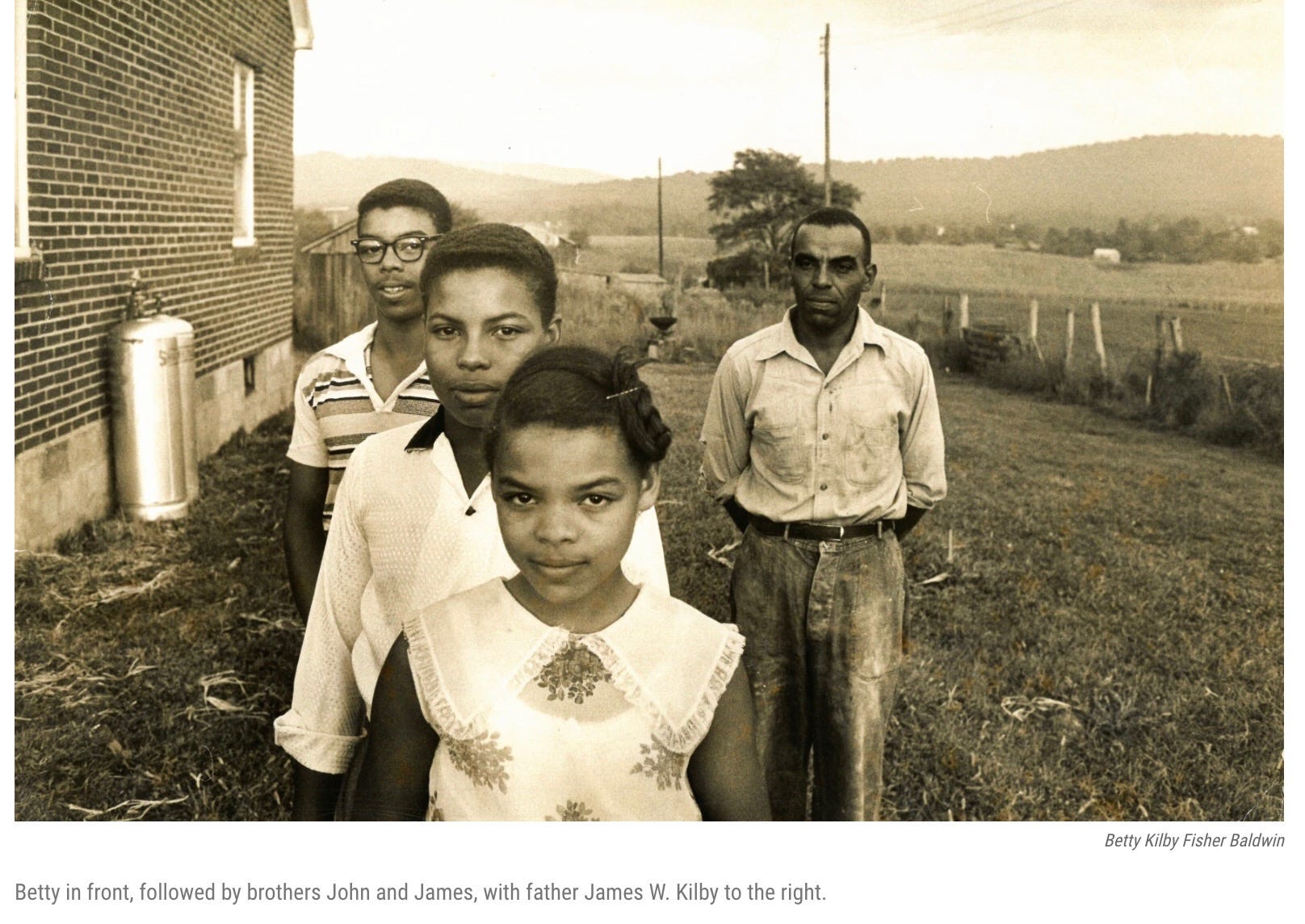
They forgot that rural Black families had spent generations building their own parallel networks of survival, faith, and legal strategies designed by people like Oliver Hill, who grew up in segregated Roanoke. They forgot the strategic brilliance of local leaders like James Wilson Kilby, the PTA president who used the federal court system to dismantle state-sponsored segregation from a rural county seat.
And they forgot the absolute discipline of those twenty-three students, including James M. Kilby and Betty Kilby, who walked up that hill on February 18, 1959, and broke the line.
The courage required to break a segregation line in a small town, where you cannot hide in a crowd, and where the people opposing you know exactly who your family is and where you live, is a specific, heavy kind of resilience that the rest of us have rarely had to contemplate. They shot at the Kilbys’ house. They cut the feet off their cows.
My investigative work on the opioid crisis and corporate exploitation has taught me one consistent rule: power structures do not disappear when they lose a historic battle; they simply adapt.
The systems that engineered Massive Resistance did not vanish. Today, injustice looks like the deliberate disinvestment in rural healthcare, the absence of hospital maternity wards, the closure of healthcare facilities.
It’s no longer a War on Poverty; it’s a War on People.
In Roanoke alone, 200 didn’t children get to go to Head Start because of the Big Ugly Bill; 21 families lost their housing because of the Big Ugly bill. It looks like hunger at levels never before seen in the Roanoke and Shenandoah valleys.
It looks like a criminal justice system that quietly and disproportionately impacts minority residents in small towns—the drug ring I wrote about in Dopesick was anchored right here in Front Royal by a man who was in and out of jail his entire life but never got rehabilitation, not once.
And it looks like the rapid collapse of local journalism, which ensures that when small-town corruption happens, it happens in the dark, and the struggles of Black communities are left out of the public archive entirely.
Systems of power rely heavily on geographic isolation because they assume no one is watching. They expect rural communities to suffer quietly, divided by race and class, while resources are extracted from our towns.
Right now, systemic exploitation is being enabled at the highest levels of our politics. We see it when Donald Trump pushes a divisive rhetoric that hinges on keeping working communities fragmented and suspicious of one another. We see it when Defense Secretary Pete Hegseth blocks the promotion of Black officers who’d been selected by a board of senior Navy admirals. We see it locally from my opponent in this congressional race, Ben Cline.
Now, Ben Cline won’t stand up here and use explicit language—he won’t see you at all, really!—but we know how to read a voting record. When the John Lewis Voting Rights Advancement Act came to the floor to protect minority access to the ballot, he voted no.
When amendments were introduced to gut funding for the Department of Education’s Office for Civil Rights, the very office meant to protect children from discrimination and unequal resource distribution in public schools, he voted yes. (His kids attend private school.)
On Friday, at a community ribbon-cutting ceremony for the reopening of Eureka Park Recreation Center—a $14.4 million city and federal investment meant to make up for the injustices of urban renewal on Black Roanoke—he was nowhere to be seen because he voted against federal funding for that project too.
Quietly and consistently, Cline votes to defund and dismantle the very legal tools designed to protect civil rights in our communities. He is actively banking on the assumption that rural voters will remain divided by race, distracted by rhetoric, and entirely checked out from the system.
The revitalization of the Warren-Page NAACP under President Gene Kilby’s leadership is the absolute refusal to be invisible, divided, or silent. Our job now is to organize against that system with the exact same disciplined, uncompromising coordination that won the battles of the past.
We must take this fight straight to the ballot box. As my friend and fellow NAACP member, the Rev. Amy Hodge, reminded me recently, “The matter isn’t finished.” Amy’s grandmother was a maid for J.D. Bassett, the southern Virginia furniture magnate whose family I chronicled in my first book, Factory Man.
J.D. Bassett was so handsy that Amy’s grandmother wore two girdles at once so she wouldn’t be raped at work. But the matter wasn’t over then, and it still isn’t. Her sister, Naomi Hodge-Muse, is now president of the Martinsville-Henry County NAACP. And Rev. Amy runs a food pantry and holistic health center from a backroom of her Mt. Zion AME church.
Their great grandmother, Amy Finney, was a renowned healer and midwife. The formerly enslaved woman was so tall and so strong she could plow a field with two mules. When a local doctor who’d refused to treat Black people in Henry County came to her door during the flu epidemic of 1918 wanting to know the secret to the cure she’d developed, she asked him, “You a doctor?” The man nodded yes.
“You cipher?” Again, yes.
“Then YOU figure it out.”
I am here today to honor your history, to fight alongside you against structural inequality, and to respectfully ask for your vote to represent Virginia’s 6th Congressional District. As Betty Kilby told an interviewer not long ago: “My Daddy said that if you were doing it for yourself you would surely fail. … But if you’re doing it for the greater good, you will succeed.”
Together, and for the greater good, let’s get to work. We can’t go back.
Thank you
.
No posts
Comments
Nothing yet. Say the first thing.
Sign in to join the conversation.