
In the preview for the recently released horror-satire Send Help, which I’ve yet to see but am eager to, Rachel McAdams plays a downtrodden, underestimated, and chronically disrespected employee of Dylan O’Brien (Twinless). The power dynamic shifts dramatically when their plane crashes, leaving them stranded together on a remote island. As expected in this Survivor-esque reversal-of-fortune setup, McAdams’s character proves far more resourceful and capable in the wild, relegating O’Brien to a distinctly beta role. The premise quietly begs a larger question. Are so-called omega personalities—those driven by internal resolve and ambition rather than outward dominance like an Alpha—actually the ones best equipped to take over the world? Perhaps that’s a story for another post…I’m sure Steve Jobs would have something to say about this.
I digress, but not really, so read on. In Matt Ross’s 2016 family com-drama Captain Fantastic, now streaming on the library app Kanopy, the quiet and soulful Viggo Mortensen plays the patriarch of a large family living off the grid somewhere in the Pacific Northwest. He has enough kids that at one point I was convinced two of them were the same child, but, in a Sound of Music Von Trapp children style, the film ultimately gives each one a distinct personality and just enough screen time to flesh out their individual traits.
If the name Matt Ross sounds familiar, it’s because he also played Gavin Belson on HBO’s tech satire Silicon Valley. Belson was a hyperbolically unlikeable CEO, a thinly veiled Jobs-esque figure (see, we got there!) whose unchecked ego was memorable. Ross’s own experiences growing up in alternative living communities inspired the film.
Like the Rodgers & Hammerstein musical, the mother in Captain Fantastic, Leslie, is dead, her absence shaping everything that follows, including their excursion to the outside world on a road trip to the SouthWest to attend her funeral. The circumstances of her death add weight to the film’s emotional gravity, leaving no Julie Andrews–style stand-in to restore order. Instead, we’re left with a father trying to hold his family together, reckoning with what must change in order for them to survive while still preserving the values they were raised on.
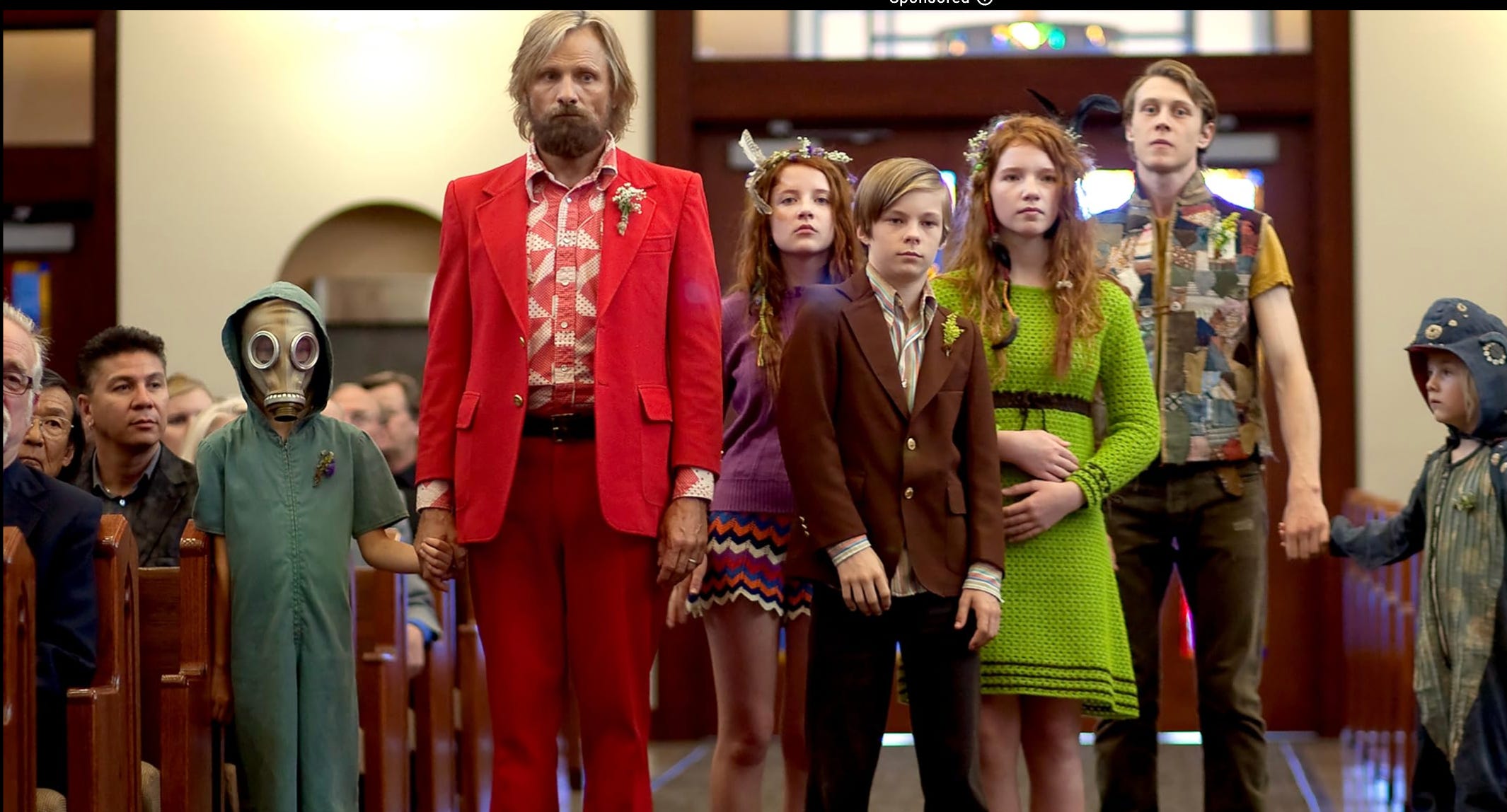
Those values are uncompromising: a communal, off-the-grid existence; no technology; education shaped by nature rather than institutions; a steady diet of the classics; political literacy; and a deeply anti-capitalist worldview. The film’s anti-tech stance feels strikingly of-the-moment, aligning neatly with the Jonathan Haidt (The Anxious Generation) worldview on child-rearing and the psychological toll of social media and technological overexposure. What’s remarkable, though, is its prescience: Captain Fantastic arrived at least five years before Haidt became a household name and nearly eight years before his book crystallized those anxieties into a broader cultural reckoning.
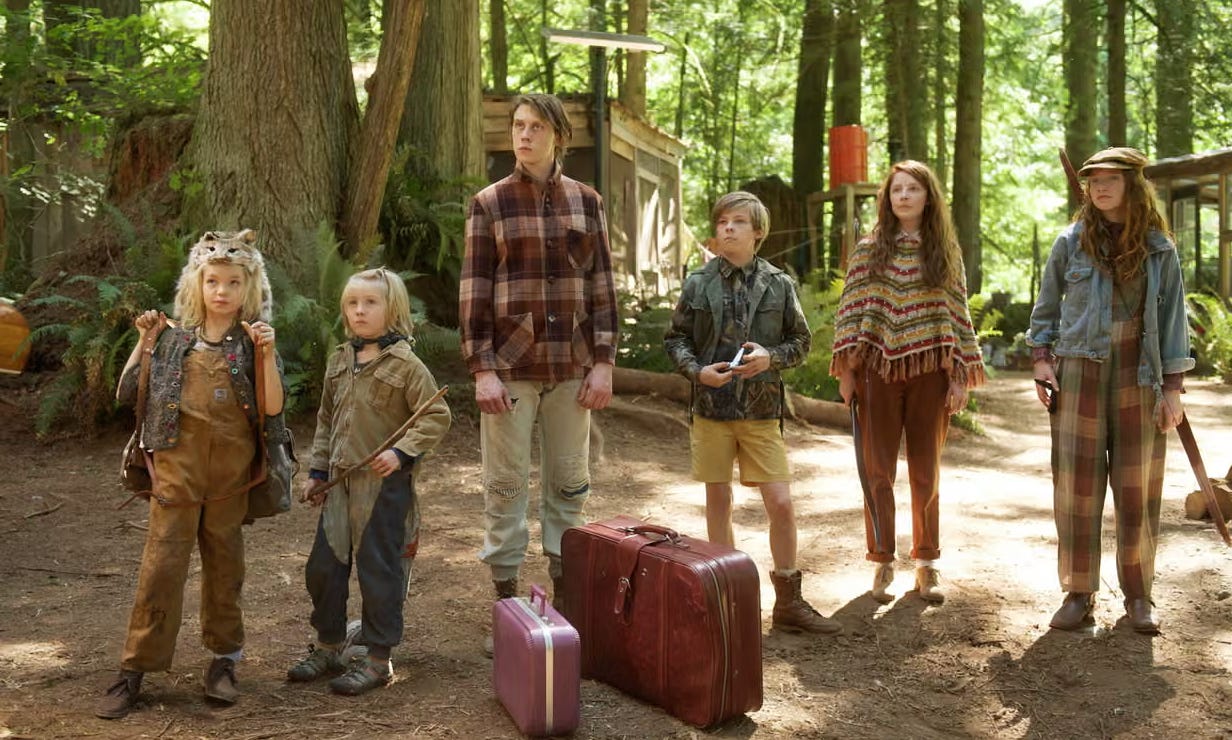
The film opens with the eldest child, Bodevan (George MacKay), named, as he later explains, because all of the children’s names are deliberately unique, immediately signaling that this is a family operating by its own rules. Camouflaged in mud, Bo prepares to hunt a deer using a knife rather than a gun. He succeeds, and his father marks the moment not as spectacle, but as ritual, less about conquest than initiation, ushering Bo into adulthood according to a belief system entirely their own.
While Viggo’s character, Jack, can be polarizing as times with his convictions and determination unyielding, there’s a lot to be said about the discipline and mental and emotional rigor he demands of his children. He’s preparing them for a world in which they will need to be strong, in all aspects, and it’s admirable. They are respectful, incredibly fit, collaborative, and as a family, for the most part operate as unit, connected by love and beliefs. They are eccentric, quirky, knowledgeable and yet confident.
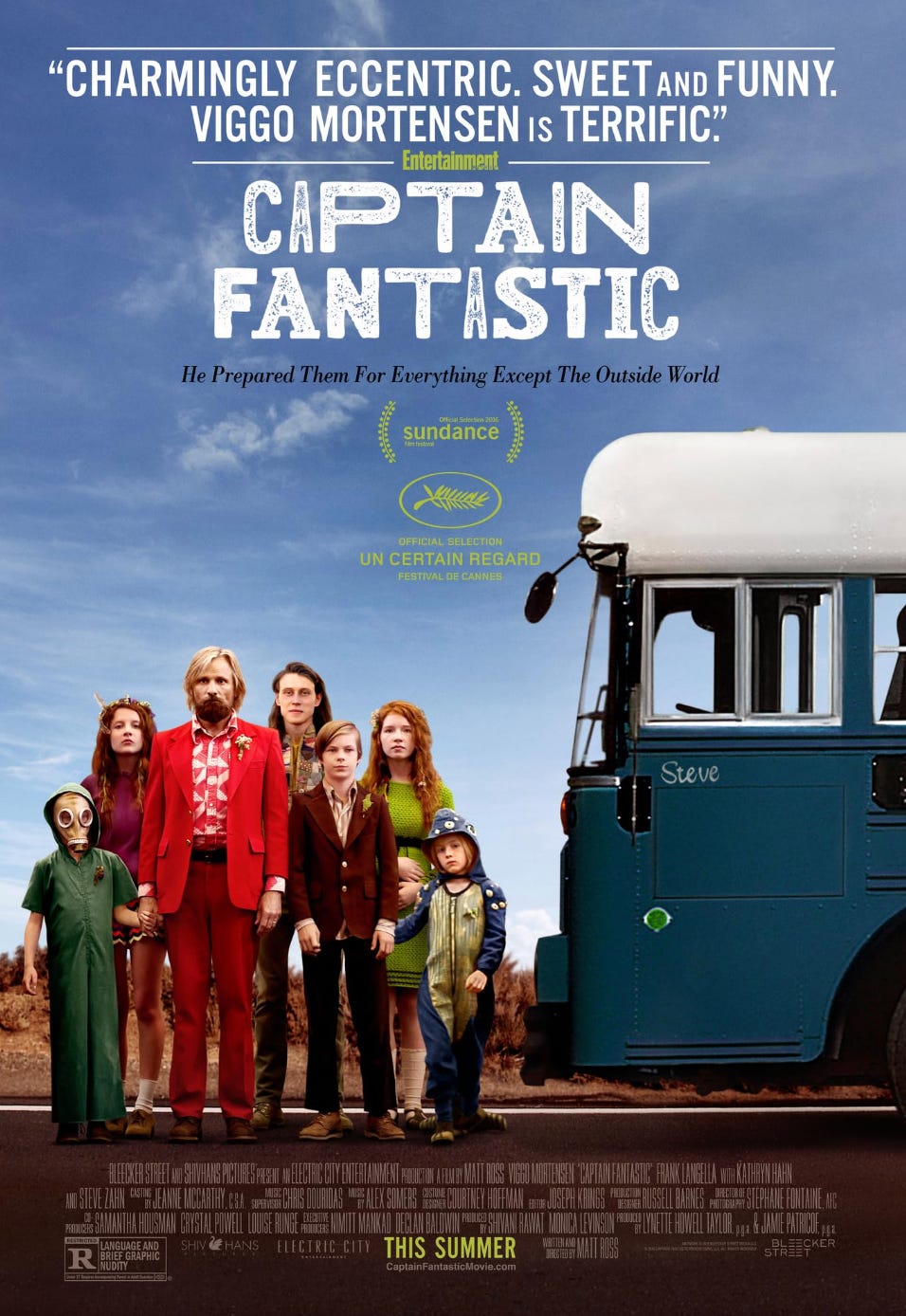
As the film’s cover art suggests, however, one thing missing from Jack’s otherwise rigorous education is social exposure to the outside world. When the family does encounter it, modern society is rendered in near–Wall-E fashion: people anesthetizing themselves with food (It’s 2016; well before GLP-1s entered the chat), an endless stream of violent video games, and a pervasive discomfort with honesty.
In one scene, the always-excellent Steve Zahn responds to his child’s question about how his sister-in-law Leslie died by offering a softened euphemism—“sickness”—and a vague explanation that people get sick and die. Jack, by contrast, gives the child a direct, clinical account of Leslie’s diagnosed illness (bipolar and manic) and what it meant, refusing to sugarcoat reality. His sister (Kathryn Hahn) is horrified. You can’t tell kids these things, she insists.
Therein lies the film’s central parental debate. Jack does not believe in euphemism or avoidance. When one of the younger children asks what sex is, he offers a straightforward, scientific explanation—no embarrassment, no moral panic, no theatrics. Just facts.
The question the film keeps circling is whether this radical honesty is a form of care or its own kind of harm.
On the highway south to Leslie’s parents’ house, Jack drives past a mall, the children watching with visible intrigue. He shares a somewhat misunderstood (context is everything) quote from 1920s pro–free market president Calvin Coolidge—“The chief business of the American people is business”—using it to distill his own disdain for the shopaholic “lazy” life. The film frames the desire for something different as an act of resistance, and as the triumphant and moving ending suggests, it is far from futile.
Comments
Nothing yet. Say the first thing.
Sign in to join the conversation.