
Fellow pilgrims,
Today, I’m pleased to bring us a guest essay from Jeff Barbeau in honor of the halfway point in our Moby-Dick read-along. And what is called for midway through a good read? A prophecy, of course.

Jeffrey W. Barbeau (Ph.D., Marquette University) is Professor of Theology and Literature at Wheaton College, Editor of The Coleridge Bulletin, and a writer on British Romanticism, religion and literature, and the history of Christian thought. Recent publications include The Last Romantic: C. S. Lewis, English Literature, and Modern Theology (2025), The Cambridge Companion to British Romanticism and Religion (2021), The Spirit of Methodism: From the Wesleys to a Global Communion (2019), and Sara Coleridge: Her Life and Thought (2014), which was praised in the Times Literary Supplement: “Sara Coleridge emerges from these pages as an intellectually formidable, powerfully compassionate and rigorously scholarly figure who bore the many difficulties of her life with profound nobility.”
Church Blogmatics by Beth Felker Jones is a reader-supported publication. To receive new posts and support my work, consider becoming a free or paid subscriber.
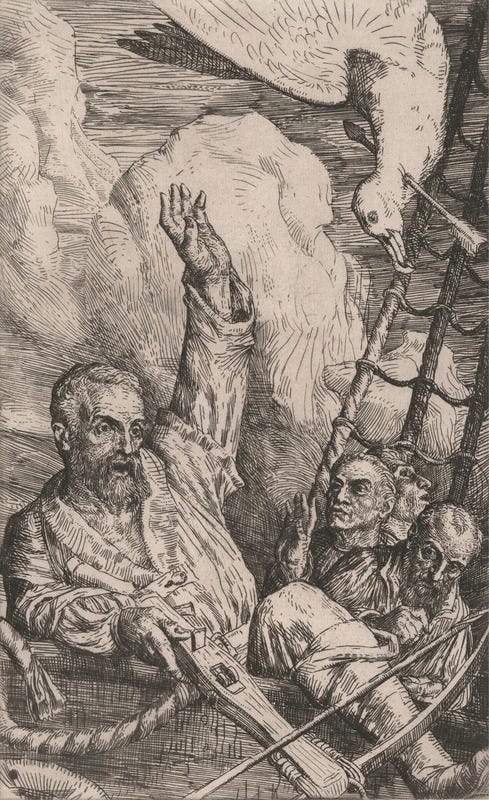
Shooting the Albatross, William Strang (Scottish, 1859-1921), via artvee.

Albatross: A Prophecy
by Jeff Barbeau
Several years ago, there was an app that just about everyone seemed to be trying on social media. The concept was simple enough: the user uploaded a photo, and the app produced the same image transformed into a likeness ‘aged’ several decades. The addition of a few wrinkles, gray hair, and unexpected age-spots made many users gasp in horror. The sight of one’s future self was enough to startle even the most stalwart among us: a portrait of an unknown fate, making visible the corrosive effects of life’s inevitable frictions.
Herman Melville dallies with such a cautionary prophecy in the chapter titled ‘Albatross’. By this point in the novel, readers have reasons aplenty to be apprehensive about both the voyage and the reckless captain with whom these sailors have thrown their lot. But the title of the chapter intimates an unknown peril that Melville’s readers would have recognized.
Melville warned his readers just ten chapters earlier. In an extended discussion of ‘The Whiteness of The Whale’ (Chapter 42), the narrator recalls a ‘white phantom’ that ‘sails in all imaginations’. Not a whale, in this case, but ‘the albatross, whence come those clouds of spiritual wonderment and pale dread’. In the note that follows, Melville describes the albatross as a gorgeous, regal bird of ‘unspotted whiteness’ and ‘a hooked, Roman bill sublime’. The albatross, with ‘vast archangel wings’, seemed to ‘embrace some holy ark’ and its eyes revealed ‘secrets’ known only to the Divine.
The beauty of the stunning albatross contrasts sharply with the vessel bearing its name (Chapter 52). The Pequod encounters the ship in a strikingly inauspicious gam (a social meeting between vessels) off the Cape of Good Hope: ‘this craft was bleached like the skeleton of a stranded walrus’. The ship had a ‘spectral appearance’, covered in ‘reddened rust’ with rigging like trees ‘furred over with hoar-frost’.
The men aboard were no less weathered. Worn by years at sea, the narrator describes them as ‘forlorn-looking fishermen’ with ‘long-bearded lookouts’, who all ‘seemed clad in the skins of beasts, so torn and bepatched’ from their years at sea. The men stared in silence, too, ‘mildly eyeing us as they passed’. Breaking convention, these men ‘said not one word to our own look-outs’ and seemed incapable of conversing, despite passing so close they might have ‘leaped from the mast-heads of one ship to . . . the other’.
The stark contrast between these two ‘albatross’ images—one monarchical and divine, the other lifeless and spectral—brings to mind the great Romantic poem by Samuel Taylor Coleridge: ‘The Rime of the Ancient Mariner’ (1798). In Coleridge’s tale, the Mariner and his crew set out on the open seas:
The ship drove fast, loud roared the blast,
And southward aye we fled.
In time, the men encounter an albatross, revering the bird as a blessing (‘a Christian soul, / We hailed it in God’s name’). Accompanied by the albatross, they pass through fast-crowding ice unharmed and enjoy a hospitable relationship with the creature:
And a good south wind, sprung up behind;
The Albatross did follow,
And every day, for food or play,
Came to the mariner’s hollo!
But then the Mariner does the unthinkable, an unexplainable act that shapes the crew’s fate: ‘With my cross-bow / I shot the Albatross’.
Melville knew his readers would understand this transatlantic allusion. Travel narratives proliferated in the nineteenth century amidst a burgeoning print market aided by new methods of book production, feeding an eager public ready for tales of adventure and exploration. Stories of life in strange, exotic places brought tales of creatures that took on symbolic meaning.
Melville admits as much when he closes his own description of the majestic albatross with mention of Coleridge’s poem. For though he was captivated by the sight of such a creature, he claims not to have known at the time ‘Coleridge’s wild Rhyme’, which had brought the seabird literary celebrity across the anglophone world. However, he admits, ‘in saying this, I do but indirectly burnish a little the brighter the noble merit of the poem and the poet’.
Melville and Coleridge sound a common concern for the personal in these stories of encounter. The failure of the Goney’s crew to communicate with the Pequod unmistakably signals this underlying theme. Not only are the men silent as they pass, but when their captain raises his trumpet to speak the instrument falls to the ground. The winds and waves, too, make futile any effort to converse. Even the fish turn away, following after ‘the stranger’s flanks’, while Ahab muses to himself, ‘Swim away from me, do ye?’
In Coleridge’s tale, the Mariner’s unthinking act of violence against the albatross leads similarly to nature’s rebellion against the sailors: the winds ceased blowing as the vessel rests in stasis, ‘As idle as a painted ship / Upon the painted ocean’. The suffering of the crew, too, is memorably evoked in the oft-quoted lines,
Water, water, every where,
And all the boards did shrink;
Water, water, every where,
Nor any drop to drink.
Soon after, the entire crew dies, only to reanimate later in a zombie-like apocalypse that leaves the Mariner in a state of abyssal isolation.
In Melville’s Moby-Dick and Coleridge’s ‘Rime’ alike, nature’s opposition reflects a deep-seated antagonism between humans and the world that is our home. It has been this way for generations.
In Coleridge’s tale, the Mariner is saved—eventually, though not his helpless crew—but he lives condemned by fate in a death-in-life state of penance. The Mariner must wander the land, telling and retelling the story of his voyage to those who cannot help but listen.
In Moby-Dick, the appearance of the Albatross serves as a prophecy. Yet the encounter with the Goney is not merely a foretelling of the Pequod’s imperiled future, but a cautionary admonition that calls the reader to look within. ‘Whereto does all that circumnavigation conduct?’, he asks, ‘Only through numberless perils to the very point whence we started, where those that we left behind secure, were all the time before us’.
Will we, in the pursuit of life’s mysteries, discover that all our labors have only been ‘barren mazes’? Shall we be desiccated by the depth of our thirsts? The future self remains unknown.
Manya thanks to Jeff for sharing this special guest essay with us today. Find Jeff’s books here.
Grace & peace,
BFJ
Consider taking a class at Northern Seminary, where we talk about theology, doctrine, the bible, and many other wonderful topics.
And check out streaming video courses on theology, church history, biblical studies, and more at Seminary Now. See my course and others from leading authors and professors.

Comments
Nothing yet. Say the first thing.
Sign in to join the conversation.