

Fellow pilgrims,
Welcome back for the June installment of our Moby-Dick read!
We hope you’ll post questions and reflections on this month’s reading in the comments section below.
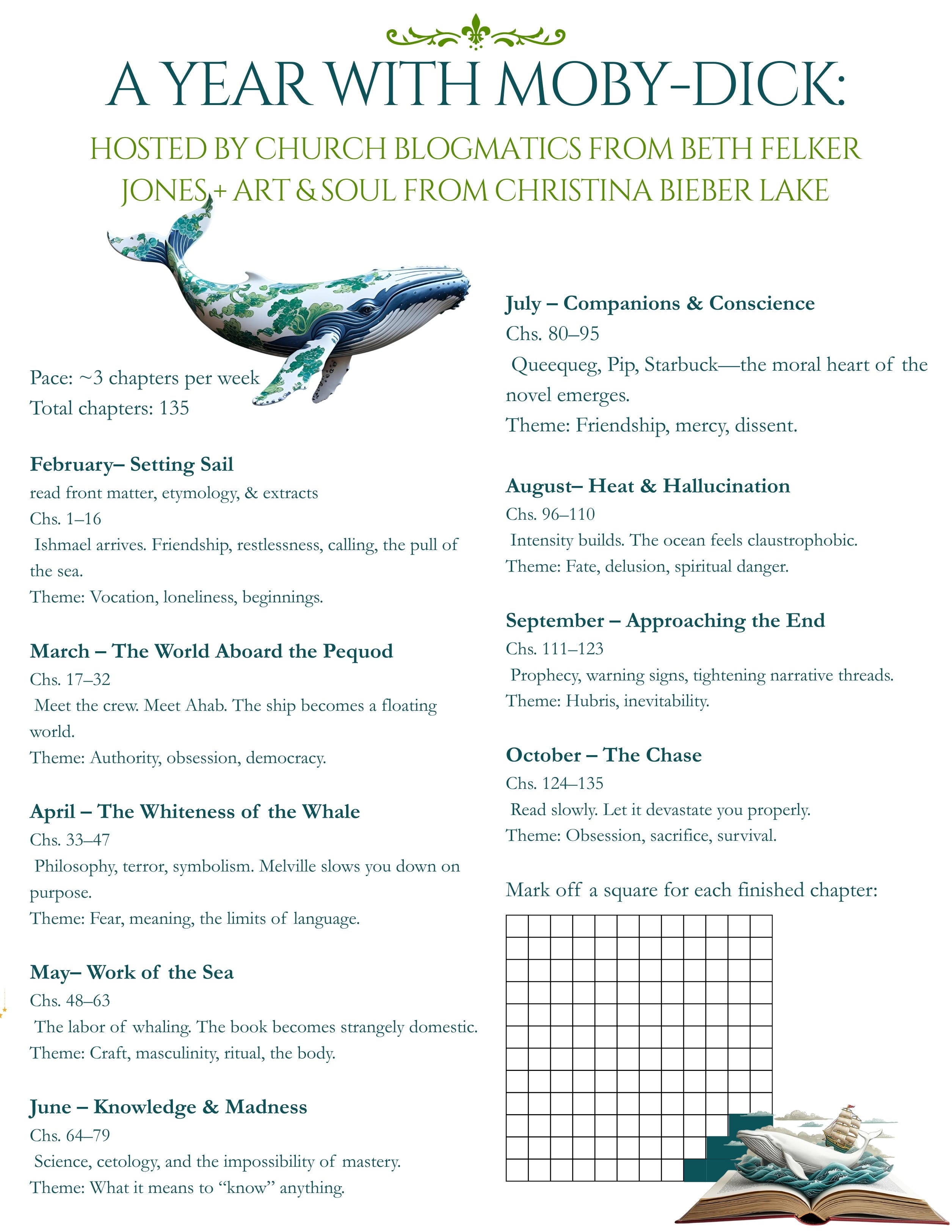
June: Knowledge and Madness, Chapters 64-79
Opening prayer:
Dear God,
Guard us from the hunger to master
what should be approached with reverence.
Teach us the difference between wisdom and fixation,
between faith and the will to control.
When intellect is used as a weapon, soften us.
Where certainty hardens, humble us. Amen.
Notice:
As you read these chapters, notice how knowledge changes character. Notice the shift from careful observation to consuming focus, from curiosity to obsession. Pay attention to how Ahab emerges not simply as a leader but as an interpreter of reality, one who insists that the world must mean what he says it means. Notice how language becomes forceful, even coercive. Words no longer invite reflection; they compel allegiance. Ask yourself how insight becomes ideology, and how intelligence can be conscripted into service of a single, narrowing vision. Notice, too, how madness is not immediately chaotic. It is disciplined, articulate, persuasive. These chapters invite us to consider how destructive certainty can masquerade as clarity—and how faith itself can be bent toward domination rather than trust.
Pre-Reading Reflection Questions: (To sit with before beginning the month’s reading)
1. The Desire to Know: What kinds of knowledge most tempt you—self-knowledge, theological certainty, control over outcomes?
2. Interpretive Power: Who do you trust to explain reality to you? How do you decide who you believe?
3. Obsession: Where does passion in your life risk narrowing into fixation?
4. Certainty & Control: How do you respond when someone claims absolute clarity about meaning or purpose?
5. Charismatic Authority: What qualities make a leader compelling to you—even when their vision feels dangerous?
6. Limits of Knowing: What would it mean for you to accept not-knowing as a faithful stance?
Post-Reading Reflection Questions: (After completing the month’s chapters)
1. Ahab’s Mind: How would you describe Ahab’s understanding of the world? What makes it persuasive—and what makes it terrifying?
2. Knowledge as Violence: In what ways does knowing become an act of domination in these chapters?
3. Madness with Method: How does Melville portray madness as structured rather than chaotic? Why is this portrayal unsettling?
4. The Crew’s Consent: How do the sailors respond to Ahab’s vision? Where do you see resistance, and where do you see surrender?
5. Faith Distorted: Where does religious language appear in Ahab’s speech or logic? How is it bent toward his purposes?
6. Interpretation & Power: What happens when one person claims the authority to name the meaning of everything?
7. Your Own Certainties: Are there convictions you hold that might benefit from gentler handling?
8. Silenced Dissent: Whose voices are diminished or overridden in these chapters? Why does that matter?
9. Knowing vs. Trusting: How do these chapters distinguish between knowledge that serves life and knowledge that consumes it?
Benediction:
May the God who is truth beyond possession
guard your mind and heart.
May you resist the lure of total explanation
and the violence of unchecked certainty.
May wisdom be tempered with humility,
and conviction softened by love.
Go in discernment.
Go in courage.
Go trusting that not all that can be known
must be mastered. Amen.


Enjoy the journey and comment below!
Grace & peace,
BFJ + CBL
Consider taking a class at Northern Seminary, where we talk about theology, doctrine, the bible, and many other wonderful topics.
And check out streaming video courses on theology, church history, biblical studies, and more at Seminary Now. See my course and others from leading authors and professors.

Comments
Nothing yet. Say the first thing.
Sign in to join the conversation.