
“How could a weak, insecure man—a conglomerate of nothing—manipulate and overpower a strong, confident person like John Mitchell?”
--Martha Mitchell
IN THE FIRST scene of the documentary The Martha Mitchell Effect, it’s 1974 and Richard Nixon is leaving office after resigning. He climbs the steps of the Army One helicopter, which will fly him away from the White House with his tail tucked. Then Nixon turns and stands in the doorway and gives that jerky trademark “double V” salute that was a move he used throughout his political career to project triumph, strength, and defiance during difficult moments. And how much more difficult could his national humiliation from the Watergate scandal be? He had been caught red-handed directing a criminal cover-up of a political burglary, abusing his presidential power, and obstructing justice.
I know. You think that sounds quaint compared to what Trump and his lieutenants are doing now. Trump would shrug and brag about it and say he could do anything he wanted—which Nixon also said in 1977 in his David Frost interviews. “When the president does it, that means that it is not illegal.”
But when Nixon was held accountable, the rule of law still mattered—even the GOP adhered to it, though Nixon was never one to take responsibility. To top it off, Nixon blames a woman for taking him down. In those same David Frost Interviews, Nixon also says… “I’m convinced if it hadn’t been for Martha (Mitchell), there’d have been no Watergate.”
Well, technically, whether Martha ratted Nixon out or not, he still would’ve done what he did. If a tree falls in a forest and no one is around to hear it, does it make a sound? If a crime is committed, whether the criminal gets caught or not, is it still a crime?
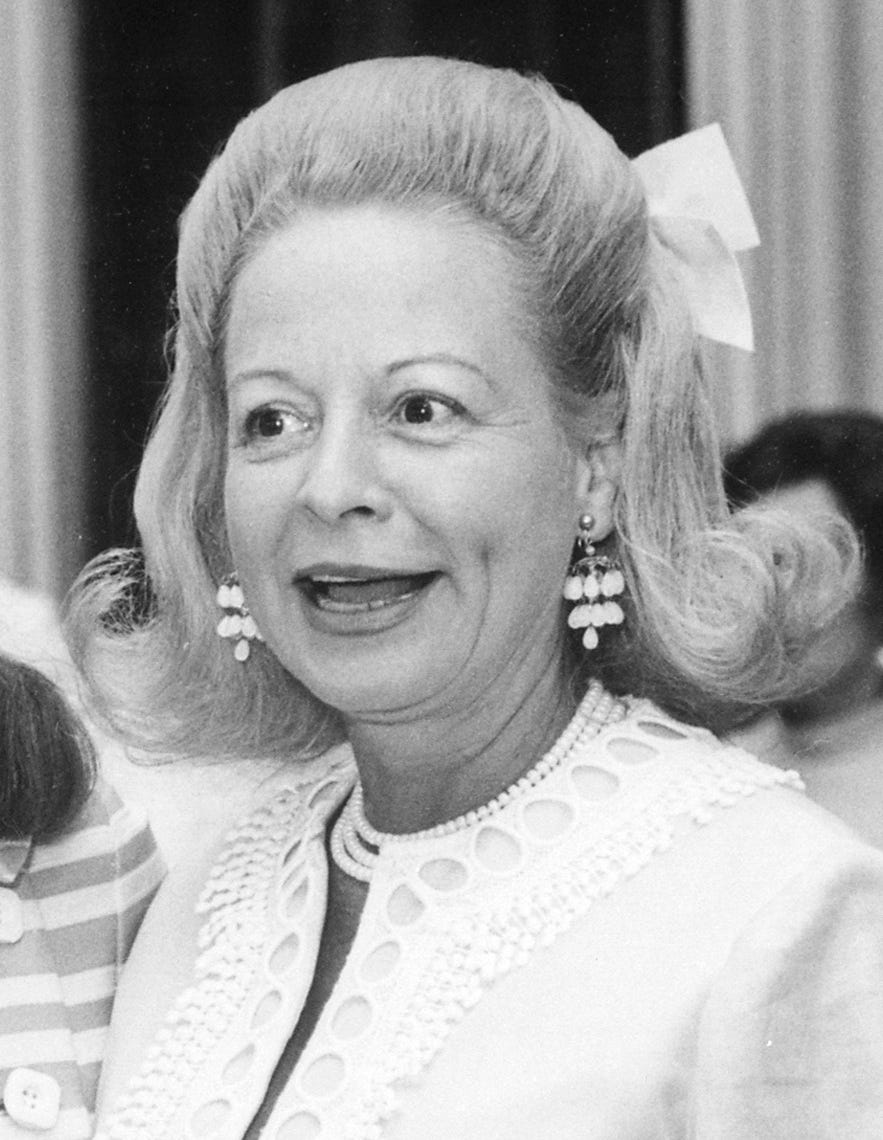
The American people owe Martha our thanks for sticking her neck out and calling up the press, spilling what she knew—and she was a Republican. Her husband, John Mitchell, was Richard Nixon’s Republican Attorney General and campaign manager. According to Garrett M. Graff’s book Watergate: A New History, Mitchell says he turned down the attorney general job 26 times before he gave in—and then his association with Nixon was ultimately his undoing.
Martha was a staunch conservative and campaigned extensively for Nixon, which made her early whistleblowing against the Nixon administration even more shocking to Washington. And, according to Graff’s book, in Nixon’s first term, Martha had become so popular she was “perhaps the first national conservative celebrity pundit, the second most requested speaker for Republican audiences, behind only the president himself.” She was so in with the Washington in-crowd, she playfully called J. Edgar Hoover “Jedgar.”
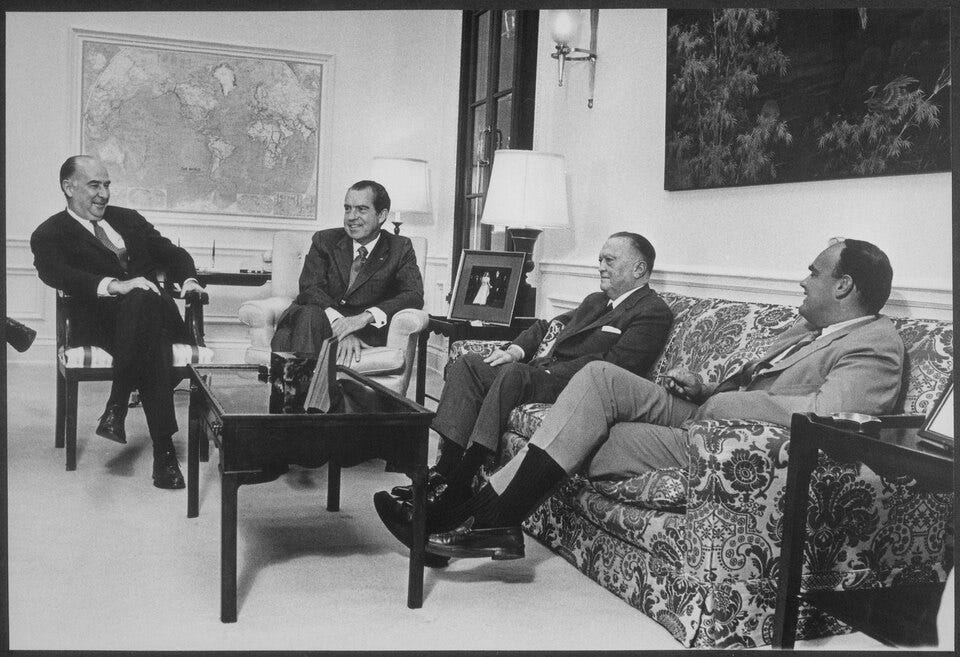
Remember, this was a time when white men ruled Washington like they were Olympian gods of American politics—and women were still good little wives and girlfriends. In the documentary, longtime Washington journalist Sally Quinn talks about D.C. in those days: “Women who were part of the Washington social scene were hostesses. Women went into the other room and had coffee while the men talked about the important things. But Martha Mitchell wasn’t playing the Washington game. She was not gonna be just the wife who sits in the background and not say anything.”
Quinn should know. Her own many accomplishments aside, she was at the pinnacle of Washington social power as the wife of The Washington Post‘s legendary and formidable editor, Ben Bradlee. Quinn is enlightened in all the ins and outs of the culture of D.C.—politics, secrets, unspoken rules, and high-stakes social life. She knows where all the bodies are buried, because she watched them dig the graves.
Brief Aside: Quinn also just wrote a piece in The New York Times called “It’s No Longer So Much Fun to Be MAGA in Washington.” Doesn’t it make you gleeful to just hear the title? She basically said that last fall when MAGA was openly celebrating their hard-won evilness, she ran into Kellyanne Conway at a private club, who said: “Sally, I wish you would stop writing all these pieces about how terrible Washington is now and how everyone is so depressed and scared. We’re having fun! You know what your problem is? You’re not invited to the right dinners and parties.”
“I held my tongue…Lately, the vibe has shifted. The MAGA Republicans don’t seem to be having such a good time ransacking the place anymore. It’s not that the party is over, exactly. And to be clear, there’s lots more damage that will be done to this city, and to our democracy — not to mention America’s place in the world — before Mr. Trump and his rabble are through. But it’s clearly starting to dawn on the MAGA minions that the morning after is going to be a doozy.
Now they’re the ones in despair, fearful and losing hope. Even the true believers are questioning the MAGA theology.”
I could wet my pants.
***
NOW BACK TO our heroine. According to the late White House journalist Helen Thomas, Martha Mitchell was the first to say Nixon should resign.
To refresh your memory: Just five days after the Watergate break-in, John Mitchell had gotten Martha out of Washington, leaving her at a villa hotel in Newport Beach, California. She was not happy. After figuring out that her former personal security guard, James McCord, was among the arrested burglars, she snuck to the bedroom phone and called UPI reporter Helen Thomas to tell her what she knew. Before she could finish, her security handler Steve King stormed the room, physically cutting her off by yanking the phone cord out of the wall.
After Martha’s call to Thomas trying to tell her she was being held prisoner in California, the backlash was swift. John Mitchell was deceptive about the incident by saying Martha was just stressed, and the gaslighting only intensified as the scandal grew. But that didn’t stop Martha. In May 1973, she called Helen Thomas again to demand that the president resign immediately. John Mitchell later released a statement blasting his wife’s comments as “ridiculous” and criticized the press for publishing them. Later that same year, Martha called UPI back to double down, predicting that the president would be forced out of office by spring 1974.
A privileged child from Pine Bluff, Arkansas, Martha was a Southern belle with all the grace, manners, and elegance that might imply. She was also full of spitfire. She wasn’t going to let those men restrain her as if she were a piece of livestock.
Underestimate the balls of a plucky Southern woman at your own peril.
And what they’d already done in that hotel room in June 1972, immediately after the Watergate break-in, was kidnap her, drug her, plan and implement a campaign to gaslight her into looking certifiably crazy. And they succeeded. People believed them. I can only imagine what this felt like to her, when what she should’ve gotten was the Presidential Medal of Freedom. After the Trump stink has left our nation’s capital and a Democrat is in office, I suggest we start a campaign to award it to her posthumously.
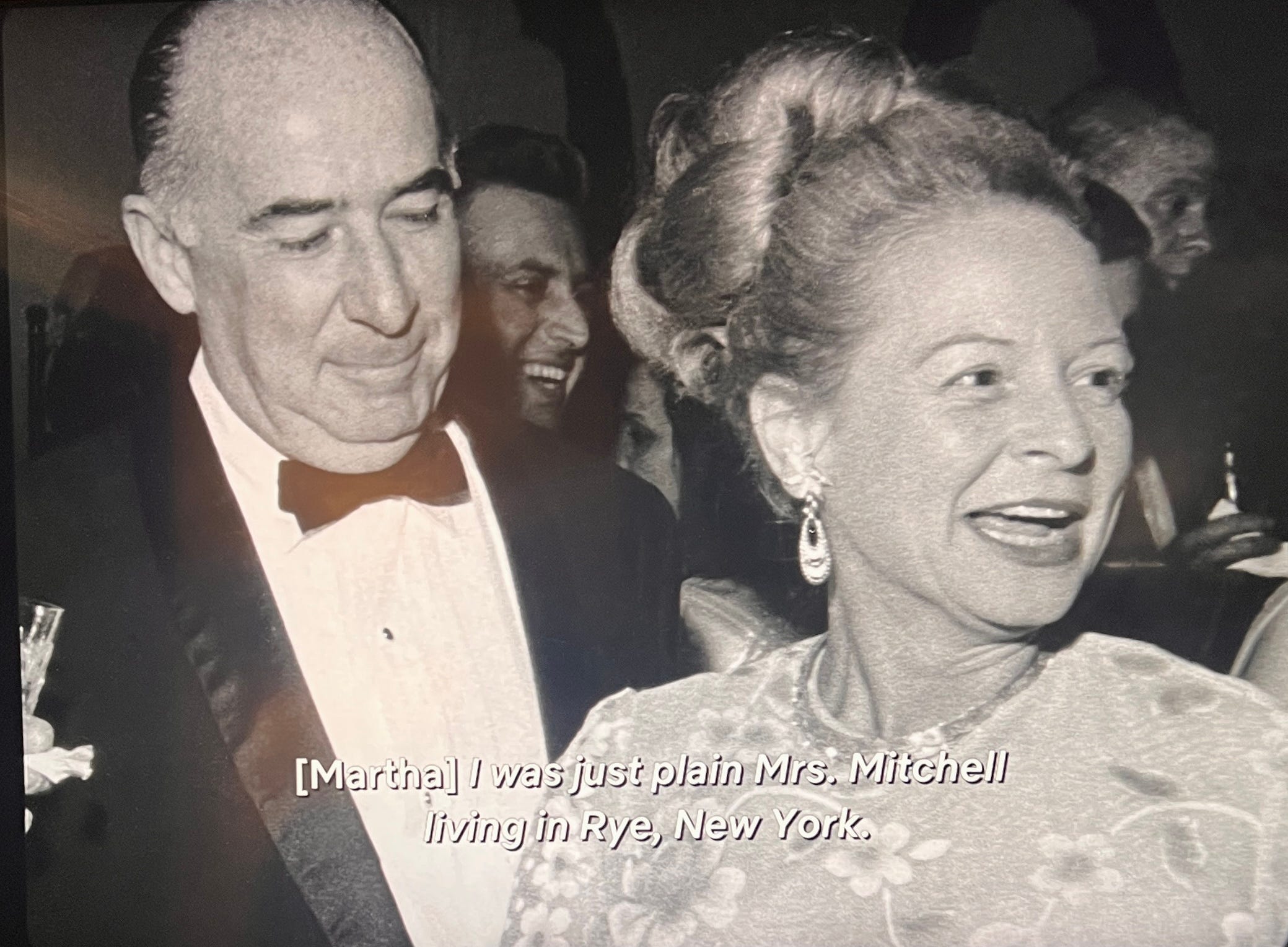
The irony is that, in the beginning, Martha was just trying to protect her husband. She’d read the writing on the wall: Nixon wasn’t going to shield his former attorney general and campaign manager, or anyone else. In fact, Nixon ordered all his soldiers to fall on their swords, but he still got nailed. And Martha’s words acted like a Molotov cocktail, tossed directly at what she knew was actually going on. Her great sin was telling the truth in Washington.
“Washington is a very corporate city where if you want a friend, buy a dog. In Washington, they’ll stab you in the back and then arrest you for carrying a concealed weapon.”
--Harry S. Truman
And this was decades before Donald Trump.
***
DEEP THROAT—OTHERWISE known as FBI Associate Director Mark Felt—was another Watergate whistleblower. He basically acted as a highly sophisticated, internal confirmation system for Washington Post reporters Woodward and Bernstein. Graff’s theory is that Felt gave his assistance to the reporters not to safeguard our democracy—which is what we all thought at the time—but to engineer his stepping into the Director’s position. It never happened. When Hoover died, Nixon handed the FBI to L. Patrick Gray. According to Graff, Felt was trying to sink Patrick Gray.
Woodward and Bernstein, who were rather green and unknown at the time, have championed Martha’s legacy, famously calling her “a Greek chorus of one,” because she was the lone voice shouting the truth to anyone who would listen. Bernstein openly admitted that while the political establishment tried to dismiss her as unstable, her instincts were dead-on about the White House cover-up from the very beginning. And it was because the two reporters had relatively nothing to lose that they were willing to go out on a limb with Martha. Too bad all the recognition she’s now received has happened after she was dead. Where is the justice?
Being a whistleblower is a dangerous business. Remember the movie Silkwood, starring Meryl Streep and Cher? Karen Silkwood was a 1970s nuclear plant worker who discovered severe radioactive safety violations and falsified corporate data. She became a tragic martyr, dying in a highly suspicious 1974 car crash while driving to deliver her proof to The New York Times. The implication is that she did the right thing and was killed for it.
Contemporary whistleblowing examples of women who exposed treachery: Erika Cheung was a young lab worker who blew the whistle on Elizabeth Holmes and Theranos’s fraudulent blood-testing technology, helping to dismantle a multibillion-dollar healthcare empire and send Holmes to prison.
Years later, Frances Haugen leaked tens of thousands of internal Facebook Papers proving that social media executives knowingly chose massive corporate profits over public safety and teen mental health. She has been proven right over and over again—most recently in the California lawsuit in which a teenager won a $6 million jury verdict for severe depression and anxiety caused by deliberate, addictive product design, and in India where Facebook’s parent company, Meta, was issued stern government warnings after an investigation proved its automated moderation systems had approved and profited from paid Instagram advertisements promoting child sexual abuse material. Could we be more disgusted?
Both women risked everything to expose the systemic corruption of their eras, refusing to remain silent to corporate greed.
***
IN ANOTHER SCENE from The Martha Mitchell Effect, Martha looks absolutely fabulous with her bouffant blonde flip and white cat-eyed sunglasses, a chic pastel blue dress and earrings complementing the look. A reporter asks her if the country is going to right itself now and whether we have Watergate behind us.
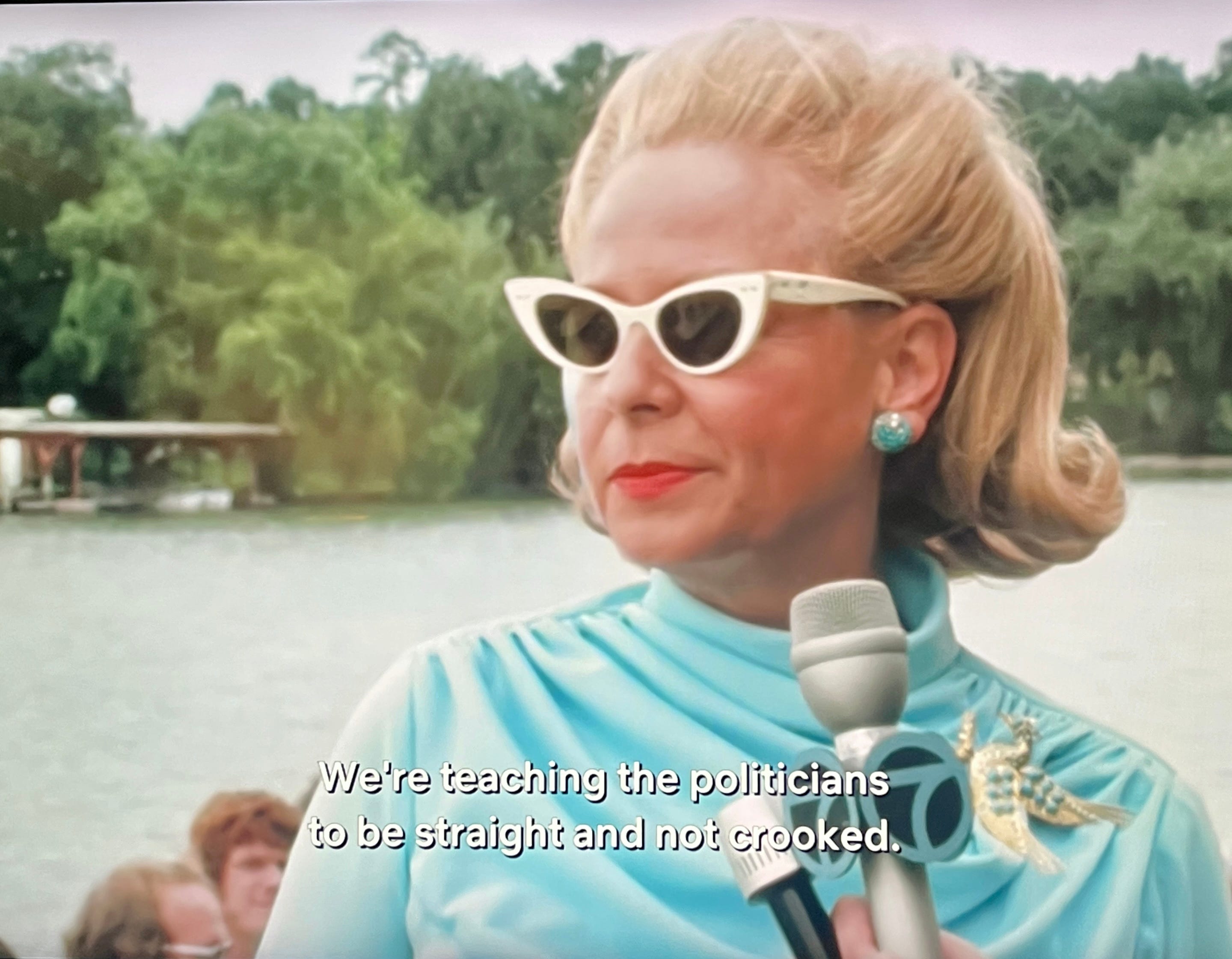
“We’ll never have Watergate behind us, I hope,” she says, “Because in a way, it’s been good. We’re teaching the politicians to be straight and not crooked.”
“Is this democracy, where people are not allowed to speak their own mind and the truth?” Martha said. “So if I have something on my mind, I’m not going out and yell it to anybody, unless I believe that it’s what should be done or said.”
Because of John Mitchell’s position and Martha’s own beauty, wit, and charm, she operated inside the top levels of the GOP. Therefore, she knew how the cow ate the cabbage, and when the egotistic white boys in the White House needed to be called out for their dirty tricks, she did it. Martha wasn’t afraid of the president; she openly mocked him
“Nixon is as exciting as a fish stick dinner!”
--Martha Mitchell
Martha eventually forced her husband to choose between his marriage and the president, and Mitchell picked Nixon. He abandoned Martha in September 1973, leaving her penniless—and then had the audacity to claim he left because of her “violent outbursts.”
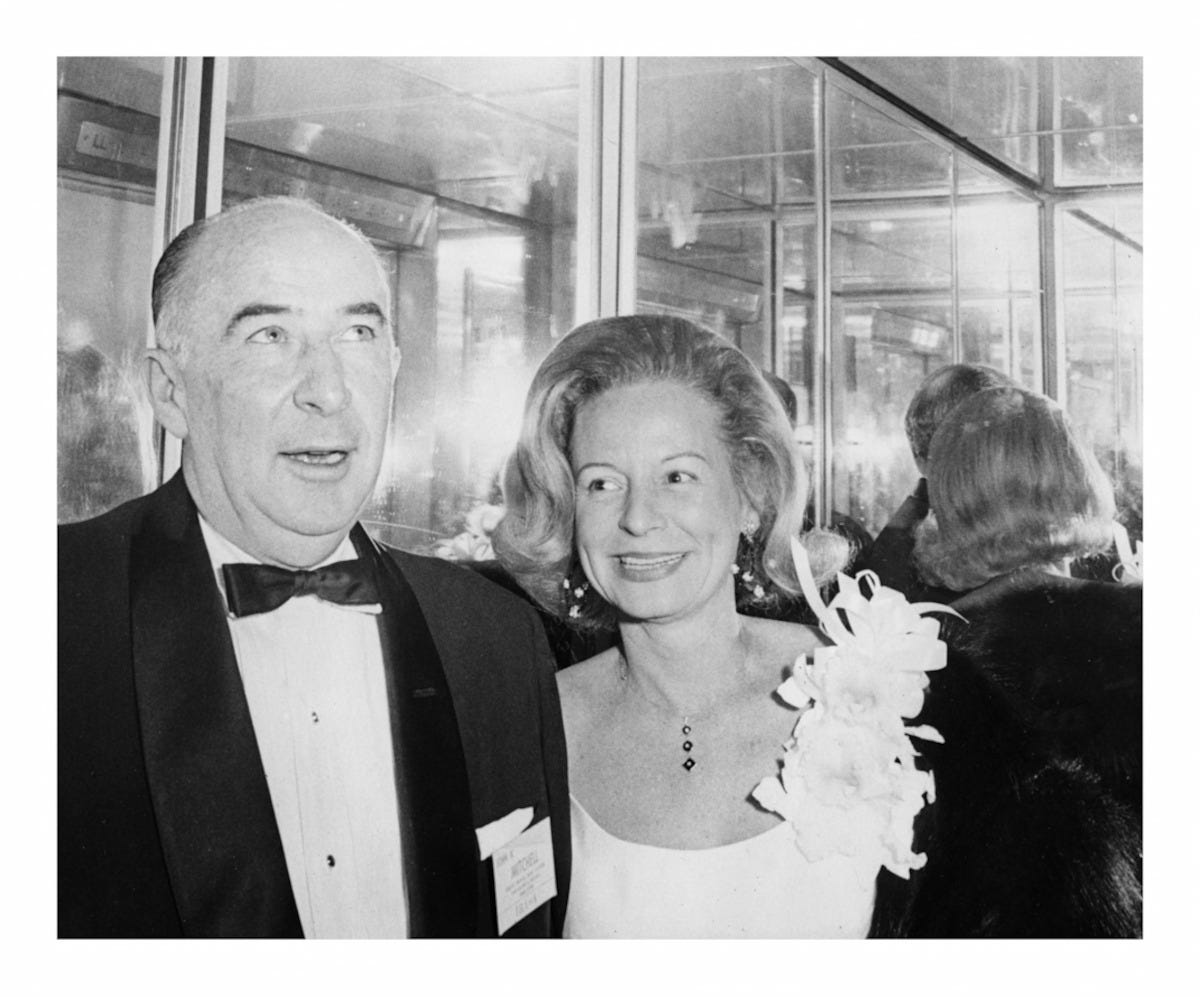
In a clip dated September 1, 1974, a reporter says to Martha, “People say you started the whole Watergate thing and let everybody know.” He asked if she was happy with the outcome.
“Thank you,” she said. “I am indeed…It’s been the greatest thing in the world for this country. We’re going to get all the politicians real true blue again. They’re not going to be dishonest.”
But even Martha Mitchell could never have imagined—no one from that era could have—how we’re being hammered with Trump’s authoritarian takeover. The constant lies of this administration, defying the Constitution and the rule of law with no accountability.
A few years after the Watergate drama, when Martha had no money and lay dying, John Mitchell refused to see her. On June 3, 1976, she was buried in Pine Bluff, and Mitchell, her daughter, and son attended the funeral with about 400 people.
“Was she a crazy lady?” someone asks Helen Thomas in the documentary. “I certainly don’t think so,” Thomas replied. “She was a terrific person, and I think she was a visionary in a sense. Prophetic.”
In a famous NBC interview, Barbara Walters asked, “Mrs. Mitchell, you’re certainly going to appear in the history books here and there. How would you like people to think of you?”
“Well, if I ever do any good, Barbara, I would like to go down as doing some good for my country, that’s all. That would be the greatest thrill in the world.”
“And your way of doing it is to speak out?” another interviewer asks.
“That’s it.”
***
CONSIDER THE PRICE Martha Mitchell paid for her honesty. She lived with poverty and rejection for speaking the truth, for naming names, for doing the right thing any moral person should do.
What does Joseph Campbell say about heroes? That nearly all world mythologies share a single, universal narrative structure called the monomyth, which consists of three core phases. 1) Separation (Departure): The hero leaves the ordinary, familiar world after receiving a call to adventure. 2) Initiation: The hero faces a series of trials, confronts deep fears, and undergoes a profound personal transformation. 3) Return: The hero comes back to the ordinary world, bearing wisdom or a “boon” that can help heal or improve the community.
Is this not Martha Mitchell?
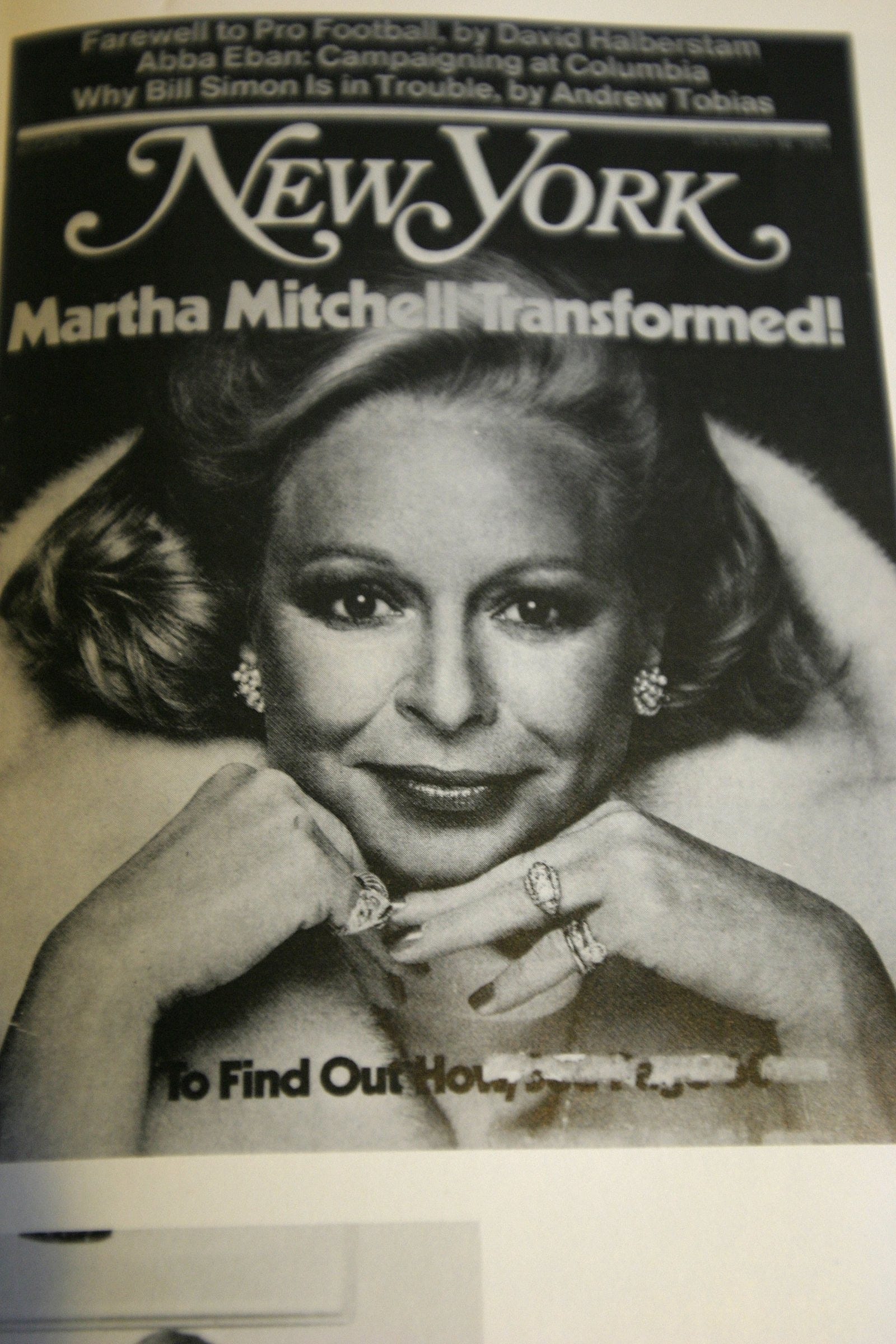
Can you imagine anyone in this corrupt administration with the courage and integrity to do what she did? Anyone? Star light, star bright, First star I see tonight, I wish I may, I wish I might…
The men who committed the crimes blamed her instead of themselves. Imagine her despair and loneliness. At Martha’s funeral, an anonymous person had sent a message in white chrysanthemums. “Martha was right.”
One day when I’m back in Arkansas, I’ll go to her grave and pay my respects.
Thank you for reading—and especially to my paid subscribers, whose support makes it possible for me to keep writing pieces like this one.
If Martha Mitchell’s story moved you, surprised you, or made you think, please share this piece with someone who might want to know her story too.
And if you’re not yet a subscriber, I’d be very glad to have you here. You can also support my work by buying me a cup of coffee. Every bit helps me keep researching, writing, and speaking out.
yes, please tip me a cup of coffee
Pull up a chair. There is plenty more to say.
SECRET ENDING…
Comments
Nothing yet. Say the first thing.
Sign in to join the conversation.