

I LIVED IN France when the tsunami that was the Digital Revolution blew up our world and began devouring our lives with an Internet that connected us to, well, everything. But I intuitively understood that this new phase of the revolution was going to transform us enormously, and I was on it. I got it, and I soaked up everything I could and was an early adopter. It was a rush to me, and I also started buying URLs. But before this—before the Lone Wolf and I left the U.S.—the engineer who was helping us design our Chasing Matisse website—and it was beautiful—told me to acquire a digital camera, because I was going to write something called a Weblog, and I would post my digital pictures on it, along with the pieces I would write. And so I did, beginning in 2002 into 2003. And the Lone Wolf created a Matisse-like drawing for the Main Page, and it was so good that the Matisse family asked us to take it down. It was too much like Matisse’s work—and wasn’t that lovely. It almost seems like a fairy tale now. We were buoyant with good cheer, excitement, and hope. We were wildly open to the world and the journey before us, not to mention the metamorphosis in our creative lives it would bring.
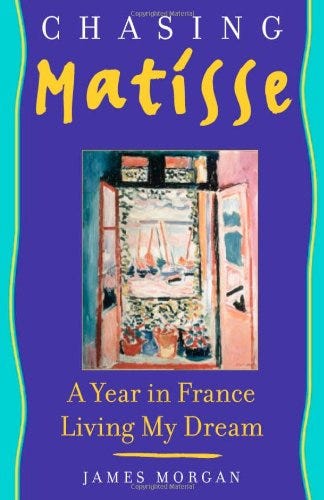
But the publishers of the book Chasing Matisse were so flummoxed by the digital age that they didn’t even understand how our website and my blog would promote their book. They were clueless, no imagination. They had absolutely no sense of what lay ahead. There were no templates then. No platform to host our site. We paid our web guys every month ourselves. It wasn’t cheap, but we looked to the future and did what we thought was right—what we needed to do—and were proud of it.
Without going into all the gory details, the next stop on the Digital Revolution was when Mark Zuckerberg (allegedly) stole the idea of Facebook from the Winklevoss Twins and, on February 4, 2004, launched what was then called The Facebook—first for Harvard, then for other universities. But by 2015-2016 (and before), when older generations started signing up, students realized Facebook was no longer cool, and they were right. But first, one of my cinematic writer-heroes Aaron Sorkin wrote his brilliant script about Zuckerberg’s story called The Social Network, and through his crack dialog and riveting scenes we can see just how it all happened.
The Social Network came out in 2010 and won three Oscars, four Golden Globes, three BAFTAS, and it won Best Picture from all four major critics’ organizations: the National Board of Review, the National Society of Film Critics, the New York Film Critics Circle, and the Los Angeles Film Critics Association.Zuckerberg and his enabler-in-chief Sheryl Sandberg must have been seething.
We’ll skip ahead a few years to October, 2019, when Facebook defended its controversial policy allowing politicians to run paid advertisements containing blatant lies, and Sorkin had another go at him. Sorkin wrote “An Open Letter to Mark Zuckerberg: Facebook isn’t defending free speech, it’s assaulting truth.” (If you haven’t read it, you should.) Sorkin:
It was hard not to feel the irony while I was reading excerpts from your recent speech at Georgetown University, in which you defended—on free speech grounds—Facebook’s practice of posting demonstrably false ads from political candidates. I admire your deep belief in free speech. I get a lot of use out of the First Amendment. Most important, it’s a bedrock of our democracy and it needs to be kept strong.
But this can’t possibly be the outcome you and I want, to have crazy lies pumped into the water supply that corrupt the most important decisions we make together. Lies that have a very real and incredibly dangerous effect on our elections and our lives and our children’s lives.
But in fact Zuckerberg did want that, and since then—and as we’ve seen in the actions of all the other Tech Bros—Zuck is going along with Trump’s authoritarian moves and could care less about anything that gets in the way of his own raking in more and more money—oodles and oodles and piles and piles of it, more money than a person should ever even dream of, or could possibly even conceive of. It is a Faustian bargain at best—and what that bargain has expressed is, Damn our democracy. Who cares if Meta’s social media sites are teeming with deceptions by hate groups and unsavory politicians—and most of all our president? Who cares if the little people have a roof over their heads, food to eat, or health care? According to Bloomberg Billionaire Index, on June 14th, 2026, Zuckerberg is the seventh richest person in the world with $202 Billion. And any of us who are on his sites are fueling every move—and every dollar—he makes. I hate to admit that I am.

As Sorkin also said in his Open Letter:
And right now, on your website, is an ad claiming that Joe Biden gave the Ukrainian attorney general a billion dollars not to investigate his son. Every square inch of that is a lie and it’s under your logo. That’s not defending free speech, Mark, that’s assaulting truth.
It turns out that Zuckerberg was even ahead of Trump on that score—at least of Trump’s campaigning and presidential records of attacking the credibility of the press and painting journalists as “enemies of the people” in order to destroy the idea that facts exist and are indisputable.
Did Zuck’s parents give him any good home training? Did he ever learn that he should value honor and integrity as consequential—as meaningful to his life—and that his aim should be to do the right thing? Even if he did learn that, clearly his character was for sale. Zuck—like the other Tech Bros—thinks rules and laws don’t apply to him. He—like them—thinks he’s smarter than everyone else, and that it’s his job to break the world.
And that means breaking us. They don’t care. You get a pretty darn good view of Zuck’s character from The Social Network. Again, from Sorkin’s Open Letter to Zuckerberg:
I didn’t push back on your public accusation that the movie was a lie because I’d had my say in the theaters, but you and I both know that the screenplay was vetted to within an inch of its life by a team of studio lawyers with one client and one goal: Don’t get sued by Mark Zuckerberg.
Sorkin now has a new Zuckerberg movie coming out—The Social Reckoning—in which Zuckerberg says in the trailer, “I’m a free speech absolutist.” Yeah, Yeah, Yeah. Can’t wait to see how Sorkin dramatically eviscerates Zuck this time.
There is, of course, a debate about whether social media platforms are a threat to democracy. I come down on the side of Professor in Sustainability and Digital Economy Itziar Castello-Molina of the Bayes Business School, City St George’s, University of London.
Social media platforms, once hailed as champions of democracy and dialogue, have become commodified spaces in which their business models incentivize hate speech, misinformation, polarization and the political fragmentation of society, benefiting corporate and political elites while eroding democracy.
Yet, billions of us reward Zuckerberg and Elon Musk by using their platforms. One by one, we made Zuckerberg the billionaire he is today.
NOTE: A wave of landmark March 2026 jury verdicts directly indicted Zuck’s corporate ethics, exposing a business model where psychological addiction is not a flaw, but the entire point. In California, a jury found Meta and YouTube negligent for designing platforms with features that could hook young users—infinite scroll, constant notifications, autoplay, algorithmic recommendations, and beauty filters—and awarded $6 million in damages (most paid by Meta). The same mechanisms are engineered to exploit basic dopamine loops in adults and children alike.
Simultaneously, a New Mexico jury ordered Meta to pay $375 million for massive consumer deception. Evidence revealed that tech executives routinely ignored internal warnings, prioritizing user metrics over safety to ensure maximum platform dependency. Together, these legal defeats shatter Zuckerberg’s long-standing defense of neutrality, legally validating what critics have argued for years: under his leadership, user safety and mental stability are systematically traded away to ensure the world remains hooked.
Zuckerberg’s long-standing defense of neutrality, legally validating what critics have argued for years: under his leadership, user safety and mental stability are systematically traded away to ensure the world remains hooked.
***
THOSE VERDICTS LANDED in the middle of an accelerating international backlash against Big Tech’s hold on children’s lives. Across the Atlantic, UK Prime Minister Sir Keir Starmer announced an aggressive, comprehensive digital crackdown earlier this week. The upcoming British legislation entirely bans children under the age of 16 from accessing core social media platforms—including Meta Platforms’ flagship services, Facebook and Instagram—and others like SnapChat, YouTube, TikTok, and X. Slated for full enforcement by early 2027, the law shifts the legal burden onto tech conglomerates, penalizing companies with multi-million-dollar fines if they fail to restrict access.

This dramatic shift responds to warnings from public-health authorities, including the World Health Organization and the U.S. Surgeon General, who have raised urgent concerns about social media’s addictive mechanisms on young people’s mental health, including anxiety, depression, compulsive use, sleep disruption, and body-image harms. Exhausted by the daily battle against this algorithmic manipulation, families are demanding state intervention. Official polling from the United Kingdom revealed that roughly 89% of British parents strongly support enforcing a strict legal age limit to shift the burden of child safety from individual households to the tech corporations themselves.
From an AP article, this is the Trump regime response (As you read it, remember that the American Ambassador to the U.K. is Warren Stephens, a billionaire from Arkansas and a Trump toady):
The ban could further inflame tensions with the U.S., which has warned that regulations should be narrow and not violate free speech protections, according to a statement from the U.S. Embassy in London. It said it was also concerned that regulations would place greater burdens on American technology companies.
Boo hoo hoo. These are the same familiar First Amendment arguments and concerns over “burdens on technology companies” that have been central to the social media legal battles in California and New Mexico. They didn’t hold up in court, and they don’t hold up morally. How greedy can these companies be?
This social media intervention is part of an accelerating global movement. The UK’s policy aligns with a framework established by Australia last December, which pioneered the under-16 social media ban. A swift domino effect has followed worldwide, with nations like Spain, Canada, Malaysia, and Indonesia introducing their own strict age limits, while others—such as Denmark, Norway, and Greece—prepare to enforce major rollouts by 2027. Together, this international crackdown strikes directly at the core valuation of Meta Platforms, systematically choking off the young demographics that Zuckerberg’s addictive business model relies on for profit.
By the way, guess who joined Trump to watch the White House Cage Fight the other night. According to New York magazine, “Aside from government and sports figures, the most well-known person in the crowd was probably Meta CEO Mark Zuckerberg, who’s really embracing his villain persona ahead of The Social Reckoning…” He looked extraordinarily chummy with Donald and Melania in the photo.
***

AND NOW WE come to new Trillionaire Elon Musk and his problems with X in France and the entire European Union. Paul Krugman recently precisely and elegantly called Musk “a human Ponzi scheme.” Great piece.
His (Musk’s) wealth has … historically rested mainly on self-fulfilling faith — investors believing in Musk’s genius have piled into stocks in Musk-controlled companies, and the rising value of these companies has enhanced his reputation for genius.
We have a term for enterprises that look successful because they keep drawing in new investors and keep drawing in new investors because they look successful. They’re called Ponzi schemes. And Elon Musk is basically a human Ponzi scheme.
Furthermore, the SpaceX IPO now in progress makes it clearer than ever that Musk’s greatest skill isn’t developing futuristic products. It’s his mastery of financial shell games and his ability to leverage insider influence, especially his influence with the Trump administration.
And I just want to say here that Musk wouldn’t be a trillionaire without U.S. Government help. Here’s a CNN article you might want to read: “How much of Musk’s wealth comes from government help? Virtually all of it.” And on February 26, 2025, The Washington Post published an overview of the $38 billion in taxpayer funding that has supported Elon Musk’s major business ventures.
Feel that vomit rising in your mouth? Take heart that the European Union, and France in particular, are working at holding Musk accountable for what he did to Twitter, which he turned into X.

First of all, you need to know that the primary difference between European and American digital privacy timelines is that the EU treats data privacy as a fundamental human right, while the U.S. treats it as a matter of consumer protection and market regulation. This philosophical divergence has shaped how both regions responded to the birth and expansion of the digital world. But especially remember this: The EU cares 1000x more about privacy than we do.
NOTE: But there’s this…Because the U.S. lacks a federal privacy standard, states like California, Texas, Virginia, and Indiana are stepping up by passing a massive wave of laws that copy Europe’s rules. Since tech corporations cannot easily build 50 different versions of their websites, these state-level laws are effectively forcing a European-style model—giving citizens the right to access, delete, and control their data—onto the entire U.S. economy. We’ll see how this goes.
When Elon Musk bought Twitter, he gutted safety teams, welcomed banned extremists back, and gave paid users algorithmic priority, pushing toxic content and explicit deepfakes straight to the top of feeds. This surge in hate speech is exactly why French criminal prosecutors recently raided X’s Paris office and summoned Musk for questioning—a meeting he completely skipped. Now, the broader European Union has hit X with a €120 million fine for breaching the Digital Services Act, while warning that continued defiance can bring escalating penalties under European law.
So here we are, two decades after we were all so dazzled by the promise of the Internet. We thought it would connect us, democratize information, open the world, and make us freer. And for a while, it did. Then the Tech Bros took over. Zuckerberg built platforms that fed on our attention, privacy, children, elections, and sanity. Musk bought Twitter and turned it into the slimy hellsite of X. America let them call addiction “engagement,” lies “free speech,” and regulation “censorship.”
But Europe, thank God, still remembers that civilization requires privacy. And that is what accountability looks like: laws with teeth, fines that hurt, and the radical idea that rich men are not above the rules.
The great lie of the Tech Bros was that they were building the future. No. They were monetizing our lives. And now, somewhere in the world, somebody is finally saying: enough.
Thank you, as always, for reading.
This publication is entirely reader-supported, and I’m deeply grateful to everyone who makes it possible for me to keep writing these pieces week after week. If you value independent voices willing to say plainly what is happening in this country—and what is being done to us in the name of power, profit, and progress—I hope you’ll consider becoming a paid subscriber.
yes, please tip me a cup of coffee
And if this piece seems important to you, please share it. Conversations like this only matter if they travel.
SECRET ENDING…
Comments
Nothing yet. Say the first thing.
Sign in to join the conversation.