
Living Undaunted is a reader-supported publication. To receive new posts and support my work, consider becoming a free or paid subscriber.
After years of inner work, we assume reaching a new baseline of joy will simply feel good, but sometimes it feels very unfamiliar at first.
I will never forget one afternoon, taking out the garbage in my apartment building in Nice. It was a normal day at the end of summer. I was standing alone in the tiny, wood-paneled elevator as it made its slow descent, and as I caught my own reflection in the mirror — I suddenly burst out laughing.
“Oh my God, I can’t believe I did this!” I said out loud breathlessly to my own reflection, holding my garbage bags.
It was as though something finally landed — like my body had caught up to my situation. I couldn’t believe I had actually permanently left the United States and moved to France. It felt absurd and amazing at the same time.
I did it.
I marveled at my own audacity. It was awe and delight, wrapped into one.
That feeling of amazement at my own courage, with a pinch of humor, was a peak moment of integration for me, I realized in retrospect. At earlier phases of my journey, when my adult self was less developed and my inner child’s fears were louder, I might have looked in that same mirror and felt something closer to Oh no. Fear. Dread. Hypervigilance. Instead, what emerged was trust, playfulness, and a complete confidence in the universe that I had been steadily building toward for years.
What the move revealed
For decades, I did deep healing work while living in the Northeast of the United States — the place where I was born, and where the healing of my CPTSD took place. What living in France is doing is revealing my more integrated self and giving me a place to deepen that integration further. A place for my integrated self to simply live. The move created the conditions (and the contrast) for me to see myself more clearly than I ever had before.
I had spent years slowly, painstakingly learning what it feels like to be more fully in the flow — so now, when something is out of alignment, it sticks out like a sore thumb. I have learned the language my body speaks to me through sensations. The main signal is that exhaustion shows up almost immediately if I’m moving in the wrong direction. I’m no longer capable of pushing myself the way I used to at earlier stages of recovering from the Mother Wound and parentification. Perimenopause has added its own mandate: move slower, tolerate less of what doesn’t work. After my chapel years, I can’t push my body too hard, can’t put off pleasure until I’m depleted, can’t skip rest or good fuel and call it fine.
Nice made this undeniable. The environment here is naturally beautiful, slower-paced, and far less stressful than my previous life — and my nervous system has had a harder and harder time convincing my subconscious that hypervigilance, fear, and dread are necessary. The place itself has become a kind of reliable scaffold.
You know that feeling when you don’t feel like exercising, but you make yourself get on the treadmill anyway — and then a good playlist kicks in, and suddenly you find yourself moving harder and lighter than you thought you had in you? The music revealed a greater capacity you had within you and made it easier to access. That’s what Nice has been for my nervous system: a buoyant, reliable anchor that helps me find my way back to a new baseline of ease, daily.
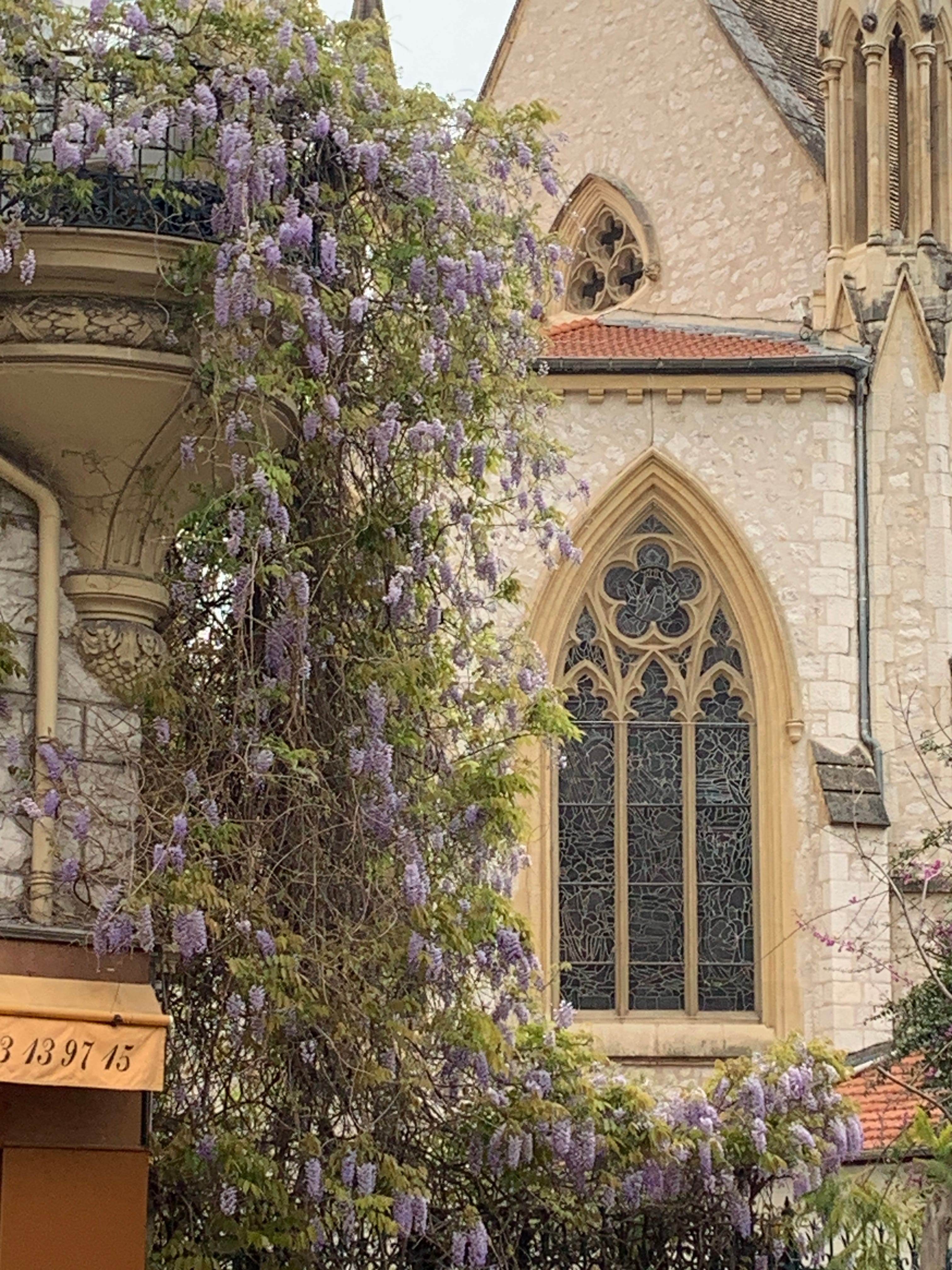
Nice is the only place I’ve been (and I’ve been to a lot of places) where I’ve walked out my door and felt my mood viscerally lifted by the collective energy of the people outside. People enjoying each other, laughing, focused on relaxation, unhurried. It was almost alarming at first, feeling my own energy rise just from sensing the atmosphere around me. The slower pace, the natural beauty, the culture of pleasure, the sea, the sunlight, the walkability, the lower cost of living — all of it has steadily challenged an old assumption I carried for most of my life: that struggle is normal, that life is difficult, that vigilance is required just to stay safe.
As the eldest daughter in a sad, dysfunctional family, I was the good girl straining to hold positivity for everyone else, as a necessity for my own emotional survival. Here, the environment does that holding for me. It feels like a visceral burden lifted. The city functions like a reliable, uplifting other, a placeholder for joy even on the days it’s hard for me to find it myself.
Understanding integration
What I’ve just described (the burden lifted, the city holding what I used to have to hold myself) has a name in the clinical literature on trauma recovery, which is integration.
One thing I’ve begun to suspect is that many people experience this. We show up for for the healing process, but there’s not much discussion about the necessary nervous system adjustments required after healing.
There’s a well-established three-phase model of trauma recovery, most associated with psychiatrist Judith Herman’s foundational work Trauma and Recovery. The first phase is “safety and stabilization,” establishing enough external and internal safety so that healing work can even begin. The second is “remembrance and mourning,” the active work of processing what happened, feeling what couldn’t be felt at the time, grieving what was lost. The third phase is integration.
Integration isn’t the processing itself. It’s what happens afterwards — when the material you’ve excavated finally settles into something you can hold, rather than something that holds you.
A few things I’ve come to understand about this phase, both from the research and from my own lived experience:
What integration feels like:
Things get quieter. This is because the trauma has been metabolized, fully digested rather than raw.
You become available for connection in a new way. There’s no longer a parallel process running in the background, constantly scanning for danger, sorting present from past, managing triggers, separating out old projections from what’s actually here. That energy in your system is now freed up.
The present moment becomes more available to you — its simple is-ness, without the past superimposed over it. You notice more, you feel more alive, and you notice the aliveness of life and others as well.
What integration is not:
It’s not a finish line. There’s no certificate, no final “done.” It’s not an ending so much as a threshold into something new. The timing is different for everyone.
It doesn’t mean the trauma is forgotten. It becomes part of your story rather than a present-tense emergency; a chapter of your life, not the whole book.
It’s not an intellectual achievement. As trauma researcher Bessel van der Kolk has emphasized, healing isn’t about arriving at a perfect, tidy understanding of what happened to you — it’s about the body and mind learning to work together again, tolerating sensation, staying present, gradually widening what feels safe. Integration lives in the body before it lives in any story you tell about it.
It’s no longer the filter you see everything through. Relationships stop being compensatory for childhood wounds, and get to simply be what they are, in the present moment.
Integration doesn’t happen all at once. It’s cyclical, more of a spiral moving upward than a straight line, revisited again and again, each time with a little more capacity than the last. My chapel years were exactly that: a temporary time where I had silence and solitude to settle into integration, layer by layer.
What I didn’t expect was what would happen next. Moving to France gave the integration process a new environment to keep unfolding in. The more integrated self I’d become in the chapel met a place that could actually hold and support that integration in ways my old environment couldn’t. Each one deepened the other. The new self made me able to receive what Nice has to offer; and what Nice offers, in turn, supports the integration going even further than it might have gone on its own.
Here’s what that’s actually felt like, living inside it day to day.
Learning a new baseline of ease
My nervous system is learning what it means to live from a paradigm of non-struggle.
It’s surprising to realize that the nervous system has to learn how to trust joy.
I can feel my nervous system acquiring a new baseline — and at times, that higher baseline of pleasure, of absence of threat, is genuinely disorienting. It’s as if very young parts of me are slowly emerging from hiding, maybe for the first time ever, and asking: “Wait. OMG. Is it really safe to come out now?”
It’s been a slow, gradual process of trusting this new baseline is real and steady.
There’s less traction here for old traumatic projections to land, even the subtlest residue of them. Fear and dread still visit, but they’re shorter-lived now, easier to see through, recognizable as old survival strategy rather than present-day reality. It’s almost like restarting my system fresh each morning, the cache of the past clearing and re-orienting to what’s actually here. The trust builds a little more each day.
What the new baseline feels like over time
I think what’s surprising is that the brief glimmers of joy felt in the previous phases of healing expand to gradually become the ongoing new baseline during integration. I had known this intellectually for years, but living it in the body now is something quite different. A new normal. And very exhilarating!
After years of feeling those periodic glimpses of relief, peace, and joy, it’s profound to feel how those qualities become the very fabric of your daily existence. In other words, something precious and intermittent becomes ordinary and abundantly available — in a quiet, gentle, ambient way.
It feels like a settling into joy, a reclaiming of a childlike way of being in life, meeting it freshly, with an open heart. AND with the adult confidence that when pain inevitably arrives, I know I have what it takes to handle it now.
There’s a depth to this that is hard to put into words. It also creates profound respect for the dignity of every human being, because everyone is carrying and processing their own histories in some shape or form. Integration feels like coming out of a dark cave into the fresh air. Compassion for all is a natural byproduct of having gone through so much intense, invisible transformation, and realizing each person is also doing the difficult invisible labor of being human.
The freshness of a new place can help the process
I had no history in Nice before I moved here; no memories, no past associations with people or place, even after years of research into where I might eventually live. My experience of it is pure. Nice is purely mine: the landscape of my new self, belonging equally to the adult me and the child me. It’s not about the past. It’s my post-trauma playground and my launchpad and, at the same time, a safe place from which to finally feel the past as truly past.
Since moving here I am amazed at how a new place can become part of one’s inner development in such a pivotal way.
In the past, I was always slightly suspicious of my desire for travel or love of far-off places because I didn’t want to unwittingly use them as projections of a “longed-for mother,” rescuing me from the intensity of my own life where I was. So even though I have had the desire to live abroad for many years, I never took the full leap before for this reason. I needed to know that I fully internalized the inner mother as my adult self, not projecting her onto any outer person or place.
No outer place can offer us the fullness of what we can only give ourselves. It can only enhance and reveal it.
This is what’s different now: neither Nice, nor I, are doing double duty. I’m not processing the present and the past at the same time, and Nice isn’t being asked to hold the projections of both — as a source of old trauma, nor as a rescue from it. It feels clean. Because I met this place as a newer, more integrated self, Nice gets to simply be what it is: a city, not a projection screen for old experiences to continue playing out.
I read once that some emotional shifts cannot fully cement without a change in environment. I don’t think that’s universally true, but it’s certainly been true of my own journey. I think I moved at the right time. Earlier in my process, while I was still excavating core trauma, that lens would have colored everything I saw here. But because the excavation phase was completed after decades of committed inner work, the lens is clear now; clear enough to actually receive what this place has to offer, in service of integration and post-traumatic evolution.
While I share my own journey to be helpful, I don’t offer it as the model or the timeline for anyone else. What I hope to model instead is tenacity and trust in your own unique process, however long or short it takes.
The magic in the mundane
Integration means the nervous system can finally experience moments of joy without bracing for menace, and feel peace without needing to also stay vigilant. Here are some moments I catch it happening in real time, very small, ordinary experiences that feel magical:
I have a long cotton “morning skirt” I put on when I get up to make myself breakfast each morning — a sweet, self-maternal ritual.
Opening my tall shutters and looking up to see my upstairs neighbor’s red blossoms on their porch against the blue sky above.
Hanging laundry on the clothesline (no dryer here). It dries very quickly!
Coffee on the balcony, watching seagulls overhead and people below.
Watching sunlight dappling on the palm tree in the back courtyard.
Being a regular at my local coffee shop, chatting with the baristas.
Waking up to the sound of birdsong echoing off the buildings.
Walking up to an hour a day just running errands, and walking slowly on purpose.
There’s nothing dramatic or “special” about these moments. They just are, just unfolding moment by moment without a heavy overlay of mental content. It’s simply about being with what actually is. That shift (to feeling safety and contentment in simply being, not striving, pushing, strategizing) is the integration: being present in benevolent reality, with life simply living itself out in small, ordinary ways.
On the surface these actions could even look like the same actions I’d experienced before in earlier phases of healing, but underneath them now the structure is quite different, in such a way that a sense of aliveness and gratitude are viscerally palpable.
Now is simply now. And in this pure nowness, there is a subtle beauty that I can sense, a beauty that’s part of me, part of Life, part of everything and everyone. Simply existing, conscious of your own being in the moment, is its own kind of fulfillment.
Living in France is amazing, but it’s just a place. It did not heal me. France has simply given my healing somewhere new to land at this phase on my own journey — a new outer place to explore from this new inner place in my journey. This new environment has shown me, by contrast and fresh experiences, how much I have already healed, and how different I am now. And how different the embodied experience of life can be, when the wounding is no longer at the wheel.
Living Undaunted is a reader-supported publication. To receive new posts and support my work, consider becoming a free or paid subscriber.
Comments
Nothing yet. Say the first thing.
Sign in to join the conversation.